The Northeast Corridor Line is NJ TRANSIT’s busiest commuter rail route, running between Trenton Transit Center and New York Penn Station on Amtrak’s electrified Northeast Corridor. It is part of the wider Northeast Corridor, the busiest passenger rail line in the United States, used by intercity, commuter, higher-speed, and high-speed trains across the Boston-to-Washington, D.C. rail spine.
| Key | Information |
|---|---|
| Primary NJ TRANSIT route | Trenton Transit Center to New York Penn Station |
| Wider corridor | Boston to Washington, D.C. |
| Overall corridor length | 457 miles (735 km) |
| Overall active stations | 109 active stations, with 30 used by Amtrak |
| Weekday NJ TRANSIT service | 131 trains as of April 27, 2025: 68 inbound and 63 outbound |
| Major transport role | Shared by Amtrak, NJ TRANSIT, and other regional public transport agencies |
| System map color | Red on NJ TRANSIT system maps |
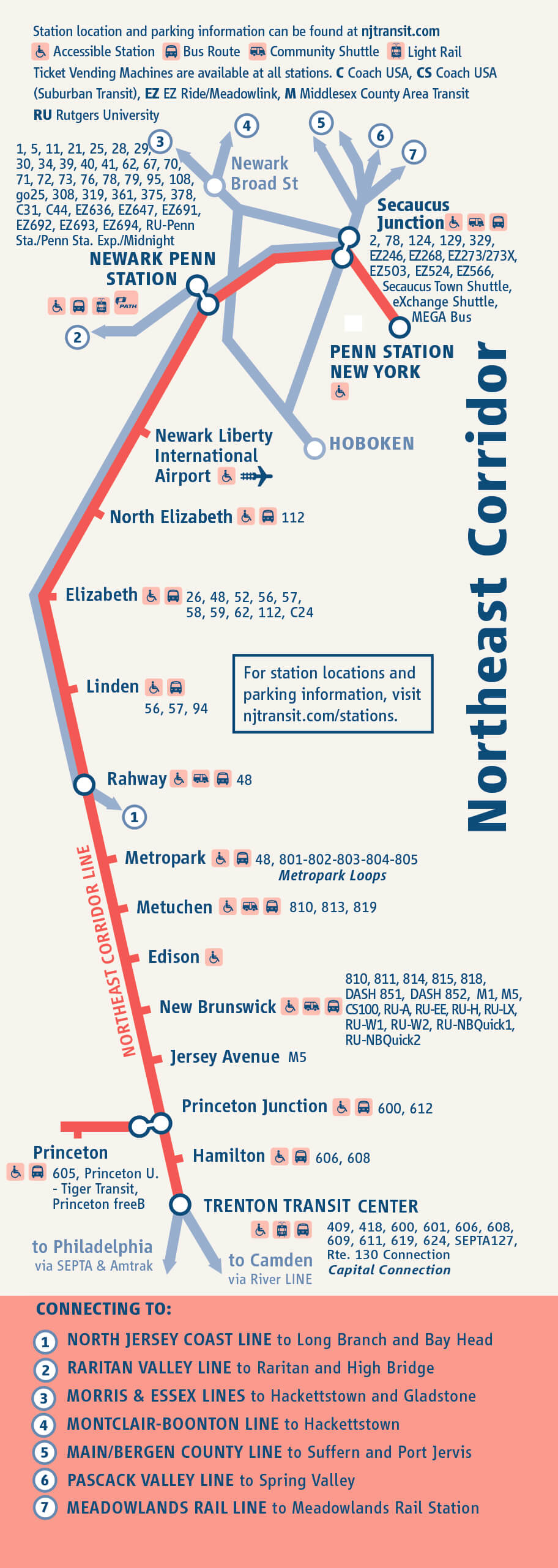
Northeast Corridor Line Map
The Northeast Corridor Line map of Tokyo Metro showing different stops. Click on the map to enlarge it or download the Northeast Corridor Line map in PDF format.
Route and Stations
The Northeast Corridor Line follows Amtrak’s Northeast Corridor through one of the busiest rail markets in the country. For NJ TRANSIT riders, the core route links central New Jersey with Newark, Secaucus, and Midtown Manhattan.
The line is especially important for daily commuters, airport riders, and visitors connecting to Amtrak, PATH train service, SEPTA, River LINE, Newark Light Rail, local buses, and other city transport. On NJ TRANSIT system maps, it appears in red and uses the New Jersey State House as its symbol.
| Station | Details |
|---|---|
| New York Penn Station | Northern terminal for NJ TRANSIT Northeast Corridor Line service, with connections to Amtrak, LIRR, subway access, and PATH. |
| Secaucus Junction | Major NJ TRANSIT transfer hub and access point for Meadowlands Rail Line service to MetLife Stadium. |
| Newark Penn Station | Key transfer station for Amtrak, PATH, Newark Light Rail, NJ TRANSIT buses, and local transport in Newark. |
| Newark Liberty International Airport | Rail connection to EWR via AirTrain Newark; served by Northeast Corridor and North Jersey Coast Line trains that stop there. |
| Rahway | Important intermediate stop, also affected by North Jersey Coast Line service patterns. |
| Metropark | Major commuter station and Amtrak stop. |
| Metuchen | Intermediate Northeast Corridor Line station. |
| Edison | Intermediate station with local bus connections noted in station information. |
| New Brunswick | Busy non-terminal station with Amtrak and NJ TRANSIT bus connections. |
| Jersey Avenue | Terminal for some NJ TRANSIT local trains; trains cannot stop there outside certain service patterns. |
| Princeton Junction | Transfer point for the Princeton Dinky shuttle and an Amtrak stop. |
| Hamilton | Large park-and-ride commuter station with direct access to Interstate 295. |
| Trenton Transit Center | Southern end of the NJ TRANSIT segment, with SEPTA, Amtrak, River LINE, and bus connections. |
New York Penn Station to Trenton Transit Center
Between New York Penn Station and Trenton Transit Center, the route serves the main commuter spine of central New Jersey. Major stops include Newark Penn Station, Metropark, New Brunswick, Jersey Avenue, Princeton Junction, Hamilton, and Trenton.
As of April 27, 2025, weekday train service includes 68 inbound trains and 63 outbound trains. Inbound trips originate at Trenton, Jersey Avenue, New Brunswick, Metropark, Newark Airport, and Newark Penn Station. Outbound trips most often terminate at Trenton or Jersey Avenue.
Some trains unload at New York Penn Station and return to New Jersey, while others continue east to Sunnyside Yard for storage. Most servicing takes place at Morrisville Yard near the west end of the line.
Trenton Transit Center is also the terminus of SEPTA’s Trenton Line and a major Amtrak stop, with Acela, Northeast Regional, Keystone Service, and many medium- and long-distance trains using the corridor.
Local, Express, and Limited-Stop Trains
Service patterns change by time of day. Local trains, express trains, and limited-stop trains all share the route, so checking the route timetable before boarding matters.
During peak periods, stations between North Elizabeth and Rahway are mostly covered by North Jersey Coast Line trains. Stations between Rahway and New Brunswick are served by Jersey Avenue Locals, while Trenton Express trains make their first or last stop at Princeton Junction or New Brunswick. A few all-stops local trains also run on weekdays and throughout the day on weekends.
Outside peak periods, Jersey Avenue Locals make local stops between Rahway and Elizabeth. North Elizabeth is skipped by most Northeast Corridor Line trains, and trains cannot stop at Jersey Avenue during those patterns.
This mix gives riders a practical route plan: use express trains for faster New York–Trenton travel, and use local or connecting services for intermediate stations.
Key Stations for Commuters and Visitors
For commuters and visitors, the most useful stations are usually the ones with strong onward connections. New York Penn Station, Newark Penn Station, Secaucus Junction, Princeton Junction, and Trenton Transit Center stand out because they connect with other rail, bus, and local transport services.
| Station | Details |
|---|---|
| Trenton Transit Center | Southern end of NJ TRANSIT Northeast Corridor Line service; connects to SEPTA, River LINE, Amtrak, and buses. |
| Princeton Junction | Best station for Princeton Dinky shuttle connections and an important Amtrak stop. |
| New Brunswick | Busy station with Amtrak and NJ TRANSIT bus connections. |
| Metropark | Major commuter station with Amtrak service. |
| Newark Penn Station | One of the strongest transfer points on the line, with PATH, Amtrak, Newark Light Rail, buses, and city transport. |
| Secaucus Junction | Large NJ TRANSIT transfer station for trips to New York Penn Station and MetLife Stadium service. |
| New York Penn Station | Northern terminal for the NJ TRANSIT line and a major hub for Amtrak, LIRR, subway, and PATH access. |
Fares, Tickets, and Passes
NJ TRANSIT fares depend on distance, ticket type, transportation mode, and travel time. For the exact fare, ticket price, or cost of a trip, use current station-to-station fare information or a fare calculator before traveling.
Buy your ticket before boarding when a ticket vending machine or ticket office is available. If you buy on board in that situation, a $5.00 USD surcharge applies. Train personnel accept cash only, and bills over $20.00 USD are not accepted.
Ticket vending machines are available at stations, and rail passes may also work on light rail or bus service under NJ TRANSIT fare rules. One-way, round-trip, and 10-trip rail tickets are not valid on other light rail or bus lines.
How NJ TRANSIT Rail Fares Work
One-way tickets cover one continuous trip between the stations printed on the ticket. From July 1, 2024, one-way tickets expire after 30 days and are non-refundable.
Monthly passes allow unlimited trips between two rail stations during a calendar month and remain valid until noon on the first business day of the following month. Weekly passes are valid from 12:01 AM Saturday through 6:00 AM the following Saturday. Ten-trip tickets cover ten one-way trips and expire after 30 days.
Tickets can be purchased in the NJ TRANSIT App, at ticket vending machines, or at ticket offices where available. Customers with disabilities and senior citizens age 62 or older may buy on board without penalty.
For Newark Liberty International Airport trips, the AirTrain fare is included with a rail ticket to or from EWR. Keep the ticket because it is used at the AirTrain fare gates.
One-Way, Round-Trip, Weekly, and Monthly Options
- One-way ticket: best for a single continuous trip.
- Round-trip ticket: useful for same-route travel out and back.
- Ten-trip ticket: covers ten one-way rides and is valid for 30 days.
- Weekly pass: best for frequent short-term commuting.
- Monthly pass: designed for regular commuting between two stations.
- Day pass: not described in the provided NJ TRANSIT rail details for this line, so check current fare options if you need one.
Some passes can also be used on connecting bus or light rail trips, depending on the bus-zone number printed on the pass and NJ TRANSIT fare rules.
NJ TRANSIT vs. Amtrak Tickets
NJ TRANSIT is usually the lower-price option for the same Northeast Corridor trip. For example, Trenton to New York Penn Station was listed at about $16.75 USD in the NJ TRANSIT app, while Amtrak fares for the same journey were often around $50.00 to $100.00 USD.
Amtrak is generally faster and more comfortable, with fewer stops, quieter cars, assigned seating on many services, tray tables, power, and priority on the corridor. NJ TRANSIT is a commuter rail service with more local stops and a lower fare, which makes it practical for everyday travel.
NJ TRANSIT rail tickets and passes are not accepted on Amtrak trains.
Schedule, Frequency, and Real-Time Departures
The Northeast Corridor Line has frequent weekday service, with trains running in both directions throughout the day. Instead of fixed opening hours like a station building or attraction, the line’s working hours are defined by the daily timetable, first train, last train, and real-time departure boards.
For schedule today, timings today, track assignments, and the next departure, check real-time information before you travel. Departure boards and transit apps can show the train schedule, stopping pattern, frequency, track information, and delays when available.
| Service detail | Timings |
|---|---|
| Weekday service level | 131 total trains as of April 27, 2025: 68 inbound and 63 outbound |
| Inbound origins | Trenton, Jersey Avenue, New Brunswick, Metropark, Newark Airport, and Newark Penn Station |
| Outbound terminals | Mostly Trenton and Jersey Avenue |
| Example real-time trip | Trenton Transit Center at 4:41 PM to New York Penn Station at 6:09 PM, about 88 minutes |
| Fastest listed New York–Trenton trips | About 49 to 50 minutes on the fastest services |
| Real-time planning | Use current departure information to confirm schedule today, closing time of service for your trip, and last train details |
Weekday, Weekend, and Holiday Service
On weekdays, service is strongest: 49 inbound trains originate at Trenton, 12 at Jersey Avenue, 4 at New Brunswick, 1 at Metropark, 1 at Newark Airport, and 1 at Newark Penn Station. Outbound service includes 50 trains terminating at Trenton and 13 at Jersey Avenue.
On weekends, all-stops local trains run throughout the day. Holiday service follows the weekend pattern on major holidays, including New Year’s Day, Presidents’ Day, Memorial Day, Independence Day, Labor Day, Thanksgiving, and Christmas.
All eleven Amtrak Northeast Corridor services also operate along this rail route, so NJ TRANSIT riders share the corridor with intercity trains.
First and Last Trains
The first train and last train depend on direction, station, and day of travel. For that reason, always check the current timetable or real-time train schedule for your exact trip, especially if you are traveling early, late, on weekends, or on a holiday.
Outbound service is concentrated at the southern end of the line, with most trains ending at Trenton and some at Jersey Avenue. Trenton Express trains make their first or last stop at Princeton Junction or New Brunswick, depending on the service pattern.
Delays, Alerts, and Track Information
Delays, cancellations, and track changes can happen with little notice on the Northeast Corridor. Recent service alerts have included delays of up to 15 minutes at Penn Station New York, Trenton, Jersey Avenue, and other NEC stations because of bridge strikes, mechanical problems, police activity, congestion, overhead wire issues, disabled trains, and earlier disruptions.
Before leaving, check real-time alerts and track information. During disruptions, some trips may be delayed, suspended, or diverted, and passengers may be directed to alternate service patterns.
Connections and Transfers
The Northeast Corridor Line is one of the most useful public transport links in New Jersey because it connects directly with rail, bus, subway, PATH, light rail, and airport services. Major transfer points include New York Penn Station, Secaucus Junction, Newark Penn Station, Newark Liberty International Airport, Metropark, New Brunswick, Princeton Junction, and Trenton Transit Center.
At Trenton, the timetable includes connecting SEPTA Trenton Line service between Philadelphia and Trenton. At Princeton Junction, the Princeton Branch shuttle links the mainline with Princeton. North of Metropark, North Jersey Coast Line trains also serve stations throughout the day.
Secaucus Junction, Newark Penn Station, and Trenton Transit Center
Secaucus Junction opened in 2003 as a major NJ TRANSIT transfer hub. It connects passengers with several NJ TRANSIT rail lines and provides access to the Meadowlands Rail Line for service to MetLife Stadium.
Newark Penn Station is another major connection point, with NJ TRANSIT buses, Newark Light Rail, Amtrak, and PATH available. It is also one of the busiest Amtrak stations on the corridor.
Trenton Transit Center anchors the south end of the NJ TRANSIT Northeast Corridor Line. It connects with SEPTA, River LINE, Amtrak, Capital Connection buses, and NJ TRANSIT bus service.
| Station | Details |
|---|---|
| Secaucus Junction | NJ TRANSIT bus connections 2, 78, 129, 329, and 353; rail transfers to multiple NJ TRANSIT and Metro-North lines. |
| Newark Penn Station | NJ TRANSIT buses, Newark Light Rail, Amtrak, PATH train service, and local transport in Newark. |
| Trenton Transit Center | NJ TRANSIT buses, River LINE, SEPTA, Amtrak, and Capital Connection buses. |
Connections to PATH, Subway, LIRR, Amtrak, SEPTA, River LINE, and Local Buses
At New York Penn Station, riders can connect to LIRR, Amtrak, subway service, and PATH access. Newark Penn Station connects with Amtrak, PATH, Newark Light Rail, and local buses. Secaucus Junction is the main NJ TRANSIT transfer point for many rail trips into New York.
Amtrak service is available at New York Penn Station, Newark Penn Station, Newark Liberty International Airport, Metropark, New Brunswick, Princeton Junction, and Trenton Transit Center. At Trenton, passengers can transfer to SEPTA for Philadelphia and to the River LINE light rail toward Camden.
Local bus connections are available at many stations, including Newark Penn Station, Metropark, New Brunswick, Princeton Junction, and Trenton Transit Center. For Hoboken, riders may need to use PATH when direct rail service is not available.
Princeton Dinky Shuttle
The Princeton Branch, often called the Dinky, is a short NJ TRANSIT commuter rail shuttle between Princeton Junction and Princeton station on the Princeton University campus. It runs on a single track with no intermediate stops.
The trip takes about 5 minutes. The branch is 2.7 miles (4.3 km), making it the shortest scheduled commuter rail line in the United States.
At Princeton Junction, riders can connect with NJ TRANSIT and Amtrak Northeast Corridor service toward Newark, New York City, Boston, Trenton, Philadelphia, and Washington, D.C. When rail service is disrupted, buses replace the Dinky on the Princeton–Princeton Junction connection.
Newark Liberty International Airport Connection
Newark Liberty International Airport is directly connected to the Northeast Corridor Line through Newark Liberty International Airport Rail Station and AirTrain Newark. From New York Penn Station, NJ TRANSIT service to the airport rail station takes about 30 minutes.
Not every Northeast Corridor or North Jersey Coast Line train stops at the airport, so check the route timetable, departure boards, and airplane symbol before boarding.
Getting to EWR by Train and AirTrain
- Take an NJ TRANSIT train to Newark Liberty International Airport Rail Station.
- Transfer to AirTrain Newark.
- Ride AirTrain to Terminals A, B, or C.
The AirTrain fee is included in your NJ TRANSIT ticket, so no separate ticket is needed. Keep your ticket for the fare gates.
From New York City, board at New York Penn Station. From North Jersey rail lines, many trips require a transfer at Secaucus Junction to a southbound Northeast Corridor or North Jersey Coast Line train. From the Raritan Valley Line, transfer at Newark Penn Station.
Getting from EWR to Manhattan, Newark, and Trenton
To reach Manhattan, take AirTrain from your terminal to Newark Liberty International Airport Rail Station, then board NJ TRANSIT to New York Penn Station. The trip to Midtown Manhattan takes about 30 minutes, and the adult ticket costs $17.25 USD.
To reach Newark, take NJ TRANSIT one stop to Newark Penn Station, where you can connect to PATH, Newark Light Rail, and local bus service. To reach Trenton, stay on a southbound Northeast Corridor Line train to Trenton Transit Center.
Buy your ticket before boarding when possible to avoid the $5.00 USD on-board surcharge.
Parking, Station Access, and First/Last-Mile Travel
Parking, station access, and first-mile or last-mile options vary by station. Check station-specific details before traveling, especially if you need daily parking, permit parking, accessible access, bike parking, or a reliable drop-off location.
Hamilton Station is a major park-and-ride stop. It opened with 1,556 spaces and later added a parking deck with 2,066 more spaces, bringing the total to 3,622. Direct access to Interstate 295 helped make it a popular commuter station.
Trenton Transit Center has a fee to park, while Trenton’s downtown station area has limited parking and can be harder to reach. Princeton Junction has no direct access to a major highway, and its large parking lot had already reached capacity. Parking charges and parking charges per day depend on the station and lot rules.
Princeton Junction is described as ADA-accessible, with high-level platforms and elevator or ramp access. It also offers permit lots, daily first-come-first-served spaces, short-term drop-off areas, ADA spaces, and bicycle parking.
- Test your route at peak hours before committing to a commute.
- Check station parking rules, permit waitlists, and backup lots.
- Map walking, biking, rideshare, taxi, shuttle, and bus options.
- Confirm safe walking routes in daylight and after dark.
- Check elevator status if you rely on accessible access.
- For airport trips, remember that Newark Airport Rail Station has no parking or passenger drop-off area.
How to Ride the Northeast Corridor Line
Start by checking your route plan, timetable, stopping pattern, and destination. Some trains are express, while others make more local stops. Some begin or end at Jersey Avenue, New Brunswick, Metropark, Newark Airport, or Newark Penn Station instead of running the full Trenton–New York route.
Buy your ticket before boarding when a ticket machine or ticket office is available. Ticket vending machines accept credit cards, debit cards, and cash, but not bills over $20.00 USD. If you need to pay by personal check, use Transit Benefits, buy 10-trip tickets, or purchase student monthly passes, use a ticket agent or major terminal.
At New York Penn Station, use the NJ TRANSIT Concourse for ticket machines and boarding areas. Watch the departure boards, then go to the track when it is announced.
Always confirm the stopping pattern before boarding, especially if you are connecting to Princeton, Newark Airport, SEPTA at Trenton, PATH, LIRR, Amtrak, or local bus service.
Tips for First-Time Riders
- Check the train schedule before leaving, not just the printed timetable.
- Buy your ticket before boarding to avoid the surcharge when machines or agents are available.
- Give yourself extra time at major stations.
- Listen for announcements and watch departure boards for track changes.
- Keep your ticket ready on your phone or printed out.
- For airport trips, look for trains that stop at Newark Liberty International Airport Rail Station.
- If price matters most, compare NJ TRANSIT and Amtrak before buying.
Rules, Accessibility, and Rider Etiquette
If ticket offices or ticket vending machines were available when you boarded, a $5.00 USD on-board surcharge applies. Train personnel accept cash only, and bills over $20.00 USD are not accepted.
If you extend your trip, you must pay the one-way fare between the destination on your ticket or pass and your final destination. A flat $3.25 USD fee is charged on board when you present a ticket or pass printed with Newark Penn Station or Hoboken Terminal for travel to or via New York or Secaucus.
For Newark Liberty International Airport, one-way tickets include a $5.50 USD access fee and are encoded for the fare gates. Children 11 and under do not pay the access fee, and the fee is currently waived on monthly passes with Newark Liberty International Airport as the origin or destination.
Reduced fares are available for senior citizens, passengers with disabilities, and children. Senior citizens age 62 and older and passengers with disabilities can travel at half the regular one-way fare or less. Children ages 5 to 11 save at least 50% on regular one-way fares, and up to three children age 4 and under ride free with a passenger paying a valid fare.
Stations with the accessible symbol are accessible to customers using mobility assist devices. If you need help boarding or leaving the train, tell the crew. Customers traveling from Hoboken should arrive 15 minutes before scheduled departure and notify an NJ TRANSIT representative.
Keep aisles clear, store larger items in overhead racks or under seats, and use phones or electronic devices at a volume that does not disturb others. Smoking is not allowed on trains, in stations, or on platforms.
Only service animals accompanying customers with disabilities or their trainers, police dogs, and small pets in carry-on travel cages are allowed on board. Collapsible bicycles are allowed on all trains at all times. Standard-frame bicycles and Segways are allowed only in accessible cars, except during restricted peak and holiday periods, and customers with disabilities have priority.
Stay safe around trains: stand behind the safety line, watch the gap, never board or leave a moving train, cross tracks only at designated locations, and never go around lowered crossing gates.
| Service detail | Timings |
|---|---|
| Schedule and service help | 6 AM to 9 PM |
| Complaints, commendations, and suggestions | 8 AM to 5 PM |
| NJ TRANSIT Police | 800 242 0236 |
| Out of state | 973 378 6565 |
| Security hotline | 888 TIPS NJT |
Brief History
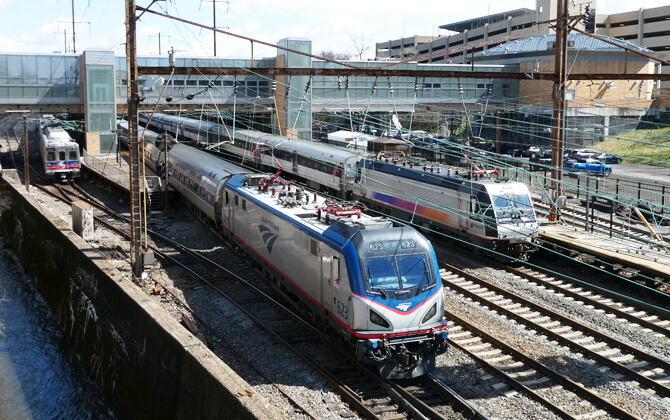
The Northeast Corridor developed from rail lines built piece by piece from the 1830s onward. By the late 19th century, these routes had formed two major but disconnected stretches: one south from Boston under the New Haven Railroad and one north from Washington, D.C. under the Pennsylvania Railroad.
Between 1903 and 1917, major projects connected the corridor, including the New York Tunnel Extension, the New York Connecting Railroad, and the Hell Gate Bridge. When the Hell Gate Bridge opened in 1917, the corridor was effectively complete.
Electrification shaped the corridor’s history. The New Haven announced plans in 1905 to electrify its main line from New York to Stamford, while the Pennsylvania Railroad electrified lines in the New York and Philadelphia regions.
In 1968, Penn Central brought the corridor under single control, but the company soon went bankrupt. Amtrak later assumed most intercity passenger service after the federal reorganization of rail passenger operations in the early 1970s.
Amtrak continued modernizing the corridor, including completing electrification north of New Haven to Boston in the 1990s and early 2000s.
Major Projects and Future Improvements
Much of the Northeast Corridor is near its capacity limit and needs major rehabilitation. Many structural components are more than 100 years old, and Amtrak has identified a State of Good Repair backlog of more than $5 billion USD.
Since the Passenger Rail Investment and Improvement Act of 2008, Amtrak, commuter agencies, states, and freight railroads have worked through the Northeast Corridor Infrastructure and Operations Advisory Commission on cost-sharing for operations and capital needs.
Amtrak’s Phase 1 NEC Upgrade Plan focuses on repair, added capacity, higher top speeds, and shorter trip times. The Gateway program is a major part of that effort, with new Hudson River tunnels, added bridge capacity, and New York station improvements planned to expand capacity between New York and New Jersey.
Phase 2, the Next-Generation High-Speed Rail Program, would create a new high-capacity rail system integrated with the existing network. It includes a dedicated two-track alignment, top speeds up to 220 mph, up to 12 high-speed trains per hour in each direction, and travel time reductions of 40% to 60% in key markets.
Work is already underway across the corridor. Projects include station master planning in Washington, D.C., Baltimore, Philadelphia, New York, and Boston; Gateway-related construction beneath Hudson Yards; upgrades for next-generation Acela trains; new or improved platforms; track upgrades; and maintenance facility improvements.
More than 300 projects are in various stages of development, with over 100 under construction. Major work includes the East River Tunnel Rehabilitation Project and replacement of the 118-year-old Connecticut River Bridge. Other projects include catenary replacement, station modernization, signal upgrades, the Sawtooth Bridges Project, and early planning for continued signal modernization and Cos Cob Bridge replacement.
Popular Trips and Destinations
The Northeast Corridor is useful for commuting, airport travel, college trips, city breaks, and longer Amtrak journeys. Along the wider corridor, travelers can reach Boston, Providence, New Haven, New York, Philadelphia, Baltimore, and Washington, D.C.
For NJ TRANSIT riders, the most common trips include New Jersey to New York City, Newark Airport trips, Princeton and New Brunswick travel, and Philadelphia connections via Trenton and SEPTA.
New Jersey to New York City
The Northeast Corridor Line is one of the main rail options between New Jersey and New York City. It connects Trenton, Princeton Junction, New Brunswick, Metropark, Newark, Secaucus, and New York Penn Station with frequent commuter service.
New York Penn Station connects to Amtrak, LIRR, subway service, and PATH access. Newark Penn Station connects with PATH, Newark Light Rail, Amtrak, NJ TRANSIT buses, and local transport.
Newark Airport Trips
NJ TRANSIT rail is one of the simplest ways to reach Newark Liberty International Airport. Take a Northeast Corridor or North Jersey Coast Line train that stops at Newark Liberty International Airport Rail Station, then transfer to AirTrain Newark for Terminals A, B, or C.
| Service detail | Timings |
|---|---|
| To Midtown Manhattan | About 30 minutes to New York Penn Station; $17.25 USD adult ticket |
| To the Financial District | About 45 to 55 minutes via NJ TRANSIT and PATH; $12.30 USD adult ticket to Newark Penn Station plus $3.00 USD for PATH |
| Airport transfer | NJ TRANSIT train to Newark Airport Rail Station, then AirTrain Newark to the terminal |
| AirTrain fee | Included in the NJ TRANSIT ticket |
For MetLife Stadium trips from the airport, travel to Newark Airport Rail Station, continue toward New York Penn Station if needed, then transfer at Secaucus Junction to Meadowlands-bound service.
Princeton, New Brunswick, and Trenton
Princeton, New Brunswick, and Trenton are key destinations on the line. Princeton is reached through the Dinky shuttle from Princeton Junction. New Brunswick has Amtrak and NJ TRANSIT bus connections. Trenton Transit Center connects with SEPTA, Amtrak, River LINE, and NJ TRANSIT buses serving Trenton, Camden, and Philadelphia.
| Station | Details |
|---|---|
| Princeton Junction | Transfer to the Princeton Dinky shuttle for downtown Princeton and Princeton University. |
| New Brunswick | Amtrak and NJ TRANSIT bus connections. |
| Trenton Transit Center | Connections to SEPTA, Amtrak, River LINE, and NJ TRANSIT bus routes. |
Philadelphia via Trenton and SEPTA
To reach Philadelphia, ride NJ TRANSIT’s Northeast Corridor Line to Trenton Transit Center, then transfer to SEPTA’s Trenton Line. This route works from New York Penn Station, Newark Penn Station, and other NJ TRANSIT Northeast Corridor stations.
SEPTA Regional Rail serves Suburban Station, Jefferson Station, and 30th Street Station, giving access to Center City and Philadelphia’s main rail hub.
SEPTA is a separate transit system with a separate fare. You need a SEPTA ticket or Key card to board the Trenton Line at Trenton Transit Center.