NJ Transit Train is the commuter rail network operated by New Jersey Transit Corporation, a state-owned public transport agency serving New Jersey and parts of New York and Pennsylvania. The wider NJ Transit system includes train, bus, and light rail service, connecting local transport across the region with major destinations such as New York City, Newark, Hoboken, Philadelphia, the Jersey Shore, and Newark Liberty International Airport.
| Key | Information |
|---|---|
| Official agency | New Jersey Transit Corporation, often shortened to NJ Transit or NJT |
| Transport modes | Commuter rail, bus, and light rail |
| Rail network | Passenger service on 12 rail lines and 165 stations |
| Service area | 5,325 square miles, about 13,792 square kilometers |
| Founded | July 17, 1979 |
| Annual ridership | 221,114,200 in 2025 |
| Main hubs | New York Penn Station, Newark Penn Station, Hoboken Terminal, and Secaucus Junction |
| Typical train operating hours | Service is generally from about 5:00 a.m. to 1:00 a.m., but opening times, closing time, and last train vary by line and date |
NJ Transit Train Map
NJ Transit Train map shows all available stops. Click on the map to enlarge it or download NJ Transit Train map in PDF format.
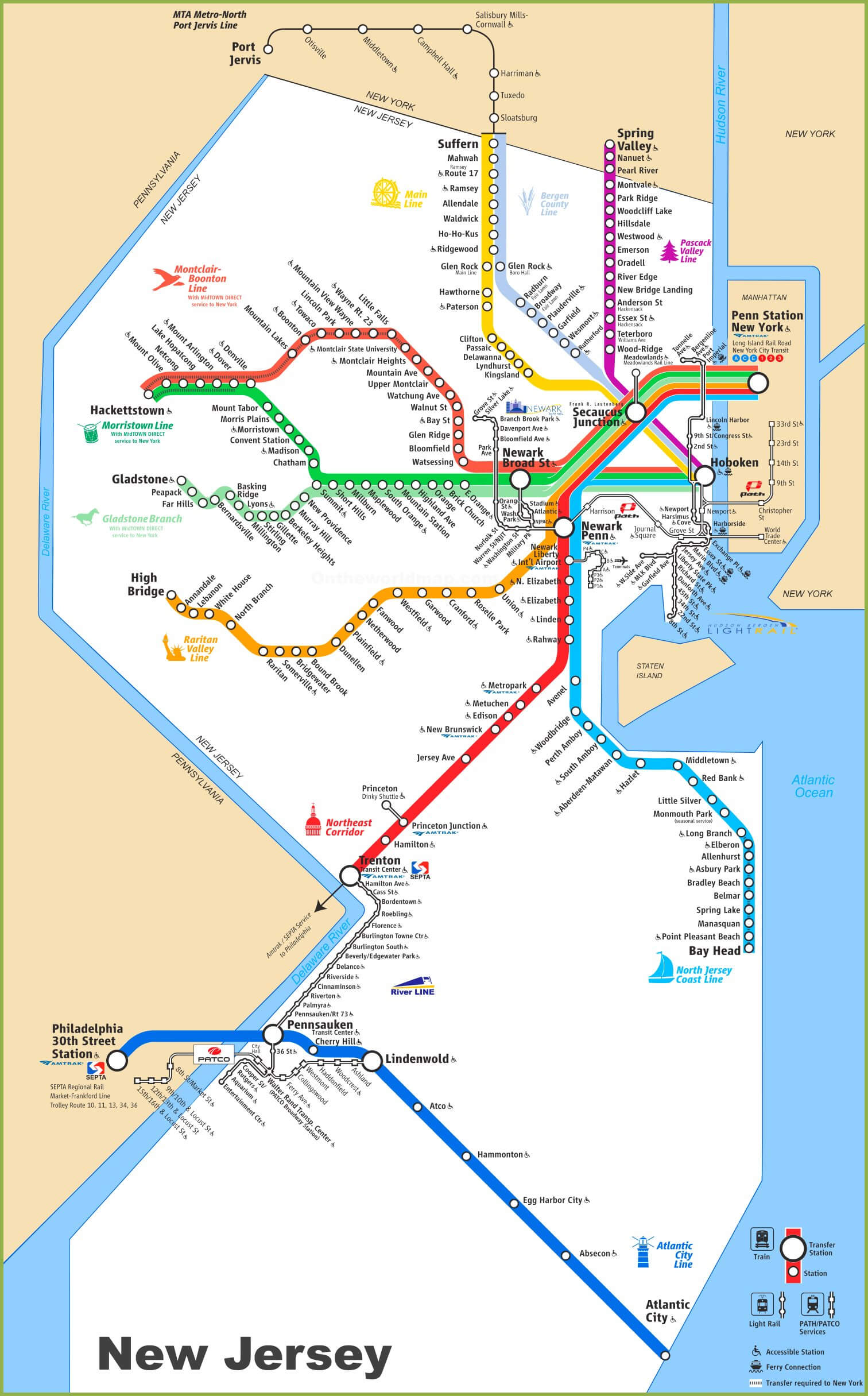
NJ Transit Train Lines and Stations
NJ Transit Rail Operations serves 165 stations across 12 commuter rail lines. The system connects northern and central New Jersey with New York City, Hoboken, Newark, and Trenton, while the Atlantic City Line links Philadelphia and Atlantic City separately from the main North Jersey network.
The route plan is built around a few major terminals: New York Penn Station, Newark Penn Station, Hoboken Terminal, and Secaucus Junction. Many riders use these hubs to change trains, connect with PATH, reach local bus routes, or continue by light rail, ferry, Amtrak, SEPTA, or Metro-North service.
Main Rail Lines
The NJ Transit train route network includes everyday commuter lines, limited-service branches, and event-only service to the Meadowlands. A route timetable should always be checked before travel, since some trains run only on weekdays, weekends, holidays, or special event days.
| Rail line | Route and service notes |
|---|---|
| Atlantic City Line | Runs between 30th Street Station in Philadelphia and Atlantic City |
| Bergen County Line | Serves Hoboken and selected New York State destinations on limited schedules |
| Gladstone Branch | Serves Hoboken, New York Penn, Summit, Gladstone, and Bernardsville on selected days |
| Main Line | Runs from Suffern, New York to Hoboken, New Jersey, with daily commuter rail service |
| Meadowlands Rail Line | Operates for MetLife Stadium events only, between Secaucus Junction and Meadowlands |
| Montclair-Boonton Line | Serves New York Penn, Hoboken, and several western terminals on limited service |
| Morristown Line | Serves New York Penn, Hoboken, Dover, Summit, and selected western terminals |
| Northeast Corridor Line | Serves New York Penn, Newark Penn, Trenton Transit Center, and Jersey Avenue |
| North Jersey Coast Line | Serves New York Penn, Long Branch, Bay Head, South Amboy, and Rahway on limited service |
| Pascack Valley Line | Serves Hoboken and selected New York State destinations on limited service |
| Port Jervis Line | Serves Hoboken and selected New York State destinations on limited service |
| Princeton Branch | Runs between Princeton Junction and Princeton |
| Raritan Valley Line | Serves Newark Penn, New York Penn, Hoboken, Raritan, and High Bridge on limited weekdays |
The Main Line is shown in yellow on NJ Transit system maps, with a water wheel symbol. The Bergen County Line splits from the Main Line west of Secaucus Junction and rejoins it at Ridgewood.
Major Stations and Terminals
The most important stations in the NJ Transit train system are also the places where riders usually change lines or connect with other public transportation. If you are reviewing a stations map or stations list, start with these hubs.
| Station | Details |
|---|---|
| New York Penn Station | Major Manhattan terminal with connections to MTA services, Long Island Rail Road, Amtrak, and nearby PATH access |
| Newark Penn Station | Key hub for NJ Transit, PATH, Amtrak, Newark Light Rail, and NJ Transit buses |
| Hoboken Terminal | Major rail terminal with connections to Hudson-Bergen Light Rail, PATH, NJ Transit bus routes, and NY Waterway ferry service |
| Secaucus Junction | Central transfer station for many NJ Transit lines, especially trips to and from New York Penn Station |
| Trenton Transit Center | Connects NJ Transit Northeast Corridor service with River LINE, SEPTA, and Amtrak |
| Princeton Junction | Connects with the Princeton Branch and Amtrak |
| Metropark | Northeast Corridor station with Amtrak connections |
| Dover | Useful station for Midtown Direct service to New York Penn Station |
| Long Branch | Important transfer point on the North Jersey Coast Line for service toward Bay Head |
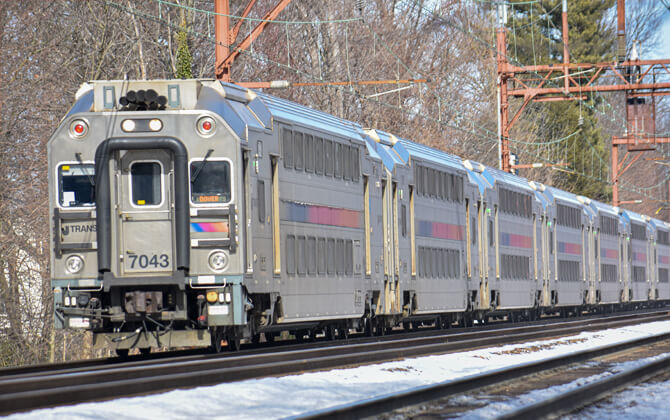
NJ Transit Train Fares, Tickets, and Passes
NJ Transit train fare depends on the stations shown on the ticket, ticket type, service used, and any discount eligibility. Riders can buy one-way tickets, ten-trip tickets, weekly passes, monthly passes, and reduced-fare options. If you need a fare calculator, ticket price, or exact cost for a trip, check the station-to-station fare for your route before buying.
How Train Fares Work
A rail ticket covers one continuous trip between the stations printed or shown on the ticket. Fares are distance-based, so a longer trip usually costs more than a short local ride. Weekly and monthly passes are priced for unlimited travel between two rail stations during their validity period.
Buy your ticket before boarding when a ticket office or ticket vending machine is available. If you purchase on board in that situation, a US$5.00 surcharge, or $5.00 USD, may apply.
Weekly and monthly rail passes can also be useful for connected city transport. Valid weekly and monthly rail passes are accepted for free travel on connecting NJ Transit light rail and bus service under pass rules, but NYC Transit and PATH tickets must be purchased separately.
Ticket Types and Pass Options
NJ Transit offers several ticket and pass choices for regular commuters, occasional riders, students, families, and visitors.
- One-way tickets cover one continuous trip between the stations on the ticket. From July 1, 2024, they expire after 30 days and are non-refundable.
- Ten-trip tickets include ten one-way trips and are valid for 30 days before expiring.
- Weekly passes provide unlimited trips between two rail stations from 12:01 a.m. Saturday through 6:00 a.m. the following Saturday.
- Monthly passes provide unlimited trips between two rail stations during a calendar month and remain valid until noon on the first business day of the following month.
- Monthly rail passes valued at US$67.00, or $67.00 USD, or more can be used on NJ Transit light rail or buses up to the number of zones shown on the pass.
- Weekly rail passes valued at US$20.50, or $20.50 USD, or more are valid for one-zone bus trips and may be used on any light rail line.
Tickets and passes can be purchased through the NJ Transit Mobile App, web ticketing, ticket offices, and ticket vending machines when available. The MyTix feature in the app lets riders buy, store, activate, and display tickets on a mobile device.
Discounts and Reduced Fares
Children ages 5 to 11 save 50 percent, and up to three children ages 4 and under ride free with a passenger paying any valid fare. On weekends and holidays, the Family SuperSaver fare allows up to two children ages 5 to 11 to ride free with a passenger paying any valid fare, from 7:00 p.m. Friday, or the day before a holiday, until 6:00 a.m. Monday, or the day after a holiday.
Senior citizens age 62 and older and customers with disabilities can travel at half the regular one-way fare or less at all times through the Reduced Fare Program. Military personnel and eligible dependents may use the one-way reduced ticket with valid military or dependent identification.
Students at participating post-secondary schools in the University Partnership Program may buy monthly student passes online and save 25 percent off regular monthly pass fares. Bulk sales are available for monthly, weekly, and one-way tickets, including reduced-fare tickets, for eligible riders.
Beginning January 1, 2026, Reduced Fare ID cards without a photo are no longer accepted for discounted travel on NJ Transit. Riders with older non-photo cards must apply for a new photo ID to continue using the program.
Ticket Validity, Activation, and Onboard Surcharge
Mobile tickets should be activated when you are ready to travel and before boarding. Once activated, a ticket is time-limited and cannot be paused or reused after it expires. Conductors verify mobile tickets by barcode scan or visual inspection.
One-way, round-trip, and ten-trip tickets expire 30 days after purchase, including the purchase date. Tickets are valid in either direction. Monthly and weekly passes activate automatically based on their validity period.
If you need to use more than one mobile ticket, up to five tickets can be activated at one time. If your phone battery is dead or you cannot display a valid ticket, you may need to buy another ticket from a ticket agent, vending machine, conductor, or operator, and the US$5.00 onboard surcharge, or $5.00 USD, may apply.
NJ Transit Train Schedule and Frequency
NJ Transit train schedules vary by line, station, direction, weekday, weekend, holiday, weather condition, and special event service. For schedule today, train schedule, route timetable, timings today, and last train details, check the timetable for your exact origin and destination before heading to the station.
Train frequency is generally higher during peak commuting periods and lower late at night, on weekends, and on holidays. The system is not a 24/7 rail service; trains generally run from about 5:00 a.m. to 1:00 a.m., although actual opening hours, starting time, working hours, running time, closing time, and final departures depend on the line.
| Service detail | Timings |
|---|---|
| Typical rail operating hours | Generally about 5:00 a.m. to 1:00 a.m.; check your line for exact opening times and last train |
| Transit Information Center automated service | Available 24/7 |
| Transit Information Center operators | 8:30 a.m. to 5:00 p.m. daily |
| Weekday peak periods for off-peak round-trip restrictions | 6:30 a.m. to 9:30 a.m. and 4:00 p.m. to 7:00 p.m., based on New York arrival and departure times |
| Weekly pass validity | 12:01 a.m. Saturday through 6:00 a.m. the following Saturday |
| Monthly pass validity | Calendar month through noon on the first business day of the following month |
For phone help, call the Transit Information Center at (973) 275-5555. Text Telephone TT service is available at (800) 772-2287.
Weekday, Weekend, and Holiday Service
NJ Transit provides weekday, weekend, and holiday timetables for rail service, along with schedule tools for bus and light rail. Holiday service may differ from the regular timetable, so do not assume your usual train runs at the same time.
NJ Transit uses holiday schedules on New Year’s Day, Martin Luther King, Jr. Day, Presidents’ Day, Good Friday, Memorial Day, Independence Day, Labor Day, Columbus Day, Veterans’ Day, Thanksgiving Day, the Friday after Thanksgiving Day, and Christmas Day.
During severe weather or other emergencies, NJ Transit may operate a limited weekday rail schedule called Severe Weather Schedule – Level 1 or Severe Weather Schedule – Level 2. When one is announced, use the severe weather timetable for your specific rail line.
Peak and Off-Peak Travel
NJ Transit rail fares are not priced by time of day in the same way as some commuter rail systems. Instead, peak and off-peak use depends on the trains identified in the timetable.
Off-peak round-trip tickets can be used at all hours except weekday mornings from 6:30 a.m. to 9:30 a.m. and weekday evenings from 4:00 p.m. to 7:00 p.m., based on New York arrival and departure times. Peak trains are highlighted in printed schedules.
Peak rules mainly apply to peak-direction travel: toward New York, Newark, or Hoboken in the morning, and away from those terminals in the afternoon. If you are riding in the reverse direction, an off-peak ticket may still be valid on the corresponding trains.
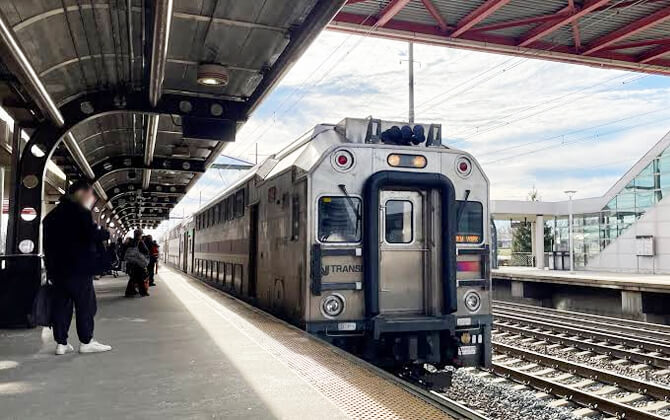
Connections with Other Transit Systems
NJ Transit trains connect with other regional transportation systems across New Jersey, New York City, and Philadelphia. These transfers make the rail network more useful for airport trips, city commuting, intercity rail, local transport, ferries, buses, trams, and light rail.
PATH, New York City Subway, and MTA Connections
PATH provides frequent 24-hour service between Newark, Harrison, Jersey City, Hoboken, and New York. NJ Transit rail customers can connect to PATH at Newark Penn Station or Hoboken Terminal, and NJ Transit bus customers can connect to any PATH station in New Jersey.
PATH connects with the New York City Subway at several Manhattan stations, but there are no free transfers between NJ Transit, PATH, and the NYC Subway. Each system uses its own ticket or fare payment.
In Manhattan, PATH serves stations including 33 Street, 23 Street, 14 Street, 9 Street, Christopher Street, and World Trade Center. In New Jersey, it serves Newark, Harrison, Journal Square, Grove Street, Exchange Place, Newport, and Hoboken.
Amtrak, SEPTA, PATCO, Ferries, Buses, and Light Rail
Amtrak runs along the Northeast Corridor and provides national rail service. NJ Transit customers can connect to Amtrak at Newark, Trenton, Metropark, New York, and Philadelphia 30th Street Station.
SEPTA connects Philadelphia and Southeast Pennsylvania with NJ Transit at Trenton Transit Center and Philadelphia 30th Street Station. Riders along the 608 bus line can also connect with SEPTA West Trenton station.
PATCO provides rail service between Southern New Jersey and Philadelphia. NJ Transit rail customers can connect to PATCO at Walter Rand Transportation Center in Camden or at Lindenwold.
Ferry connections are available at Hoboken Terminal, Port Imperial, Exchange Place, Newport, and other Hudson waterfront locations through NY Waterway. Seastreak connects Monmouth County’s Sandy Hook Bay communities with Downtown and Midtown Manhattan, with NJ Transit 834 bus stops within walking distance of ferry terminals in Highlands and Atlantic Highlands.
Light rail connections include Hudson-Bergen Light Rail, Newark Light Rail, and River LINE. The River LINE also connects with the PATCO system and NJ Transit’s Atlantic City Line.
Important Transfer Stations
Many NJ Transit rail trips require a transfer, especially when traveling between suburban lines and New York Penn Station, Philadelphia, PATH, or airport service.
| Station | Details |
|---|---|
| Newark Penn Station | Major hub for NJ Transit, PATH, Amtrak, Newark Light Rail, and bus connections |
| Secaucus Junction | Main transfer point for many NJ Transit lines serving New York Penn Station |
| Trenton Transit Center | Southern gateway for NJ Transit, River LINE, SEPTA, and Amtrak connections |
| Hoboken Terminal | Terminal for several rail lines, with PATH, light rail, bus, and ferry connections |
| Princeton Junction | Transfer point for the Princeton Branch and Northeast Corridor service |
| Metropark | Northeast Corridor station with Amtrak service |
| Dover | Useful for Midtown Direct service to New York Penn Station |
Newark Liberty International Airport Connection
NJ Transit train service is one of the easiest ways to reach Newark Liberty International Airport by public transport. Trains serve Newark Liberty International Airport Rail Station on the Northeast Corridor and North Jersey Coast Line, where passengers transfer to AirTrain Newark for Terminals A, B, and C.
Your NJ Transit airport ticket includes the AirTrain fee, so you do not need to buy a separate AirTrain ticket for airport access. Look for the airplane symbol or EWR on departure boards when choosing an airport-bound train.
| Service detail | Timings |
|---|---|
| Newark Airport to New York Penn Station | About 30 minutes by NJ Transit train |
| Newark Airport to the Financial District | About 45 to 55 minutes via NJ Transit and PATH |
| Typical rail service span | Generally about 5:00 a.m. to 1:00 a.m.; check schedule today for exact last train |
NJ Transit Train and AirTrain Newark
To use NJ Transit and AirTrain Newark, take an NJ Transit train to Newark Liberty International Airport Rail Station, transfer to AirTrain Newark, and ride directly to your terminal. AirTrain is fare-free within the airport, but passengers using the airport rail station pay an access fee, which is included when buying an NJ Transit airport ticket.
From North Jersey lines such as Main-Bergen, Pascack Valley, Montclair-Boonton, and Morris & Essex, transfer at Secaucus Junction to a southbound Northeast Corridor or North Jersey Coast Line train. From the Raritan Valley Line, transfer at Newark Penn Station. Many North Jersey Coast Line services run directly to the airport station.
AirTrain Newark opened in 1996 and is planned to be replaced by a Cable Liner system by 2030. Starting January 15, 2026, weekday service between the train station and the terminals is suspended from 5:00 a.m. to 3:00 p.m. for construction work, while AirTrain continues running between terminals.
From EWR to Manhattan
For Midtown Manhattan, take AirTrain Newark from your terminal to Newark Liberty International Airport Rail Station, then board NJ Transit toward New York Penn Station. The running time is about 30 minutes, and the adult ticket price is US$17.25, or $17.25 USD.
For the Financial District, take AirTrain Newark to the airport rail station, ride NJ Transit to Newark Penn Station, then transfer to PATH for Lower Manhattan. The trip takes about 45 to 55 minutes. The adult NJ Transit fare to Newark Penn Station is US$12.30, or $12.30 USD, plus a PATH fare of US$3.00, or $3.00 USD.
Buy your ticket before boarding if possible, and keep it with you. It covers the AirTrain fee when you are arriving at or leaving the airport rail station.
Parking, Bikes, and First/Last-Mile Access
Biking, scooting, walking, local bus service, and park-and-ride access all play a role in getting to NJ Transit stations. Station parking availability and parking charges vary by location, day, and time, and some stations may require a permit. If you need station parking or parking charges per day, check the specific station before you travel.
Bike racks are available at about 90 percent of New Jersey train stations, as well as at several bus park-and-ride lots, bus terminals, and most Hudson-Bergen Light Rail and River LINE stations. NJ Transit provides free parking capacity for more than 3,000 personal vehicles at stations and park-and-ride locations.
Folding personal vehicles are always permitted on all NJ Transit trains. Non-folding personal vehicles are allowed only during certain time periods, and rules vary by line, weekday, weekend, and holiday. Capacity may be limited by crowding or accessibility needs.
Riding or charging personal vehicles inside NJ Transit facilities or onboard vehicles is prohibited. Hoverboards, tandem bicycles, and gasoline-powered personal vehicles such as mopeds are not allowed on NJ Transit vehicles. Shared or rented personal vehicles from providers such as Citi Bike, Lime, or Bird are not allowed on NJ Transit vehicles or property.
How to Use NJ Transit Train
Start by identifying your origin and destination stations, then check the route, schedule, fare, and whether a transfer is required. The NJ Transit Mobile App is the simplest tool for planning, buying, and riding because it combines trip planning, real-time departures, service alerts, and mobile ticketing.
In the app, riders can buy rail, bus, and light rail tickets and passes; view real-time arrivals and departures; save favorite routes and stations; and store tickets in My Tickets. An account is required to purchase, store, and manage mobile tickets.
Match Day rail tickets to NYNJ Stadium are available only through the NJ Transit Mobile App. They are not sold at station ticket machines, ticket windows, or onboard, and a Match Day rail ticket is required to board trains to and from NYNJ Stadium.
Tips for First-Time Riders
Plan your trip before leaving home. Check the timetable, confirm your station, review the fare, and look for any service alerts. Some NJ Transit train trips require a transfer, so read the schedule notes closely.
Buy your ticket before boarding. If using the app, charge your phone and activate the ticket when you are ready to travel. If you board without a ticket when a ticket agent or vending machine was available, a US$5.00 surcharge, or $5.00 USD, may apply.
Arrive early if you need parking, because availability can change by station and time of day. At the platform, stay behind the yellow safety line until the train stops, let passengers exit first, then board.
Once onboard, take any available seat, keep aisles clear, store bags overhead or with you, and have your ticket ready. Smoking and vaping are not allowed. Listen for announcements, watch your stop, and use marked crossings only when moving around stations.
Accessibility and Passenger Services
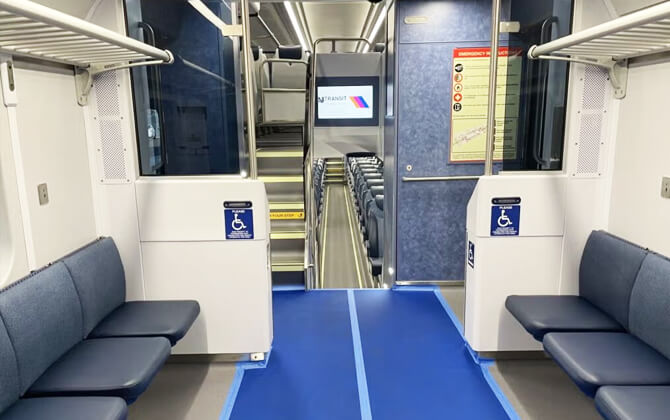
NJ Transit provides accessible travel options across rail, bus, light rail, and Access Link, its ADA paratransit service. Many rail stations are accessible by elevator, ramp, mini high-level platform, or portable lift. Accessible stations are shown on the system map with the international accessibility symbol.
At high-level and mini high-level platforms, bridge plates help bridge the gap between the platform and train. A crew member can assist with a bridge plate upon request. Priority seating is provided near train car entrances, and customers may also ride in the center vestibule of the car.
Other passenger services may include onboard stop announcements, accessible parking where provided, detectable warning edges along platforms, customer service offices, reduced fare options, and travel assistance. Access Link offers curb-to-curb shared-ride transportation for eligible riders who cannot use local fixed-route bus or light rail service because of physical or functional limitations.
For accessibility help, Access Link information is available at 973-491-4224. NJ Transit information is available at 973-275-5555, and TTY for deaf and hearing-impaired customers is available at 800-772-2287.
Rules, Safety, and Onboard Etiquette
NJ Transit trains are designed to be safe, but riders still need to follow basic rules. Know your departure and arrival stations, check alerts before traveling, and buy your ticket before boarding when ticketing options are available.
At stations, stay behind the yellow line until the train comes to a complete stop. Let riders exit before boarding, use handrails on stairs, and watch the gap between the train and platform. Never try to board or leave a moving train, and cross tracks only at designated crossings.
Onboard, keep aisles clear, do not block doors, and store bags in the overhead rack or with you instead of on another seat. Priority seating is for riders who need it. Keep noise low, respect quiet cars where offered, and avoid playing loud audio.
Smoking and vaping are prohibited on NJ Transit vehicles, stations, and platforms. If you see smoke, suspect a fire, notice an unattended package, or see someone in distress, notify the crew immediately and follow instructions.
NJ Transit rail equipment includes slip-resistant flooring, glow-in-the-dark emergency exit markings, handrails, emergency doors and windows, fire extinguishers, and Passenger Emergency Intercoms on multilevel cars. Use emergency equipment only when needed.
Brief History
NJ Transit, officially the New Jersey Transit Corporation, was created on July 17, 1979, after the Public Transportation Act of 1979. The agency was formed to acquire, operate, and contract for transportation service in the public interest.
It first expanded by taking over private bus operations, including services once run by Public Service Electric and Gas Company. In 1983, NJ Transit assumed operation of New Jersey commuter rail service from Conrail, bringing together rail lines with roots in the 19th century.
Major milestones include Midtown Direct service in the 1990s, the opening of Newark Liberty International Airport Station in 2001, and Secaucus Junction in 2003. Secaucus Junction connected the agency’s two northern New Jersey commuter rail networks for the first time.
NJ Transit later took over Clocker service in 2005 and operated the seasonal Atlantic City Express Service from 2009 to 2011. The system also faced major disruption from Hurricane Sandy in 2012, which damaged rail equipment and operations facilities.
More recently, Positive Train Control was certified in 2020, the Portal North Bridge construction contract was approved in 2021, and a 2025 rail strike briefly suspended service before trains resumed after an agreement and safety inspections.
Projects and Future Improvements
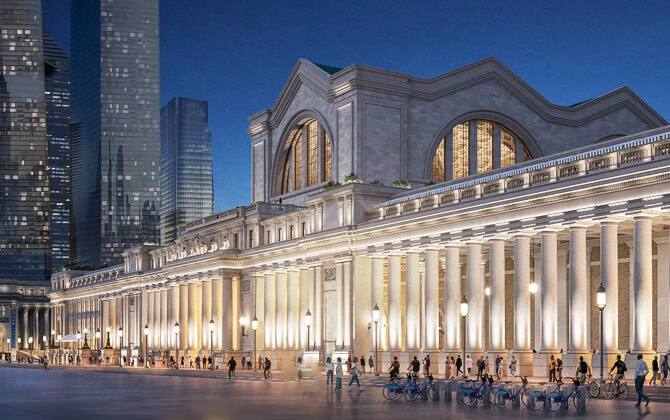
NJ Transit continues to invest in expansion, reliability, capacity, safety, and customer experience while operating bus, train, and light rail service. Recent work has included more trains added to the schedule, improved operating performance compared with FY2019, and lower rail cancellations in FY2023 versus FY2019.
Fleet upgrades remain a major focus. NJ Transit has secured contracts for 550 new 40-foot buses and 408 articulated buses, with plans to seek approval for 257 additional 40-foot buses. The agency expects to replace 1,235 older buses by 2031. It has also invested more than US$2 billion, or $2 billion USD, in 374 new multi-level cars and 37 new dual-mode locomotives.
Major capital projects include Portal North Bridge, the Gateway Program, the Hudson Tunnel Project, Elizabeth Station renovation, Raritan River Bridge Replacement, New Brunswick Train Station revitalization, Walter Rand Transportation Center improvements, Hoboken Connect, the Long Slip Project, and the Morris & Essex Lines Sawtooth Bridge replacement.
NJ Transit’s 10-year Strategic Plan and 5-year Capital Plans guide long-term improvements through 2030 and beyond. The agency is also advancing zero-emission bus work, transit-oriented projects, and Northeast Corridor coordination through CONNECT NEC 2037.
NJ Transit and Amtrak have also continued joint reliability work on the Northeast Corridor. Ongoing efforts include infrastructure repairs, increased inspections, equipment upgrades, contingency planning, and customer service improvements.
Popular Destinations Served by NJ Transit Train
NJ Transit train service reaches business districts, airport connections, college towns, beach communities, event venues, and intercity rail hubs. Some destinations are served by direct trains, while others require a transfer at Secaucus Junction, Newark Penn Station, Trenton Transit Center, Long Branch, or another hub.
New York City
New York Penn Station is one of the busiest NJ Transit destinations. Five NJ Transit rail lines serve Penn Station New York, and many riders transfer at Newark Penn Station or Secaucus Junction to reach Manhattan.
From the south, the Northeast Corridor offers frequent service from Trenton to New York Penn Station, with connections at Trenton Transit Center from River LINE, Amtrak, and SEPTA. The North Jersey Coast Line provides direct service from Long Branch to New York Penn Station at all times, with weekday peak-period service between Bay Head and Long Branch and connecting rail shuttle service in that segment.
From the west, the Raritan Valley Line provides weekday service from High Bridge, Raritan, and Plainfield to Newark Penn Station, with some trains extended to and from New York during midday and evening hours. On weekends and holidays, service operates between Raritan and Newark Penn Station, with connections to and from New York.
From the northwest, Morris & Essex service connects Dover, Summit, and Gladstone with Newark Broad Street, Hoboken, and New York. Montclair-Boonton service connects Hackettstown, Mount Olive, Lake Hopatcong, Dover, Montclair State University, Newark Broad Street, Hoboken, and New York on weekdays.
Newark and Jersey City Connections
Newark is served by NJ Transit rail, Newark Light Rail, and bus service. The main rail gateways are Newark Penn Station and Newark Broad Street Station.
Direct rail service to Newark Penn Station is available on the Northeast Corridor, North Jersey Coast Line, and Raritan Valley Line. From Main-Bergen County Lines or the Pascack Valley Line, transfer at Secaucus Junction to a southbound train for Newark Penn Station.
Newark Light Rail connects Newark Penn Station and Newark Broad Street Station and continues through the Central and North Wards. It is useful for reaching Branch Brook Park, NJPAC, and downtown Newark connections.
Jersey City is connected by Hudson-Bergen Light Rail, which links Bayonne and western Jersey City with Exchange Place, Newport Center, and Hoboken Terminal. NJ Transit rail riders can also connect to PATH at Newark Penn Station or Hoboken Terminal.
Jersey Shore, Princeton, Philadelphia, and Event Travel
For the Jersey Shore, the North Jersey Coast Line serves destinations such as Asbury Park, Red Bank, Long Branch, Belmar, Spring Lake, Point Pleasant Beach, Manasquan, and Bay Head. Many southbound shore trips require a transfer at Long Branch.
Princeton is reached by taking the Northeast Corridor to Princeton Junction and transferring to the Princeton Branch. Trenton is served by the Northeast Corridor, with SEPTA Regional Rail connections toward Philadelphia.
Philadelphia can be reached by taking the Northeast Corridor to Trenton Transit Center and transferring to SEPTA, or by using the Atlantic City Line to Philadelphia 30th Street Station. South and Central Jersey bus service also connects to Center City Philadelphia.
For event travel, the Meadowlands Rail Line operates between Secaucus Junction and Meadowlands for MetLife Stadium events only. Always check the route timetable for the event date, since special service can have different timings and ticket rules.
FAQ
How do I know which NJ Transit train to take?
Use the NJ Transit Mobile App or a station-to-station timetable. Enter your starting point and destination, then compare route options, transfers, schedule today, fare, and estimated running time.
At the station, check DepartureVision, listen for announcements, and follow track assignments. If using Map My Ride, select DepartureVision, choose your station and train, then open the Map tab to see the path train location as it moves toward your station.
Can I use NJ Transit Train to get from Newark Airport to NYC?
Yes. Take AirTrain Newark from your terminal to Newark Liberty International Airport Rail Station, then board NJ Transit toward New York Penn Station. The trip to Midtown Manhattan takes about 30 minutes, and the adult fare is US$17.25, or $17.25 USD.
For Lower Manhattan, ride NJ Transit to Newark Penn Station and transfer to PATH. This takes about 45 to 55 minutes and costs US$12.30, or $12.30 USD, for NJ Transit plus US$3.00, or $3.00 USD, for PATH.
Do NJ Transit trains run 24/7?
No. NJ Transit trains do not run 24/7. Rail service generally operates from about 5:00 a.m. to 1:00 a.m., but opening hours, closing time, and last train vary by line and date.
The Transit Information Center offers automated phone service 24/7, with live operators available from 8:30 a.m. to 5:00 p.m. daily.
Can I use one ticket for NJ Transit, PATH, and the NYC Subway?
No. NJ Transit, PATH, and the NYC Subway are separate systems, so one ticket does not cover all three. NJ Transit tickets are separate from PATH and NYC Transit fares.
Weekly and monthly NJ Transit rail passes may be accepted for connecting NJ Transit light rail and bus service under pass rules, but PATH and NYC Subway fares must still be paid separately.
Do I need to buy a ticket before boarding?
Yes, buy your NJ Transit train ticket before boarding whenever a ticket agent or ticket vending machine is available. If you buy onboard when station ticketing was available, a US$5.00 surcharge, or $5.00 USD, may apply.
If using the mobile app, activate your ticket when you are ready to travel and before boarding. Some special event tickets, including Match Day rail tickets to NYNJ Stadium, are app-only.
Are NJ Transit train stations accessible?
Many NJ Transit rail stations are accessible by elevator, ramp, mini high-level platform, or portable lift. Accessible stations are marked on the system map with the international accessibility symbol.
Bridge plates are available at high-level and mini high-level platforms, and crew members can assist upon request. Priority seating is provided near train car entrances, and other features may include onboard stop announcements, accessible parking, and detectable warning edges.
Can I bring luggage or a bike on NJ Transit Train?
Yes. Small bags can be stored in the overhead luggage rack or kept with you, but they should not be placed on another seat.
Bikes are allowed under NJ Transit rules. Folding bikes are always permitted on trains, while standard bicycles are allowed on many trains during off-peak times and where capacity permits. If space is not available, you may need to wait for the next train.
Personal vehicles must be walked in stations and on platforms, not ridden or charged. Hoverboards, tandem bicycles, gasoline-powered personal vehicles such as mopeds, and some motorized scooters or bikes are prohibited.