The Market-Frankford Line, now branded as the L, is a SEPTA Metro rapid transit line in Philadelphia, Pennsylvania. It runs between 69th Street Transit Center in Upper Darby and Frankford Transit Center in Near Northeast Philadelphia, crossing West Philadelphia and Center City along a route with underground, elevated, and ground-level sections. The line is SEPTA’s busiest route, serves 28 stations, and generally operates from about 5:00 AM to 1:00 AM.
| Key | Information |
|---|---|
| Current name | L, formerly the Market-Frankford Line |
| Transit system | SEPTA Metro public transport in Philadelphia |
| Route | 69th Street Transit Center to Frankford Transit Center |
| Length | 12.9 miles (20.8 km) |
| Stations | 28 stations |
| Operating hours | About 5:00 AM to 1:00 AM |
| Running time | About 40 to 41 minutes end to end |
| Base fare | USD $2.50 |
| Common connections | Broad Street Line, subway-surface trolleys, Regional Rail, Amtrak, PATCO, bus routes, and the Airport Line via transfer |
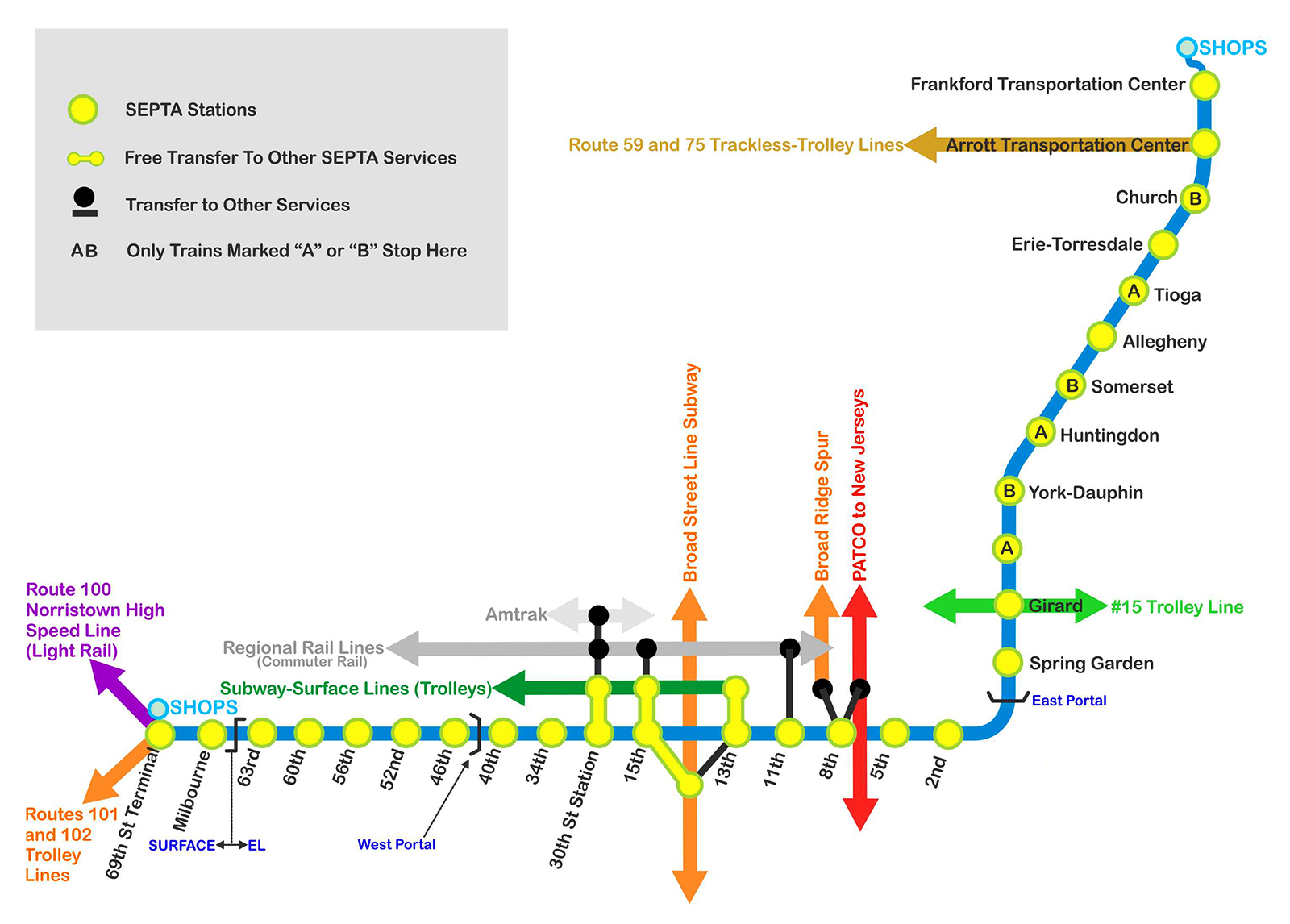
Market-Frankford Line Map
The Market-Frankford Line map shows all available stops. Click on the map to enlarge it or download the Market-Frankford Line map in PDF format.
Route and Stations
The L follows an east-west route from Upper Darby through West Philadelphia, Center City, Northern Liberties, Kensington, and Frankford. It uses two tracks and includes a mix of elevated, underground, and ground-level running. For trip planning, the route plan is simple: westbound trains head toward 69th Street Transit Center, while eastbound trains head toward Frankford Transit Center.
From 69th Street, trains run east, pass Millbourne, continue above Market Street in West Philadelphia, and enter the subway near 44th Street. After crossing beneath the Schuylkill River, trains continue through Center City, then turn north near Front Street before rising toward the Frankford Elevated alignment. The path of the train then follows Kensington Avenue and Frankford Avenue toward the eastern terminal.
Eastbound and Westbound Terminus Stations
The westbound terminus is 69th Street Transit Center in Upper Darby. It is the main starting point for trips toward Center City and Frankford, and it also works as a major local transport hub for bus and suburban transit connections.
The eastbound terminus is Frankford Transit Center in Near Northeast Philadelphia. It replaced the original Bridge and Pratt Street terminal and remains the key transfer point at the eastern end of the line.
| Station | Details |
|---|---|
| 69th Street Transit Center | Western terminus in Upper Darby; starting point for eastbound service toward Center City and Frankford. |
| Frankford Transit Center | Eastern terminus in Near Northeast Philadelphia; major bus and transit connection point. |
Full Station List
The Market-Frankford Line stations list below follows the route from west to east. For a stations map, use this list with the L route direction: 69th Street-bound trains run west, and Frankford-bound trains run east.
| Station | Details |
|---|---|
| 69th Street Transit Center | Opened 1907; Upper Darby; western terminus with Norristown 101 and 102 connections. |
| Millbourne | Opened 1907; Millbourne; originally named 66th Street. |
| 63rd Street | Opened 1907; Haddington. |
| 60th Street | Opened 1907; Haddington and Cobbs Creek. |
| 56th Street | Opened 1907; Haddington and Cobbs Creek. |
| 52nd Street | Opened 1907; Haddington, Dunlap, Walnut Hill, and Cobbs Creek. |
| 46th Street | Opened 1907; Mill Creek and Walnut Hill. |
| 40th Street | Opened 1955; University City; connections to trolley routes 10, 11, 13, 34, and 36. |
| 34th Street | Opened 1955; University City. |
| 30th Street subway | Opened 1955; University City; connections to trolleys, SEPTA Metro, Regional Rail, Atlantic City Line, and Amtrak. |
| 15th Street | Opened 1907; Center City; central interchange for the L, Broad Street Line, and subway-surface trolleys. |
| 13th Street | Opened 1908; Center City; trolley connections. The elevator from the L platform to the T platform is temporarily out of service, so riders should use 15th Street/City Hall for T access. |
| 11th Street | Opened 1908; Center City; access to SEPTA Metro and Jefferson Station. |
| 8th Street | Opened 1908; Center City; connections to Broad-Ridge Spur and PATCO. |
| 5th Street | Opened 1908; Center City; useful for Independence Hall and Old City. |
| 2nd Street | Opened 1908; Center City and Old City waterfront access. |
| Spring Garden | Opened 1977; Northern Liberties; replaced Fairmount station on the Frankford Elevated. |
| Girard | Opened 1922; Fishtown; connection to Route 15 trolley service. |
| Berks | Opened 1922; Kensington. |
| York-Dauphin | Opened 1922; Kensington. |
| Huntingdon | Opened 1922; Kensington. |
| Somerset | Opened 1922; Kensington. |
| Allegheny | Opened 1922; Kensington. |
| Tioga | Opened 1922; Harrowgate. |
| Erie-Torresdale | Opened 1922; Juniata. |
| Church | Opened 1922; Frankford. |
| Arrott Transit Center | Opened 1922; Frankford. |
| Frankford Transit Center | Opened 1922; Frankford; eastern terminus. |
Fares, Tickets, and Passes
The base fare for the Market-Frankford Line is USD $2.50. Riders can pay with SEPTA Key Travel Wallet, a Quick Trip ticket, or contactless payment. SEPTA Key users and contactless riders previously received a USD $0.50 discount, but that discount ended with the system-wide fare restructuring.
One paid fare includes free transfers to subway-surface trolley lines at Drexel, 15th Street/City Hall, and 13th Street, plus free transfer to the B1 Local and B2 Express on the Broad Street Line at 15th Street. At 8th-Market, the Broad-Ridge Spur connection remains, but the free-transfer passageway is no longer available.
SEPTA Key and Contactless Payment
SEPTA Key and contactless payment are accepted at Market-Frankford Line turnstiles. You can tap a SEPTA Key card, contactless credit or debit card, smartphone, or smartwatch. Apple Pay, Google Pay, and Samsung Pay are supported for contactless travel.
Transfers are available with SEPTA Key and contactless payment, and up to two free transfers are included. To receive them, use the same card or device for every tap.
- No passbacks are allowed.
- You cannot use the same card to tap in other people in your group.
- To avoid card clash, remove the card you want to use before tapping.
- Contactless charges may settle within two to three business days.
Quick Trip Tickets
Quick Trip tickets are single-ride magnetic-stripe tickets sold at SEPTA Key fare kiosks for travel on Market-Frankford Line, Broad Street Line, and Broad-Ridge Spur stations. They are useful for occasional riders who do not need a SEPTA Key card or pass.
A Quick Trip is valid for one-way travel only, must be used on the day it is purchased, and cannot be used with discounted transfers. The station and purchase date are printed on the ticket, and the ticket must be swiped through the magnetic card reader at a SEPTA Key turnstile.
Transfers and Pass Options
Weekly and monthly TransPass and TrailPass products loaded on a SEPTA Key card are accepted on the Market-Frankford Line. Weekly and monthly TransPasses are listed at USD $25.50 and USD $96.00, respectively, and include transit trips with transfers. On weekends and major holidays, TransPasses can also be used on Regional Rail.
If you are comparing fare options, the practical choice depends on how often you ride. A single ticket works for one trip, while a pass is better for regular city transport use across subway, trolley, and bus services.
Schedule, Frequency, and Real-Time Service
The Market-Frankford Line operates every day. Its usual opening hours start at about 5:00 AM, with service continuing until about 1:00 AM. A listed departure time of 4:45 AM appears in available schedule information, and the full route running time is about 40 to 41 minutes.
Live trip data may not always be available, so the published timetable is the best reference for the train schedule. Riders can also use SEPTA service tools or the Transit app to check timings today, schedule today, and service changes before traveling.
| Service detail | Timings |
|---|---|
| General operating hours | About 5:00 AM to 1:00 AM |
| Listed starting time | 4:45 AM in available schedule information |
| Closing time | About 1:00 AM |
| Full route running time | About 40 to 41 minutes |
| Weekday frequency | About every 6 minutes during off-peak periods; every 15 minutes or less Monday through Friday between 6:00 AM and 9:00 PM |
| Weekend frequency | About every 10 minutes |
| Night frequency | About every 12 minutes |
| Night-owl bus frequency | About every 15 minutes |
| Last train connection | Timed transfer around 12:30 AM at City Hall for Broad Street Line final trains |
Weekday, Weekend, and Holiday Service
Weekday service is frequent, with off-peak trains generally running about every 6 minutes and higher frequency during peak travel periods. SEPTA increased weekday off-peak service in 2008, moving from eight-minute intervals to six-minute intervals.
Weekend service is usually about every 10 minutes. Holiday service generally follows SEPTA’s Sunday schedule, though opening times and working hours may change on holidays, so it is smart to check the latest route timetable before riding.
Late-Night Service
Late-night service continues until about 1:00 AM. On weekdays, overnight subway service is replaced by the L Owl bus, which serves the same stops as the train.
Weekend late-night subway hours, running from 5:00 AM Friday to 1:00 AM Monday morning, were restored in 2014 and later made permanent. At night, trains run about every 12 minutes, while the Owl bus runs about every 15 minutes during night-owl service.
Connections with Other SEPTA and Regional Transit
The L is one of the main public transport links in Philadelphia and connects with subway lines, trolleys, Regional Rail, Amtrak, PATCO, and many bus routes. These transfer points make the line useful for both daily commuting and visitor trips across the city transportation network.
Major connections include 69th Street Transit Center, Drexel Station at 30th Street, 15th Street/City Hall, 11th Street, 8th-Market, and Frankford Transit Center. At 69th Street, riders can transfer to SEPTA City Bus routes 21, 30, 65, and 68, plus multiple SEPTA Suburban Bus routes.
Broad Street Line and Subway-Surface Trolleys
The main transfer between the Market-Frankford Line and the Broad Street Line is at 15th Street/City Hall. This is also the central interchange for the L, T trolley routes, and B services.
The Market-Frankford Line and subway-surface trolleys share the same tunnel between 15th and 30th Streets. In this section, L tracks run in the center, while trolley tracks use the outside tracks. At Drexel Station at 30th Street, the station layout reflects that shared arrangement.
Free transfers are available to the subway-surface trolleys at Drexel, 15th Street/City Hall, and 13th Street, and to the Broad Street Line at 15th Street. A timed late-night transfer at City Hall around 12:30 AM helps connect riders with final Broad Street Line trains.
Regional Rail and Amtrak Connections
Drexel Station at 30th Street connects riders with 30th Street Station, including Amtrak, SEPTA Regional Rail, NJ Transit Rail’s Atlantic City Line, trolley routes, and multiple bus services. It is the most important rail transfer on the western side of Center City.
At 15th Street/City Hall, riders can reach Suburban Station for Regional Rail. At 11th Street, riders can connect to Jefferson Station. These stops make the L a useful link between rapid transit and the larger regional rail system.
PATCO and New Jersey Connections
PATCO connects Center City Philadelphia with Camden County, New Jersey, running from 15-16th and Locust to Lindenwold. The key connection from the Market-Frankford Line is at 8th and Market, where riders can reach PATCO, the Broad-Ridge Spur, and nearby Jefferson Station.
In New Jersey, PATCO connects with NJ Transit at several points, including Lindenwold Station for the Atlantic City Rail Line and Broadway Station at the Walter Rand Transportation Center for River Line and local bus connections.
Bus and Trolley Connections at Transit Centers
69th Street Transit Center is the main western bus and trolley transfer hub for the L. Frankford Transit Center plays a similar role at the eastern end, connecting riders to surrounding neighborhoods through SEPTA bus service.
In Center City, 15th Street/City Hall, Drexel Station at 30th Street, 11th Street, and 8th-Market handle many of the busiest transfers. Together, these stations link the L with bus, trolley, subway, Regional Rail, PATCO, and Amtrak services.
Getting to Philadelphia International Airport
The Market-Frankford Line does not go directly to Philadelphia International Airport. For airport rail service, use SEPTA’s Airport Line, which runs between Center City and the airport terminals.
The Airport Line runs every day about every 30 minutes from 5:00 AM to midnight. The trip from Center City to the airport takes about 20 to 25 minutes, and the last four stops serve airport terminals A-East and A-West, B, C-D, and E-F. Before boarding, check your airline and gate so you use the right terminal stop.
The Airport Line fare is USD $6.75, and QuickTrips can be purchased from the fare machine before boarding.
Airport Line Transfer Options
From the Market-Frankford Line, the most useful Airport Line transfer points are Jefferson Station, Suburban Station, and 30th Street Station. Jefferson has an indoor passageway to the Market-Frankford Line area, Suburban connects by indoor passageway to subway lines, and 30th Street is convenient for University City.
From the airport, follow the “Center City Train” signs to reach the rail station. From Center City, board the Airport Line at 30th Street Station, Suburban Station, or Jefferson Station for direct service to the terminals.
Parking and Park-and-Ride Options
SEPTA provides station parking at many locations, including select Market-Frankford Line access points. Parking charges apply at most SEPTA-owned surface lots and garages, and nearby municipal or non-SEPTA lots may have different prices.
| Service detail | Timings |
|---|---|
| Surface lot parking charges per day | USD $2 per day |
| Garage parking charges per day | USD $4 per day |
| Monthly permit parking | Suspended until further notice at SEPTA-operated station lots and garages |
| Weekend and holiday parking | Charged at the same daily-use rate |
| Overnight parking | Permitted at many locations for up to 14 days at the daily-use rate |
Parking can be paid through the SEPTA Park app, by text to pay using Station ID code 727563, or at kiosks with credit or debit cards and coins. When using station parking, pull into a marked space and do not back in.
SEPTA has identified parking near Spring Garden station, with additional garage capacity at Frankford Transportation Center. Lots may fill early on weekday mornings, sometimes before typical commute peaks, so checking nearby station parking can save time.
Frankford Transit Center Parking
Frankford Transit Center has garage parking only; there is no customer surface lot. The garage is open 24 hours a day, 365 days a year, and the phone number listed for the facility is 215-580-4978.
The garage parking price is USD $4 per day. Payment can be made at pay stations with credit or debit cards, contactless payment, or coins. Riders may also use text-to-pay at 727563 or the SEPTA Park mobile app.
- Garage only; no surface lot available
- Open 24 hours a day, 365 days a year
- Daily garage cost: USD $4
- Overnight station parking permitted for up to 14 days at the daily-use rate
- If you pay in advance and leave the lot, your space is not guaranteed
Accessibility, Elevators, and Rider Amenities
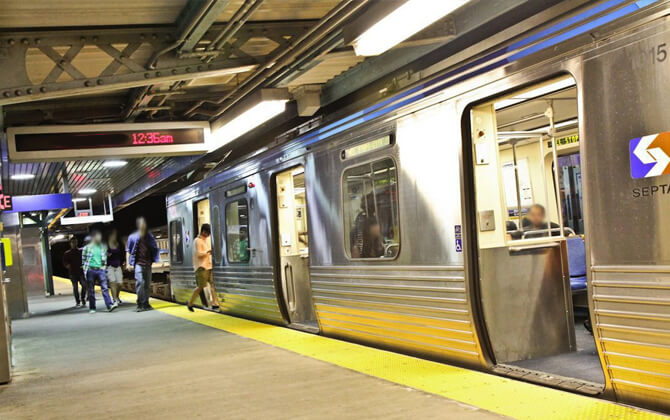
Accessibility has been a major part of Market-Frankford Line modernization. New and rebuilt stations include higher boarding platforms, elevators, improved fare lines, better lighting, clearer wayfinding, and upgraded passenger areas.
At 40th Street Station, two ADA-compliant elevators provide direct access from street level to the subway fare line. At 15th Street Station, elevators were installed on both sides of the street, improving access for riders using wheelchairs, strollers, or other mobility aids.
Station projects have also added public art, architectural repairs, improved doors and gates, new signage, and employee facility upgrades. As of the latest upgrade information in the draft materials, 26 of the 28 Market-Frankford Line stations comply with the Americans with Disabilities Act.
Safety, Rules, and Rider Etiquette
The Market-Frankford Line is safe to use when riders follow basic SEPTA rules and stay alert. Keep back from the platform edge, watch your surroundings, and do not lean into the track area to look for the next train. The line uses an electrified third rail, so never jump down from a platform.
If someone appears to be in danger, try to alert them before they reach the edge. If they do not respond, contact SEPTA personnel, speak with the station cashier, use the yellow emergency call box, call SEPTA Transit Police at 215-580-8111, or use the Transit Watch app.
- Do not walk between train cars unless it is allowed for emergency use.
- Use headphones instead of playing audio out loud.
- Keep aisles and doors clear when boarding or exiting.
- Secure your belongings in crowded stations and trains.
- Alert SEPTA staff or police if you notice unsafe behavior.
A little common sense goes a long way: stay aware, give others room, and let passengers exit before boarding.
Brief History
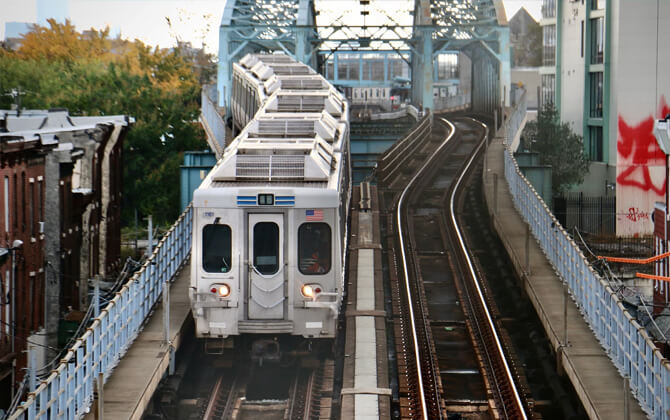
The Market-Frankford Line combines two historic pieces of Philadelphia rapid transit: the Market Street subway and the Frankford Elevated. The first section opened on March 4, 1907, linking 69th Street with City Hall at 15th Street.
Service was extended east to 2nd Street on August 3, 1908, and the Delaware Avenue Elevated, also known as the Ferry Line, opened on October 4, 1908. Construction on the Frankford section began in 1915, and the extension opened in 1922, giving Northeast Philadelphia a direct rapid transit connection to Center City.
Later changes included route relocation tied to Interstate 95 construction, the replacement of Fairmount station with Spring Garden station, and major Frankford Elevated reconstruction from the late 1980s into the early 2000s. In 2024, SEPTA rebranded the line as the L as part of its SEPTA Metro naming system.
Modernization and Future Improvements
SEPTA has continued to modernize the Market-Frankford Line through station rebuilds, accessibility work, fleet planning, and infrastructure upgrades. The reconstruction of 15th Street Station made the station fully modernized and ADA accessible, and it is part of broader work around the City Hall and 15th Street complex.
With the 15th Street project complete, 26 of the 28 stations are now fully ADA accessible. Improvements include elevators, reconstructed fare lines and platforms, better lighting, new finishes, customer amenities, and an Art-in-Transit installation by Philadelphia artist Ray King.
Future improvements include the Market-Frankford Line Vehicle Replacement and Infrastructure program. The program includes new M-5 vehicles, signal system modernization, and shop facility improvements at Bridge Street Yard and 69th Street Yard. The new fleet is planned to include open gangways, staggered passenger doors, and dynamic passenger information systems.
The vehicle replacement program is supported in part by a USD $317 million Federal Transit Administration grant awarded in February 2024. SEPTA awarded the vehicle contract in July 2024, and the broader expansion and modernization program is scheduled to continue through the next decade.
Best Stops for Visitors and Nearby Attractions
The Market-Frankford Line is one of the easiest ways to reach Philadelphia attractions, especially in Old City, Center City, University City, Fishtown, Northern Liberties, and the Delaware River waterfront. For visitors, the best stop depends on whether the trip is focused on history, food, shopping, museums, or nightlife.
Old City and Independence Hall
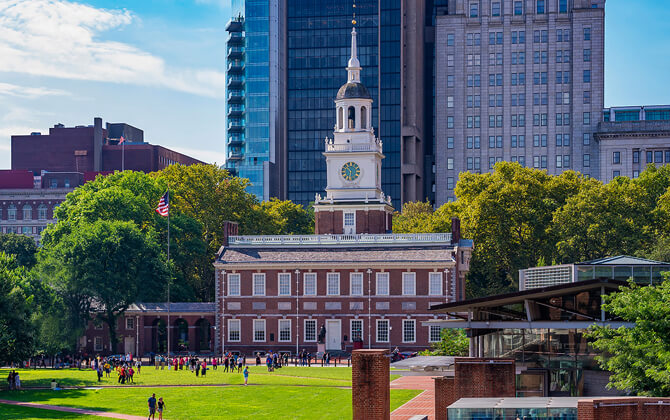
For Independence Hall and the historic core, use 5th Street/Independence Hall. It provides access to Independence National Historical Park and places you close to Old City attractions.
- Best stop for Independence Hall: 5th Street/Independence Hall
- Nearby area: Historic Old City
- Also useful: 2nd Street and 8th-Market, depending on where you want to start
Center City, Convention Center, and Reading Terminal Market
For the Pennsylvania Convention Center and Reading Terminal Market, 11th Street is the most direct Market-Frankford Line stop. From 11th Street Station, walk one block west to 12th Street, turn right, and continue one block to the market.
Other convenient nearby options include Jefferson Station by Regional Rail, City Hall by the Broad Street Line, 13th Street by subway-surface trolleys, and 8th and Market by PATCO.
University City
University City is served by 40th Street, 34th Street, and 30th Street. The 34th Street area is useful for Drexel and UPenn, while the 30th Street subway station connects with Philadelphia’s major train station and Amtrak.
Westbound trains continue toward 69th Street, while eastbound trains return toward Center City and Frankford Transit Center.
Fishtown, Northern Liberties, and Penn’s Landing
Spring Garden serves Northern Liberties, Girard is the key stop for Fishtown, and 2nd Street is the most convenient station for Penn’s Landing and the Old City waterfront. These stops work well for walking trips that combine dining, historic streets, and riverfront views.
- Spring Garden: Northern Liberties
- Girard: Fishtown
- 2nd Street: Old City District and Penn’s Landing
FAQ
Is the Market-Frankford Line the same as the L?
Yes. The Market-Frankford Line is now called the L as part of SEPTA Metro’s system-wide rebranding. Many riders still use older names such as the El, Market-Frankford El, Market-Frankford Subway-Elevated Line, or Blue Line.
The route has not changed because of the name: it still runs from 69th Street Transit Center through Center City to Frankford Transit Center.
Does the Market-Frankford Line go to Philadelphia International Airport?
No. The Market-Frankford Line does not serve Philadelphia International Airport directly. To reach PHL by rail, transfer in Center City to SEPTA’s Airport Line.
Useful transfer points include Jefferson Station, Suburban Station, and 30th Street Station. The Airport Line runs about every 30 minutes from 5:00 AM to midnight, with a trip time of about 20 to 25 minutes from Center City.
Which stations connect to the Broad Street Line?
The main Market-Frankford Line connection to the Broad Street Line is at 15th Street/City Hall. The base fare includes a free transfer to B1 Local and B2 Express services at 15th Street.
The line also connects at 8th Street to the Broad-Ridge Spur and PATCO, though there is no longer a free-transfer passageway between the Market-Frankford Line and the Broad-Ridge Spur there.
Can I use SEPTA Key or contactless payment on the Market-Frankford Line?
Yes. You can use SEPTA Key, contactless credit or debit cards, smartphones, smartwatches, or digital wallets at the turnstile. The base ticket price is USD $2.50.
SEPTA Key Travel Wallet and contactless payments include up to two free transfers when you use the same payment method for each trip. Quick Trip tickets are also available for one-way rides.
Is the Market-Frankford Line accessible?
Yes. SEPTA has made accessibility a major part of recent line improvements. The line includes higher boarding platforms and elevators at many stations, and 26 of the 28 stations are listed as ADA accessible in the latest upgrade information included in the draft materials.
Recent work includes accessibility improvements at 40th Street and 15th Street, with broader modernization continuing across the system.