The Lansdale/Doylestown Line is a SEPTA Regional Rail public transport route connecting Center City Philadelphia with Doylestown in Bucks County, Pennsylvania. The line serves 25 stations, runs through Montgomery County and Bucks County, and links with SEPTA Regional Rail, Metro, bus, and other city transport connections. It is one of SEPTA’s busiest commuter rail routes, with 9,257 average weekday riders in FY 2024.
| Key | Information |
|---|---|
| System | SEPTA Regional Rail |
| Route | Center City Philadelphia to Doylestown |
| Stations | 25 commuter rail stations |
| Main Center City stops | Temple University, Jefferson Station, and Suburban Station |
| Typical running time | Lansdale to Jefferson Station takes 52 minutes inbound on local service; the fastest express takes 46 minutes |
| Fare | Fare depends on zone, trip type, day of travel, and payment method |
| Airport access | No direct airport train; transfer in Center City to the Airport Line |
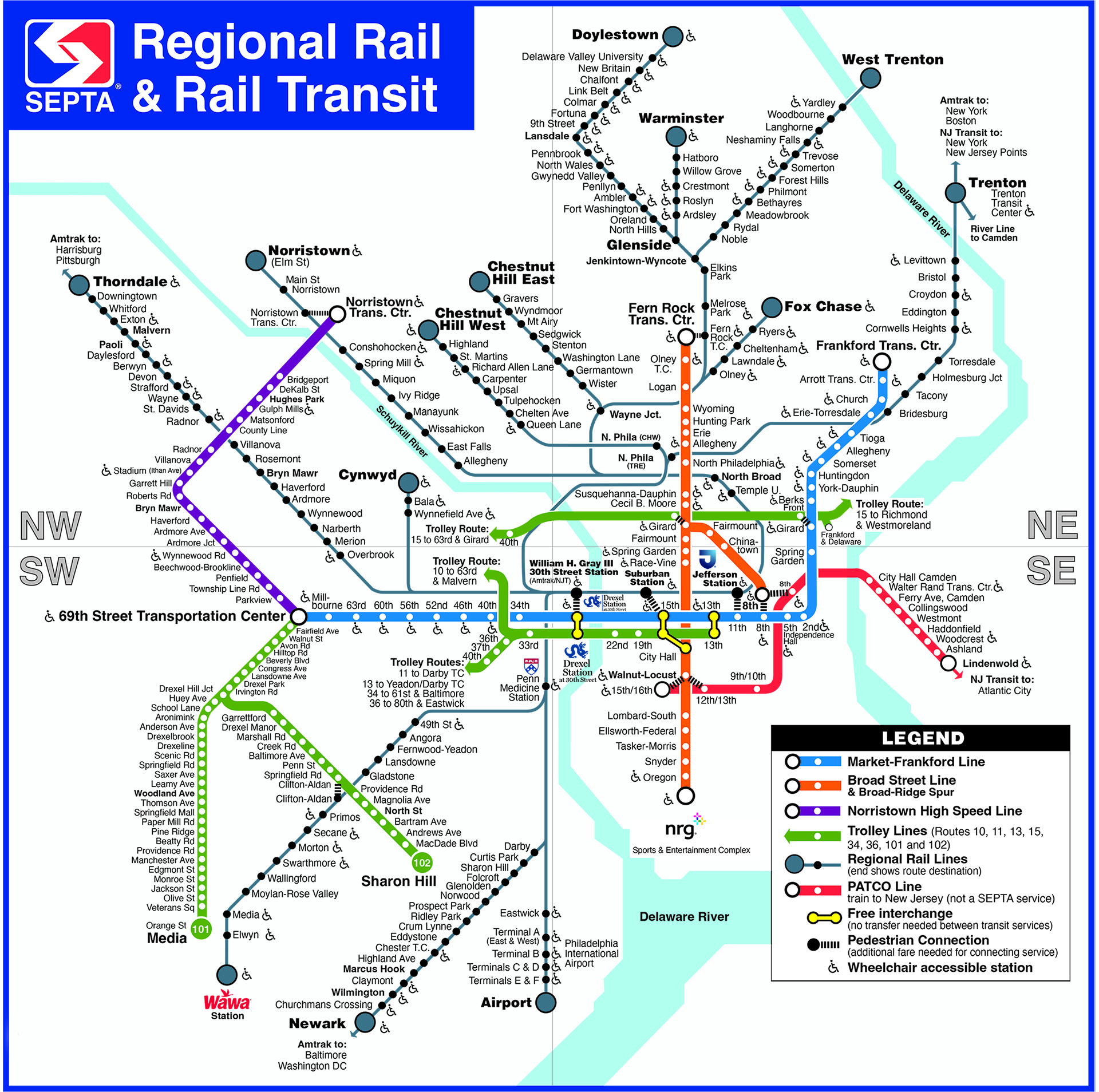
Fox Chase Line Map
The Lansdale Doylestown Line map shows all available stops. Click on the map to enlarge it or download the Lansdale Doylestown Line map in PDF format.
Stations and Key Stops
The Lansdale/Doylestown Line serves 25 stations between Center City Philadelphia and Doylestown. In the Center City Commuter Connection, trains stop at Suburban Station and Jefferson Station, then continue through North Philadelphia, Montgomery County, and Bucks County.
For riders checking a stations map or stations list, the core route is straightforward: Center City, North Philadelphia, inner suburbs, Lansdale, then the final stretch to Doylestown. Typical travel times vary by service pattern. In 2025, a local trip from Lansdale to Jefferson Station takes 52 minutes inbound and 48 minutes outbound, while the fastest express train runs in 46 minutes in both directions.
| Station | Details |
|---|---|
| Temple University | Major Regional Rail stop with connections across the SEPTA system |
| North Broad | Connects with SEPTA Metro and City Bus routes 4, 16, and 54 |
| Wayne Junction | Regional Rail, City Bus routes 2, 23, and 53, plus Trackless Trolley 75 |
| Fern Rock Transit Center | SEPTA Metro and bus connections |
| Fort Washington | SEPTA Suburban Bus routes 94, 95, and 201 |
| Ambler | SEPTA Suburban Bus routes 94 and 95 |
| Lansdale | Major intermediate stop with SEPTA Suburban Bus routes 96 and 132 |
| Doylestown | Terminal station with SEPTA City Bus 55, BCT Doylestown DART, Trans-Bridge Lines, and Greyhound Lines |
The line has also included stations that are no longer in service, including Logan, Tabor, and Fellwick. Fellwick closed in 1996 because of low ridership.
Center City Core Stations
The line reaches Center City Philadelphia through the Center City Commuter Rail Tunnel, which has connected the former Reading Terminal side to the ex-PRR/Penn Central side since 1985. These downtown stops are the easiest places to transfer between Regional Rail and other local transport.
| Station | Details |
|---|---|
| Temple University | Serves all SEPTA Regional Rail lines and is close to bus and Broad Street Line connections |
| Jefferson Station | Downtown Center City station with broad SEPTA and bus connections |
| Suburban Station | Major Center City rail hub with extensive transit connections |
These stations form the core Philadelphia section before trains continue north toward North Broad, Wayne Junction, and the rest of the route.
Major Transfer Stations
The Lansdale/Doylestown Line connects with several major SEPTA hubs. Temple University, North Broad, Wayne Junction, and Fern Rock Transit Center are especially useful if your route plan includes another Regional Rail line, SEPTA Metro, bus, or trolley connection.
| Station | Details |
|---|---|
| Temple University | SEPTA Regional Rail connections on all lines |
| North Broad | Regional Rail, SEPTA Metro, and City Bus routes 4, 16, and 54 |
| Wayne Junction | Regional Rail, City Bus routes 2, 23, and 53, and Trackless Trolley 75 |
| Fern Rock Transit Center | Regional Rail, SEPTA Metro, and City Bus routes 4, 28, 57, and 70 |
| Suburban Station | Major Center City transfer point for rail, metro, and bus service |
| Jefferson Station | Center City transfer point with SEPTA and NJ Transit bus service |
| 30th Street Station | Major rail hub with SEPTA, Amtrak, and NJ Transit Atlantic City Rail Line connections |
Suburban transfer stations include Fort Washington, Lansdale, Chalfont, New Britain, Delaware Valley University, and Doylestown, with connections such as SEPTA Suburban Bus, BCT DART West, Doylestown DART, Trans-Bridge Lines, and Greyhound Lines.
Suburban Stations Toward Lansdale and Doylestown
After leaving the Center City Commuter Connection, trains continue through a long suburban section before reaching Doylestown. The route includes active stations, bus connections, and a few former stops that no longer serve passengers.
North Broad was known as North Broad Street until 1992, and Logan was discontinued by SEPTA on October 4, 1992. Elkins Park was originally known as Elkins and also as Ashbourne. Jenkintown-Wyncote was originally called Jenkintown. Fellwick, also known as Sandy Run, Camp Hill, and Sellwick, closed on November 10, 1996 due to low ridership.
| Station | Details |
|---|---|
| Temple University | Regional Rail connections and access to North Philadelphia |
| North Broad | Formerly North Broad Street until 1992 |
| Wayne Junction | Major transfer stop for Regional Rail, bus, and trackless trolley service |
| Fern Rock Transit Center | SEPTA Metro and city bus connections |
| Melrose Park | Suburban station on the route toward Lansdale |
| Elkins Park | Former names include Elkins and Ashbourne |
| Jenkintown-Wyncote | Important inner-suburban station; originally called Jenkintown |
| Glenside | Regional Rail and City Bus connections |
| Fort Washington | Suburban station with bus connections |
| Ambler | Intermediate Montgomery County stop |
| Lansdale | Major stop with bus connections and extensive parking |
| 9th Street Lansdale | Alternate parking location opened in 2015 |
| Colmar | Station noted for available parking capacity near Route 309 |
| Chalfont | Stop on the final section toward Doylestown |
| Delaware Valley University | Station before the Doylestown terminal |
| Doylestown | Terminal station in Bucks County |
The trip from Center City to Doylestown is listed at approximately 76 to 102 minutes in the provided schedule material, depending on the train schedule shown.
Schedule and Frequency
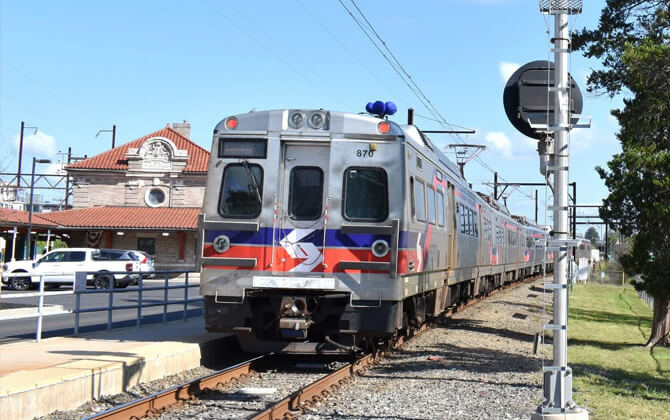
The Lansdale/Doylestown Line schedule combines local and express trains. Most trains continue through Center City: on weekdays many run to Wilmington or Newark, while weekend trains often continue to Malvern or Thorndale.
Service has changed several times. During the COVID-19 pandemic, trains were truncated to Lansdale on April 9, 2020, and Doylestown service resumed on June 22, 2020. Service has returned, though peak-hour frequency remains more limited than before the pandemic.
| Service detail | Timings |
|---|---|
| Weekday operating hours and opening hours | Provided schedule material lists regular weekday service generally from 5:54 AM to 11:35 PM |
| Weekend opening times | Provided schedule material lists weekend service generally from 6:44 AM to 11:44 PM |
| Example starting time from Suburban Station | 5:54 AM departure, arriving Doylestown at 7:36 AM |
| Example closing time and last train window | Late service is listed up to 11:35 PM on weekdays and 11:44 PM on weekends in the provided material |
| Lansdale to Jefferson Station local running time | 52 minutes inbound and 48 minutes outbound in 2025 |
| Fastest express running time | 46 minutes in both directions in 2025 |
| Peak train schedule restoration | 8 morning peak trains and 8 afternoon peak trains, with roughly half running express |
For timings today, schedule today, and the current train schedule, riders should check the latest published timetable before traveling. The route timetable can change because of repairs, equipment availability, service alerts, and special operating conditions.
Local and Express Trains
Local trains make more stops, while express trains shorten the trip for riders traveling between key stations and Center City. Before the pandemic, peak service included 10 morning trains into Center City and 11 afternoon trains out of Center City, with 5 express trains in each direction.
In the first half of 2024, peak service was reduced to 7 morning trains and 6 afternoon trains. SEPTA later began restoring up to 80% of pre-pandemic system capacity, bringing the line to 8 peak trains in the morning and 8 in the afternoon, with roughly half operating as express service.
Service notices can affect the timetable, including skipped stations, delays, cancellations, modified express patterns, and changes to boarding on selected inbound trains. Evening rush-hour express service has been restored.
Fares, Tickets, and SEPTA Key
Fare on the Lansdale/Doylestown Line depends on your start and end stations, the travel day, the fare zone, and how you pay. A practical fare calculator for this line is simple: check the station zone, confirm whether it is a weekday or weekend trip, then choose SEPTA Key, contactless payment, Quick Trip, or onboard payment.
On Regional Rail, riders using a SEPTA Key card or contactless credit or debit card must tap on at the starting station and tap off at the destination. If you do not tap off, SEPTA may charge the maximum fare.
| Fare type | Price |
|---|---|
| Weekday Zone 1 | US$5.00 with SEPTA Key, Contactless, or Quick Trip; US$7.00 on board |
| Weekday Zone 2 | US$6.50 with SEPTA Key, Contactless, or Quick Trip; US$9.00 on board |
| Weekday Zone 3 | US$7.75 with SEPTA Key, Contactless, or Quick Trip; US$10.00 on board |
| Weekday Zone 4 | US$8.75 with SEPTA Key, Contactless, or Quick Trip; US$11.00 on board |
| Weekend Zone 1 | US$5.00 with SEPTA Key, Contactless, or Quick Trip; US$7.00 on board |
| Weekend Zone 2 | US$6.00 with SEPTA Key, Contactless, or Quick Trip; US$9.00 on board |
| Weekend Zone 3 | US$7.00 with SEPTA Key, Contactless, or Quick Trip; US$10.00 on board |
| Weekend Zone 4 | US$8.00 with SEPTA Key, Contactless, or Quick Trip; US$11.00 on board |
| NJ fare | US$11.00 with SEPTA Key or Quick Trip; US$13.00 on board |
Weekday fares apply Monday through Friday. Weekend fares apply Saturday, Sunday, and major SEPTA holidays including New Year’s Day, Memorial Day, Independence Day, Labor Day, Thanksgiving, and Christmas.
Children under age 12 ride free with a fare-paying adult. Seniors age 65 and older ride free with a valid SEPTA Senior Fare card on Regional Rail when both stations are in Pennsylvania. For travel to or from New Jersey or Delaware, seniors with a valid Senior Fare Card pay 50% of the weekday fare.
Fare Zones and How Fares Are Calculated
SEPTA calculates Regional Rail fare by zone. The timetable shows each station’s zone, and your ticket price depends on the zone you board in, the zone you travel to, and whether your trip passes through Center City.
The available timetable material identifies Zone C at Temple University and Zone 1 at North Broad. Farther out, Doylestown is shown in Zone 4.
Local trip rates apply when you travel outside Center City on one line without passing through Center City stations. Extended trip rates apply when you board and exit outside Center City and travel through Center City, including trips where you change trains at a Center City station.
SEPTA Key, Contactless Payment, and Quick Trips
SEPTA accepts contactless payment on bus, Metro, and Regional Rail. You can use a credit card, debit card, or mobile wallet such as Apple Pay, Google Pay, or Samsung Pay. Multi-Rider contactless payment is available on all SEPTA services, but contactless payment is not available for travel to or from New Jersey.
SEPTA Key is a reloadable contactless chip card that can hold passes and Travel Wallet funds. The card costs US$4.95, and that cost is refunded to your Travel Wallet if you register the card within 30 days of purchase.
SEPTA Key cards can be loaded with Daily, Weekly, or Monthly passes, including a day pass where available, as well as Travel Wallet funds. Multi-Rider is available on all SEPTA services and can be used by up to 5 passengers traveling together with one SEPTA Key card.
Quick Trip tickets are available for selected trips. For inbound trips toward Center City Philadelphia, a Quick Trip can be purchased from a conductor aboard trains. For outbound trips from Center City Philadelphia, riders without a fare must buy a Quick Trip from a Fare Kiosk or Sales Office for one station entry on the date of purchase.
SEPTA accepts Visa, Mastercard, Discover, and AMEX credit cards, debit cards, and digital wallets. JCB and Union Pay are not accepted.
Connections and Transfers
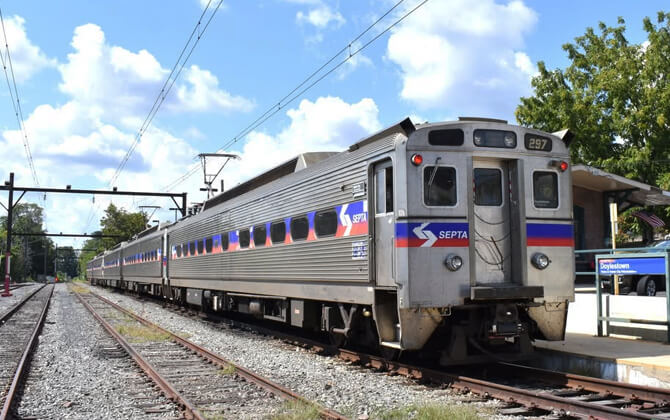
The Lansdale/Doylestown Line is tied into transportation in the Philadelphia region through the Center City Commuter Rail Tunnel. In Center City, riders can connect at Suburban Station, Jefferson Station, Temple University, and 30th Street Station.
As of 2026, most Lansdale/Doylestown Line trains continue through Center City on weekdays to Wilmington or Newark via the Wilmington/Newark Line, and on weekends to Malvern or Thorndale via the Paoli/Thorndale Line. The line also carries freight service and is currently used by the East Penn Railroad for freight.
| Station | Details |
|---|---|
| Temple University | SEPTA Regional Rail connections on all lines |
| North Broad | Regional Rail, SEPTA Metro, and City Bus routes 4, 16, and 54 |
| Wayne Junction | Regional Rail, City Bus routes 2, 23, and 53, and Trackless Trolley 75 |
| Fern Rock Transit Center | Regional Rail, SEPTA Metro, and City Bus routes 4, 28, 57, and 70 |
| Glenside | Regional Rail and City Bus routes 22 and 77 |
| Fort Washington | Route 201 service to and from the Fort Washington Office Center on some trains |
SEPTA Metro includes rail transit and trolley services, but the Lansdale/Doylestown Line itself is not a tramway and does not operate as trams.
Regional Rail Connections in Center City
The line connects Center City Philadelphia with Doylestown and has been directly linked to the ex-PRR/Penn Central side since 1985. This replaced the older setup where trains arrived and departed at Reading Terminal, now part of the Pennsylvania Convention Center.
| Station | Details |
|---|---|
| Jefferson Station | Center City Regional Rail station with downtown access |
| Suburban Station | Major Center City rail and transit hub |
| 30th Street Station | Listed as a Center City connection in SEPTA materials |
| Temple University | Regional Rail connections north of Center City |
| North Broad | Connection point before Wayne Junction and Fern Rock |
| Wayne Junction | Important Regional Rail transfer station |
| Fern Rock Transportation Center | Regional Rail, Metro, and bus connections |
Many trains continue beyond Center City instead of ending there: weekdays to Wilmington or Newark, and weekends to Malvern or Thorndale.
SEPTA Metro and Bus Connections
If Lansdale/Doylestown Line service is unavailable, some stations have alternate service by SEPTA Metro, Regional Rail, or bus. Not every station has a substitute option, so check the station-specific connection before you travel.
- Bus Route 55 provides service toward Olney Transit Center and 15th St/City Hall, with outbound service toward Doylestown Station at some locations.
- Bus Route 132 connects to Lansdale Station, and Bus Route 96 connects to Norristown Transit Center at some stations.
- The Manayunk/Norristown Line can be used for travel to Center City via Norristown Transit Center at some locations.
- Bus Route 94 connects to Chestnut Hill, with onward rail service on the Chestnut Hill East or Chestnut Hill West Line.
- Bus Route 23 connects to Erie Station and continues toward 15th St/City Hall.
- Bus Route 22 provides service to Olney Transit Center and onward travel to 15th St/City Hall.
For trip planning or service questions, SEPTA Customer Service is available by phone at 215-580-7800.
Getting to and from Philadelphia International Airport
There is no direct Lansdale/Doylestown Line train to Philadelphia International Airport. The main public transportation option is to ride Regional Rail into Center City and transfer to the Airport Line.
From Lansdale to Airport Terminal A via Suburban Station, the train trip takes about 1 hour 37 minutes including transfers. Driving is faster, at about 53 minutes over 52.8 km (32.8 miles), with an estimated cost of US$6 to US$9. A taxi takes about 53 minutes and typically costs US$90 to US$120, while a towncar is estimated at US$150 to US$210.
Choose the train if you want the public transit route. Choose driving, taxi, or towncar if you need a more direct trip with luggage.
Transfer Between the Airport Line and the Lansdale Doylestown Line
To travel by rail from Philadelphia International Airport, take the Airport Line from Airport Terminal A to Suburban Station, then transfer to the Lansdale/Doylestown Line. The full trip is listed at about 1 hour 52 minutes, including the transfer.
For the reverse trip, ride the Lansdale/Doylestown Line into Center City, then connect to the Airport Line. Suburban Station is the transfer point named in the provided material.
Parking, Bike Access, and Station Facilities
The line offers station parking, bike access, and accessible station amenities at selected stops. Lansdale is the main park-and-ride location, with a large garage, surface parking, bike parking, and ADA access.
Parking at Lansdale has expanded over time. The station includes a surface lot and a large garage that opened on April 17, 2017. SEPTA reinstated parking fees in 2024: surface lots cost US$2 per day ($2), and garage parking costs US$4 per day ($4). Overnight parking is available.
9th Street Station opened in 2015 as an alternate parking location during garage construction and remains open. It includes accessible high-level platforms, a heated waiting shelter, benches, wayfinding signage, LED lighting, a covered bicycle shelter, landscaping, and a 78-space parking lot.
Park-and-Ride Options
Lansdale is a popular park-and-ride stop for Regional Rail commuters. Parking may include daily spaces, permit spaces, or mixed-use areas, so check posted rules before leaving your car.
The Lansdale Station garage is a major option for drivers, with a 680-space, six-story facility connected to the town center by an overhead covered walkway. You can enter through the station surface lot off Main Street or from Fifth Street between Walnut and Kenilworth Streets.
- Confirm whether your chosen lot is daily, permit, or mixed use.
- Check current parking charges per day, hours, and enforcement rules.
- Use nearby municipal lots if station parking is full.
- Consider bike racks or connecting bus service if parking is tight.
Lansdale Station Garage and Station Lots
Lansdale Station is one of the most important parking points on the line. SEPTA lists 868 total parking spaces, with overnight parking available. Surface lots cost US$2.00 every day from 5 AM to 2 AM, while garages cost US$4.00 daily, 24 hours a day, 7 days a week.
The large garage opened on April 17, 2017 and added space for more than 600 vehicles. During construction, demand shifted partly to 9th Street Station, which opened in 2015 and remains available as part of planned transit-oriented development.
9th Street Station has a permanent lot, a temporary lot, and bicycle storage. Lansdale Station also has bike parking. The station address is 80 W. Main Street, Lansdale, PA 19446.
How to Ride the Lansdale Doylestown Line
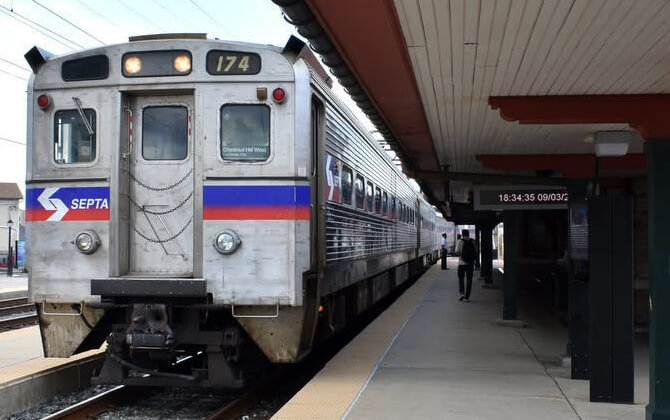
To ride the Lansdale/Doylestown Line, first check the timetable, station times, and any service alerts. Then confirm your fare, tap on with SEPTA Key or contactless payment, and board the correct inbound or outbound train.
Typical stops include Suburban Station, Jefferson Station, Temple University, Wayne Junction, Fern Rock Transit Center, Jenkintown-Wyncote, Glenside, Fort Washington, Ambler, Lansdale, Chalfont, and Doylestown.
A scheduled trip from Suburban Station to Doylestown may take about 102 minutes, depending on the train. Arrive a few minutes early, especially if you need to buy a ticket, use a faregate, or find the correct platform.
If you are boarding at Jefferson Station, the provided material notes that the down escalator at the Convention Center entrance is out of service. Use the elevator or adjoining stairs instead.
Accessibility
SEPTA has improved accessibility at several Lansdale/Doylestown Line stations. In the early 2000s, upgrades added elevated platforms at selected stops to meet ADA accessibility needs.
Further station work followed. Construction began in 2005 on a new Fort Washington station moved 0.09 km (0.06 miles) south. In 2007, work started at North Wales to reconstruct platforms and build a new station on the existing footprint. In 2008, construction began on a new Ambler station across the street from the existing station. All three projects were completed by 2010.
Accessibility can change during maintenance or emergency work. North Broad Station’s ADA high-level platform has been listed as out of service because of emergency track work, with passengers directed to use Temple University or Wayne Junction or contact SEPTA for accessible van service.
ADA-Accessible Stations
Several stations on the line are listed as accessible. Riders should still confirm current station status before traveling, because maintenance work can affect boarding options.
| Station | Details |
|---|---|
| Fort Washington | New station project began in 2005 and was completed by 2010 |
| North Wales | Platform reconstruction began in 2007 and was completed by 2010 |
| Ambler | New station construction began in 2008 and was completed by 2010 |
| Doylestown | Wheelchair accessible and has a 169-space parking lot |
Accessibility Features and Rider Assistance
Accessible stations on the Lansdale/Doylestown Line include 9th Street, 30th Street Station, Ambler, Chalfont, Colmar, Delaware Valley University, Doylestown, Fern Rock Transportation Center, Fortuna, Fort Washington, Jefferson Station, Lansdale, Link Belt, Melrose Park, New Britain, North Broad, North Wales, Pennbrook, Suburban Station, Temple University, and Wayne Junction.
At accessible stations, passengers can use bridge plates where needed. Riders who need help boarding should wait at the front of the platform so the train operator or conductor can assist.
Most Regional Rail cars can accommodate wheelchairs up to 76 cm wide and 122 cm long (30 inches wide and 48 inches long). Larger mobility devices may not fit because of the narrow entryway and sharp turn required. Wheelchair spaces are available on board, but space is limited.
Rules, Safety, and Onboard Etiquette
To keep the ride safe and comfortable, follow SEPTA rules and basic public transit courtesy. Smoking and vaping are not permitted in stations, on platforms, in transit shelters, or on vehicles. Alcohol is forbidden at all times, and gasoline-powered vehicles, mopeds, and motorcycles are not allowed on SEPTA vehicles.
Have the correct fare ready before boarding. Yield designated seats to seniors and riders with disabilities, keep feet and bags off seats, and avoid blocking aisles or doors. Sealed drinks and light snacks are allowed, but hot or processed foods should not be consumed on board.
Keep calls short, speak quietly, and use earbuds or headphones. Let passengers exit before boarding, stand behind the yellow line, stay out of the track area, and do not run for the train. On trains, respect the QuietRide Car where applicable.
Strollers and shopping carts may stay open while riding, boarding, and exiting, but they must not block aisles or doors. Depending on conditions, they may need to be folded.
Brief History
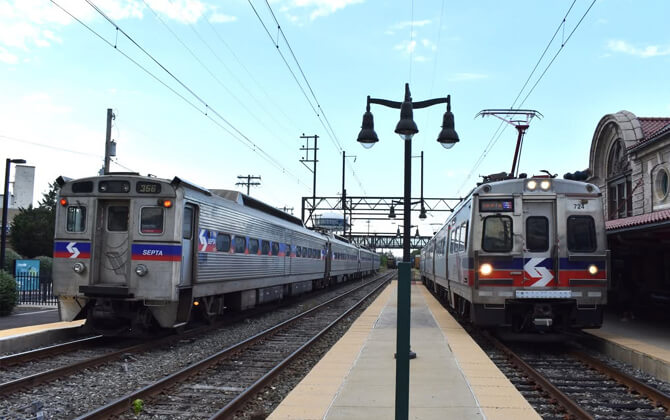
The Lansdale/Doylestown Line traces its history to the mid-19th century, when the North Penn Railroad built a route from Philadelphia toward the Lehigh Valley. Local business owners in Doylestown helped finance a spur to their town, and the junction point chosen by surveyor Philip Lansdale Fox gave rise to the name Lansdale.
The route to Doylestown opened in fall 1857, and the Bethlehem branch entered service in January 1858. Lansdale became an important rail town, with more than 85 trains a day passing through by the late 1880s.
Electrified service between Philadelphia, Hatboro, Lansdale, Doylestown, and West Trenton began on July 26, 1931. Early electric service used dark green multiple-unit cars built by the Reading Railroad, and some were rebuilt in the 1960s with air conditioning and a blue livery that earned them the nickname Blueliners. Today, the line is operated with SEPTA Silverliner EMU equipment.
After World War II, rail service north of Lansdale declined as automobile use increased and the Pennsylvania Turnpike Northeast Extension opened in 1957. SEPTA ended passenger service north of Lansdale on July 29, 1981. Restored service to the Lehigh Valley has been proposed as an expansion idea, but it is not currently planned by SEPTA.
The SEPTA Main Line has been owned by SEPTA since 1983. Since 1985, the route has used the Center City Commuter Rail Tunnel. Between 1984 and 2010, the service was known as R5 Doylestown and R5 Lansdale under SEPTA’s former diametrical naming system.
SEPTA introduced positive train control in stages between 2016 and 2017. During the COVID-19 pandemic, service was truncated to Lansdale on April 9, 2020, and Doylestown service resumed on June 22, 2020.
Service Changes and Future Updates
SEPTA updates Regional Rail schedules four times each year to improve reliability, adjust for capital projects, and respond to service needs. The Lansdale/Doylestown Line has seen changes tied to midday service, weekend service, positive train control, and pandemic-related adjustments.
As of 2026, most trains continue beyond Center City on weekdays to Wilmington or Newark via the Wilmington/Newark Line, and on weekends to Malvern or Thorndale via the Paoli/Thorndale Line. SEPTA also notes that restoring service beyond Lansdale to Quakertown, Bethlehem, and Allentown has been proposed, but is not currently planned.
New Regional Rail schedules are set to take effect on Sunday, July 5, 2026. SEPTA says the updates will include more consistent line pairings, simplified express-stop patterns, more capacity to Penn Medicine Station, and longer trains as more cars become available. For this line, the plan is 8 peak trains in the morning and 8 in the afternoon, with roughly half running express.
- Train pairings are expected to become more consistent.
- Express service should follow a more regular stop pattern.
- Longer trains may add space when more cars are available.
- Riders should check individual schedules because not every station time changes.
- Updated schedules are shown online about one week before the effective date.
Useful Stops and Nearby Attractions
The Lansdale/Doylestown Line links Center City Philadelphia with Bucks County and Montgomery County, so it works for commuters, students, and visitors planning a day trip.
In Center City, Suburban Station, Jefferson Station, and Temple University are the main access points. Jefferson Station sits by Market Street, while Suburban Station is at 16th Street and JFK Boulevard. Temple University connects to several SEPTA services and is a practical starting point for trips across the city.
| Station | Details |
|---|---|
| Temple University | Useful for the university area and multiple SEPTA connections |
| Jefferson Station | Central downtown stop near Market Street |
| Suburban Station | Main downtown rail hub |
| Jenkintown-Wyncote | Well-connected suburban station with bus service |
| Ambler | Convenient stop with local bus links |
| Lansdale | Major intermediate station with several bus connections |
| Doylestown | End of the line and a gateway to the borough and beyond |
Doylestown
Doylestown is the last stop on the Lansdale/Doylestown Line, making it the natural endpoint for riders coming from Center City Philadelphia. In the provided schedules, trains reach Doylestown after Lansdale, Chalfont, New Britain, and Delaware Valley University.
A typical weekday example shows a train leaving Suburban Station at 5:54 AM and arriving in Doylestown at 7:36 AM. The line runs every day, with regular working hours generally listed from 5:54 AM to 11:35 PM on weekdays and from 6:44 AM to 11:44 PM on weekends in the provided material.
Lansdale and Ambler
Ambler and Lansdale are two important intermediate stops. Ambler was known as Wissahickon until 1869, when it was renamed after Mary Johnson Ambler, a local hero who helped in the Great Train Wreck of 1856. Lansdale connects with SEPTA Suburban Bus routes 96 and 132.
| Station | Details |
|---|---|
| Ambler | SEPTA Suburban Bus routes 94 and 95; renamed from Wissahickon in 1869 |
| Lansdale | SEPTA Suburban Bus routes 96 and 132; major parking and transfer location |
Construction began in 2008 for a new Ambler station across the street from the existing station, showing the stop’s continued importance on the route.
Center City Philadelphia
The line connects Center City Philadelphia with Doylestown and is one of SEPTA Regional Rail’s busiest routes. In Center City, trains use the Center City Commuter Rail Tunnel, allowing many trips to continue beyond downtown.
For trips into Center City, SEPTA trains run from Lansdale to Jefferson Station in about 52 minutes, with hourly service every day in the provided material. The main city stops include Jefferson Station, Suburban Station, Temple University, North Broad, Wayne Junction, and Fern Rock Transit Center.
Driving between the Lansdale/Doylestown Line area and Center City is listed at about 34 minutes over roughly 39.4 km (24.5 miles). Bus travel is available but takes longer.
| Station | Details |
|---|---|
| Jefferson Station | Downtown stop with SEPTA and bus connections |
| Suburban Station | Major Center City rail stop |
| Temple University | Useful for the university area |
| North Broad | Local access near the city core |
FAQ
These answers cover the most common rider questions about the Lansdale/Doylestown Line route, fare, schedule, airport transfer, bike access, and parking.
Is the Lansdale Doylestown Line a commuter rail line?
Yes. The Lansdale/Doylestown Line is a SEPTA Regional Rail commuter rail line connecting Center City Philadelphia to Doylestown in Bucks County, Pennsylvania. It serves 25 stations and carried 9,257 average weekday riders in FY 2024.
It is also described as a 56.3 km (35-mile) commuter rail line serving residents of Bucks and Montgomery counties.
How do I get from Doylestown to Center City Philadelphia?
The train is the best option without a car. SEPTA operates direct rail service from Lansdale to Jefferson Station hourly in the provided material, with a journey time of about 52 minutes.
Driving is the fastest road option, taking about 34 minutes over 39.4 km (24.5 miles). A taxi takes about the same time but costs more. Bus travel via line 96 and line 124 takes about 2 hours and 13 minutes.
- Train: about 52 minutes from Lansdale to Jefferson Station
- Drive: about 34 minutes over 39.4 km (24.5 miles)
- Taxi: about 34 minutes
- Bus: about 2 hours 13 minutes via line 96 and line 124
Do I need to tap out when using SEPTA Regional Rail?
Yes. SEPTA Regional Rail uses tap on and tap off payment. Tap when you begin your trip and tap again when you exit at your destination.
Depending on the station, you may tap at a faregate or platform validator. Tapping off helps calculate the correct fare. If you do not tap out, SEPTA may charge the maximum fare, and failure to tap out is not eligible for refund or credit requests under the stated policy effective 10/1/24.
Does the Lansdale Doylestown Line go to Philadelphia International Airport?
No. There is no direct Lansdale/Doylestown Line train to Philadelphia International Airport. Riders must transfer in Center City, typically at Suburban Station or Jefferson Station, and continue on the Airport Line.
The train trip usually takes about 1 hour 37 minutes including transfers. Driving takes about 53 minutes in normal conditions.
Can I bring a bike on the Lansdale Doylestown Line?
Bike access is supported at selected stations through bike racks and bicycle storage. Lansdale and 9th Street Station both have bike parking noted in the provided material.
If you ride to the station, confirm where to lock your bike before traveling. For early or rainy trips, lights, reflective gear, and weather protection are practical.
Where can I park along the Lansdale Doylestown Line?
Parking is available at several stations, including Colmar, Pennbrook, North Wales, 9th Street, and Lansdale. Lansdale has the largest parking setup, including a garage and surface lots.
At Lansdale, SEPTA lists 868 total parking spaces and overnight parking. Surface lots cost US$2 per day ($2), and garage parking costs US$4 per day ($4). Colmar is noted for available parking near Route 309, and 9th Street Station remains open as an alternate parking location.