The Broad Street Line, now branded by SEPTA Metro as the B, is a rapid transit route in Philadelphia, Pennsylvania. It runs mainly north and south under Broad Street from Fern Rock Transit Center in North Philadelphia to NRG Station in South Philadelphia, with the Broad-Ridge Spur branching toward 8th Street. The line is part of public transport and city transport in Philadelphia, is operated by SEPTA, and is owned by the City of Philadelphia.
Opened on September 1, 1928, the line remains one of SEPTA’s busiest rapid transit routes. It has 24 stations, a mostly underground route, local and express tracks on much of the northern section, and service patterns for Local, Express, and Spur trains.
| Key | Information |
|---|---|
| Type | Rapid transit |
| System | SEPTA Metro |
| Location | Philadelphia, Pennsylvania, United States |
| Owner | City of Philadelphia |
| Operator | SEPTA |
| Stations | 24 |
| Opened | September 1, 1928 |
| Last extension | April 8, 1973 |
| Line length | 20.1 km / 12.5 mi |
| Daily ridership | 79,155 in FY 2023 |
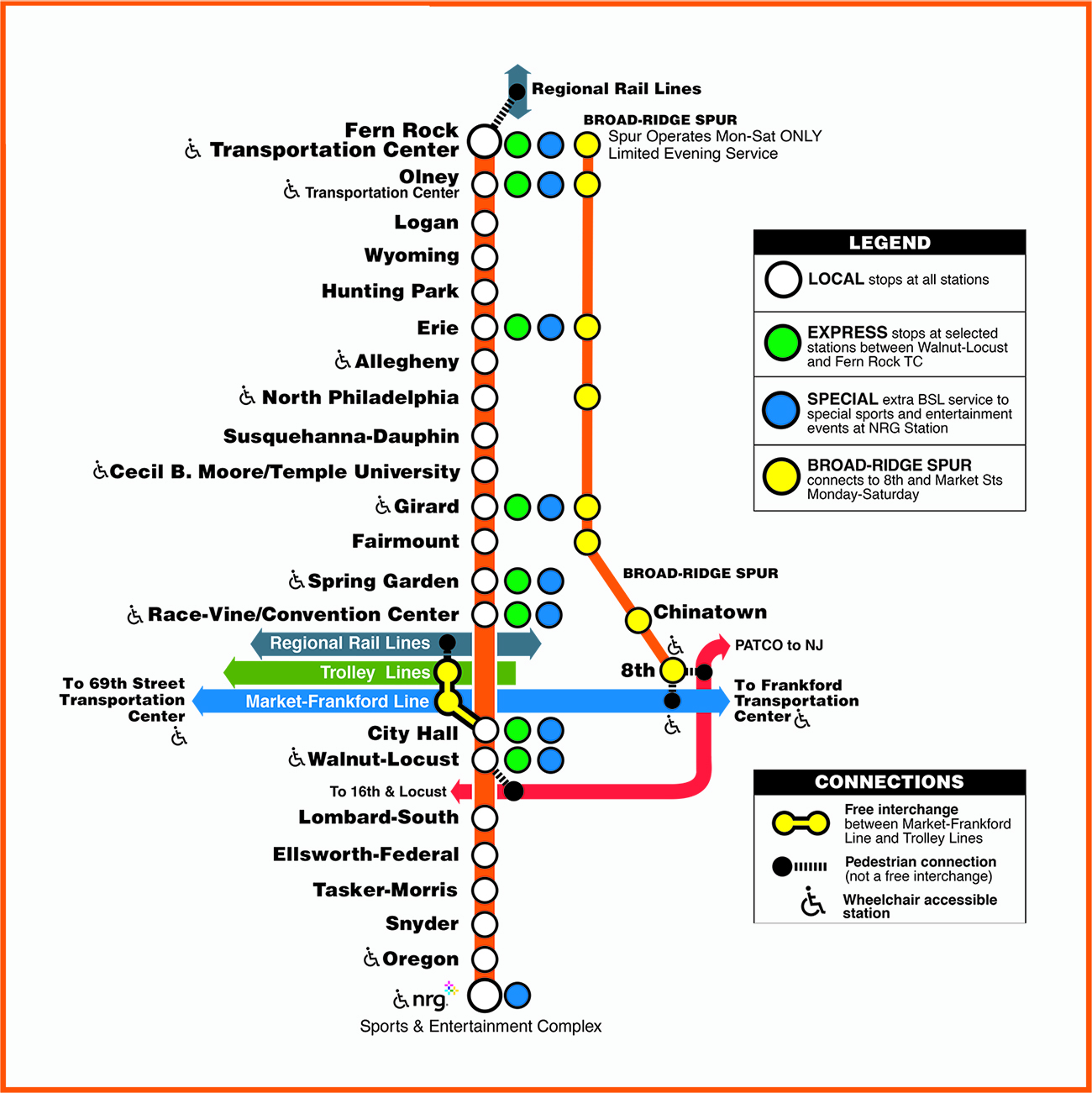
Broad Street Line Map
The Broad Street Line map shows all available stops. Click on the map to enlarge it or download the Broad Street Line map in PDF format.
Lines and Stations
The Broad Street Line route runs from Fern Rock Transit Center to NRG Station, with the Broad-Ridge Spur splitting from the main subway at Fairmount and continuing toward 8th Street. For trip planning, the route plan is simple: B1 Local serves the full main line, B2 Express serves selected weekday stops, and B3 serves the Ridge Spur.
The subway is underground almost everywhere except Fern Rock Transit Center. Between Fern Rock and Walnut-Locust, the line uses four tracks for local and express service. South of Walnut-Locust, it uses two tracks. Station layouts vary: local stations generally use side platforms, express stations use island platforms, and the two-track sections use simpler platform arrangements.
Use a stations map with the stations list below if you are choosing between local, express, and spur trains.
| Station | Details |
|---|---|
| Fern Rock Transit Center | Northern terminal, surface-level station, depot area, Regional Rail connections |
| Olney Transit Center | Important northern terminal for selected weekday and limited evening service |
| Logan | Main line station in North Philadelphia |
| Wyoming | Main line station in North Philadelphia |
| Hunting Park | Main line station; accessibility design work has advanced |
| Erie | Main line station and useful North Philadelphia stop |
| Allegheny | Main line station with accessible transfer information noted by SEPTA |
| North Philadelphia | Transfer area for SEPTA Regional Rail, Amtrak, and bus connections |
| Susquehanna-Dauphin | Main line station with completed accessibility renovation |
| Cecil B. Moore | Closest Broad Street Line stop for Temple University |
| Girard | Express stop and important North Broad station |
| Fairmount | Junction area where the Broad-Ridge Spur diverges |
| Spring Garden | Main line and spur service area; useful for northern Center City trips |
| Race-Vine | Useful for the Pennsylvania Convention Center area |
| City Hall | Major Center City interchange with the Market-Frankford Line and trolley routes |
| Walnut-Locust | Center City stop for the Avenue of the Arts and PATCO pedestrian access |
| Lombard-South | South Center City station |
| Ellsworth-Federal | South Philadelphia station |
| Tasker-Morris | South Philadelphia station with accessibility work underway |
| Snyder | South Philadelphia station with bus connections |
| Oregon | South Philadelphia station |
| NRG Station | Southern terminal for the Sports Complex |
| Chinatown | Broad-Ridge Spur station |
| 8th and Market | Broad-Ridge Spur terminal with Market-Frankford Line and PATCO connections |
B1 Local Service
B1 is the Broad Street Line local service. It runs between Fern Rock Transit Center and NRG Station and serves all 22 main line stops along the route.
Typical B1 operating hours are about 5:00 am to midnight, with replacement bus service overnight. The scheduled running time is about 40 minutes. On weekdays, trains run every 8 minutes or better between 7:00 am and 6:00 pm, and every 15 minutes or better at most other times except the first and last hours of weekend rail service.
- Route: Fern Rock Transit Center to NRG Station
- Service pattern: local
- Stops served: all 22 main line stops
- Typical running time: about 40 minutes
- Overnight service: replacement bus service
B2 Express Service
B2 is the Broad Street Line express service. It operates between Fern Rock Transit Center and Walnut-Locust, serving eight stops and skipping local stations on the four-track section.
B2 runs on weekdays only, approximately 6:00 am to 10:00 am and 2:00 pm to 6:00 pm. During those timings, trains operate every 15 minutes or better, with frequency of about 7 minutes or better at peak times. The scheduled running time is about 20 minutes.
B2 Special service also operates for events at the South Philadelphia Sports Complex. It runs between Walnut-Locust and NRG without intermediate stops.
B3 Broad-Ridge Spur
B3 is the Broad-Ridge Spur. It leaves the Broad Street Subway at Fairmount and runs southeast under Ridge Avenue and 8th Street to 8th and Market.
B3 service operates between Olney and 8th Street, serving eight stops. It runs Monday through Saturday from about 6:00 am to 9:00 pm, with some Saturday service and a small number of weekday trains terminating at Fern Rock. Headways range from about 7 minutes during weekday peak periods to about 20 minutes on Saturdays. Scheduled running time is about 16 to 19 minutes.
The spur uses two-car trains, though platforms can accommodate up to five cars. Its main role today is to give riders a shortcut to 8th and Market while using the main line express tracks before branching off.
| Station | Details |
|---|---|
| Fairmount | Branch point from the main Broad Street Subway |
| Spring Garden | Served by the spur and useful for northern Center City access |
| Chinatown | Broad-Ridge Spur station near Chinatown |
| 8th and Market | Spur terminal with transfers to the Market-Frankford Line and PATCO Speedline |
Major Stations for Visitors and Commuters
The most useful stations for many riders are Fern Rock Transit Center, Olney Transit Center, City Hall, Walnut-Locust, 8th and Market, and NRG Station. These stops cover commuter access, Center City transfers, visitor destinations, and major event travel.
| Station | Details |
|---|---|
| Fern Rock Transit Center | Northern end of the main line and the only surface-level station |
| Olney Transit Center | Major northern terminal for selected weekday and evening service |
| City Hall | Central downtown station and key transfer point |
| Walnut-Locust | Useful for hotels, dining, the Academy of Music, and the Kimmel Center |
| 8th and Market | Important Broad-Ridge Spur and downtown transfer station |
| NRG Station | Main stop for Lincoln Financial Field, Citizens Bank Park, and the arena complex |
| Cecil B. Moore | Best subway stop for Temple University |
| Race-Vine | Useful for the Convention Center area |
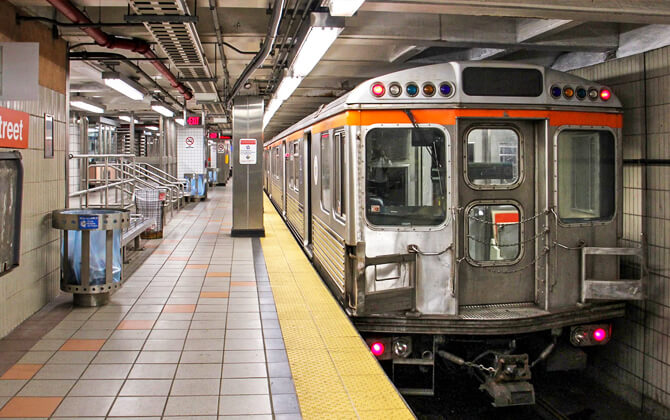
Schedule, Frequency, and Real-Time Updates
The Broad Street Line schedule is published by service pattern, but live trip data is not available for this line. If you need timings today or the schedule today, check the timetable and station-specific departures before you travel.
In general, rail service starts around 5:00 am and runs until about midnight, with some schedules showing later trips. Overnight periods are covered by replacement buses. The exact starting time, closing time, and last train can vary by direction and service pattern.
| Service detail | Timings |
|---|---|
| B1 Local operating hours | Daily, about 5:00 am to midnight |
| B1 frequency | Every 8 minutes or better on weekdays from 7:00 am to 6:00 pm; every 15 minutes or better at most other times |
| B1 running time | About 40 minutes |
| B2 Express opening times | Weekdays only, about 6:00 am to 10:00 am and 2:00 pm to 6:00 pm |
| B2 frequency | Every 15 minutes or better, with about 7 minutes or better at peak hours |
| B2 running time | About 20 minutes |
| B3 Spur working hours | Monday through Saturday, about 6:00 am to 9:00 pm |
| B3 frequency | About 7 minutes at weekday peaks to about 20 minutes on Saturdays |
| B3 running time | About 16 to 19 minutes |
| Late-night service | Replacement bus service instead of trains |
SEPTA service alerts and transit apps can help with disruptions, but the draft information notes that live trip data is not available for the Broad Street Line. For the most reliable train schedule, use the published route timetable and check station signs before boarding.
Weekday and Weekend Service
Weekday and weekend opening hours vary by service type. Local trains provide the core service, while express and spur services have more limited timings.
| Service detail | Timings |
|---|---|
| General train service | Approximately 5:00 am to 1:00 am in some schedules |
| Timed late-night transfer at City Hall | About 12:30 am, coordinated with final Market-Frankford Line trains |
| Local weekday daytime frequency | 8 minutes or less |
| Local evening frequency | About 12 minutes |
| Local weekend and major holiday frequency | About 10 to 12 minutes |
| Weekend night frequency | About 20 minutes |
| Weekday early-morning Owl bus frequency | About 15 minutes |
| Express frequency | About 7 minutes at peak hours and 12 minutes off-peak |
| Broad-Ridge Spur frequency | About 7 minutes at peak hours and 20 minutes off-peak |
| Northbound rail service | About 4:52 am to 12:55 am |
| Southbound rail service | About 4:45 am to 12:43 am |
| Northbound night Owl bus | About 12:22 am to 5:35 am |
| Southbound night Owl bus | About 12:14 am to 5:34 am |
| Northbound spur service | Weekdays about 5:45 am to 9:15 pm; Saturdays about 6:40 am to 9:26 pm |
| Southbound spur service | Weekdays about 5:24 am to 8:48 pm; Saturdays about 6:17 am to 9:03 pm |
A full local trip along the line takes roughly 35 to 40 minutes depending on the schedule used. Express service is faster when it is operating, but it does not serve every station.
Late-Night Service
Late-night service is handled differently from daytime service. Overnight rail service was restored on a trial basis in June 2014, made permanent in October 2014, and later replaced again by buses in 2020.
Today, riders should expect replacement bus service overnight instead of subway trains. Local service provides the core late-night coverage, while express service does not run overnight.
| Service detail | Timings |
|---|---|
| Overnight subway service | Replaced by buses |
| Weekend overnight rail service | Previously available, then suspended again in 2020 |
| Late-night main option | Local service and replacement bus coverage |
| Express overnight service | Not available |
Because late-night operating hours have changed over time, always check the current timetable before traveling after midnight.
Fares, Tickets, and Payment Methods
SEPTA offers several fare and ticket options for the Broad Street Line. Riders can pay with a SEPTA Key card, contactless credit or debit card, Apple Pay, Google Pay, or Samsung Pay. Quick Trip tickets are available for single rides from Metro fare kiosks.
SEPTA Key is a reloadable contactless card that can hold passes and Travel Wallet funds. You can buy and reload it at fare kiosks, select retail locations, online, or through the SEPTA App. Cash is also accepted on SEPTA services, and exact fare is required for transit trips.
Quick Trips are valid for one one-way ride on the Broad Street Line, Market-Frankford Line, Trolleys, and Norristown High Speed Line. They are valid on the day purchased until 2:00 am the next day and are not valid on bus rides.
For most Broad Street Line trips, you do not need a fare calculator: the subway price is handled by the standard SEPTA transit fare system. Still, check SEPTA fare information before you ride if you plan to combine Metro, bus, Regional Rail, or New Jersey travel.
SEPTA Key, Contactless Payment, and Quick Trips
Contactless payment works on SEPTA bus, Metro, and Regional Rail services. Tap the card or mobile wallet you want charged, and keep other cards away from the reader to avoid card clash.
A SEPTA Key card costs US$4.95, which is refunded to your Travel Wallet if you register the card within 30 days. After registration, you can load Daily, Weekly, or Monthly Passes and Travel Wallet value, set up auto-load, review trip history, or report a lost or stolen card.
| Payment option | What it is used for |
|---|---|
| Contactless payment | Tap a credit or debit card, Apple Pay, Google Pay, or Samsung Pay |
| SEPTA Key | Reloadable card for passes and Travel Wallet funds |
| Quick Trip | Single one-way ride on select Metro services |
| Cash | Accepted on SEPTA services; exact fare required for transit trips |
Multi-rider contactless payment is available on SEPTA services, but it is not available for travel to or from New Jersey.
Transfers and Multi-Rider Payment
Transfers depend on the service you are using. Riders can connect between the Broad Street Line and the Market-Frankford Line at City Hall. PATCO riders from New Jersey can use 12th/13th and Locust and walk to Walnut-Locust. Regional Rail riders can connect through Center City or use Fern Rock Transportation Center.
SEPTA’s Multi-Rider feature lets up to five passengers traveling together pay with one SEPTA Key Card. The feature must be activated through SEPTA Key customer channels before use.
SEPTA also lists passes including a Convenience Pass for US$6, a Neighborhood Flex Pass for US$10, and an Anywhere FleX Pass for US$13. These pass options are useful if your trip includes repeated rides on local transport during the same travel period.
Reduced Fares and Free Ride Categories
Riders with disabilities may apply for a Reduced Fare card. Once Travel Wallet funds are added, the card provides half-fare travel on SEPTA service and includes two free transfers on buses and SEPTA Metro within 120 minutes of the first tap.
Reduced Fare cards can be used at fareboxes, turnstiles, and on Regional Rail with tap-on and tap-off procedures. Funds can be added at SEPTA Sales Offices, fare kiosks, select bus loops, Center City Regional Rail stations, by phone, or online with a credit or debit card.
SEPTA Reduced Fare cards require renewal, and the expiration date is printed on the card. Appointments are encouraged, while walk-ins are accepted Monday through Friday from 8:00 am to 4:45 pm.
- Phone appointments: 215-580-7145, press 6
- Bring a completed application to SEPTA Headquarters or the SEPTA Accessible Travel Center at Suburban Station
- Medicare Cards are no longer accepted for free or reduced fares
SEPTA also provided free Broad Street Line rides for registered Blue Cross Broad Street Run participants on race day with an official 2024 race bib and competitor number.

Connections with Other Transit Systems
The Broad Street Line is one of the core rapid transit routes in transportation in Philadelphia. It links subway riders to the Market-Frankford Line, trolleys, Regional Rail, PATCO, NJ TRANSIT bus routes, and SEPTA bus services.
City Hall is the key interchange for the Market-Frankford Line and trolley routes. Walnut-Locust gives riders a pedestrian connection to PATCO, though it is outside the paid area and does not provide a free transfer. The Broad-Ridge Spur adds another useful connection at 8th and Market.
Market-Frankford Line, Trolleys, and Regional Rail
At 15th Street/City Hall, riders can connect between the Broad Street Line, the Market-Frankford Line, and trolley routes. In Philadelphia, these trolley services are often similar to trams or tramway-style city transport, though SEPTA uses the trolley name.
The Market-Frankford Line also connects to major multimodal hubs. At 69th Street Transportation Center, riders can reach trolley routes, the Norristown High Speed Line, and bus services. At Frankford Transportation Center, bus and trackless trolley routes connect with the eastern end of the line.
Regional Rail connects with the subway network through Center City and at Fern Rock Transportation Center. Center City’s rail network links 30th Street Station, Suburban Station, and Jefferson Station, making transfers possible with a short walk or connecting ride.
- 15th Street/City Hall: central interchange for the Market-Frankford Line, trolleys, and the Broad Street Line
- 69th Street Transportation Center: trolley, Norristown High Speed Line, and bus connections
- Frankford Transportation Center: bus and trackless trolley connections
- Fern Rock Transportation Center: Broad Street Line and Regional Rail connections
PATCO and NJ TRANSIT Connections
PATCO connects Center City Philadelphia with New Jersey and offers useful onward links. In Philadelphia, PATCO connections are available around 8th and Market, where NJ TRANSIT bus routes 400, 404, 406, 414, 417, and 555 are listed among nearby options.
In Camden, Broadway Station is also Walter Rand Transportation Center, a major transfer point for PATCO, NJ TRANSIT buses, and the River LINE. Farther south, Lindenwold connects PATCO with NJ TRANSIT’s Atlantic City Rail Line and bus routes 403, 459, and 554.
PATCO also lists NJ TRANSIT bus connections at several New Jersey stations, including Collingswood, Westmont, and Haddonfield. Woodcrest and Ashland do not have NJ TRANSIT bus connections listed.
Bus Connections Along Broad Street
Broad Street has strong bus connections, so the subway works well with local transport beyond the rail corridor.
- Route 4 follows Broad Street for much of its trip, running between South Philadelphia and North Philadelphia before continuing toward Fern Rock Transportation Center.
- Route 16 follows Broad Street from City Hall north to Cheltenham Avenue and then to the Cheltenham-Ogontz Bus Loop.
- At Snyder, riders can connect with routes G, 7, and 68.
- At Walnut-Locust, routes 9, 12, 21, and 42 connect westbound.
- At Spring Garden, Route 43 runs along Spring Garden Street.
- At North Philadelphia, routes H, XH, 23, 53, and 56 connect to the station area.
Getting to and from Philadelphia International Airport
The Broad Street Line does not run directly to Philadelphia International Airport. For the simplest public transit trip, use SEPTA’s Airport Line between the airport and Center City, then transfer to the subway, bus, or walk to your final destination near Broad Street.
The Airport Line runs from Airport Terminal A to Suburban Station every 30 minutes. The trip takes about 24 minutes, with a broader downtown estimate of about 25 to 30 minutes.
At PHL, follow SEPTA signs to the Airport Line platforms on the lower level near baggage claim. Trains display final stops on destination boards, so check before boarding. You can use a SEPTA Key Card or buy a one-way ticket from platform vending machines, which accept cards and cash.
| Option | Details |
|---|---|
| Airport Line | About 24 minutes to Suburban Station; trains every 30 minutes |
| Taxi | About 15 minutes; US$26 to US$32 |
| Drive | About 15 minutes; 12.9 km / 8 mi; estimated cost US$2 to US$3 |
| Towncar | About 15 minutes; US$90 to US$130 |
| Shuttle | About 16 minutes; US$40 to US$60 |
| Bus | Routes 37 and 4 can take about 1 hour 4 minutes; cost US$6; no direct bus |
The airport is also served by bus routes 37, 108, and 115. If you want the most straightforward transit route, take the Airport Line to Center City and connect from there.
Parking and Park-and-Ride
Parking near Broad Street is easiest to manage if you compare garages before you go, especially in Center City. Garages are often preferable to street parking or open lots, but prices can vary. Parking farther out and finishing the trip by subway can be less stressful on busy days.
For station parking, SEPTA charges daily-use fees at many lots and garages. Typical parking charges are US$2 per day for surface lots and US$4 per day for garages. Monthly permit parking remains suspended until further notice.
Some Broad Street Line stations offer park-and-ride access. Broad and Spring Garden and Girard are express stops with free parking on Sundays. In South Philadelphia, street parking near stations such as Snyder, Tasker, or Federal may be possible, but always check signs and local restrictions.
Parking can fill early during major events, and Broad Street may be affected by crowds or road closures. On game days, parking a little farther away and using the train can be the easier move.
How to Pay for SEPTA Parking
Daily-use parking fees apply at most Regional Rail stations and at select Broad Street Line, Media-Sharon Hill Line, Market-Frankford Line, and Norristown High Speed Line stations. Surface lot station parking costs US$2 per day, and garage parking costs US$4 per day. These are the standard parking charges per day, including weekends and holidays.
- SEPTA Park app: pay for parking on a mobile device after free registration
- Text to pay: text your Station ID to 727563
- Kiosks: pay with credit or debit card, contactless payment, or coins
Most SEPTA lots have striped and numbered daily-use spaces. Pull into a space, do not back in, and pay for the time you need. Overnight parking is charged at the daily-use rate for up to 14 days. If you pay in advance and leave, your space is not guaranteed.
Tips for First-Time Riders

If this is your first time riding the Broad Street Line, get your fare ready before you head to the platform. A SEPTA Key card is the easiest option for repeat travel, while Quick Trip tickets work for a single ride.
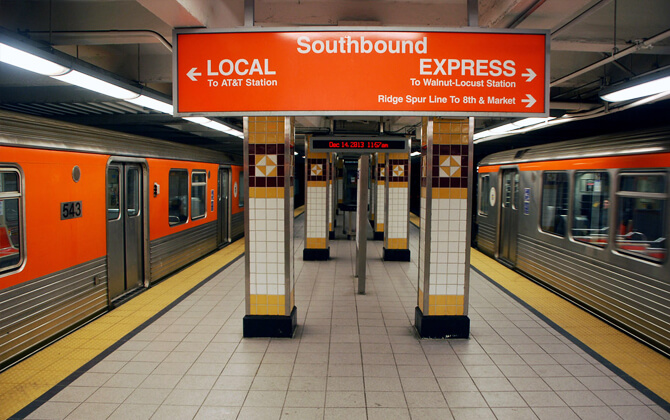
Look for the station entrance and check directional signs before going down to the platform. Northbound and southbound platforms are clearly marked, and express trains do not stop everywhere, so confirm the service before you board.
On the platform, stand back from the edge and let riders exit before boarding. Inside the train, listen for announcements and watch station signs. If you are unsure, use the route map, stations map, or posted schedule to stay oriented.
- Arrive early during rush hours, games, and special events
- Check whether you need Local, Express, or Spur service
- Use station signs to confirm the right platform
- Check the timetable if you are riding late at night
- Keep your payment card separate from other cards when tapping
Accessibility and Station Facilities
The Broad Street Line is being upgraded through a long-term accessibility program. SEPTA has prioritized elevator installation, platform work, new signage, improved lighting, security cameras, waterproofing, and other station renovations.
Susquehanna-Dauphin Station has been made fully accessible. Work is underway at Tasker-Morris, and design work has advanced for Logan, Wyoming, and Hunting Park. SEPTA has said its broader goal is to make all Broad Street Line and Market-Frankford Line stations accessible.
As of the latest information in the draft, 13 of the 25 Broad Street Line stations are fully ADA accessible. Listed accessible stations include 8th and Market, Allegheny, AT&T Station, Cecil B. Moore, Fern Rock Transportation Center, Girard, North Philadelphia, Oregon, Race-Vine, Spring Garden, and Walnut-Locust. Many stations still rely on stairs, so check station facilities before you travel if elevators are required.
Other improvements include LED lighting, upgraded finishes, electronic service signage, and fare-line modifications. These changes aim to make stations safer, easier to navigate, and more comfortable.
Safety, Rules, and Passenger Etiquette
To keep your trip safe, stand behind the yellow strip, avoid crowding platform entrances, and stay aware of your surroundings. When the train arrives, let other riders get off first before boarding.
On crowded trains or buses, move away from the doors if you are not getting off at the next stop. Give priority seating to older riders and riders with disabilities, and make room for wheelchairs and strollers in designated areas.
Keep bags on your lap or on the floor, keep feet off seats, and use headphones for music or podcasts. Do not smoke or vape, graffiti property, or eat on the train. Drinks should be covered, and alcoholic beverages should not be consumed while riding.
SEPTA asks riders to report suspicious activity. Use the SEPTA Transit Watch app, call SEPTA Transit Police at 215-580-8111, or text 215-235-1911.
Never move between railcars while a train is moving. If someone falls onto the tracks, do not jump down. The third rail is dangerous, and only SEPTA personnel should enter the track area.
Brief History and Name Changes
The Broad Street Line began service on September 1, 1928, between City Hall and Olney Avenue. The subway tunnel had already been built farther south to near today’s Lombard-South area, but service reached that area later. Lombard-South entered service in 1932, and service to Snyder Avenue began on September 18, 1938.
Fern Rock opened as a park-and-ride station in 1956. In 1973, the line was extended to Pattison Avenue to serve the Sports Complex. The four-track local and express sections reflect early planning for future capacity and expansion.
SEPTA took over operation from the Philadelphia Transportation Company in 1968. The line ran 24 hours a day until 1991. Overnight service returned on June 20, 2014, as a Friday and Saturday trial, and became permanent on October 8, 2014.
On February 24, 2025, SEPTA rebranded the Broad Street Line as the B under its Wayfinding Master Plan. Local service became B1, express and special service became B2, and the Broad-Ridge Spur became B3. The Pattison Avenue terminal was later renamed NRG Station through sponsorship naming.
Future Expansions and Improvements
SEPTA’s future work on the Broad Street Line focuses on reliability, accessibility, security, and easier wayfinding. Planned improvements include essential infrastructure work, station upgrades, and investments that support more dependable service.
Accessibility remains a major priority. SEPTA is continuing projects at stations such as Susquehanna-Dauphin and Tasker-Morris, with a long-term goal of making all Broad Street Line and Market-Frankford Line stations accessible. SEPTA has also said transformational investments could bring 99% of SEPTA Metro trips through an accessible station by 2035, compared with 61% today.
Operational improvements include new vehicles and an upgraded signal system to support better reliability and higher service frequency. SEPTA is also rolling out clearer maps, station signage, neighborhood maps, mobile information, and real-time communication tools where available.
Longer-term expansion ideas have included extensions toward Roosevelt Boulevard and the Philadelphia Naval Yard. These remain future concepts rather than active projects.
Nearby Attractions and Important Destinations
The Broad Street Line is useful for sports, culture, universities, restaurants, and neighborhood destinations. NRG Station serves the South Philadelphia Sports Complex, including Lincoln Financial Field, Citizens Bank Park, and the Wells Fargo Center area. The American Swedish Historical Museum and FDR Park are also near the southern end of the line.
In Center City, Walnut-Locust is convenient for the Avenue of the Arts, the Kimmel Center for the Performing Arts, the Academy of Music, restaurants, hotels, and nightlife. City Hall is a major downtown stop and transfer point.
Lombard-South is useful for Philadelphia’s Magic Gardens. Ellsworth-Federal is near Pho 75 and the Asian shops and restaurants at Wing Phat Plaza. Farther north, Olney is associated with MUTA Korean BBQ & Karaoke, and Erie is the closest stop for Max’s Steaks.
Race-Vine is close to the Pennsylvania Convention Center, the Pennsylvania Academy of the Fine Arts, and Hahnemann University Hospital. Cecil B. Moore serves Temple University and the Temple Performing Arts Center, while North Philadelphia is useful for Joe Frazier’s Gym.
Center City and Convention Center
The Broad Street Line reaches the heart of Center City Philadelphia. Useful stops include City Hall for downtown transfers, Walnut-Locust for the Gayborhood and Midtown Village, and Race-Vine for the Convention Center area.
For the Pennsylvania Convention Center, riders can also use Jefferson Station on Regional Rail or take the Broad Street Line to City Hall. The Market-Frankford Line, Broad Street Line, and trolley lines serve nearby Center City stations with frequent service.
City Hall is also a good transfer point for buses heading toward Benjamin Franklin Parkway, the Barnes Foundation, and the Philadelphia Museum of Art.
Temple University and North Broad
Temple University’s Main Campus is centered in the Cecil B. Moore neighborhood and sits along Broad Street, making the Broad Street Line one of the most useful ways to get there.
Cecil B. Moore Station is the closest subway stop for Temple University. The area also connects to Regional Rail through Temple University Station at 10th and Berks streets and North Broad Street Station at Broad Street and West Huntingdon Street.
- Subway: Cecil B. Moore Station on the Broad Street Line
- Regional Rail: Temple University Station and North Broad Street Station
- Bus: SEPTA routes 3, 4, and 16
- Additional rail access: North Philadelphia Station for Amtrak and SEPTA services
Nearby Broad Street Line stations include North Philadelphia and Hunting Park, making North Broad a practical corridor for students, visitors, and event-goers.
South Philadelphia Stadium District
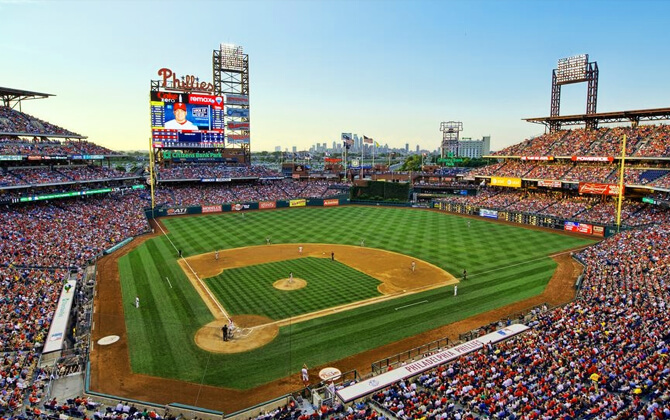
NRG Station is the Broad Street Line stop for the South Philadelphia Sports Complex. From the station, riders can reach Lincoln Financial Field, Citizens Bank Park, and the surrounding arena complex on Pattison Avenue.
For major events, SEPTA operates B2 Special trains that run without stops between Walnut-Locust and NRG. B1 Local trains also serve NRG Station and make all stops.
The station remains the main transit gateway for South Philadelphia sports and entertainment trips.
FAQ
Is the Broad Street Line the same as the B?
Yes. SEPTA officially rebranded the Broad Street Line as the B on February 24, 2025. You may still see the older name during the transition.
The services are numbered under the new system: B1 is Local, B2 is Express and special service, and B3 is the Broad-Ridge Spur.
Which Broad Street Line train should I take?
Take B1 Local if you need any main line station between Fern Rock and NRG. Take B2 Express if it is running and you are traveling between express stops, especially during weekday peak periods. Take B3 if you are going to the Broad-Ridge Spur or 8th and Market.
- B1 Local: Fern Rock Transit Center to NRG Station, all main line stops
- B2 Express: Fern Rock Transit Center to Walnut-Locust, weekdays during rush periods
- B3 Spur: Olney or Fern Rock to 8th Street via the Ridge Spur
Does the Broad Street Line run to Philadelphia International Airport?
No. The Broad Street Line does not run to Philadelphia International Airport. Use the SEPTA Airport Line for direct rail service between the airport and Center City, then transfer if your destination is near Broad Street.
Common Center City Regional Rail transfer points include 30th Street Station, Suburban Station, and Jefferson Station.
Which station serves the stadiums?
NRG Station at Pattison Avenue serves the South Philadelphia Sports Complex. It is the southern terminal of the line and is about 0.4 km / 0.25 mi from the complex.
From NRG Station, riders can reach Lincoln Financial Field, Citizens Bank Park, and the arena complex area. B2 Special trains may run for major events.
Can I transfer to Regional Rail from the Broad Street Line?
Yes. Fern Rock Transportation Center offers a transfer between the Broad Street Line and Regional Rail. A separate fare may be required unless your pass covers both services.
In Center City, Regional Rail stations are also reachable from the Broad Street Line through nearby subway and concourse connections.
Is the Broad Street Line accessible?
Some Broad Street Line stations are wheelchair accessible, but not all. SEPTA notes that trains are wheelchair accessible and include designated seating areas, while several stations still depend on stairs.
Accessible stations listed in the draft include 8th and Market, Allegheny, AT&T Station, Cecil B. Moore, Fern Rock Transportation Center, Girard, North Philadelphia, Oregon, Race-Vine, Spring Garden, and Walnut-Locust. SEPTA is continuing elevator and station renovation projects with the long-term goal of improving accessibility across the line.