Amtrak’s Texas Eagle is a long-distance passenger train in the U.S. public transport network, running daily between Chicago and San Antonio and continuing three days per week between San Antonio and Los Angeles. The full Chicago-Los Angeles route covers 2,728 miles (4,390 km), making it the longest passenger train route in the United States. It serves 43 stations across the Midwest, South, Southwest, and West, with major stops including St. Louis, Little Rock, Dallas, Fort Worth, Austin, San Antonio, El Paso, Tucson, and Los Angeles.
| Key | Information |
|---|---|
| Train name | Amtrak Texas Eagle |
| Main daily route | Chicago to San Antonio |
| Through-service route | Chicago to Los Angeles, three days per week via the Sunset Limited connection |
| Full route length | 2,728 miles (4,390 km) |
| Daily segment length | 1,306 miles (2,102 km) between Chicago and San Antonio |
| Stations served | 43 stations on the full route |
| Train numbers | 21 and 22 for Chicago-San Antonio; 421 and 422 for Chicago-Los Angeles through service |
| Onboard options | Coach seats, Superliner private rooms, Dining Car, Cafe Service, and Sightseer Lounge access where available |
| San Antonio layover | About 2 to 5 hours for coupling or separating trains on through trips |
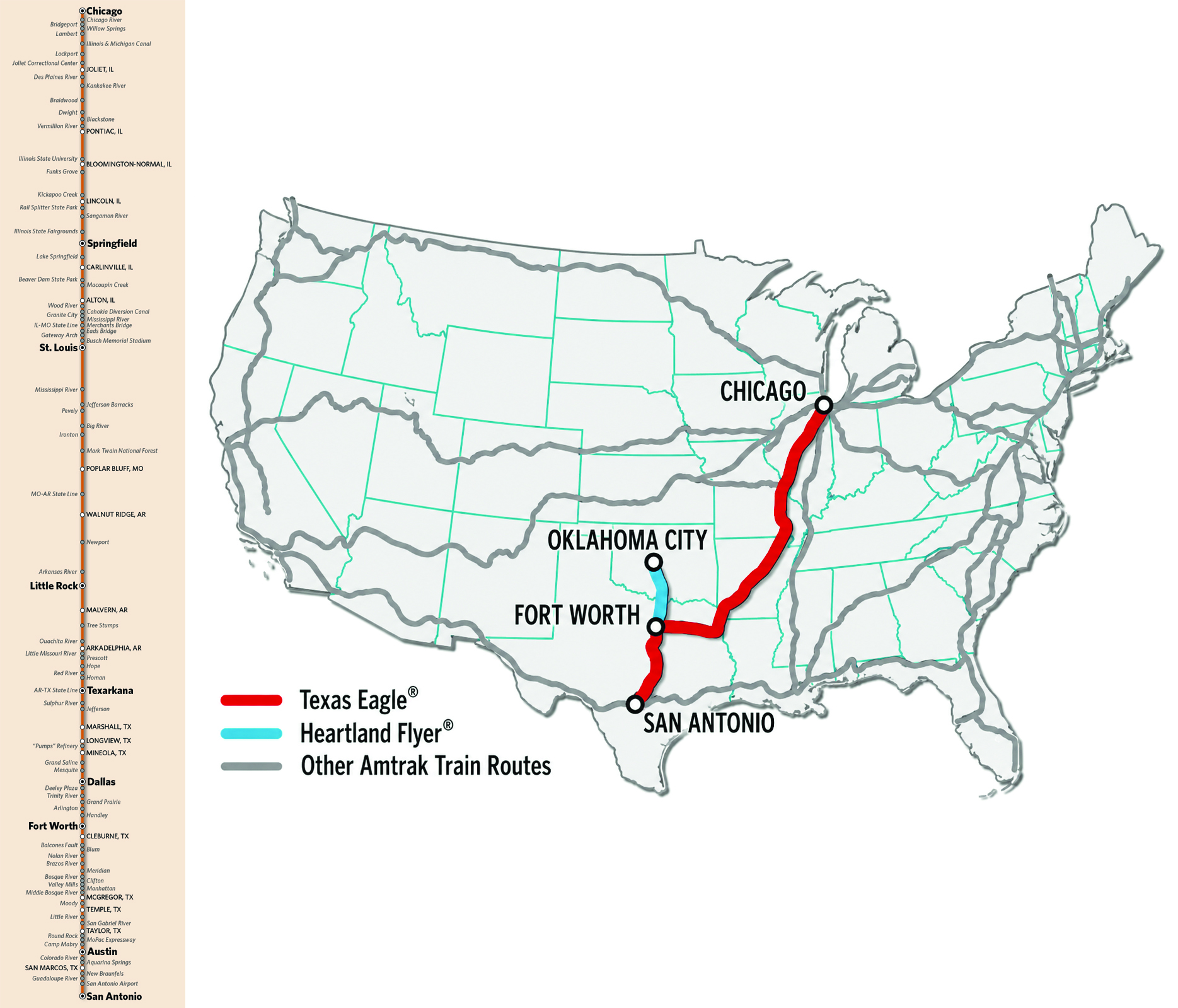
Amtrak Texas Eagle Map
The Amtrak Texas Eagle map shows all available stops. Click on the map to enlarge it or download the Amtrak Texas Eagle map in PDF format.
Stations and Stops
The Texas Eagle stations list spans Illinois, Missouri, Arkansas, Texas, New Mexico, Arizona, and California. Daily trains run between Chicago and San Antonio, while the San Antonio-Los Angeles segment operates three days per week when the train connects with the Sunset Limited.
If you are using a stations map or building a route plan, San Antonio is the key split point. Passengers on trains 421 and 422 should expect a 2 to 5 hour layover there for coupling operations. You may stay onboard or step off, though access to train cars can be limited during the work.
| Station | Details |
|---|---|
| Illinois stations | Chicago, Joliet, Pontiac, Bloomington-Normal, Lincoln, Springfield, Carlinville, Alton |
| Missouri stations | St. Louis, Arcadia, Poplar Bluff |
| Arkansas stations | Walnut Ridge, Little Rock, Malvern, Arkadelphia, Hope, Texarkana |
| Texas stations | Marshall, Longview, Mineola, Dallas, Fort Worth, Cleburne, McGregor, Temple, Taylor, Austin, San Marcos, San Antonio, Del Rio, Sanderson, Alpine, El Paso |
| New Mexico stations | Deming, Lordsburg |
| Arizona stations | Benson, Tucson, Maricopa, Yuma |
| California stations | Palm Springs, Ontario, Pomona, Los Angeles |
Amtrak Connection service also extends the route to selected destinations such as Shreveport, Houston, Galveston, Phoenix Metro Center, Phoenix Airport, and Tempe.
Major Stations
Major Texas Eagle stations include large city terminals, regional hubs, and connection points for other Amtrak routes, bus links, or local transport. These stops are the most useful for planning longer trips, transfers, and city breaks.
| Station | Details |
|---|---|
| Chicago, IL – Union Station (CHI) | Northern endpoint for daily Texas Eagle service and a major Amtrak connection hub |
| St. Louis, MO – Gateway Station (STL) | Major Missouri stop with connections including the Missouri River Runner |
| Little Rock, AR – Union Station (LRK) | Major Arkansas stop on the route |
| Dallas, TX – Union Station (DAL) | Major North Texas stop |
| Fort Worth, TX (FTW) | Connection point for the Heartland Flyer |
| Austin, TX (AUS) | Major Central Texas stop |
| San Antonio, TX (SAS) | Daily segment endpoint and connection point for Sunset Limited through service |
| El Paso, TX – Union Depot (ELP) | Major West Texas stop |
| Tucson, AZ (TUS) | Major Arizona stop on the Los Angeles segment |
| Maricopa, AZ (MRC) | Connection point for service toward Phoenix Metro Center, Phoenix Airport, and Tempe |
| Los Angeles, CA – Union Station (LAX) | Western endpoint for three-weekly through service |
Texas Stations
The Texas section is one of the route’s busiest and most useful parts for regional travel. The train serves East Texas, North Texas, Central Texas, San Antonio, and West Texas before continuing toward New Mexico and Arizona on selected days.
| Station | Details |
|---|---|
| Marshall | Texas Eagle stop in East Texas |
| Longview | Texas stop with Amtrak Connection service listed in route materials |
| Mineola | East Texas station |
| Dallas | Major North Texas station |
| Fort Worth | Major station and Heartland Flyer connection point |
| Cleburne | Texas Eagle station south of Fort Worth |
| McGregor | Central Texas stop |
| Temple | Texas stop with Thruway connections listed in route materials |
| Taylor | Central Texas station |
| Austin | Major Central Texas station |
| San Marcos | Texas stop between Austin and San Antonio |
| San Antonio | Daily endpoint, Sunset Limited connection, and coupling layover point |
| Del Rio | Southwest Texas station |
| Sanderson | West Texas station |
| Alpine | West Texas station |
| El Paso | Major West Texas stop before the route continues west |
Fares, Tickets, and Reservations
Texas Eagle fares depend on your travel date, route, accommodation, and how many people are in the reservation. You can book a ticket online, through the Amtrak mobile app, at station kiosks and ticket counters, or by calling Amtrak.
Booking online is often the easiest way to compare fare options, see the current ticket price, and avoid ticket lines at the station. If you are checking menus before a trip, remember that onboard menu items and prices can change.
Coach Tickets
Coach tickets are the standard lower-cost option on the Texas Eagle. The draft fare information lists coach ticket prices starting at around $146 USD, though discounts, sales, and route-specific pricing can change the final cost.
Amtrak offers special rates for eligible seniors, military personnel, and students, along with group discounts for traveling parties. Children ages 2-12 typically receive half-off fares with a paid adult, while children under 2 ride free on a parent’s lap. Amtrak Guest Rewards may also help frequent riders save on future travel.
If you are comparing coach fare options, treat the Amtrak booking flow as your practical fare calculator: enter the exact date, stations, and passenger details to see the current price.
Private Rooms and Sleeper Accommodations
Superliner First Class private rooms give overnight travelers more space, privacy, and included amenities. Meals are included with private room travel, and customers also receive complimentary lounge access at major stations and priority boarding.
A Roomette is a compact option for one or two travelers, with two seats by day and upper and lower beds by night. Bedding, pillows, towels, and linens are included, with shared restroom and shower access.
A Bedroom offers more space, with a sofa and chair that convert into upper and lower beds. It also includes a private in-room sink, restroom, and shower.
A Bedroom Suite combines two adjoining Bedrooms, creating space for up to four beds, two big picture windows, and two private in-room sinks, restrooms, and showers.
A Family Room is designed for two adults and two children ages 2-12. It spans the width of the car, with seating for four by day and two upper and two lower beds at night.
An Accessible Bedroom is located on the entry level and provides room for a wheelchair, seating that converts to upper and lower beds, a big picture window, linens, and an accessible in-room sink.
Private room fares vary based on when and where you travel and how many people are traveling with you. Except for Family Rooms and Bedroom Suites, private rooms generally accommodate one or two travelers.
Schedule, Frequency, and Train Status
The Texas Eagle schedule is built around daily Chicago-San Antonio service and three-weekly through service to Los Angeles. Train numbers 21 and 22 cover the daily Chicago-San Antonio segment, while 421 and 422 cover the Chicago-Los Angeles through route.
Unlike a metro system, the Texas Eagle does not have simple opening hours, opening times, working hours, or a fixed closing time to memorize. Riders should use the train schedule, route timetable, and current train status for their exact travel date. Timetables may change because of holidays, special events, construction, and other operating reasons.
| Service detail | Timings |
|---|---|
| Chicago-San Antonio service | Daily on trains 21 and 22 |
| Chicago-Los Angeles through service | Three days per week on trains 421 and 422 |
| San Antonio layover for through passengers | About 2 to 5 hours for train coupling or separation |
| Train 22 from San Antonio | Listed as departing San Antonio at 7:00 AM in the provided timetable notes |
| Train 422 joins train 22 at San Antonio | Listed for Tuesdays, Fridays, and Sundays in the provided timetable notes |
| Westbound meal pattern | Dinner, breakfast, lunch, dinner |
| Eastbound meal pattern | Breakfast, lunch, dinner, breakfast, lunch |
For timings today, schedule today details, last train information, and any delay alerts, check Amtrak for the exact station pair and date before you travel.
Daily Service and Three-Weekly Segments
The daily Texas Eagle segment runs 1,306 miles (2,102 km) between Chicago and San Antonio. It links major cities including St. Louis, Little Rock, Dallas, Fort Worth, and Austin, making it both a long-distance train and a useful city transport option for selected regional trips.
Three days per week, the route continues beyond San Antonio to Los Angeles as part of the combined service with the Sunset Limited. On these through trips, the full route covers 2,728 miles (4,390 km).
Amtrak also supplements capacity on the Chicago-St. Louis portion with an extra Superliner coach operating as trains 321 and 322. Service was reduced to tri-weekly from October 11, 2020, to May 24, 2021, during the COVID-19 pandemic, and daily Chicago-San Antonio service later resumed.
Typical Travel Times by Popular City Pair
Running time varies by direction, segment, and operating conditions. The timetable gives the best starting time and routing detail for your exact date, but the typical travel times below show what to expect on popular city pairs.
| Service detail | Timings |
|---|---|
| San Antonio to Chicago | About 30 hours 56 minutes |
| Chicago to San Antonio | About 32 hours 24 minutes |
| Chicago to Los Angeles | About 61 hours 44 minutes in one listed direction and about 65 hours 43 minutes in the other listed full-route timing |
| Chicago to Austin | About 28 hours |
| Chicago to Dallas | About 21.5 hours |
| Dallas to Austin | About 6 to 6.5 hours |
| Dallas to San Antonio | About 8 hours |
| Los Angeles to Palm Springs | About 2.5 hours |
Passengers traveling between Chicago and Los Angeles should also allow for the San Antonio layover, usually about 2 to 5 hours.
Connections with Other Routes and Local Transit
The Texas Eagle connects with other Amtrak routes, Thruway buses, airport connections, and local transportation options at several points. In Chicago, riders can connect with routes including the Capitol Limited, Lake Shore Limited, Cardinal, City of New Orleans, Hiawatha Service, Wolverine Service, Pere Marquette, Illinois Zephyr, Illini, Hoosier State, and Amtrak Thruway Motorcoach service.
In St. Louis, the train connects with the Missouri River Runner. In Fort Worth, it connects with the Heartland Flyer. In San Antonio, it connects with the Sunset Limited for through travel to Los Angeles on selected days.
Amtrak Connection service also reaches destinations beyond the rail line, including Shreveport, Houston, Galveston, Phoenix Metro Center, Phoenix Airport, and Tempe. These bus and van links make the Texas Eagle more useful for broader transportation in the region, especially when your final stop is not directly on the rail route.
Sunset Limited Connection in San Antonio
San Antonio is the key connection point between the Texas Eagle and the Sunset Limited. Passengers on trains 421 and 422 traveling between Chicago and Los Angeles usually have a 2 to 5 hour layover while train cars are coupled or separated.
During the layover, you may stay onboard or detrain if you prefer. Access to cars can be limited, and temporary power outages may occur, including loss of air conditioning.
If you have time in San Antonio, nearby highlights include the River Walk, the Spanish Missions including the Alamo, SeaWorld, the Tower of the Americas, and HemisFair Park.
Heartland Flyer and Other Amtrak Connections
The Heartland Flyer provides daily coach service between Oklahoma City and Fort Worth, with intermediate stops in Norman, Purcell, Pauls Valley, Ardmore, and Gainesville. In Fort Worth, it connects with the Texas Eagle for onward travel.
Other connections appear along the route, including Thruway Motorcoach links at selected stations and service links in St. Louis and Springfield, Illinois. These transfers help passengers reach more cities without building a completely separate bus or rail itinerary.
Amtrak Thruway and Airport Connections
Amtrak Connection service adds bus and van links to the Texas Eagle route. Listed connections include Shreveport, Louisiana; Houston and Galveston, Texas; and, from the Sunset Limited at Maricopa, service toward Phoenix Metro Center, Phoenix Airport, and Tempe.
Amtrak handles booking and ticketing for these connections, which helps when planning a multi-leg trip on one reservation. The Thruway list is not all-inclusive, so check the current timetable before travel.
Onboard Experience
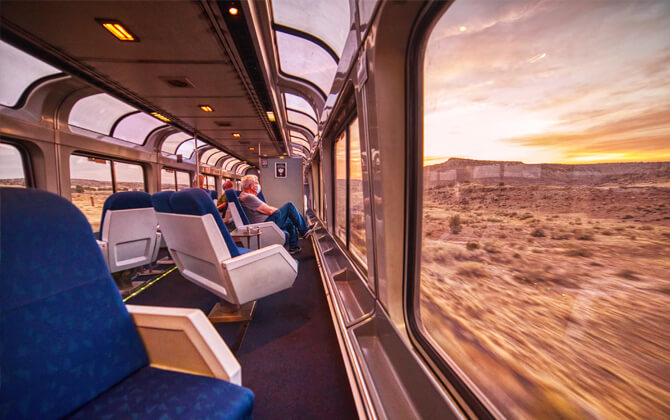
The Texas Eagle uses bi-level Superliner cars with coach seating, private rooms, dining options, and a Sightseer Lounge where available. It is a long ride, so the onboard experience matters: you can stretch out in coach, book a sleeper, eat in the Dining Car, or spend time watching the scenery.
Dining options include Flexible Dining, Traditional Dining between San Antonio and Los Angeles only, and Cafe Service. Coach passengers may use the Lounge Car and purchase meals in the Dining Car. Sleeper passengers have meals included with private room travel.
Accommodations include lower and upper level Coach Class seats, Superliner Roomettes, Bedrooms, Bedroom Suites, Family Rooms, and Accessible Bedrooms. Checked baggage service is available on some trains, and amenities vary by train.
Passengers on trains 421 and 422 should remember the San Antonio layover. It can last 2 to 5 hours, and while you may remain onboard, car access may be limited and temporary power outages can occur.
First-Time Rider Tips and Rules
If this is your first Texas Eagle trip, plan like you are boarding a true long-distance train, not a commuter line. The full journey can take more than 61 hours, delays can happen, and the schedule should be checked close to departure.
Traditional Dining is available only on the San Antonio-Los Angeles segment. After the split in San Antonio, sleeper passengers switch from Traditional Dining to Flexible Dining on the Chicago-San Antonio portion.
The Sightseer Lounge may not be available in the same way on every segment, especially between San Antonio and Chicago. If the lounge is important to you, ask onboard staff about current access.
Bring entertainment, chargers, snacks, and anything you want within reach. The Amtrak app or website is useful for service updates, delays, schedule today checks, and train status.
- Arrive about 30 minutes before departure if you are not checking bags.
- Allow more time at large or unfamiliar stations.
- Expect possible late running and keep connections flexible.
- Pack for a long ride, especially in coach.
- Use official train status tools for timings today and last-minute changes.
- During the San Antonio layover, be ready for limited car access or temporary power interruptions.
The train is generally a safe and comfortable way to travel, but long-distance rail works best when you are patient, prepared, and not in a rush.
Baggage, Bikes, Pets, and Accessibility
Checked baggage service is available at select Texas Eagle stations, and availability varies by train. Stations listed for checked baggage include Austin, Bloomington-Normal, Chicago, Dallas, Fort Worth, Little Rock, Longview, Los Angeles, St. Louis, San Antonio, Springfield, Temple, Texarkana, and Tucson.
When checked baggage is available at both endpoints of your trip segment, each ticketed passenger may check up to two pieces of reasonable size and weight. Passengers may also bring one personal item and two carry-on items, subject to Amtrak size and weight limits.
Trainside checked bicycle service is available on some Texas Eagle trains. Standard full-size bicycles are accepted when space is available and are stored in designated racks in the baggage car.
Small dogs and cats are allowed on the Texas Eagle, but rules apply. The pet must weigh less than 20 pounds including the carrier, the trip must be under seven hours, reservations are required, and pet owners must complete the paperwork sent after booking.
Accessible options include a Superliner Accessible Bedroom and lower-level coach seating on Superliner-equipped trains. The lower level also includes restrooms, luggage storage space, and a limited number of coach seats. A wheelchair ramp with a wheeled mobility device is available to help passengers board and leave the train.
Brief History
The modern Texas Eagle began service on October 2, 1981, when Amtrak restructured its Inter-American service and renamed the train the Eagle. The new service replaced older Amfleet coaches with Superliner equipment, cut back the southern terminus from Laredo to San Antonio, and dropped the Houston section that had operated via Temple.
At first, the train ran three times per week and included a through car to the Sunset Limited for travel to Los Angeles. In 1988, Amtrak restored the Texas Eagle name for Chicago-San Antonio and Chicago-Houston service, while the Chicago-St. Louis segment remained the Eagle on off days.
Houston service returned in November 1988 on a routing via Dallas and the former Southern Pacific Sunbeam line, restoring passenger trains to that corridor for the first time since 1958. That branch ended in September 1995.
Daily Chicago-San Antonio service returned on May 21, 2000. New infill stations later opened at Hope, Arkansas, in 2013 and Arcadia, Missouri, in 2016, with a station approved for De Soto, Missouri, in 2023.
The Texas Eagle name itself goes back to a Missouri Pacific and Texas and Pacific Railway train that first ran in 1948 and ended in 1971. Much of today’s Amtrak route follows former Missouri Pacific and Texas and Pacific trackage, keeping a direct link to that history.
During the COVID-19 pandemic, service was reduced to tri-weekly operation from October 11, 2020, to May 24, 2021. It also ran five days per week for part of early 2022 because of the Omicron variant. Today, Amtrak operates the Texas Eagle daily between Chicago and San Antonio, with tri-weekly through service to Los Angeles.
Best Trips, Scenic Highlights, and Attractions
The Texas Eagle works for both long rail journeys and shorter city-pair trips. Between Chicago and San Antonio, the route covers 1,306 miles (2,102 km) through major cities, river country, Arkansas, East Texas, Central Texas, and South Texas.
Notable places to visit along the route include Chicago’s Grant Park, museums, skyscrapers, and Magnificent Mile; St. Louis’s Gateway Arch, Union Station, Forest Park, and Anheuser-Busch Brewery; Springfield’s Lincoln sites; Little Rock as a gateway to the Ozarks; Dallas attractions such as Reunion Tower, Pioneer Plaza, the Dallas Zoo, and the Sixth Floor Museum; Austin’s live music and state capitol; and San Antonio’s River Walk, Alamo, Spanish Missions, Tower of the Americas, and HemisFair Park.
Scenic highlights mentioned for the route include the Mississippi River, the Ozarks, the piney woods of East Texas, Hill Country, the Franklin Mountains in El Paso, the Sierra Blanca mountains in New Mexico, and high desert scenery farther west. Spring and fall are especially appealing for cooler weather, wildflowers, or fall foliage.
Best Shorter Trips on the Texas Eagle
You do not need to ride the full route to enjoy the Texas Eagle. Shorter trips between major stops can be practical if you want an Amtrak experience without spending three nights onboard.
| Service detail | Timings |
|---|---|
| Chicago to Dallas | About 21.5 hours |
| Chicago to Austin | About 28 hours |
| Dallas to Austin | About 6 to 6.5 hours |
| Dallas to San Antonio | About 8 hours |
| Los Angeles to Palm Springs | About 2.5 hours |
The most practical shorter rides are usually between major stops such as St. Louis, Little Rock, Dallas, Fort Worth, Austin, and San Antonio.
Scenic Sections of the Route
The Texas Eagle is not nonstop mountain scenery, but it has several memorable stretches. The Mississippi River crossing is a standout, and the area around St. Louis gives riders a classic river-and-city view.
Farther south, East Texas and Hill Country add a softer, greener landscape. Travelers often mention the Piney Woods, the upper Brazos River Valley between McGregor and Cleburne, and the stretch near Fort Worth and Taylor as attractive parts of the trip.
West of San Antonio, the scenery becomes more varied on the combined route to Los Angeles. The train passes high desert landscapes, the Sierra Blanca mountains, the Franklin Mountains near El Paso, and views near the Mexico border.
For the best chance to enjoy the scenery, use the Sightseer Lounge when it is available and check with onboard staff about current access.
Things to Do Near Major Stops
Chicago is a strong starting point, with Grant Park, Buckingham Fountain, the Art Institute of Chicago, Millennium Park, the Chicago Riverwalk, Chinatown, deep-dish pizza, and Chicago-style hot dogs all commonly paired with a Union Station departure.
St. Louis offers the Gateway Arch, Busch Stadium, Union Station, the Saint Louis Art Museum, Saint Louis Science Center, Saint Louis Zoo, and the Anheuser-Busch Brewery.
Little Rock is useful for outdoor time and local exploring. Pinnacle Mountain State Park, the Arkansas Museum of Fine Arts, the Old Mill in North Little Rock, and the Rock Region Metro Streetcar give visitors several easy options.
Dallas has big-city landmarks and museums, including Reunion Tower GeO-Deck, Pioneer Plaza, the Dallas Museum of Art, the Perot Museum of Nature and Science, the Sixth Floor Museum at Dealey Plaza, and the Dallas Zoo.
Fort Worth is known for cowboy culture, especially the Stockyards, the twice-daily cattle drive, boot shopping, Billy Bob’s Texas, Cowtown Coliseum, the Amon Carter Museum of American Art, and The Cowgirl: The National Cowgirl Museum and Hall of Fame.
Austin is a good stop for live music, the Texas State Capitol, Hill Country atmosphere, wildflowers, and outdoor scenery. San Antonio adds the River Walk, the Alamo, San Antonio Missions National Historical Park, the Pearl District, Tower of the Americas, SeaWorld, and HemisFair Park.

FAQ
Does the Texas Eagle run every day?
Yes. The Texas Eagle runs daily between Chicago and San Antonio. Service between San Antonio and Los Angeles operates three days per week when the train connects with the Sunset Limited in San Antonio.
If you are traveling between Chicago and Los Angeles, expect a San Antonio layover of about 2 to 5 hours for coupling operations.
How long is the full Texas Eagle route?
The full Texas Eagle route is 2,728 miles (4,390 km) between Chicago and Los Angeles. The daily Chicago-San Antonio segment is 1,306 miles (2,102 km).
The full through trip takes roughly 62 to 66 hours, depending on direction and schedule.
Does the Texas Eagle have sleeper cars?
Yes. The Texas Eagle has Superliner sleeper cars with private rooms, including Roomettes, Bedrooms, Bedroom Suites, Family Rooms, and Accessible Bedrooms.
Sleeper accommodations include meals, more privacy, and additional comfort compared with coach seating.
Does the Texas Eagle have an observation car?
Yes. The Texas Eagle includes a Sightseer Lounge, Amtrak’s observation-style lounge car, when available. It has large windows and seating for watching the scenery along the route.
Access can vary by segment and operating conditions, so ask onboard staff for the current setup.
Is there Wi-Fi on the Texas Eagle?
No. The Texas Eagle does not offer onboard Wi-Fi. If you need internet access, bring a mobile hotspot or use cellular data, keeping in mind that coverage may be spotty in remote areas.
What is the difference between the Texas Eagle and the Sunset Limited?
The Texas Eagle runs daily between Chicago and San Antonio. The Sunset Limited runs three times per week between Los Angeles and New Orleans.
West of San Antonio, the Texas Eagle through cars operate with the Sunset Limited on selected days. The main differences are route, frequency, schedule, and car assignment.
Can you take the Texas Eagle for short trips within Texas?
Yes. You can use the Texas Eagle for shorter trips within Texas, including travel between cities such as Dallas, Fort Worth, Austin, Temple, Longview, and San Antonio.
Travel times can be longer than driving or flying. Dallas to Austin takes about 6 to 6.5 hours, and Dallas to San Antonio takes about 8 hours, so it works best when you are not in a hurry.