The London Underground, often called the Underground or simply the Tube, is a rapid transit system serving Greater London and parts of Buckinghamshire, Essex, and Hertfordshire. Managed by Transport for London, it is the core of transportation in London and one of the best-known public transport systems in the world. The network began in 1863 as the world’s first underground passenger railway and has grown to 11 lines, 272 stations, and about 250 miles (400 km) of track. Despite the nickname, only around 45% of the system is actually underground, with many outer sections running above ground. Even so, it handles up to 5 million passenger journeys a day and recorded 1.216 billion journeys in 2024/25.
| Key | Information |
|---|---|
| System | London Underground, also known as the Tube |
| Operator | Transport for London |
| Opened | 10 January 1863 |
| Lines | 11 |
| Stations | 272 |
| Network length | About 250 miles (400 km) |
| Fare zones | 9 |
| Daily ridership | Up to 5 million journeys |
| Annual ridership | 1.216 billion journeys in 2024/25 |
| Map design icon | Harry Beck’s schematic Tube map from 1931 |
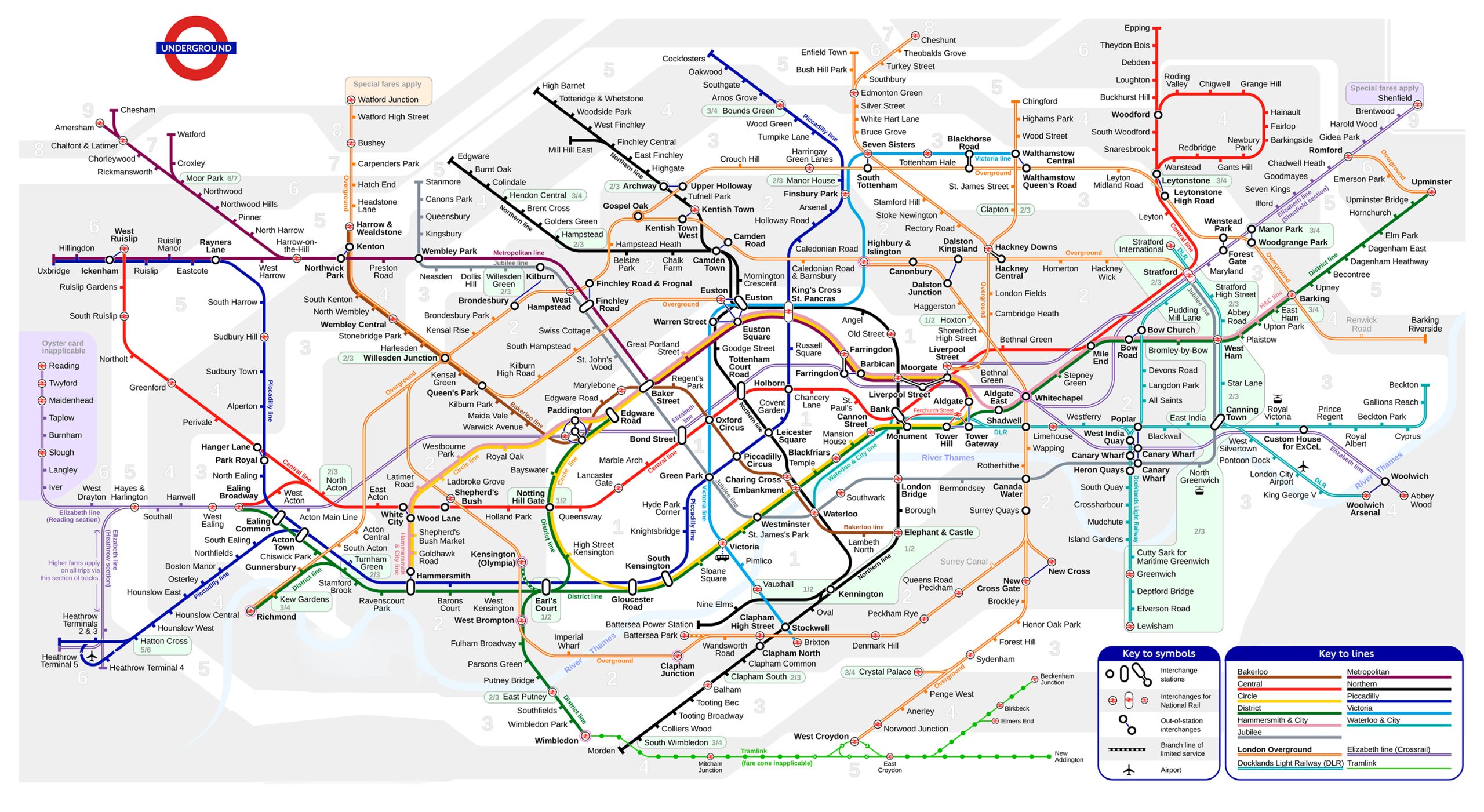
Map of London Underground
Map of London Metro showing different lines. Click on the map to enlarge it or download the London Metro map in PDF format.
London Underground Lines
The London Underground has 11 lines, each with its own name and color, which makes the stations map and route plan easier to read. Together, these lines serve 272 stations across Greater London and beyond, with the network split into 9 fare zones.
- Bakerloo line
- Central line
- Circle line
- District line
- Hammersmith & City line
- Jubilee line
- Metropolitan line
- Northern line
- Piccadilly line
- Victoria line
- Waterloo & City line
The route structure includes both sub-surface and deep-level lines. The Circle, District, Hammersmith & City, and Metropolitan lines form the sub-surface network, while the other seven are deep-tube lines.
The District line has the most stations, with 60. At the other end, the Waterloo & City line is the shortest path train route, with just 2 stations between Bank and Waterloo. The Metropolitan line is the longest at 41.4 miles (66.6 km), while the Waterloo & City line is only 1.6 miles (2.6 km) long.
The Tube map also shows links to other TfL services, including the DLR, London Overground, and the Elizabeth line. They appear on the stations map for easier journey planning, but they are not part of the Underground itself.
Service patterns vary by line. In general, opening hours start around 5 am and services close around midnight, with Night Tube running on Fridays and Saturdays on the Central, Victoria, Jubilee, Northern, and Piccadilly lines.
Main Stations
The London Underground has 272 stations, so a stations list of the main ones usually means the busiest interchanges and the best-known central stops. These are key points for changing lines, following a route, or reaching major parts of the city.
| Station | Details |
|---|---|
| Baker Street | Well-known interchange and one of the network’s major stations |
| Bank | Important central interchange; also one end of the Waterloo & City line |
| Liverpool Street | Busy central station with strong wider rail connections |
| King’s Cross St. Pancras | Major interchange for Underground and other rail services |
| Oxford Circus | Key central stop for moving around the West End |
| Waterloo | Major interchange and one of the city’s busiest transport hubs |
| Farringdon | Important transfer point with wider rail connections |
| Green Park | Well-known interchange station in central London |
| Finsbury Park | Useful transfer point for Underground and other services |
| Stratford | Important station for wider travel across London |
| Paddington | Shown as one station on the Tube map, though counted as two in the official total |
| London Bridge | Major station for Underground and broader city transport connections |
| Battersea Power Station | Newer Northern line station, opened in September 2021 |
| Nine Elms | Newer Northern line station, opened in September 2021 |
A few names are shared by separate stations on different lines, including Edgware Road and Hammersmith. Little details like that can matter when checking the stations list before you travel.
Operation Hours, Schedule, and Frequency
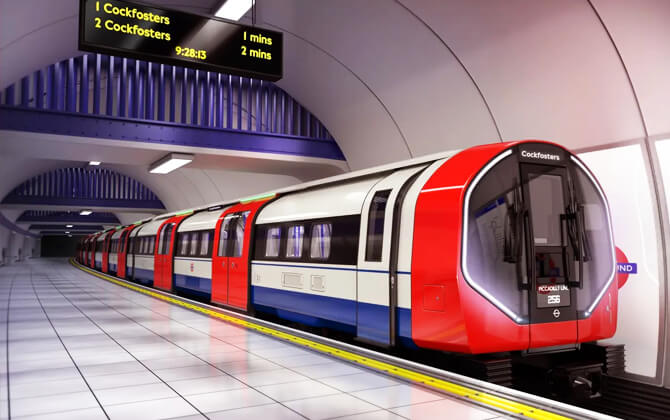
The London Underground usually runs from around 5:00 am until midnight, Monday to Saturday, with slightly reduced operating hours on Sunday. Opening times, working hours, and closing time can vary by line, so checking the timetable or station signs before you travel is always a smart move.
| Service detail | Timings |
|---|---|
| Usual starting time | Around 5:00 am |
| Usual closing time | Around midnight |
| Opening hours | Monday to Saturday, generally from around 5:00 am to midnight |
| Sunday service | Slightly reduced hours |
| Night Tube | Friday and Saturday nights on selected routes |
| Night Tube lines | Victoria, Central, Jubilee, Northern, and Piccadilly |
During the day, frequency is usually high, so there is rarely much need to sprint for a train. For route timetable details, schedule today updates, or timings today on a specific line, station signage and TfL journey tools are the best place to check.
Night Tube services run through the night on selected routes on Friday and Saturday nights. If you are travelling late, confirm whether your line runs all night and when the last train leaves your station, especially if you need to change lines.
Peak and Off-Peak Fares
Fares depend on distance, time of day, and payment method. When paying as you go, peak fares apply Monday to Friday, excluding public holidays, between 6:30 am and 9:30 am, and between 4:00 pm and 7:00 pm.
Off-peak fares apply at all other times. They also apply when travelling from a station outside Zone 1 to a station in Zone 1 between 4:00 pm and 7:00 pm, Monday to Friday.
Oyster cards and contactless payment are usually the cheapest ticket options for Tube travel.
Practical Tips
- Avoid weekday rush hours if you can, especially in the morning and evening peak.
- Check the front of the train so you know it is following the right route.
- If you are travelling late, confirm Night Tube availability and the last train for your line.
- If service is disrupted, the DLR, London Overground, Elizabeth line, and National Rail can be useful alternatives.
Fares and Tickets
London Underground fare rules depend on the zones you travel through, the time you travel, and how you pay. For most passengers, pay as you go with an Oyster card or contactless card is cheaper than buying a single paper ticket.
You can compare single-journey cost, daily caps, and Travelcard prices across Tube and rail services. The wider fare system also covers bus and tram services, River services, the IFS Cloud Cable Car, and travel beyond Zone 9.
Pay as you go, caps and Travelcards
If you travel regularly, daily caps help limit how much you pay in a day. With pay as you go, you will not be charged above the relevant cap for the zones and services you use.
Travelcards are another option if you want unlimited travel for a fixed period. They are available for different durations, and the ticket price depends on the zones covered.
Tickets and discounts
Single tickets are available, but they are usually the most expensive option. Children under 11 travel free on the Underground, and some children and young people can get discounted fares with the correct Oyster or ID card.
Visitors do not get senior fares. Some London residents may qualify for concessionary travel depending on age and circumstances. Since fare and price rules can change, it is worth checking the latest details before you travel.
Card Types
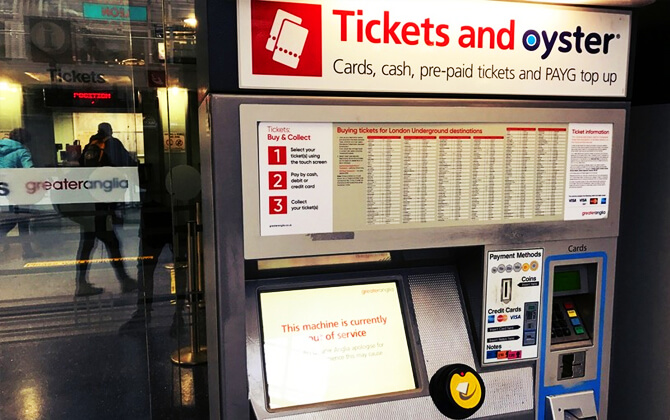
For London Underground travel, you can use several ticket and card options. Some are paper tickets, while others are electronic smartcards that you load with credit and tap on the yellow reader at the gates.
Travelcards are paper or season pass products that allow unlimited travel in the zones they cover. They are sold as day, 7-day, monthly, and annual tickets. A day pass can work well for a short stay, while weekly or monthly options are often better value for longer visits.
Oyster cards are smartcards for pay as you go travel. You can buy one at a station, add credit, and tap in and out so the correct fare is deducted automatically. Oyster also supports daily capping.
Visitor Oyster cards are aimed at non-UK residents and can be bought before arrival in London. They work like standard Oyster cards and can save time when you first get into the city.
Contactless payment cards work in much the same way. Tap in, tap out, and the correct fare is charged automatically. Like Oyster, they use capping to help control daily spending.
For children, the rules vary by age. Children aged 0 to 11 travel free on all public transport in London. Children aged 11 to 15 get discounts on the metro and travel free on trams and buses. Sixteen- and 17-year-olds can use a Zip Oyster +16 card for discounted travel.
If you are only in London briefly, a pay as you go card or day pass is usually the easiest option. For a longer stay, a weekly or monthly Travelcard may make more sense.
Connections to Other Systems
The London Underground is tightly connected with several other transport services, which makes city transport in London easier to navigate. It is the backbone of the capital’s rapid transit network, but not the only system shown on the Tube map.
Many stations connect directly with London Overground, and Overground lines appear on the map. The Elizabeth line also connects with several Underground stations and is shown on the map even though it is not part of the Underground itself.
The Underground also shares parts of its infrastructure with other rail systems in some places. The Piccadilly line shares track with the District and Metropolitan lines on certain sections, while the Bakerloo line shares track with London Overground’s Lioness line north of Queen’s Park. Parts of the District line and other routes are also used by main line services, including Chiltern Railways and some South Western Railway trains.
Airport access is another big part of the network. The Piccadilly line serves Heathrow directly, while the Elizabeth line also reaches the airport. London City Airport connects to the Underground via the DLR, with onward links to stations such as Canning Town, Stratford, and Bank.
The Tube map also shows the wider local transport network, including the DLR, London Overground, Thameslink, the Elizabeth line, and Tramlink. That makes it a practical route plan for trips that go beyond the Underground alone.
- London Overground: close interchange with the Underground and shown on the Tube map
- Elizabeth line: connects with several Underground stations and serves Heathrow
- DLR: links London City Airport and connects with Underground stations in east London
- Main line rail: some Underground sections are shared with or used by National Rail services
- Heathrow Airport: directly served by the Piccadilly line and the Elizabeth line
- Tramlink: part of the wider London transport network shown on the map
Airport Connections
The London Underground connects Heathrow Airport to central London via the Piccadilly line, making it one of the most affordable public transport options for the trip. Trains serve Terminals 2 and 3, Terminal 4, and Terminal 5, and the running time to central London is typically around 45 to 60 minutes.
Heathrow has three Underground stations in Travelcard Zone 6. Heathrow Terminals 2 and 3 station sits between those terminals, Terminal 4 station is below Arrivals, and Terminal 5 station is in the basement of the terminal building. When travelling from London to Heathrow, make sure you board a train for the correct terminal, since not every service goes to both Terminal 4 and Terminal 5.
Frequency is strong, with trains usually running every 10 minutes or less even off-peak. Standard operating hours are generally from 05:00 to 23:30, and the Piccadilly line also has Night Tube service on Friday and Saturday nights. Night Tube trains do not serve Terminal 4. Outside Piccadilly line opening hours, the N9 night bus runs every 30 minutes between central London and Heathrow via Terminal 5 and Heathrow Central bus station.
For fares, the cheapest option is usually Oyster or contactless payment. Paper tickets are available from station machines, but they cost more. A single ticket price between Heathrow and central London starts from £5.80 (about $7.31), though fares can change.
The Underground is especially practical if your destination is on or near the Piccadilly line. For some journeys, though, the Elizabeth line may be faster, particularly for Paddington and some other connections across London.
If you have luggage, give yourself a bit of extra time. Busy interchanges such as Green Park can slow things down more than you might expect.
London Underground Tips and Rules
The London Underground is one of the oldest metro systems in the world, and knowing a few basics makes travel smoother. The network is divided into nine zones, with Zone 1 in central London, and fares depend on distance, time of day, and payment method. Oyster and contactless are usually the cheapest choices.
Tube services generally run from around 5 am until midnight, Monday to Saturday, with slightly reduced hours on Sunday. If you are travelling late, check your route in advance, especially if you need Night Tube.
Useful travel tips
- Use TfL journey tools or Citymapper to check the best route, stations, and train schedule.
- Tap in and out with your phone, contactless card, Oyster card, or Visitor Oyster card. If you miss a tap out, you may be charged the maximum fare.
- Check the front of the train, platform signs, and digital displays for service updates.
- If you have luggage, use raised platform areas where available for easier boarding.
- Hold the rails if you are standing, and mind the gap when getting on or off.
Tube etiquette and rules
- Stand on the right on escalators and leave the left side clear.
- Let passengers leave the train before boarding.
- Move down inside the carriage so you do not block the doors.
- Stand behind the yellow line while waiting on the platform.
- Offer your seat to elderly, pregnant, unwell, or disabled passengers, and to adults with small children.
- Avoid eating on the Tube and keep noise low.
- Do not block the barriers or hold the doors.
For free maps and travel information, you can pick up a Tube map at many stations. If you need an accessible route, check station details in advance, since step-free access is available at some stations but not all.
Navigating the London Underground Video
Introduction
Detailed Information
Fun Facts
The London Underground is packed with details that go well beyond daily transport. A few are about scale, some about design, and others are just wonderfully odd.
- The network of tunnels extends to 249 miles (400.7 km), longer than the 204-mile (328.3 km) distance from Hull to London.
- The system became known as the Tube in the early 20th century, shortened from the nickname The Twopenny Tube for the Central line.
- Harry Beck designed the famous Underground map using the logic of an electrical circuit diagram.
- The average speed on the Underground is 20.5 mph (33.0 km/h), including station stops, while Metropolitan line trains can exceed 60 mph (96.6 km/h).
- The shortest distance between two adjacent stations is only 260 metres (0.26 km or 0.16 miles), while the longest is 6.3 kilometres (3.9 miles).
- The Central line twists and turns because its tunnels follow the curves of London’s medieval street plan.
- Less than 10% of stations are south of the Thames.
- The Underground was funded entirely by private companies until the 1930s.
- Alcohol was banned on the Tube and all London Transport services in June 2008.
- During the three-hour morning peak, Waterloo is the busiest Tube station, with around 57,000 people entering.
- Every week, Underground escalators travel the equivalent of going twice around the world.
- The Jubilee line is the only line that connects with all the other Underground lines.
- More than 1,000 bodies lie beneath Aldgate station, which stands over a plague pit from 1665.
- The London Underground has 272 stations.
- The longest possible single journey on one train is 34 miles (54.7 km), between West Ruislip and Epping on the Central line.
- During the Second World War, part of the Piccadilly line was used to store British Museum treasures.
- Around 55% of the London Underground is actually above ground.
- At Temple station, small temple-shaped emblems appear at the bases of the columns.
- There are 49 abandoned ghost stations on the network, plus North End on the Northern line, a station that was started but never completed.
- The shape of north and west London was heavily influenced by the expansion of the underground railway network.
- A team of railway enthusiasts spent 26 years researching six miles (9.7 km) of vintage wall tiling on 94 station platforms for a book.
- Black arches are hidden in the green and cream tiling pattern at Archway station.
- Canary Wharf serves 40 million people a year through a station measuring the length of two football pitches.
- The round blue and red logo is one of the oldest modern corporate brands and has inspired similar designs worldwide.
History
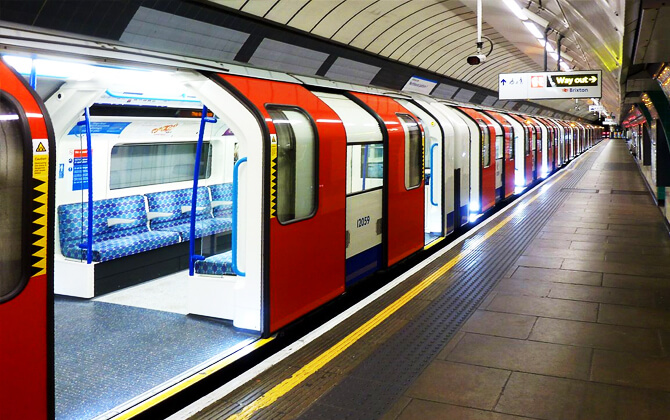
The history of the London Underground starts in the 19th century with the Metropolitan Railway, which opened in 1863 as the world’s first underground passenger railway. It ran between Paddington and Farringdon with gas-lit wooden carriages hauled by steam locomotives, and despite the smoke, it was an immediate success. In its first year, it carried 9.5 million passengers.
Early development focused on sub-surface lines built using cut-and-cover construction. The Metropolitan District Railway opened in 1868, and together with the Metropolitan Railway it completed the Circle line in 1884. Both companies expanded far beyond central London, with the Metropolitan eventually reaching Verney Junction in Buckinghamshire. The first deep-level electric tube line, the City & South London Railway, opened in 1890 and later became part of the Northern line.
At the turn of the 20th century, several private companies built new deep-level routes with circular tunnels, including the Waterloo & City Railway, the Central London Railway, and the Great Northern and City Railway. Electrification became crucial for expansion, and in 1902 the Underground Electric Railways Company of London was created to finance and operate new lines, including the Bakerloo, Hampstead, and Piccadilly railways. By 1907, the District and Metropolitan Railways had electrified their underground sections.
In the early 20th century, the companies started working together more closely through joint publicity, maps, through-ticketing, and UNDERGROUND station signs. The term Underground was adopted for the system, while Tube became widely used later. During the First World War, extensions slowed and stations were used as shelters during air raids.
In 1933, most of London’s underground railways, tramway services, and bus routes were merged into the London Passenger Transport Board. This created coordinated management under the London Transport brand. Harry Beck’s diagrammatic Tube map also first appeared that same year. The Second World War interrupted many expansion plans, though stations again served as air-raid shelters.
After nationalisation in 1948, the system became the London Transport Executive and later the London Transport Board. New lines and major extensions followed, including the Victoria line in the 1960s, the Jubilee line in 1979, and the Piccadilly line extension to Heathrow. The Waterloo & City line joined the Underground in 1994, and the Jubilee Line Extension opened in 1999.
In 2000, Transport for London was created, and London Underground later became a TfL subsidiary. Since then, the network has continued to modernise with new trains, station upgrades, step-free access improvements, contactless payment, Night Tube services, and the Northern line extension to Battersea Power Station and Nine Elms in 2021. The Elizabeth line opened in 2022 and connects with several Underground stations.
Today, the Underground has 11 lines, 272 stations, and around 250 miles (400 km) of track. It remains a defining part of London’s transport system and the city’s history.
Future Extensions
Transport for London is working on projects aimed at faster, more reliable, more comfortable, and safe journeys across London. These plans include station improvements, step-free access, line modernisation, and related transport schemes.
Station improvements and accessibility
Several stations are set to gain new entrances, ticket halls, and step-free access. Colindale station is due to get step-free access and a new ticket hall by the end of 2025, while Leyton station is expected to receive step-free access and a new ticket hall by 2027. At Northolt, work is under way on a new footbridge and lift for platform access. TfL is also working to reduce congestion and improve access at South Kensington station, while continuing to add step-free access to more Tube and London Overground stations.
Elephant & Castle station is also being upgraded with a new entrance and ticket hall to support future connections in the area.
Line upgrades and capacity
TfL is modernising the Circle, District, Hammersmith & City, and Metropolitan lines through the Four Lines Modernisation programme. The goal is to increase capacity and improve reliability. On the Piccadilly line, work is under way to modernise the route and prepare for new trains from 2026.
Road, cycle and regeneration schemes
Outside the Underground, TfL has related projects in progress, including the extension of Cycleway 4 between Greenwich and Woolwich, the regeneration of Wandsworth town centre, and work to return Vauxhall to two-way roads. Other schemes include regeneration on Nine Elms Lane and Battersea Park Road until 2026, work on the Vauxhall Cross gyratory, and continued changes to the roundabouts at Lambeth Bridge in 2025.
Additional projects include the next phase of Westway refurbishment, the replacement of the Lodge Avenue flyover, and improvements at Twickenham roundabout, intended to make access to the town centre easier and improve journey times.
Proposed Bakerloo line extension
The Bakerloo line extension from Elephant & Castle to Lewisham remains a long-term proposal. TfL has safeguarded a route via Old Kent Road, and the project is intended to improve accessibility, cut journey times, and support regeneration and housing growth in south-east London. A possible future extension beyond Lewisham to Hayes and Beckenham Junction has also been proposed, with all stations on that section intended to be step-free.
The project is currently on hold because of the financial effects of the COVID-19 pandemic, but it remains one of the Underground’s most important long-term expansion proposals.
Nearby Attractions
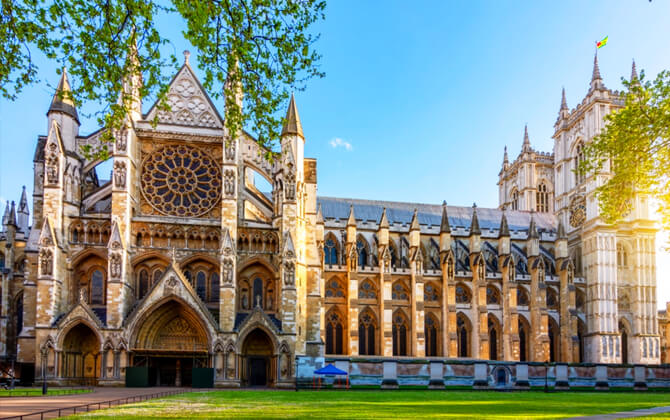
London Underground stations put many of the city’s best-known sights within easy reach. In central London, you can get to Westminster Abbey, Big Ben, the Houses of Parliament, and Buckingham Palace with a short walk from nearby stations.
If history is your thing, the network also gives you easy access to the Churchill War Rooms and the Churchill Museum. Westminster Cathedral is another notable sight close to several stations.
For something a little different, the Underground can take you to St Martin-in-the-Fields near Trafalgar Square, where the crypt includes a cafe, gallery, and concert venue. You can also reach the London Dungeon at County Hall for a theatrical look at the city’s darker past.
Other nearby places worth adding to your route plan include St. James’s Park, the National Gallery, and Covent Garden. The Tube makes it easy to combine sightseeing with city transport, whether you are stopping briefly or planning a full day out.