Madrid Metro is the rapid transit system of Spain’s capital and a core part of public transport in Madrid. Open since 1919, the system now includes 13 conventional metro lines and 3 Metro Ligero light rail lines, linking the city with surrounding municipalities under a unified transport fare system. It is one of Europe’s busiest networks, with trains usually running daily from 06:00 to 01:30 and direct links to buses, Cercanías suburban rail, and the airport.
| Key | Information |
|---|---|
| Official name | Metro de Madrid |
| Opened | 1919 |
| Network | 13 heavy-rail lines and 3 Metro Ligero light-rail lines |
| Heavy-rail length | 296.6 km (184.3 miles) |
| Light-rail length | 27.8 km (17.3 miles) |
| Heavy-rail stations | 241 |
| Light-rail stops | 37 |
| Annual ridership | 715 million passengers in 2024 |
| Usual operating hours | 06:00 to 01:30 |
| Operator | Metro de Madrid S.A. |
Madrid Metro Map
Map of Madrid Metro showing different lines and stations. Click on the map to enlarge it or download the Madrid Metro map in PDF format.
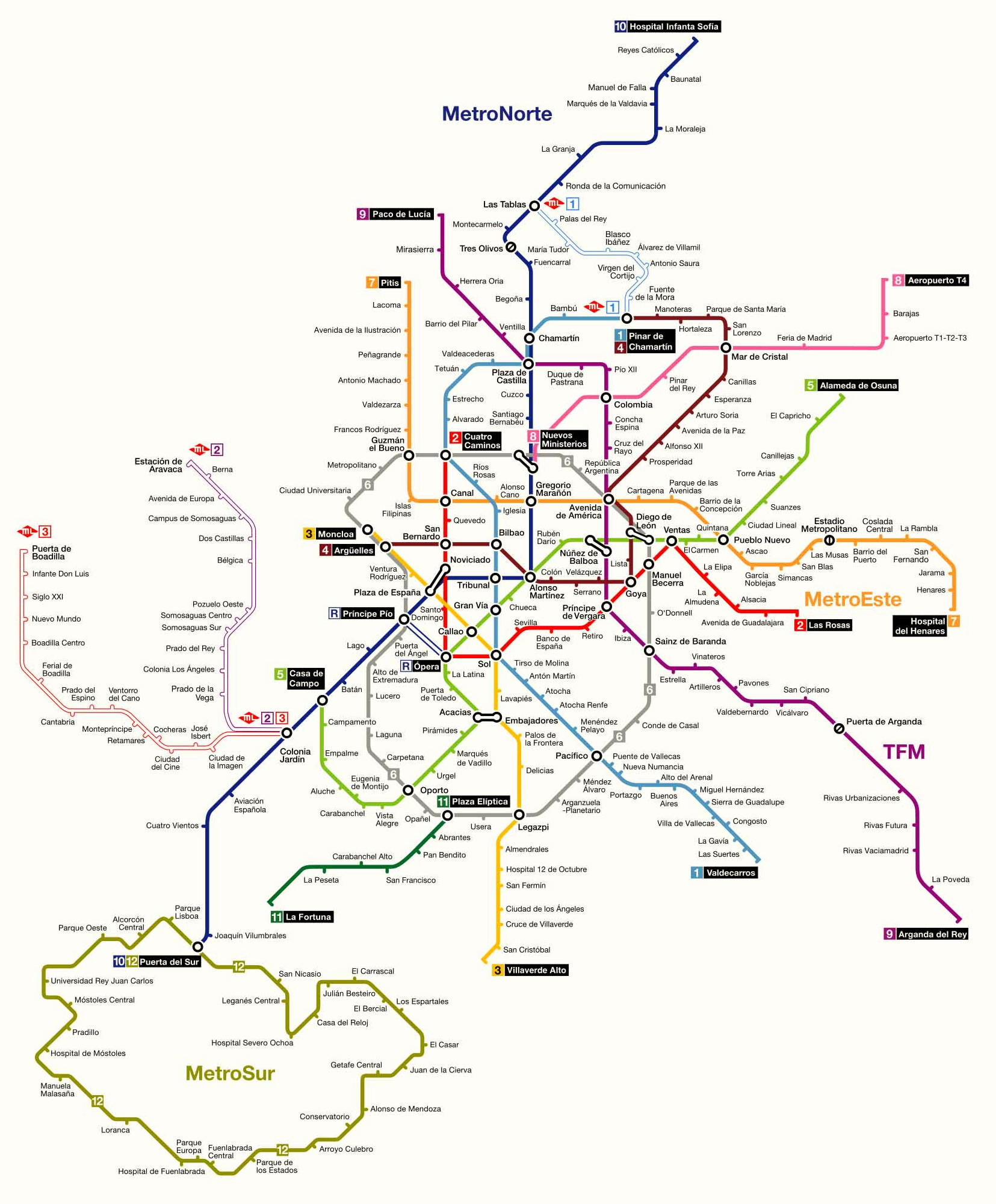
Overview of Madrid Metro Lines and Stations
The Madrid Metro system covers the metropolitan area and has grown steadily since 1919. Today, the network combines 13 heavy-rail lines with 3 Metro Ligero tramway-style light rail lines. The conventional network forms the backbone of transportation in Madrid, while the light rail routes extend service to selected suburbs and newer districts.
The heavy-rail network has 241 stations. Twelve lines are numbered 1 to 12, and the thirteenth is the two-station Ramal Ópera–Príncipe Pío, shown as R on the stations map and journey planners. Most routes are radial, connecting central Madrid with outer areas. Line 6 is circular, and Line 12 runs as a separate circular route southwest of the capital.
Metro Ligero includes ML1, ML2, and ML3, with 37 stops across 27.8 km (17.3 miles). ML1 serves the northern suburbs and connects with the metro at Pinar de Chamartín and Las Tablas. ML2 and ML3 run west and connect with Line 10 at Colonia Jardín.
Several stations matter more than others if you are changing lines. Estadio Metropolitano, Puerta de Arganda, and Tres Olivos are notable split-route interchanges with cross-platform transfers. The network also includes unusual station layouts, such as island platforms, Spanish-solution platforms, and a small number of cross-platform interchange designs.
Line 6 is the busiest line by annual passenger numbers. Line 8 stands out for its route to Madrid-Barajas Airport. Line 9 extends beyond the city to Rivas-Vaciamadrid and Arganda del Rey, while Line 12 links five municipalities without entering Madrid itself.
| Station | Details |
|---|---|
| Estadio Metropolitano | Important split-route interchange with cross-platform transfers |
| Puerta de Arganda | Key transfer point on a split route with cross-platform interchange |
| Tres Olivos | Cross-platform transfer station on a split section |
| Pinar de Chamartín | Connection between Metro Ligero ML1 and heavy-rail lines |
| Las Tablas | Interchange between ML1 and Line 10 |
| Colonia Jardín | Connection point for ML2, ML3, and Line 10 |
As of September 2025, the conventional lines total 296.6 km (184.3 miles), while the light rail network adds 27.8 km (17.3 miles). Metro de Madrid S.A. manages most of the system as part of a wider city transport network with integrated ticketing.
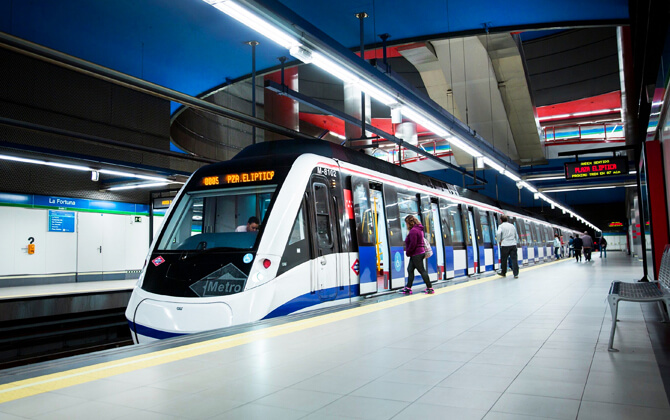
Fares: Tickets and Season Tickets
The Madrid public transport system is fairly straightforward to use. Metro and bus tickets share the same fare structure in many cases, while Cercanías commuter rail follows a different system. For visitors and regular riders, the main things to check are ticket price, pass type, and whether an airport supplement applies.
A standard single ticket costs €1.50 (about $1.64). On the metro, the fare increases by €0.10 (about $0.11) per station after 5 stations. Trips to the airport require an extra €3.00 (about $3.28) supplement per journey.
The 10-journey ticket is one of the most practical options if you plan several trips by city transport. It has no expiry date and can be shared by different people at the same time. For first use, you also need a rechargeable Multi card costing €2.50 (about $2.73). The standard ticket price is €12.20 (about $13.34), although the draft notes it is reduced to €6.10 (about $6.67) until 31 December 2024. Ticket machines work a bit like a fare calculator: you select the destination and the price is calculated automatically.
The Tourist Card is a non-transferable day pass available for 1, 2, 3, 4, 5, or 7 days from validation. During that period, it gives unlimited travel across the Madrid transport network. It can be bought at metro stations, airport sales points, the management offices at Atocha and Sol, and the Regional Transport Consortium headquarters.
| Service detail | Timings |
|---|---|
| Tourist Card validity options | 1, 2, 3, 4, 5, or 7 days from validation |
| Zone | 1 day | 2 days | 3 days | 4 days | 5 days | 7 days |
|---|---|---|---|---|---|---|
| Zone A | €10 ($10.93) | €17 ($18.58) | €22.50 ($24.59) | €27 ($29.51) | €37.50 ($40.99) | €42 ($45.91) |
| Zone T | €15 ($16.40) | €25.50 ($27.88) | €34 ($37.17) | €42 ($45.91) | €49 ($53.56) | €61 ($66.68) |
Children under 11 get a 50% discount on the Tourist Card, and the card cost is already included.
Season tickets are better suited to longer stays. The main options listed in the draft are:
- 30-day pass: €54.60 ($59.68) for Zone A and €82 ($89.61) for Zone C2
- Youth card: €20 ($21.86)
- Metro pass for seniors over 65: free
Availability and fare zones should be checked at the time of purchase.
You can buy tickets from metro station machines and some tobacco shops. On your first purchase, you also need the transferable Multi card, valid for 10 years and priced at €2.50 ($2.73).
Metro Madrid Operating Hours
The Madrid Metro operating hours are generally easy to remember. The usual opening hours are from 6:05 am to 2:00 am, and the schedule normally stays the same even on holidays.
That said, the last train does not leave every station at the same starting time. Final departures from each end of the line are around 1:33 am, so the actual closing time at your station may fall anywhere between 1:33 am and 2:00 am depending on the route and location.
Train timetable and working hours can also vary slightly by line. At weekends, service is usually less frequent during the day. Some stations follow special opening times, including Pitis on Line 7 and the section between Puerta de Arganda and Arganda del Rey.
There is one major exception to the standard route timetable: Line 6 closes earlier on weekday nights because of modernization works. From Sunday to Thursday, service ends at 11:00 pm. On Fridays and Saturdays, it keeps the usual schedule. If Line 6 is affected, passengers can use the alternative EMT Madrid bus at no extra cost.
When engineering works affect other lines, replacement bus services are usually provided free of charge as well.
| Service detail | Timings |
|---|---|
| Usual metro opening hours | 6:05 am to 2:00 am |
| Last train from line terminals | About 1:33 am |
| Closing time at stations | Between 1:33 am and 2:00 am depending on the station |
| Line 6 weekday closing time | 11:00 pm from Sunday to Thursday |
| Line 6 on Fridays and Saturdays | Usual timetable |
Frequency
Madrid Metro frequency changes through the day rather than following one fixed train schedule. During peak hours, trains can arrive every 2 minutes. Late at night, the running time between trains may stretch to around 15 minutes. As a broad reference, the average frequency is about 5 minutes.
For Line 1, the published timetable is:
- Every 7 minutes on Saturdays and Sundays from 06:00 to 24:00
- Every 10 minutes on Fridays and Saturdays from 00:00 to 01:30
- Every 15 minutes from Sunday to Thursday from 00:00 to 01:30
In practice, schedule today, timings today, and frequency depend on the line, time period, and day of the week. If your trip is time-sensitive, it is worth checking station boards or the operator app before you travel.
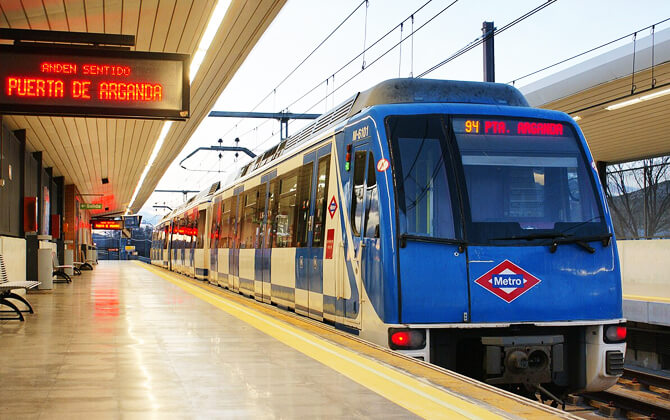
Connections to Other Systems
Madrid Metro is part of a wider integrated public transport network in the Community of Madrid. Fares are coordinated by the Consorcio Regional de Transportes de Madrid, which manages the common ticketing framework for local transport across the region.
Alongside the metro, transportation in Madrid also includes Cercanías suburban rail, EMT Madrid city bus services, and interurban buses for trips outside the capital. Because the fare system is coordinated, it is easier to combine transport modes on one journey.
The Metro also connects directly with the Metro Ligero tramway network. ML1 links with the heavy-rail system at Pinar de Chamartín and Las Tablas, while ML2 and ML3 connect at Colonia Jardín with Line 10. Line 12 also offers direct interchange with the rest of the metro network, including Puerta del Sur and El Casar.
For rail journeys beyond Madrid, Cercanías provides additional regional coverage and also serves Adolfo Suárez Madrid-Barajas Airport at Terminal 4.
| Station | Details |
|---|---|
| Pinar de Chamartín | Connection with Lines 1 and 4 and Metro Ligero ML1 |
| Las Tablas | Connection with Metro Ligero ML1 and Line 10 |
| Colonia Jardín | Connection with ML2, ML3, and Line 10 |
| Puerta del Sur | Interchange between Line 10 and Line 12 |
| El Casar | Interchange between Line 3 and Line 12 |
| Príncipe Pío | Cross-platform interchange involving the Ramal and Line 6 |
On some parts of the network, transfers are especially convenient. Cross-platform interchange is available at the A/B split stations on Lines 7, 9, and 10.
Airport Connections
Madrid Airport is connected to the city by Metro Line 8, running between Nuevos Ministerios and Aeropuerto T4. The metro operating hours on this route are 6:00 am to 1:30 am, and the trip from the start of Line 8 takes about 13 to 15 minutes.
There are two airport stations on the metro route plan: Aeropuerto T1-T2-T3 for Terminals 1, 2, and 3, and Aeropuerto T4 for Terminal 4. The ride between these two stations takes about 5 minutes. Barajas station lies between them, but it serves the town of Barajas rather than the airport itself.
If you are coming from other parts of Madrid, you can transfer to Line 8 at Nuevos Ministerios. From Atocha Renfe, the draft route is Line 1 to Tribunal, then Line 10 to Nuevos Ministerios, and finally Line 8 to the airport. From Madrid Chamartín, take Line 10 to Nuevos Ministerios and change there.
The airport journey uses a Special Service fare. Depending on what ticket or pass you already have, you may need a Zone A ticket plus the airport supplement, a combined single ticket, or a separate airport supplement ticket. Pass holders and Tourist Card users do not pay the airport supplement, and children under 4 travel free.
If the metro is not the best fit, especially with lots of luggage, other options mentioned are Airport Bus 203 from central Madrid and the Cercanías train to Terminal 4.
| Station | Details |
|---|---|
| Nuevos Ministerios | Main city interchange for Line 8 airport services |
| Aeropuerto T1-T2-T3 | Serves Terminals 1, 2, and 3 |
| Barajas | Town station between the two airport stops, not inside the airport |
| Aeropuerto T4 | Serves Terminal 4 |
Tips and Rules
Madrid Metro is easy to use, but a few practical rules help. All pay-per-ride metro tickets must be loaded onto a Tarjeta Multi, a contactless and transferable smart card. You can buy it at Metro and Metro Ligero stations from machines marked with the red Tarjeta MULTI Disponible AQUÍ sticker, as well as at tobacco shops and other authorized retailers.
Single tickets expire on the day of purchase. Single bus tickets and Airport Express shuttle tickets cannot be loaded onto the Multi card and must be bought separately. If you expect to use public transport often during your stay, a Tourist Travel Pass may be the simplest option. Children under 4 travel free.
Inside stations, follow line and direction signs and check platform displays or onboard next-stop screens before boarding. A quick check saves time.
- Stand back and let passengers get off before boarding.
- On escalators, stand on the right so others can pass on the left.
- Offer priority seats to elderly passengers, pregnant women, and people with disabilities.
- Keep your belongings close, especially on crowded trains.
There are also some specific travel rules across the system.
- Dogs are allowed, one per passenger, on a lead and muzzle in the last coach, but not during morning and afternoon rush hours.
- Bicycles are allowed at certain times, usually in the first or last coach.
- Electric scooters are not allowed on the Community of Madrid public transport network.
- Some stations have lifts, and the official stations map marks accessible stations clearly.
For airport travel, Line 8 is convenient, but if you are carrying heavy luggage and need multiple changes, the bus or Cercanías may be easier.
The metro is generally considered a safe way to get around, but basic awareness still matters in busy areas.
Interesting Facts
Madrid Metro opened in 1919 and has grown into a large urban transport system with 13 heavy-rail lines and 3 Metro Ligero lines. By September 2025, the conventional network measured 296.6 km (184.3 miles), with another 27.8 km (17.3 miles) of light rail.
It is one of the biggest metro networks in Europe, ranking third in length behind only the Moscow Metro and the London Underground. In 2024, the full system carried 715 million passengers, which puts it among the continent’s busiest public transport networks.
One unusual feature is the direction of travel. Heavy-rail trains run on the left, even though road traffic in Spain keeps right. Metro Ligero lines run on the right, largely because much of the network is at street level.
The system also has a distinctive timetable. Trains normally run every day from 06:00 to 01:30. Plans for later night service on Fridays and Saturdays were halted by the pandemic, so the network still closes at 01:30 throughout the week as of February 2026.
That said, the metro has stayed open 24 hours on special occasions, including World Pride in 2017 and the Madrid snowstorm in January 2021.
Another notable point is how far the route reaches beyond the city proper. Since Line 9 was extended to Rivas-Vaciamadrid and Arganda del Rey in 1999, nearly a third of the network has been outside the municipality of Madrid while still within the Community of Madrid.
The system also saw one of Europe’s fastest periods of metro expansion. Between 1995 and 2011, 172 km (106.9 miles) of new line and 132 stations were added, an average of more than 10 km (6.2 miles) per year.
Metro Ligero began operating in 2007. These trams were built for areas where demand did not justify a full heavy-rail metro line.
Madrid Metro also preserves pieces of its history. Chamberí station closed when platforms were lengthened, then later reopened as a museum. Other stations contain archaeological and historical remains discovered during construction or renovation works.
History
The Madrid Metro, or Metro de Madrid, opened in 1919 and has expanded through many phases over more than a century. Today it includes 13 conventional heavy-rail lines and 3 Metro Ligero lines, managed mainly by Metro de Madrid S.A., which is owned by the Government of the Community of Madrid.
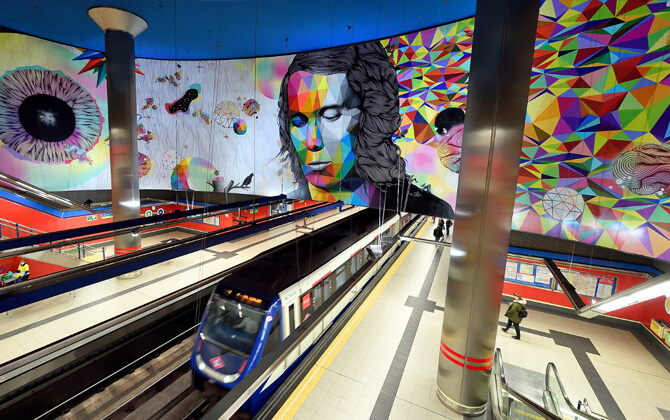
1916–1918: conception and financing
On 19 September 1916, a royal decree approved the four-line plan for the Madrid Metro. Engineers Mendoza, González Echarte, and Otamendi then began raising the 8 million pesetas needed for the first phase, including Line 1 between Sol and Cuatro Caminos. Banco de Vizcaya offered 4 million pesetas on the condition that the public would provide the other 4 million. After fundraising efforts and public donations, King Alfonso XIII invested 1.45 million pesetas of his own money.
1919: construction and inauguration
The first phase was completed in 1919. It was built to a narrow profile, with stations featuring 60 m (0.06 km / 0.04 miles) platforms. Madrid Metro was inaugurated on 17 October 1919 by King Alfonso XIII. At that point, the system had one line measuring 3.48 km (2.16 miles) between Puerta del Sol and Cuatro Caminos, with eight stops.
Two days later, on 19 October 1919, the metro opened to the public. On its first day, 390 trains ran and 56,220 passengers used the system. The company later issued 12,000 new shares to help fund further expansion.
1920s to 1980s: early growth and postwar expansion
During the 1920s, Line 1 was extended and Line 2 began to develop. In 1924, Madrid switched from left-hand to right-hand road traffic, but the metro’s heavy-rail lines continued running on the left. By 1936, the network had three lines and a branch line between Ópera and the old Estación del Norte.
During the Spanish Civil War, many stations were used as air raid shelters. After the war, the system kept growing. A fourth line opened in 1944, and in the 1950s the branch between Goya and Diego de León was absorbed into Line 4. In the 1960s, a suburban railway was built between Plaza de España and Carabanchel, and Line 5 was added. Around that time, Line 1 platforms were enlarged from 60 m to 90 m (0.06 to 0.09 km / 0.04 to 0.06 miles), which led to the permanent closure of Chamberí station. It later reopened as a museum.
In the early 1970s, the network expanded again to meet demand created by population growth and urban sprawl. New lines were planned with 115 m platforms, and Lines 4 and 5 were also lengthened. A management crisis in 1979 interrupted development, but projects already underway were completed during the 1980s. By 1983, the network had reached 100 km (62.1 miles) of track.
Expansion from the 1990s
A major expansion began in 1995. Between then and 2011, 172 km (106.9 miles) of new line and 132 new stations were opened in four phases. This included extensions of Lines 1, 4, and 7, the construction of Line 11, the merger of Lines 8 and 10 into a longer Line 10, and a new Line 8 giving access to the airport. Line 9 was extended to Rivas-Vaciamadrid and Arganda del Rey, becoming the first line to go beyond Madrid’s municipal boundary. During this period, control of the network was transferred to Metro de Madrid S.A.
In the early 2000s, more projects added about 50 km (31.1 miles) of new tunnels. These works included extending Line 8 to connect central Madrid with the airport and building MetroSur, one of Europe’s largest civil engineering projects. MetroSur became Line 12, a 41 km (25.5 miles) loop linking Móstoles, Alcorcón, Leganés, Getafe, and Fuenlabrada, and it opened on 11 April 2003. The same broader strategy also brought metro service to many districts and outskirts that had previously been unserved, while three Metro Ligero lines were built for the western and northern suburbs.
Since 2008, expansion has slowed sharply. The financial crisis delayed several projects, and during the 2010s the focus shifted toward improving the existing system. Only a few extensions were completed in that decade, including Line 11 to La Fortuna, Line 2 to Las Rosas, and Line 9 to Mirasierra and then Paco de Lucía.
The network marked its 100th anniversary on 17 October 2019. In April 2025, Line 3 was extended to El Casar in Getafe, ending a ten-year period without new line extensions in the city.
Historic rolling stock
For much of its history, the metro operated with limited investment and kept some trains in service far beyond their intended lifespan. One especially unpopular example was on Line 5, which used nearly 40-year-old series 300 and 1000 trains built by CAF.
Future Extensions
After almost ten years without a new station, Madrid Metro is entering another growth phase. The network is expected to reach 311 stations as several long-planned expansion projects move ahead and reshape cross-city transport.
Line 11 as the main project
The biggest project is the expansion of Line 11, often described as the diagonal line. It is planned to run from Cuatro Vientos in the south to Valdebebas in the north, linking areas such as Madrid Río, Comillas, and the Zendal Hospital. The project adds 33 km (20.5 miles) of track and includes stations such as Ciudad de la Justicia, IFEMA-Cárcavas, and Valdebebas Norte.
In the central section, Comillas and Madrid Río are already in operation between Plaza Elíptica and Conde de Casal, improving mobility in districts including Carabanchel and Arganzuela.
Airport links and cross-city connections
Line 5 is planned to extend to Barajas Airport terminals T1, T2, and T3, improving airport access from central Madrid. No intermediate stations are planned, and the works are expected to take around three years.
Line 8 is also being studied for a possible new station between Nuevos Ministerios and Colombia, which could improve the connection between Santiago Bernabéu and the airport. For now, though, there is no start date, and it would not be ready before 2030.
Southern, eastern and northern growth
In the south, Line 3 will gain a 2.6 km (1.6 miles) branch connecting Villaverde Alto with El Casar, strengthening integration with Cercanías. Line 9 is planned to extend toward Los Ahijones and Los Berrocales, with completion estimated for 2029.
In the north, the future Line 13 is expected to connect Chamartín’s new financial center with development areas such as Fuencarral Sur and Fuencarral Norte. With three stations over 3 km (1.9 miles), it is intended to support growth in that part of the city.
Even with these route plan projects, some challenges remain, including the unresolved Henares Corridor connection. Madrid’s population continues to grow by more than 100,000 people per year, so further expansion is likely to remain a major transport issue.
| Station | Details |
|---|---|
| Line 11 | Planned from Cuatro Vientos to Valdebebas, 33 km (20.5 miles) |
| Line 5 | Planned extension to Barajas Airport terminals T1, T2, and T3 |
| Line 8 | Possible new station between Nuevos Ministerios and Colombia |
| Line 3 | Planned 2.6 km (1.6 miles) branch from Villaverde Alto to El Casar |
| Line 9 | Planned extension toward Los Ahijones and Los Berrocales |
| Line 13 | Future line linking Chamartín with northern development areas |
Nearby Attractions
Madrid Metro is more than a way to move around the city. Quite a few stations lead directly to cultural, historical, and artistic points of interest, both underground and at street level. If you want your route to double as sightseeing, these stops are worth noting.
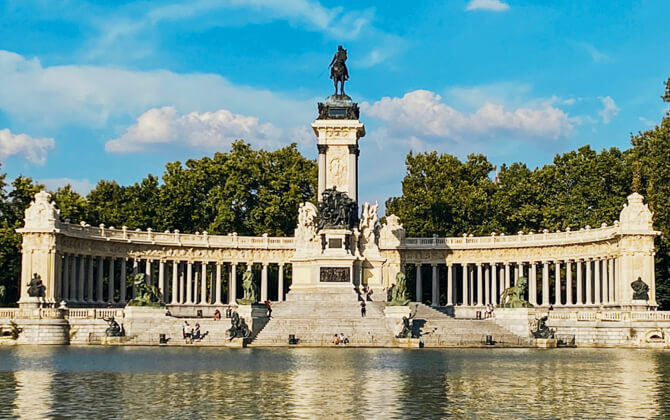
Stations with unique attractions
| Station | Details |
|---|---|
| Feria de Madrid | Ceramic mural honoring the nations and peoples of the earth |
| Ópera | Caños del Peral Museum with archaeological remains, the Amaniel Aqueduct, and the Arenal Sewer |
| Goya | Platform artwork inspired by Francisco de Goya, including references to The Caprichos, The Follies, and Bullfighting |
| Pacífico | Next to the former metro power station with original early-20th-century machinery |
| Carpetana | Paleontological museum with prehistoric fossils and a recreated mastodon |
| Chamberí | Preserved ghost station with original ticket offices, platforms, billboards, and turnstiles |
| Príncipe Pío | Paleontological remains and replicas of fossilized skulls found during interchange works |
| Madrid-Chamartín-Clara Campoamor | Historic Trains Exhibition with vintage trains and original metro objects |
| Paco de Lucía | Permanent mural dedicated to the flamenco guitarist and songwriter |
| Rubén Darío | Large vinyl works honoring Antonio Mingote and metro history |
Art, history, and museum stops
| Station | Details |
|---|---|
| Gran Vía | Replica of the original Antonio Palacios entrance and a small museum with archaeological remains |
| Atocha | Station of art with 36 reproduced works from the Prado, Reina Sofía, and Thyssen-Bornemisza museums |
| Plaza de Castilla | Mural by Paco Roca dedicated to older people |
| La Latina | Ceramic mural dedicated to Lina Morgan |
| Manuela Malasaña | Illustrated portraits and biographies of notable women in history |
These stations show how Madrid Metro blends transport, history, and culture. Sometimes the station itself ends up being part of the visit.