The Delhi Metro is the largest and busiest metro rail system in India, serving Delhi and nearby NCR cities including Faridabad, Gurugram, Ghaziabad, Noida, Bahadurgarh, and Ballabhgarh. This public transport system has 10 colour-coded lines, 271 stations, and a network length of 374.466 km (232.682 mi). It includes underground, elevated, and at-grade sections, runs more than 4,300 trips a day, and connects with other local transport systems such as Rapid Metro Gurgaon, Noida Metro, and the Delhi-Meerut RRTS. Construction began in 1998, the first section opened in 2002, and the system is operated by DMRC.
| Key | Information |
|---|---|
| System | Delhi Metro rapid transit system operated by DMRC |
| Coverage | Delhi and NCR cities including Faridabad, Gurugram, Ghaziabad, Noida, Bahadurgarh, and Ballabhgarh |
| Lines | 10 colour-coded lines |
| Stations | 271 |
| Network length | 374.466 km (232.682 mi) |
| Daily trips | More than 4,300 |
| Opening | First section opened on 25 December 2002 |
| Construction start | 1998 |
| Ridership | 235.8 crore (2.35 billion) annual ridership in 2025 |
Map of Delhi Metro
Map of Delhi Metro showing different lines and stations. Click on the map to enlarge it or download the Delhi Metro map in PDF format.
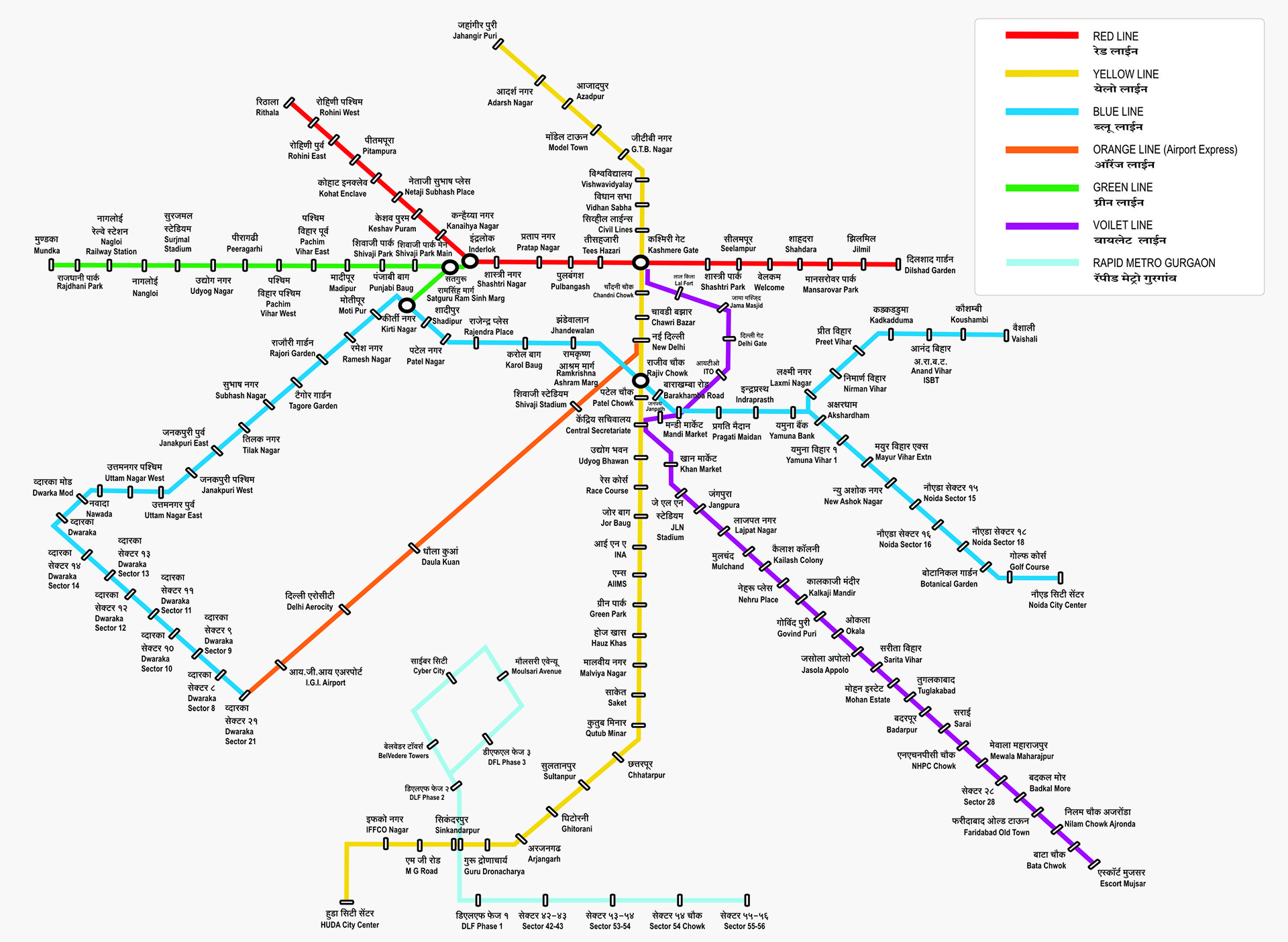
Delhi Metro Route Lines and Stations
The Delhi Metro route network covers Delhi and nearby NCR cities through a large, easy-to-follow system of colour-coded lines. It has 271 stations across 374.47 km (232.68 mi), with elevated, underground, and at-grade sections. For daily city transport, the network is a major backbone, and peak train frequency usually reaches 2 to 3 minutes.
The system also links with other transport networks. Important interchanges connect the metro with Gurgaon Metro, Noida Metro, the Delhi-Meerut RRTS, Indian Railways, and major bus terminals. If you are checking a stations map or building a route plan, these transfer points matter a lot.
Delhi Metro Lines
| Station | Details |
|---|---|
| Red Line | Rithala to Shaheed Sthal (New Bus Adda) |
| Yellow Line | Samaypur Badli to Millennium City Centre Gurugram |
| Blue Line | Dwarka Sector 21 to Noida City Centre, with a branch to Vaishali |
| Green Line | Inderlok to Brigadier Hoshiyar Singh, with a branch connecting Ashok Park Main and Kirti Nagar |
| Violet Line | Kashmere Gate to Raja Nahar Singh |
| Airport Express Line | New Delhi to Yashobhoomi Dwarka Sector 25 |
| Pink Line | Majlis Park to Shiv Vihar |
| Magenta Line | Janakpuri West to Botanical Garden |
| Grey Line | Dwarka to Dhansa Bus Stand |
Each line has its own colour, which makes the stations list and route map much easier to read.
Key Interchange Stations
| Station | Details |
|---|---|
| Kashmere Gate | Interchange for the Red, Yellow, and Violet lines |
| Rajiv Chowk | Interchange for the Blue and Yellow lines |
| Central Secretariat | Interchange for the Yellow and Violet lines |
| New Delhi | Interchange for the Yellow Line and Airport Express Line, with a connection to New Delhi Railway Station |
| Hauz Khas | Interchange for the Yellow and Magenta lines |
| Janakpuri West | Interchange for the Blue and Magenta lines |
| Botanical Garden | Interchange for the Blue and Magenta lines |
| Lajpat Nagar | Interchange for the Violet and Pink lines |
| Dwarka Sector 21 | Interchange for the Blue Line and Airport Express Line |
| Dwarka | Interchange for the Grey and Blue lines |
Several stations also connect directly to major rail and bus hubs, including Anand Vihar Railway Terminal, Anand Vihar ISBT, Kashmere Gate ISBT, and Delhi Junction Railway Station.
Service and Network Facts
- The system has 193 elevated stations, 71 underground stations, and 7 at-grade stations.
- There are 27 transfer stations in the network.
- The metro carries an average daily count of 2,760,000 commuters.
- More than 4,300 trips run each day.
- The network has grown through multiple phases since 2002.
Delhi Metro Timings
The Delhi Metro operating hours generally run from around 5:00 a.m. to 11:30 p.m., though exact opening times, working hours, and closing time vary by line and station. The Airport Express starts earlier than most lines. If you need timings today or the last train for a specific station, check the train schedule for your boarding point and destination.
Here is a quick timetable with typical first train and last train timings for major lines.
| Service detail | Timings |
|---|---|
| Red Line | Typical first train 5:25 a.m. to 5:30 a.m.; typical last train 11:00 p.m. to 11:17 p.m. |
| Yellow Line | Typical first train 5:45 a.m. to 5:50 a.m.; typical last train 11:00 p.m. |
| Blue Line | Typical first train 5:45 a.m. to 6:12 a.m.; typical last train 10:32 p.m. to 11:00 p.m. |
| Green Line | Typical first train 6:00 a.m. to 6:10 a.m.; typical last train 10:40 p.m. to 11:00 p.m. |
| Violet Line | Typical first train 5:40 a.m. to 6:00 a.m.; typical last train 10:36 p.m. to 11:00 p.m. |
| Pink Line | Typical first train 6:00 a.m.; typical last train 11:00 p.m. |
| Magenta Line | Typical first train 5:40 a.m. to 6:00 a.m.; typical last train 11:00 p.m. |
| Grey Line | Typical first train 6:00 a.m.; typical last train 11:00 p.m. |
| Airport Express Line | Typical first train 4:40 a.m. to 5:00 a.m.; typical last train 11:15 p.m. to 11:40 p.m. |
Schedule today can differ at interchange stations and terminals, so the exact route timetable may change slightly depending on direction and station.
Delhi Metro Fares
Delhi Metro fare is distance-based. For most lines, the one-way ticket price starts at Rs 10 ($0.12) and goes up to Rs 60 ($0.72). The final cost depends on the distance between stations, so a fare calculator is useful when planning a trip.
| Distance | Token Fare | Smart Card Fare |
|---|---|---|
| Up to 2 km (1.24 mi) | Rs 10 ($0.12) | Rs 9 ($0.11) |
| 2 to 5 km (1.24 to 3.11 mi) | Rs 20 ($0.24) | Rs 18 ($0.22) |
| 5 to 12 km (3.11 to 7.46 mi) | Rs 30 ($0.36) | Rs 27 ($0.33) |
| 12 to 21 km (7.46 to 13.05 mi) | Rs 40 ($0.48) | Rs 36 ($0.43) |
| 21 to 32 km (13.05 to 19.88 mi) | Rs 50 ($0.60) | Rs 45 ($0.54) |
| Above 32 km (19.88 mi) | Rs 60 ($0.72) | Rs 54 ($0.65) |
Using a smart card lowers the fare by 10% on regular journeys. It also makes entry and exit quicker, which is handy during busy hours.
The Airport Express Line has a separate price structure. Based on the available fare details, single-trip fares range from Rs 10 ($0.12) to Rs 70 ($0.84), depending on the route.
| Distance | Token Fare | Smart Card Fare |
|---|---|---|
| New Delhi to IGI Airport | Rs 60 ($0.72) | Rs 60 ($0.72) |
| Shivaji Stadium to IGI Airport | Rs 50 ($0.60) | Rs 50 ($0.60) |
| Dhaula Kuan to IGI Airport | Rs 40 ($0.48) | Rs 40 ($0.48) |
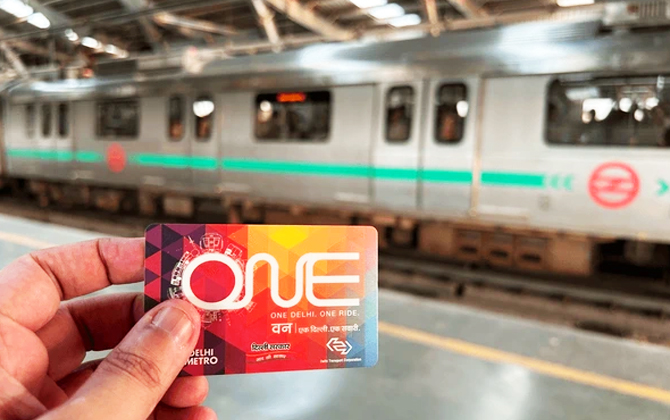
Ticket options include single journey tokens, paper QR tickets, electronic QR tickets, smart cards, tourist cards, and NCMC cards. Tourist cards are offered as a 1-day pass and a 3-day pass. On the Airport Express, trip cards and store value cards are also accepted.
Connections to Other Systems
The Delhi Metro is closely connected to other public transport systems in the National Capital Region. These links make transportation in and around Delhi much easier, especially for longer cross-city journeys.
Existing interchanges include Rapid Metro Gurgaon, Noida Metro, and the Delhi-Meerut RRTS. Delhi Metro also has shared ticketing with Rapid Metro Gurgaon, and DMRC took over its operations on 22 October 2019.
Several lines already extend beyond Delhi:
- The Yellow Line connects to Gurugram.
- The Blue Line connects to Noida and Ghaziabad.
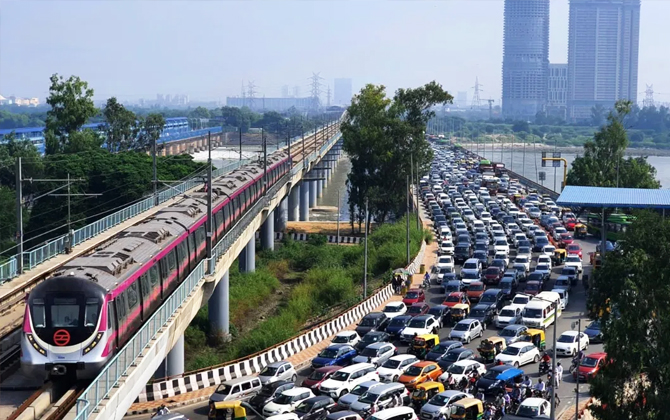
- The Violet Line connects Delhi with Faridabad and Ballabhgarh.
The system also connects with Indian Railways and major bus terminals at stations such as New Delhi, Anand Vihar, Kashmere Gate, and Chandni Chowk. That mix of metro, rail, and bus links makes it one of the most important city transport networks in the region.
Airport Connections
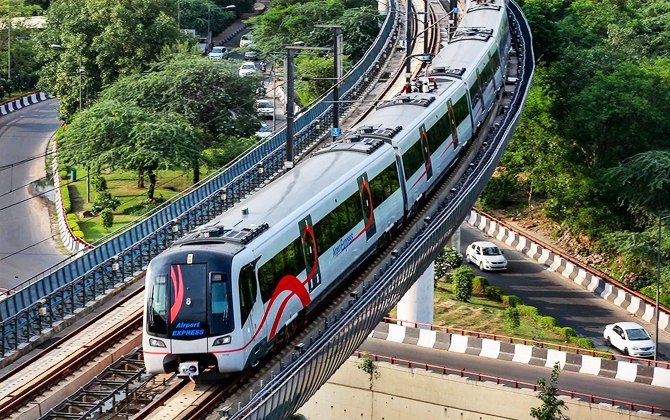
The Airport Express Line, also called the Orange Line, provides a fast path train connection between New Delhi and IGI Airport. Stations on this route include New Delhi, Shivaji Stadium, Dhaula Kuan, Delhi Aerocity, IGI Airport (T-3), Dwarka Sector 21, and Yashobhoomi Dwarka Sector 25.
Its opening hours run from early morning until late night. From New Delhi, the starting time is 4:45 a.m. and the last train leaves at 11:40 p.m. From Dwarka Sector 21, the first train is at 4:45 a.m. and the last train is at 11:15 p.m. Frequency is every 10 minutes in peak hours and every 15 minutes in non-peak hours.
The fare from New Delhi to IGI Airport or Dwarka Sector 21 is Rs 60 ($0.72). Metro pass options are also available for 30 and 45 trips, priced at Rs 1,600 ($19.28) and Rs 2,000 ($24.10) for travel from New Delhi to IGI Airport.
The helpline number listed for the Airport Express Line is 011-22561231. The line also offers city check-in facilities at New Delhi Metro Station for select airlines.
Terminal 3 is directly connected to the IGI Airport metro station. Terminal 2 can be reached from the same station by a covered walk. Terminal 1 is served by the Magenta Line, not the Airport Express.
Delhi Metro Parking
Delhi Metro provides station parking at selected locations through Park and Ride facilities. These lots are meant to support metro users and encourage wider use of public transport. Parking is managed by outsourced agencies and is designed to prioritize efficient turnover, feeder modes, bicycles, and access for differently-abled passengers.
Parking charges
| Vehicle | Up to 6 hrs. | Up to 12 hrs. | More than 12 hrs. |
|---|---|---|---|
| Car | Rs 20 ($0.24) | Rs 30 ($0.36) | Rs 40 ($0.48) |
| Bike | Rs 10 ($0.12) | Rs 15 ($0.18) | Rs 20 ($0.24) |
| Cycle | Rs 3 ($0.04) | Rs 4 ($0.05) | Rs 5 ($0.06) |
Monthly parking charges and night charges also apply in some cases. Night charges cover the period from 00:00 to 05:00.
| Vehicle | Monthly | Night Charges Daily | Night Charges Monthly |
|---|---|---|---|
| Car | Rs 1000 ($12.05) | Rs 40 ($0.48) | Rs 1000 ($12.05) |
| Bike | Rs 475 ($5.72) | Rs 20 ($0.24) | Rs 475 ($5.72) |
| Cycle | Rs 45 ($0.54) | Rs 5 ($0.06) | Rs 45 ($0.54) |
Parking availability
Parking is available at many stations across the network, including selected Red Line stations and major interchange hubs. Availability may change over time.
Parking rules and facilities
- Goods vehicles are not allowed in parking lots during revenue hours from 06:00 to 23:00.
- Bulk parking, such as showroom vehicle parking, is not allowed during revenue hours.
- Separate areas should be provided for cars, two-wheelers, and cycles.
- Reserved ECS spaces should be kept near station entry for differently-abled passengers.
- Parking receipts are issued where smart-card collection is not available.
- Vehicles should be collected within 48 hours, or DMRC may move them to a dumping yard after required formalities.
Contractors are also required to provide boom barriers, CCTV, attendants, lighting, safety arrangements, and clear displays of parking charges per day and occupancy status.
Bicycle Rental at Delhi Metro Stations
Delhi Metro offers bicycle rental at selected stations to improve last-mile travel. The service includes both pedal cycles and battery-operated cycles parked outside stations for easy pickup.
A total of 994 cycles are available under the cycle-sharing system. Pedal cycles are available at 11 stations, while battery-operated cycles are available at 41 stations.
| Station | Details |
|---|---|
| Pedal cycle stations | Dilshad Garden, Mandi House, Kashmere Gate, Barakhamba Road, Kohat Enclave, Rohini East, Indralok, GTB Nagar, Rithala, Vishwavidyalaya |
| Battery cycle stations | AIIMS, Panchsheel Park, IIT, Barakhamba Road, Shivaji Stadium, Janpath, Bhikaji Cama Place, Jangpura, JLN Stadium, Central, Secretariat, Assembly, Supreme Court, Chirag Delhi, South Extension, RK Puram, Patel Chowk, Udyog Bhawan, Malviya Nagar, Vinobhapuri, Vasant Vihar, GTB Nagar, Civil Lines, Lajpat Nagar, Mandi House, Shalimar Bagh, Khan Market, SV Moti Bagh, Delhi Haat-INA, Jor Bagh, Munirka, DD South Campus, Moolchand, Nehru Enclave, Greater Kailash, Model Town, Qutub Minar, Green Park, Hauz Khas, Kalkaji Mandir, Saket, Vishwavidyalaya |
To use the service, riders generally need to register and provide valid ID. Some operators also allow access through a mobile app or smart card. GreenRide users can register in the app, recharge in multiples of Rs 50 ($0.60), scan the QR code on a bicycle, and return it at a nearby station.
Rental price varies by operator. Greenolution and Planet Advertising Pvt. Ltd. charge Rs 10 ($0.12) per hour. GreenRide starts at Rs 10 ($0.12) for 60 minutes. Its operating hours are listed as 8:00 a.m. to 8:00 p.m., Monday to Saturday, with Sunday and gazetted holidays closed. Some stands are noted as running from 8:00 a.m. to 8:00 p.m. in summer and 8:00 a.m. to 7:00 p.m. in winter. Another listed fare is Rs 10 ($0.12) for the first 4 hours, then Rs 2 ($0.02) extra after that.
Operators mentioned in the source material include Greenolution, Planet Advertising Pvt. Ltd., and Delhi Cycles Pvt. Ltd.
- Greenolution operates cycle stands at Shastri Park, Hauz Khas, Saket, M G Road, Dwarka Sector-14, Akshardham, and Neb Sarai.
- Planet Advertising Pvt. Ltd. operates cycle stands at Barakhamba Road, Patel Chowk, Mandi House, Kohat Enclave, and Rithala.
- Delhi Cycles Pvt. Ltd. operates cycle stands at Rohini East, Vishwavidyalaya, and GTB Nagar, with free renting mentioned in the source material.
Rules and Tips
If you are using the Delhi Metro for the first time, a few simple rules make the trip smoother and safer. Listen to announcements, follow station instructions, and keep your journey orderly.
Basic Travel Etiquette
- Listen to announcements and follow them.
- Wear a mask when required.
- Do not sit on the floor.
- Do not lean against the train doors.
- Keep your bag in front of you while traveling.
- Give priority to ladies on ladies’ seats.
- Offer seats to senior citizens and pregnant women first.
- Let passengers get off before boarding.
- Do not eat inside the metro.
- Keep the system clean and do not litter.
First-Time Journey Tips
- Take a coupon ticket from the ticket window.
- The ticket vendor enters your destination and journey type.
- Use the coupon-reading machine to open the barrier.
- Go through the security check.
- Reach the platform by elevator or escalator.
- Queue and wait for the train.
- Ask station attendants if you need help.
- Let passengers exit before you board.
- At your destination, insert the coupon into the machine.
Common Fares and Penalties
Rules are enforced strictly, and violations can lead to fines or other penalties. The source material mentions drunkenness or misbehavior, carrying dangerous material, unauthorized entry, walking on the track, traveling without a ticket, misuse of the alarm, defacing public notices, unauthorized selling, and obstructing metro operations or officials.
A single Pay-Per-Ride MetroCard can be used by up to four people traveling together. You can also get off before your destination, since intermediate exits are allowed.
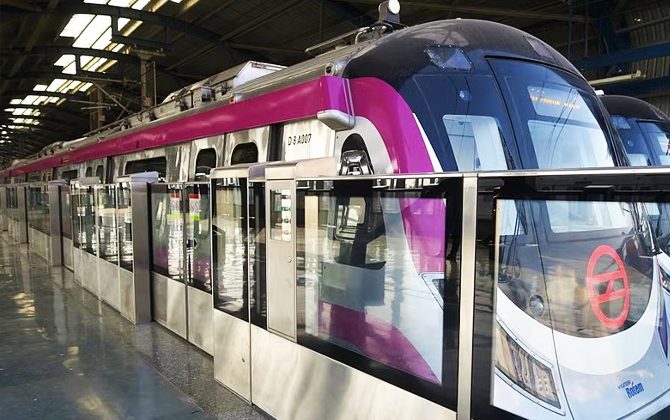
Fun Facts
The Delhi Metro is India’s largest and busiest metro rail system, with 10 lines, 271 stations, and a total length of 374.466 km (232.682 mi). It runs more than 4,300 trips every day and reaches several NCR cities.
Construction started in 1998, and the first elevated section opened on the Red Line on 25 December 2002. The first underground section opened on the Yellow Line on 20 December 2004. Phase I was completed in 2006, ahead of schedule and on budget.
In 2011, DMRC was certified by the United Nations as the first metro rail and rail-based system in the world to receive carbon credits for reducing greenhouse-gas emissions. The source material says this helped cut annual carbon emissions in the city by 630,000 tonnes.
The Green Line was the first standard-gauge line. The Magenta Line became the first driverless line, and the Pink Line began driverless operations shortly before it. The Pink Line is the longest line in the system, while the Grey Line is the shortest.
Hauz Khas is listed as the deepest station in the source material at 29 metres (0.029 km, 0.018 mi) below ground. Dhaula Kuan is the highest point mentioned, at 23.6 metres (0.024 km, 0.015 mi) above ground.
The system is also known for practical design details. Escalators include sari guards, and trains use even numbers of coaches such as four, six, or eight. Patel Chowk is home to the Metro Museum, described as South Asia’s only rapid-transit museum.
History
The idea of a mass rapid transit system for New Delhi dates back to a 1969 traffic and travel study. In 1984, the Urban Arts Commission proposed a multi-modal transport plan with three underground corridors, along with improvements to suburban rail and roads.
As Delhi expanded, congestion, pollution, and overloaded bus services became more serious. Between 1981 and 1998, the city’s population doubled and the number of vehicles increased five-fold.
DMRC was set up on 3 May 1995 by the Government of India and the Government of Delhi, with E. Sreedharan as managing director. After Union Cabinet approval in September 1996, Japan provided official development assistance loans in 1997 to help finance Phase I.
Construction began on 1 October 1998. DMRC was given unusual autonomy so it could hire staff, award tenders, and manage funds more independently. It also hired Hong Kong MTRC as a technical consultant. In 2000, a major dispute emerged when the Ministry of Railways required broad gauge instead of DMRC’s preferred standard gauge, increasing costs.
The first section, between Shahdara and Tis Hazari on the Red Line, opened on 24 December 2002. The first underground section, between Vishwa Vidyalaya and Kashmere Gate on the Yellow Line, opened on 20 December 2004. Phase I was completed in 2006 on budget and ahead of schedule.
Phase II expanded the network with new lines and extensions to Noida, Ghaziabad, and Gurugram. Phase III focused on better connectivity, additional extensions, ring corridors, and the Grey Line. It also introduced driverless operations on the Magenta Line in December 2021 and the Pink Line in November 2021.
The final section of Phase III opened on 18 September 2021 with the Grey Line extension from Najafgarh to Dhansa Bus Stand. The Airport Line was later extended to Yashobhoomi Dwarka Sector 25 in 2023.
Phase IV was finalized in December 2018, approved in part in March 2019, and construction began on 30 December 2019. Completion is planned for 2026.
Future Extensions
Delhi Metro expansion continues through new phases, with Phase IV under way and Phase V planned. These projects are intended to widen the network, improve route options, and strengthen links across Delhi and the wider NCR.
Phase IV and Phase V
Phase IV includes the Pink Line extension, the Magenta Line extension, the Golden Line, the Inderlok- Indraprastha link, and the Rithala-Narela-Nathupur extension. Phase V is expected to add more corridors, including the Central Vista Corridor, the Aerocity-Terminal 1 link, and the Tughlakabad-Kalindi Kunj corridor, along with additional routes in Delhi, Haryana, and Uttar Pradesh.
Connectivity Beyond Delhi
Future extensions are also planned toward Gurugram, Ghaziabad, Noida, Faridabad, Jhajjar, and Sonipat. These proposals aim to improve integration with existing metro systems and regional rail services.
Integration with RRTS
Planned interchange points with the Delhi-Meerut RRTS include Sarai Kale Khan, New Ashok Nagar, and Anand Vihar. These links should make regional travel smoother across the NCR network.
Nearby Attractions
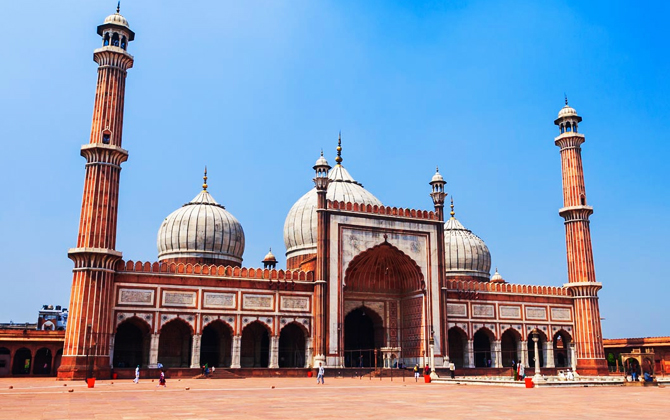
Delhi Metro makes it easy to reach many of the city’s best-known attractions, from historic sites to shopping districts and museums. A lot of popular places are just a short ride or walk from major stations.
Frequently mentioned attractions include Connaught Place, Jama Masjid, Chandni Chowk, Gurudwara Sis Ganj Sahib, Agrasen ki Baoli, Jantar Mantar, India Gate, Purana Qila, Akshardham Temple, and the National Zoological Park. Stations such as Rajiv Chowk, Chandni Chowk, Jama Masjid, Akshardham, Supreme Court, and Central Secretariat are commonly used for sightseeing.
- Connaught Place
- Agrasen ki Baoli
- Jama Masjid
- Chandni Chowk
- Gurudwara Sis Ganj Sahib
- Jantar Mantar
- India Gate
- Purana Qila
- Akshardham Temple
- National Zoological Park
For a day out by metro, this is a practical mix of history, architecture, shopping, and local food.
Delhi Metro Museum
The Delhi Metro Museum at Patel Chowk is described as the only museum about metro railway in South Asia. It may also be the only museum in the world located inside an operational metro station. Founded in 1995, it presents the history and development of DMRC through display panels, photographs, models, and technical exhibits.
The museum covers planning, construction, rail gauge details, safety systems, earthquake-resistant structures, and DMRC’s management style. Visitors can also see interactive displays, working models of the Operations Control Centre, CCTV cameras, and a tunnel boring machine.
It is located at 20, Ashoka Road, Janpath, Sansad Marg Area, close to Dak Bhavan. Nearby attractions include the National Museum, Philately Museum, Parliament Museum, Jantar Mantar, Twin Art Gallery, and Bangla Sahib Gurudwara.
Opening hours are 10:00 a.m. to 4:00 p.m. The museum is closed on Monday. Entry is free, and the contact number is 011 2334 5851.
The museum also sells souvenirs, including metro models, ties, pens, key-chains, books, and other items. It is especially useful for students, engineers, researchers, and school groups interested in urban transport, tramway history, trams, and metro systems.
- Jantar Mantar: 0.6 km (0.37 mi)
- Twin Art Gallery: 1 km (0.62 mi)
- Bangla Sahib Gurudwara: 1 km (0.62 mi)