The Berlin U-Bahn is Berlin’s rapid transit system and a core part of public transport in the German capital. Together with the S-Bahn and the tramway network, it forms the backbone of city transport. Opened in 1902, the system now has nine lines, 175 stations, and 155.64 kilometers (96.83 miles) of track, with about 80% of the route underground. It is operated by BVG and carries more than 500 million passengers a year, including 554.3 million in 2024. The network was heavily affected by World War II, the division of Berlin, and the Berlin Wall, then fully reopened after reunification.
| Key | Information |
|---|---|
| System | Berlin U-Bahn rapid transit network |
| City | Berlin, Germany |
| Operator | Berliner Verkehrsbetriebe (BVG) |
| Opening | 1902 |
| Lines | 9 |
| Stations | 175 |
| Network length | 155.64 kilometers (96.83 miles) |
| Ridership | 554.3 million passengers in 2024 |
| Typical frequency | Every 2 to 5 minutes at peak hours, every 5 minutes for most of the day, about every 10 minutes in the evening |
Berlin U-Bahn Map
Map of Berlin U-Bahn showing different lines and stations. Click on the map to enlarge it or download the Berlin U-Bahn map in PDF format.
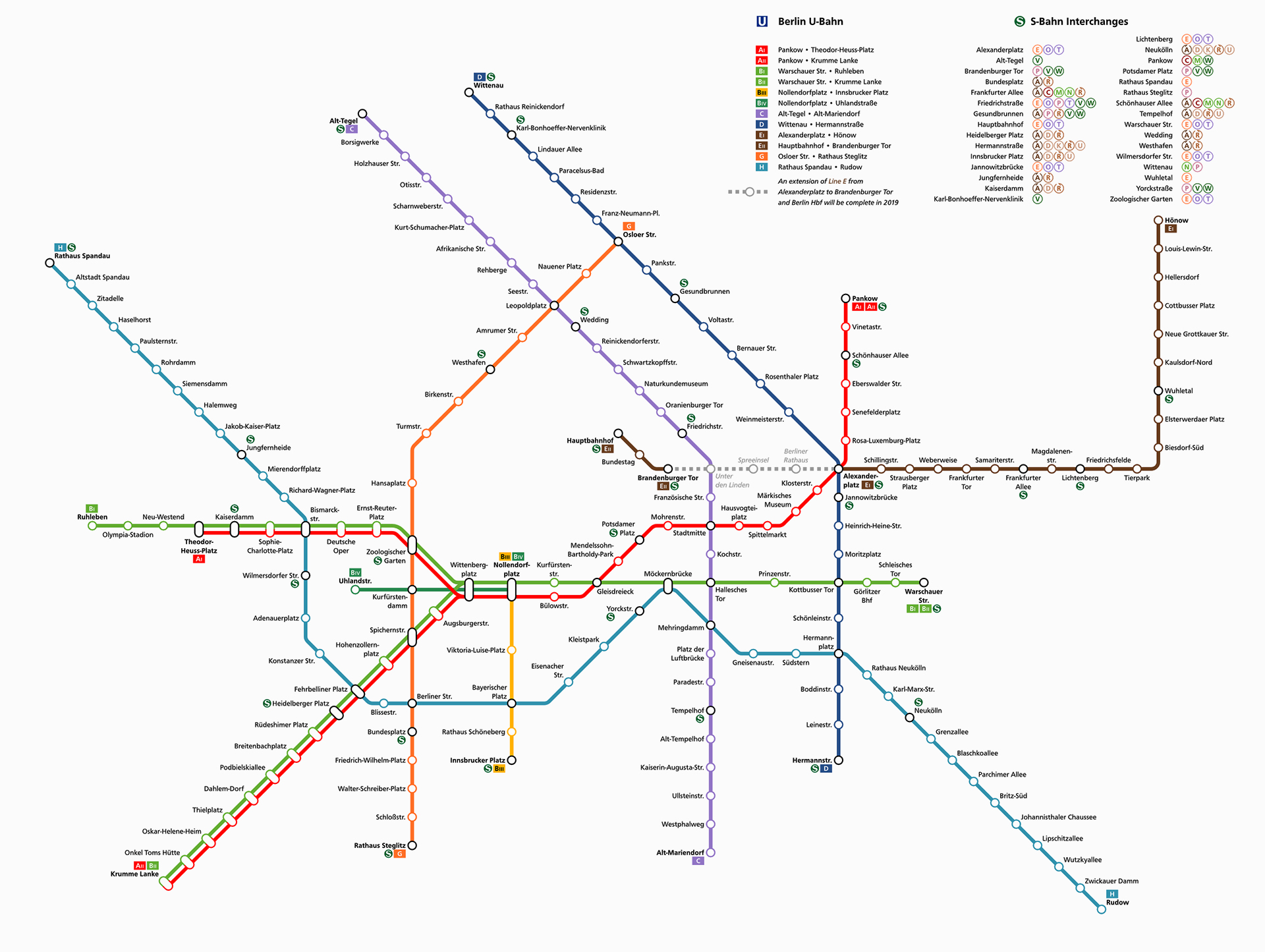
Berlin Metro Lines (U-Bahn)
The Berlin U-Bahn route network is straightforward to use and covers major districts, central interchanges, and many of the city’s best-known places. Some sections run underground, while others are above ground. If you are checking a stations map or planning a route, these are the main lines to know.
Main U-Bahn lines
| Station | Details |
|---|---|
| U1 | Runs from Uhlandstraße to Warschauer Straße and serves stops near Kurfürstendamm, Wittenbergplatz, the Kaiser Wilhelm Memorial Church, and KaDeWe. |
| U2 | Connects Ruhleben and Pankow, with key stations including Alexanderplatz and Potsdamer Platz. |
| U3 | Runs from Krumme Lanke to Nollendorfplatz and is most useful if you are staying near one of its stations. |
| U4 | The smallest line in the system, with five stations between Nollendorfplatz and Innsbrucker Platz. |
| U5 | Runs from Hönow to Alexanderplatz and is useful for reaching Friedrichshain, including Frankfurter Tor. |
| U6 | Runs from Alt-Tegel to Alt-Mariendorf and serves Friedrichstraße, Stadtmitte, Mehringdamm, and Tempelhof. Kochstraße is the closest station for Checkpoint Charlie. |
| U7 | The longest line in Berlin, running from Rathaus Spandau to Rudow through Charlottenburg, Schöneberg, Kreuzberg, and Neukölln. |
| U8 | Runs from Wittenau to Hermannstraße. |
| U9 | Connects Osloer Straße and Rathaus Steglitz, with stops near Kurfürstendamm and Zoologischer Garten. |
Route maps
Route maps are available for all nine lines: U1, U2, U3, U4, U5, U6, U7, U8, and U9. A stations list or stations map is especially helpful if you want to compare lines, plan transfers, or check the best route across the city.
Useful facts
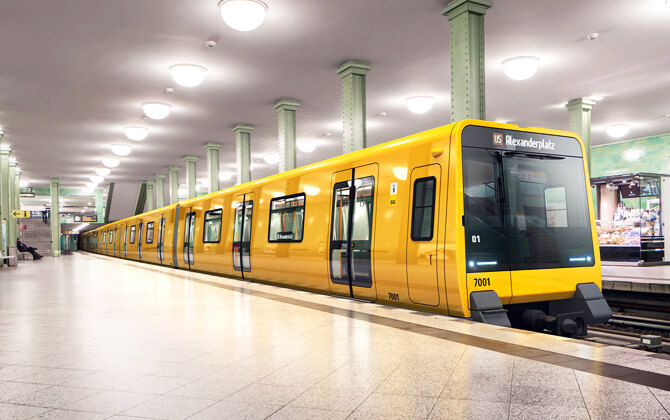
The network has about 155 kilometers (96.3 miles) of track and 175 stations. Most of the system is underground, though some stretches run above ground. The trains are yellow and operated by BVG.
As for opening hours and working hours, the U-Bahn usually runs on weekdays from 4:00 am to 1:00 am. On weekends, it runs 24 hours. During peak periods, frequency is usually every 3 to 5 minutes; at other times, every 10 minutes, and at night every 15 minutes.
Tickets are valid across Berlin public transport, including bus, trams, the S-Bahn, and the U-Bahn, which makes local transport simple to navigate.
Tickets and Fares
A valid ticket covers Berlin’s wider public transport system, including the U-Bahn, S-Bahn, buses, trams, and ferries. Fare rules depend on the tariff zone and how long the ticket stays valid.
Berlin uses AB and ABC fare zones. Zone AB covers the city center and reaches the city limits. Zone ABC also includes the surrounding area, BER Airport, and Potsdam Central Station.
| Ticket | Zones AB | Zones ABC |
|---|---|---|
| Single ticket | €4 ($4.36) | €5 ($5.45) |
| 24-hour ticket | €11.20 ($12.21) | €12.90 ($14.06) |
| 24-hour small group ticket | €35.30 ($38.48) | €37.70 ($41.09) |
| Short trip ticket | €2.80 ($3.05) | n/a |
The single ticket is valid for one person for one two-hour journey. It is one-way only, so a return trip needs another ticket. Reduced ticket price options are available for children aged 6 to 14, while children under 6 travel free.
The short trip ticket is valid for three stops on the U-Bahn or S-Bahn, or six stops on buses and trams. You cannot change vehicles with this ticket.
A 24-hour ticket allows unlimited travel for 24 hours. The small-group day pass is valid for up to five people, and one dog can be taken along.
Tickets are sold at multilingual machines in U-Bahn and S-Bahn stations, at ticket counters in larger stations, on buses from the driver, on trams from onboard machines, and in the free BVG app. Cash is not accepted on buses.
You must validate paper tickets before travel or right after boarding, depending on the mode of transport. Traveling without a valid ticket can lead to a higher fare of €60 ($65.40).
If you need a fare calculator, zone check, or pass option for transportation in Berlin, start by deciding whether your trip stays in AB or goes into zone C.
Berlin Underground Hours and Frequency of Service
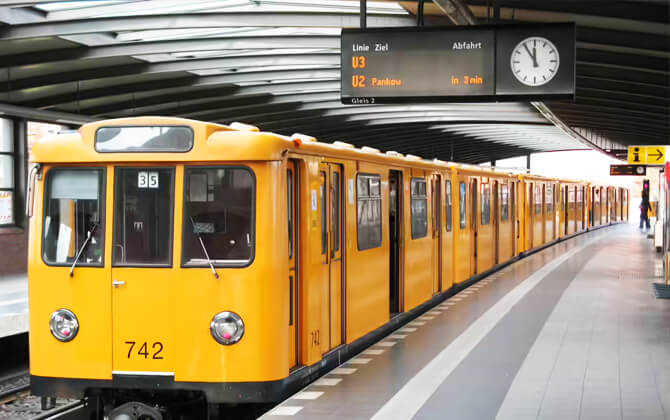
The Berlin U-Bahn has clear operating hours and a regular timetable. On weekdays, opening times are generally 4:00 am to 1:00 am. During the day, trains usually run every 5 minutes, while night service intervals are typically 10 minutes. When rail service is not running, night buses replace parts of the network.
On weekends, the system operates 24 hours a day. Most lines run every 10 minutes in daytime hours and every 15 minutes at night. On Fridays, Saturdays, Sundays, and public holidays, many routes continue almost all night, which is handy if you are checking schedule today or timings today for late travel.
Frequency changes with the time of day. In peak periods, trains may arrive every 3 to 5 minutes. Outside the busiest hours, service is less frequent but still regular enough for daily transport across the main districts and interchange points.
| Service detail | Timings |
|---|---|
| Weekday opening hours | 4:00 am to 1:00 am |
| Weekday daytime frequency | Every 5 minutes |
| Weekday night frequency | Every 10 minutes |
| Weekend operating hours | 24-hour service |
| Weekend daytime frequency | Every 10 minutes |
| Weekend night frequency | Every 15 minutes |
| Night replacement | Night buses operate when the subway is not running |
If you are looking for the starting time, closing time, last train, or route timetable for a specific line, remember that exact timings can vary by route and day.
Connections to Other Systems
The Berlin U-Bahn is tightly integrated with the city’s wider public transport network. It uses the shared VBB tariff, so one ticket can be used across the U-Bahn, S-Bahn, trams, buses, and ferries within the valid fare zones.
Several major interchange stations connect directly with the S-Bahn and other rail services. Friedrichstraße is a well-known example and also had an important historical role during the division of the city. Alexanderplatz is another key hub, where three U-Bahn lines meet, while Wittenbergplatz links U1, U2, and U3.
The system also connects with the S-Bahn and regional rail network at several points across Berlin. That makes it easier to switch between underground services, suburban rail, and longer-distance trains within the same city transport system.
Beyond rail connections, the U-Bahn is part of a broader network that includes bus, trams, and ferries. This coordinated setup supports local transport across Berlin and into Brandenburg.
The network has also had a few physical links with other transport systems in its history, including former connections to the tram network and service links used for operations and maintenance.
Airport Connections
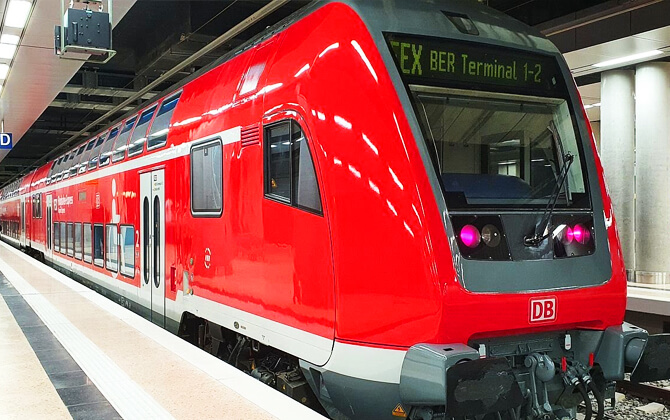
Berlin Brandenburg Airport (BER) is the city’s main airport. It is located in the southeast, in Schönefeld, Brandenburg. Terminals 1 and 2 connect to Berlin and the surrounding region through the station Flughafen BER under Terminal 1.
The Airport Express (FEX) links the airport with central Berlin, stopping at Flughafen BER, Berlin Südkreuz, Berlin Potsdamer Platz, and Berlin Hbf. Regional trains RE20, RB22, RB24, and RB32 also serve the airport. S-Bahn lines S9 and S85 connect BER with Berlin and the wider area at regular intervals.
For bus connections, the X7 and X71 express buses link Rudow, the last station on U7, with BER Airport. The BER2 AirportShuttle also runs directly from Potsdam via Teltow to the airport.
Bus stops for arrivals and departures are clearly marked at Terminal 1 on level E0. Long-distance coaches stop at the Airport-City exit of Terminal 1 on level U1. Taxi ranks are in front of Terminal 1, while Terminal 2 does not have its own taxi rank.
BER is in fare zone C. For trips to central Berlin or Potsdam, you need a Berlin ABC ticket. Tickets must be bought before travel and validated before use. They are available from the DB Navigator app, ticket counters, and ticket machines in Terminal 1.
How to Use the Berlin Metro?
The Berlin U-Bahn is generally easy to use. It is fast, well connected, and practical for reaching many of the city’s main attractions. If you are planning a route, checking a train schedule, or just trying to understand the system, the basics are simple.
Metro Lines
The U-Bahn has nine lines running both underground and above ground. For visitors, some of the most useful routes are listed below.
| Station | Details |
|---|---|
| U1 | One of the oldest lines, running from Uhlandstraße to Warschauer Straße, with stops near Kurfürstendamm, the Kaiser Wilhelm Memorial Church, and Wittenbergplatz for KaDeWe. |
| U2 | Runs from Ruhleben to Pankow and stops at Alexanderplatz and Potsdamer Platz. |
| U5 | Useful for Alexanderplatz and the Friedrichshain area, including Frankfurter Tor. |
| U6 | Runs from Alt-Tegel to Alt-Mariendorf and stops at Friedrichstraße. Kochstraße is the nearest station for Checkpoint Charlie. |
| U7 | The longest line, about 30 kilometers (18.6 miles) long with 40 stops, connecting Rathaus Spandau and Rudow. Richard-Wagner-Platz is useful for Charlottenburg Palace. |
| U8 | Runs between Wittenau and Hermannstraße. |
| U9 | Connects Osloer Straße and Rathaus Steglitz, including Kurfürstendamm. |
| U3 | Less useful for short visits unless your hotel is near one of its stations. |
| U4 | The smallest line, with five stations between Nollendorfplatz and Innsbrucker Platz. |
Schedule and Frequency
On weekdays, the U-Bahn usually runs from 4:00 am to 1:00 am. On weekends, it runs 24 hours. During peak hours, frequency is every 3 to 5 minutes. At other times, trains usually come every 10 minutes, and at night every 15 minutes. On Fridays, Saturdays, Sundays, and public holidays, many routes continue almost all night.
Rates
If you plan to use public transportation in Berlin often, the Berlin Welcome Card can be worth considering. It includes unlimited travel on public transport and offers discounts at major attractions, shops, and restaurants.
Berlin’s fare system is zone-based. Most central sights are in zones A and B, while the airport is in zone C. If you already have an AB ticket and need to travel into zone C, you can buy an extension ticket instead of a full ABC ticket.
Ticket inspection is strict, so always travel with a valid ticket. If you are using a digital ticket, buy it before boarding. If you have a paper ticket, stamp it before use.
Future Extensions
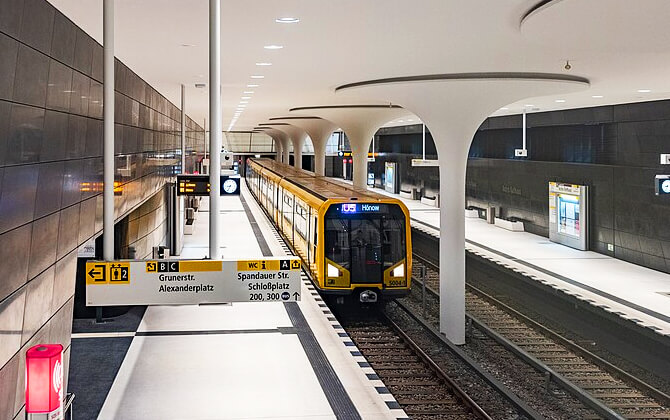
Berlin has a long tradition of debating U-Bahn expansion. A 200-kilometer (124.3-mile) route plan drawn up in the 1950s imagined a much larger system, and some of those ideas were later built, including the northern extension of the former C line to Tegel. Other parts survive as unused stations, platforms, and tunnels prepared for lines that never opened.
One example is the reserved infrastructure at Potsdamer Platz for a planned line toward Weißensee. That project is considered unlikely, but the space has partly been reused for events and exhibitions. In a way, it shows how older plans still shape the system today.
Right now, major expansion is limited by finances and by competition with other transport priorities. New U-Bahn projects are discussed regularly, with some groups supporting metro growth and others arguing for trams instead.
Among the ideas discussed are short gap closures and outward branches that would improve interchange with the S-Bahn or serve developing districts. Proposals have been mentioned for U3, U8, U9, U6, U7, U1, U2, U4, and U5, as well as the proposed U0 ring line. Some seem more realistic than others, especially where they would fill a clear gap in the network.
Even so, there are no immediate plans for large-scale expansion after the last U5 extension opened in 2020. For now, future development remains a mix of inherited plans, technical preparation, and political debate.
History
The history of the Berlin U-Bahn began in 1880, when Werner Siemens proposed an urban railway for Berlin. As the city grew, traffic problems became more serious. In 1896, Siemens & Halske started building the first elevated railway, and on April 1, 1897, work began on an electric underground railway.
The first section, between Stralauer Tor and Potsdamer Platz, opened on February 18, 1902. Four more lines were built before World War I. In 1923, a new line with a wider car body, known as Großprofil, opened. BVG was formed in 1928 and took over further construction and operation of the network. In 1938, the company was renamed Berlin Transport Company, though the BVG acronym stayed in use. Since 1994, BVG has been a public company.
The U-Bahn developed in three main phases:
- Until 1913: construction of the Kleinprofil network in Berlin, Charlottenburg, Schöneberg, and Wilmersdorf
- 1913–1930: introduction of the Großprofil network, including the first north–south lines
- After 1953: postwar development
Construction continued after World War I, but hyperinflation slowed expansion at first. The north-south line opened in stages during the 1920s and was completed in 1930. During the Great Depression, Berlin lacked the money for further large-scale growth.
The construction of the Berlin Wall in August 1961 brought major restrictions. Lines C and D passed through stations in East Berlin without stopping, except at Friedrichstraße, which worked as a border crossing. Several stations closed, while construction continued in West Berlin. In East Berlin, only Tierpark on Line E opened in 1973. Between 1985 and 1989, Line E was extended from Tierpark to Hönow.
After the fall of the Wall, former ghost stations reopened step by step. Jannowitzbrücke reopened on November 11, 1989, followed by Rosenthaler Platz on December 22 and Bernauer Straße on April 12, 1990. All remaining ghost stations reopened on July 1, 1990. After reunification, U2 reopened in 1993, U1 was reinstated in 1995, and short extensions followed in the late 1990s and in 2000. Because of budget limits, there was no further expansion after that.
The early network was mainly east-west, reflecting the strongest travel patterns of the time. Later, more north-south routes were added. Today, the U-Bahn remains one of the city’s key transport systems.
Nearby Attractions
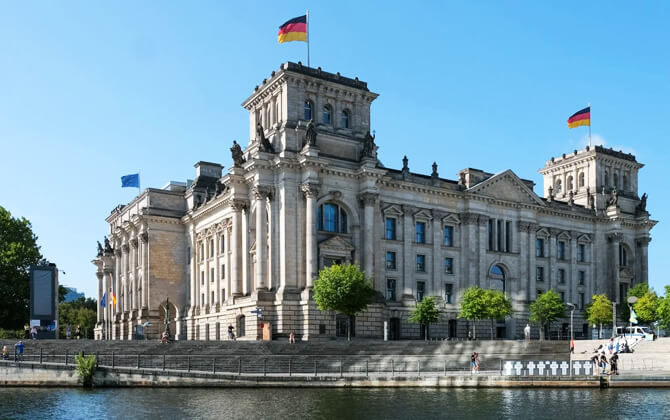
Berlin has plenty to see, and the U-Bahn makes getting around easy. If you want a simple route for sightseeing, several lines connect directly with major landmarks, museums, shopping streets, and local neighborhoods.
The U5 is especially useful. In 41 minutes, it runs from Berlin Central Station to Hönow and passes important stops including the Reichstag, Brandenburg Gate, Unter den Linden, Museum Island, Rotes Rathaus, and Alexanderplatz. Farther east, it also reaches Tierpark and the Gardens of the World.
The U1 is another scenic choice, crossing the Spree on the Oberbaumbrücke and linking Friedrichshain with Charlottenburg. It has stops near Kurfürstendamm, KaDeWe, and the Kaiser Wilhelm Memorial Church. The U2 is also great for sightseeing, connecting Alexanderplatz, Potsdamer Platz, the Zoo, and Konnopke’s.
If you want to see more of the city above ground, buses 100 and 200 are also useful. They pass the State Opera House, Brandenburg Gate, the Reichstag, Berlin Cathedral, the Victory Column, and Bellevue Palace before finishing at Zoo Station.
For a more local feel, the S1 gives you a north-south ride through changing parts of Berlin, while the S41 and S42 circle the city center and show everyday residential districts. It is an easy way to mix big sights with regular city life.
| Station | Details |
|---|---|
| U5 | Reichstag, Brandenburg Gate, Museum Island, Rotes Rathaus, Alexanderplatz, Tierpark, Gardens of the World |
| U1 | Oberbaumbrücke, Kurfürstendamm, KaDeWe, Kaiser Wilhelm Memorial Church |
| U2 | Alexanderplatz, Potsdamer Platz, Zoo, Konnopke’s |
| Bus 100/200 | State Opera House, Brandenburg Gate, Reichstag, Berlin Cathedral, Victory Column, Bellevue Palace |