GO Transit is a regional public transport system serving the Greater Toronto Area and the Greater Golden Horseshoe in Ontario, Canada. Centered on Union Station in Toronto, its green-and-white trains and buses connect more than seven million people across over 11,000 square kilometres (6,835 square miles). The system launched regular passenger service on May 23, 1967, grew from a single rail line to seven train lines, and now operates as a division of Metrolinx. GO Transit links rail and bus services with local transport across the region and continues to grow through the GO Expansion program.
| Key | Information |
|---|---|
| System type | Regional public transport network of trains and buses |
| Main hub | Union Station, Toronto |
| Service area | Greater Toronto Area and Greater Golden Horseshoe, Ontario, Canada |
| Train lines | 7 |
| Started service | May 23, 1967 |
| Operator | Metrolinx |
| Coverage area | Over 11,000 square kilometres (6,835 square miles) |
| 2025 ridership | 79,165,600 |
| Expansion program | GO Expansion, planned in phases through 2025–2032 |
Go Transit Map
Map of GO Transit showing different lines and stations. Click on the map to enlarge it or download the map in PDF format.
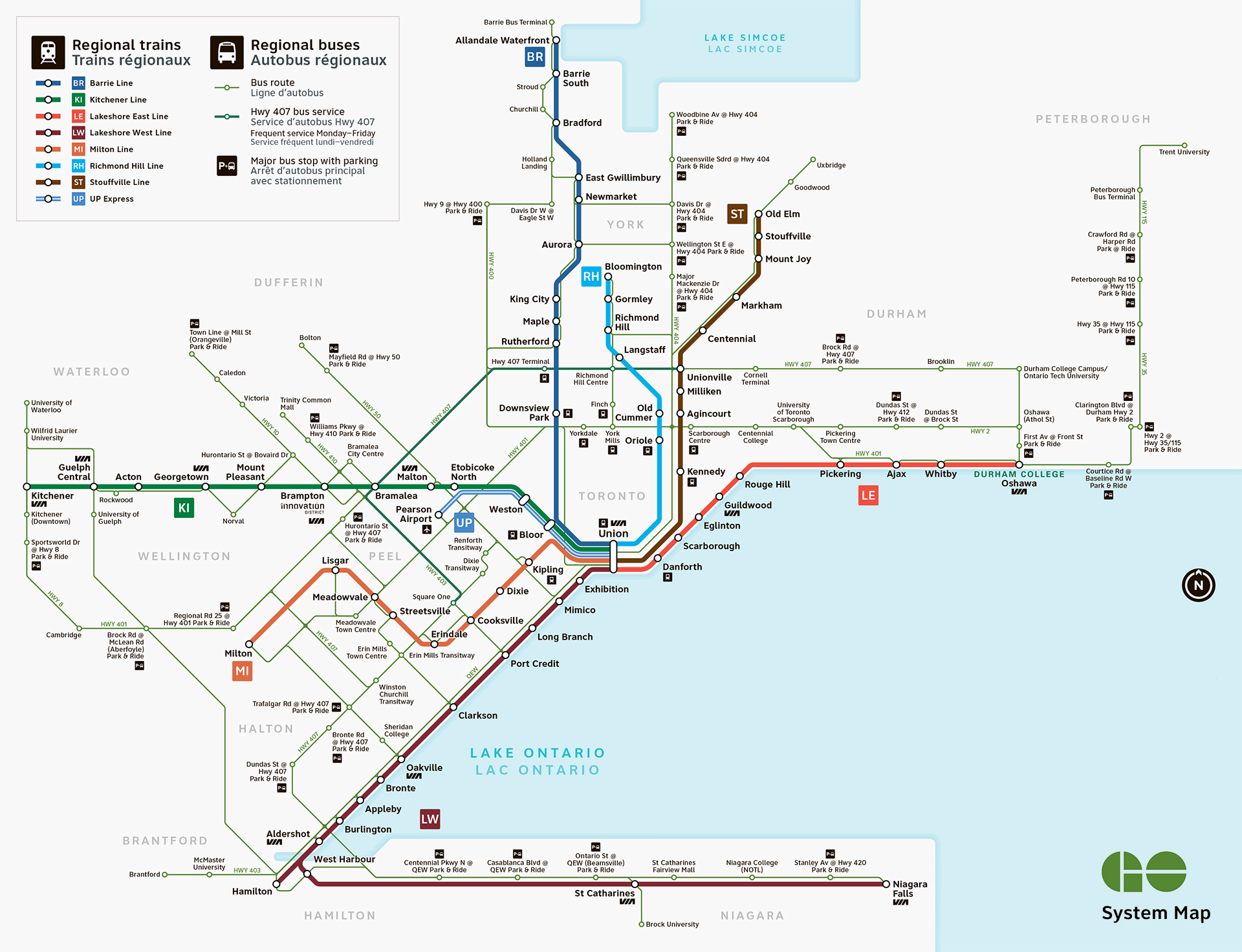
GO Transit Lines and Stations
GO Transit runs a regional network of trains and buses across the Greater Toronto Area and the Greater Golden Horseshoe. The rail system is built around Union Station in downtown Toronto and includes seven train lines: Lakeshore West, Lakeshore East, Milton, Kitchener, Barrie, Richmond Hill, and Stouffville.
Most stations are designed for easy transfers between train and bus services. Common features include elevators, washrooms, parking, ticket machines, PRESTO card readers, and bus loops for timed connections. Some stations are shared with VIA Rail, Amtrak, or UP Express, which makes the stations map especially useful when planning a route.
Current train lines
| Station | Details |
|---|---|
| Lakeshore West | Runs from Union Station toward Hamilton and Niagara Falls, with bus connections to Brantford. |
| Lakeshore East | Runs from Union Station to Oshawa, with bus connections to Bowmanville and Peterborough. |
| Milton | Serves Toronto, Mississauga, and Milton. |
| Kitchener | Serves Toronto, Brampton, Georgetown, Acton, Guelph, and Kitchener. |
| Barrie | Serves Toronto, King City, Aurora, Newmarket, East Gwillimbury, Bradford, and Barrie. |
| Richmond Hill | Serves Toronto and Richmond Hill. |
| Stouffville | Serves Toronto, Markham, and Stouffville, with bus connections to Uxbridge. |
Stations and service updates
GO Transit continues to expand its route plan with new stations and corridor upgrades. Projects mentioned in the source material include East Harbour, Thornton’s Corners, Ritson Road, Courtice, Bowmanville, King–Liberty, St. Clair–Old Weston, Woodbine, and Spadina–Front.
Construction can affect train schedule details on specific lines. The source material notes service changes on the Lakeshore East, Stouffville, Kitchener, and Barrie lines, including some late-night and weekend reductions.
For trip planning, GO Transit provides a stations list, system maps, station and stop search tools, PDF timetable files, and Union Station departure information.
Timings and Schedule
GO Transit publishes full timetable PDFs for each line or bus route. You can download a route timetable for your trip or check Union Station departures for live schedule today updates.
Service changes may affect operating hours, timings today, and the last train on some routes. In the source material, planned construction affects the Kitchener line on April 18 and 19, with late-night adjustments on April 17. During the weekend of April 18 and 19, there is no GO Transit service between Downsview Park GO and Union Station.
When checking the train schedule, remember that not every trip stops at every station. Departure times are shown in 24-hour format, and some trips run only on certain days, such as Saturday-only or Sunday-only service.
For live timings, delays, cancellations, platform details, and Service Guarantee claim access, GO Transit apps can help track trips in real time. Eligibility updates for the guarantee may take up to 24 hours for some trips.
Before you travel, it is smart to check the latest schedule, departure board, or app update, especially during construction, late-night changes, or weekend work.
| Service detail | Timings |
|---|---|
| Schedule format | PDF schedules by line or route, plus live Union Station departures |
| Time display | 24-hour format |
| Stopping pattern | Not all trips stop at every station |
| Day-specific service | Some trips operate only on specific days, including Saturday-only or Sunday-only service |
| Kitchener line construction | April 18 and 19 |
| Late-night service adjustments | April 17 |
| Downsview Park GO to Union Station closure | No service during the weekend of April 18 and 19 |
| Real-time updates | Available in GO Transit apps |
GO Transit Fares, Tickets and Cards
GO Transit fare rules are based on your fare type and the distance between two points. Riders can pay with a physical PRESTO card, PRESTO in Mobile Wallet, a contactless credit or debit card, an e-ticket, a pass, or a paper ticket. The same ticket or card works on GO train, GO bus, or a combined trip.
Fare types include adult, senior, youth, and post-secondary student. Kids 12 and under ride free. GO e-tickets are not eligible for Ontario’s One Fare.
How GO fares work
The fare calculator is based on distance between origin and destination fare zones. Tickets are generally valid for the two named fare zones and any fare zones between them on the same corridor. Some train and bus combinations between certain corridors are also covered.
All GO Transit tickets are valid only for continuous trips of no more than two and a half hours. For longer journeys, more than one ticket may be required.
You can use the trip planner to check fare, ticket price, and cost before you travel.
Fare types
- Adult
- Senior — riders age 65 and older save 55% and can use a PRESTO card, GO e-ticket, or paper ticket.
- Child — children 12 and under ride free and do not need a ticket or PRESTO card.
- Youth — riders age 13 to 19 save 40% with PRESTO.
- Post-Secondary Student — full-time post-secondary students save 40% with PRESTO.
- Weekday Group Pass — all-day unlimited travel on a weekday for a group.
- Weekend Pass — a one-day weekend pass with a price of CA$10 (US$7.40).
PRESTO card overdraft update
Starting March 2, 2026, registered PRESTO card taps will be accepted only if there are enough funds to cover the full local transport fare.
For GO Transit customers, if the balance is too low to cover the full fare at tap off, the PRESTO card will go into negative balance. It cannot be used on GO Transit, UP Express, or local transit until funds are added.
Once the card is reloaded, the negative balance is cleared and the remaining amount becomes available for the next trip.
Presto cards and contactless credit cards
PRESTO cards and contactless credit cards are accepted across GO Transit. Riders must tap on and tap off when using train or bus services.
With PRESTO, the minimum fare is deducted at tap on and adjusted after tap off. With contactless credit cards, charges are processed at the end of the day as a single total for that day’s trips.
Accepted credit cards include Visa, Mastercard, and American Express. If you do not tap off, you may be charged the maximum fare.
E-tickets
GO Transit e-tickets can be bought on the GO Transit website. They must be activated on a smartphone and cannot be printed.
You need access to a smartphone with data or Wi-Fi to view and activate the ticket.
Weekday Group Passes and Weekend Passes
GO Transit also sells One-Day Weekend Passes and Weekday Group Passes online. These passes allow unlimited travel across the network during their validity period, regardless of the origin and destination entered when purchased.
One-Day Weekend Passes are valid for one person on a Saturday, Sunday, or statutory holiday. Weekday Group Passes are valid Monday to Friday, excluding statutory holidays, for groups of 2 to 5 people depending on the pass selected.
Connections to Other Systems
GO Transit is part of a wider regional transportation in the Greater Toronto and Hamilton Area. Its trains and buses connect with local transport systems across the region, with Union Station as the main rail transfer hub.
Stations and terminals are set up for easier transfers between services. Many rail stations have bus loops for timed GO Bus connections, while bus terminals often include ticket sales facilities. PRESTO readers are available at all GO stations, and the system also accepts contactless bank cards and mobile wallets.
GO Transit connects with the following systems and operators:
- Toronto Transit Commission (TTC)
- York Region Transit (YRT/Viva)
- MiWay
- Durham Region Transit
- Brampton Transit
- Burlington Transit
- Hamilton Street Railway (HSR)
- Oakville Transit
- Ontario Northland
- Megabus
- TOK Coachlines
- Greyhound Lines services to the United States
- VIA Rail
- Amtrak
- Union Pearson Express
Some stations are shared with VIA Rail, Amtrak, and UP Express, making them important transfer points for both city transport and longer-distance travel. Metrolinx identifies many of these as mobility hubs in regional planning.
GO also has fare integration with local transit. As of April 21, 2024, many free transfers are available with connecting local transit systems across the GTHA when paying with PRESTO or another accepted contactless method. GO Transit also offers discounts with select local transit agencies connected to its network.
For rail transfers, Union Station remains the key interchange. Other notable connections include Kipling on the Milton line, Bloor on the Kitchener line, and Kennedy on the Stouffville line.
Airport Connections
GO Transit offers several airport transport options for Pearson Airport and connections that can work alongside UP Express. GO tickets can be bought online, and GO Transit also offers e-tickets at regular fare. Mobile tickets are not available at the station.
Pearson Airport by UP Express
You can take UP Express to Pearson from Union, Weston, and Bloor stations. If you transfer from a GO train to UP Express, two separate fares apply, one for each train. PRESTO users must tap on and off for both services.
Pearson Airport by GO Bus
GO Bus Route 40 serves Pearson Airport from Hamilton GO Centre, Burlington at Dundas & Hwy 407 Park & Ride, Oakville Carpool Lot at Trafalgar Road @ Hwy 407 Park & Ride, Square One GO Terminal, Dixie Transitway, Renforth Transitway, Hwy 407 Bus Terminal, and Richmond Hill Centre Terminal.
GO Bus Route 94 serves Pearson Airport from Square One GO Terminal, Dixie Transitway Station, Renforth Transitway Station, Keele St. @ Hwy. 401, Yorkdale GO Bus Terminal, Yonge St. @ Poyntz Ave., Scarborough Centre Bus Terminal, and Pickering GO.
GO Transit at Pearson Airport
GO Transit buses depart from Terminal 1, Ground Level, at Columns Q2 to Q4. At Pearson Airport, tickets can be bought online or from the vending machine in Terminal 1 on the Ground Level.
Route 94 connects Pearson with Pickering, Mississauga, Yorkdale, Sheppard-Yonge, and Scarborough Centre. Route 40 connects Pearson with Highway 407 Station.
Both routes run 24 hours a day, 7 days a week. Route 94 runs every 1 to 2 hours. Route 40 runs every 20 to 30 minutes during the day and every 1 to 2 hours in the evening and overnight.
Save with PRESTO
PRESTO is an electronic payment card for GO Transit and other public transport services including TTC, MiWay, and UP Express. You can buy PRESTO cards at vending machines and at UP Express customer service counters at the airport.
Parking
GO Transit offers free station parking at most stations on a first-come, first-served basis. If you want a guaranteed space, reserved parking, carpooling, or Zipcar may be a better fit.
Stations without free parking
| Station | Details |
|---|---|
| Bloor GO | No free parking. |
| Danforth GO | No free parking. |
| Downsview Park GO | No free parking. |
| Exhibition GO | No free parking. |
| Mount Dennis GO | No free parking. |
| Oriole GO | No free parking. |
| Union Station | No free parking. |
| Union Station Bus Terminal | No free parking. |
Stations with paid parking only
| Station | Details |
|---|---|
| Kennedy GO | Paid parking only. |
| Kitchener GO | Paid parking only. |
| Kipling GO | Paid parking only. |
Free overnight parking is available in any empty, non-reserved space for up to 48 consecutive hours, except at the stations listed above. Overnight parking is not allowed at Allandale Waterfront GO.
Most parking lots have CCTV security systems and are patrolled by Transit Safety Officers working with local police. If you exceed the 48-hour limit, you will receive a ticket.
Reserved parking is available at selected stations for registered customers. It provides exclusive weekday access to a designated space, Monday to Friday, excluding weekends and holidays.
Reserved parking
Applications must be submitted online by the 15th of the month, and agreements begin on the first day of the following month, subject to availability.
Reserved parking charges are CA$98 per month (US$72.50), including HST, with a 6-month minimum commitment. After that, the agreement continues month to month.
At Aurora GO station, reserved parking is in a garage with a height restriction of 1.93 m (6 ft 4 in). Payments can be made by pre-authorized debit or credit card, including Visa, Mastercard, and American Express.
If a payment is declined, a CA$35 dishonoured payment fee (US$25.90) may apply. The first transfer to a new station or spot is free; later transfers cost CA$35 (US$25.90). Cancelling within the first 6 months carries a CA$100 fee (US$74.00).
Reserved spaces are assigned differently at each station and are not always closest to the station building or platforms.
Using a reserved space
You may use your reserved space at any time on weekdays for up to 48 hours. At Weston GO station, reserved parking is unavailable between 2 a.m. and 5 a.m. daily.
You may not lend, sublet, or transfer the space to another vehicle. Only vehicles listed on the application may use it.
If someone parks in your reserved spot, use the Pick-Up & Drop-Off area without blocking traffic, then notify staff or Customer Protective Services after 9:00 a.m.
Reserved parking pilot
GO Transit’s Reserved Parking Pilot Project allows customers to park in unoccupied reserved spaces after 11:00 a.m. on weekdays at Port Credit and Durham College Oshawa GO stations. During reserved parking hours from 5:00 a.m. to 11:00 a.m., non-registered vehicles are ticketed and towed at the owner’s expense.
Rules and Tips
GO Transit aims to keep travel comfortable, safe, and low-stress. A little courtesy goes a long way, especially during busy periods.
Keep doorways, stairways, aisles, and platforms clear. When boarding, spread out and avoid blocking access. Bags, backpacks, and jackets should go on your lap or on the floor, not on empty seats.
On board, keep your feet off the seats, stay quiet in the Quiet Zone, and use headphones for music or videos. Smoking, vaping, and alcohol are not allowed on GO Transit.
Respect Priority Seating and offer your seat to passengers who need it, including elderly riders, expectant mothers, passengers with disabilities, passengers with young children, and passengers with strollers. If you bring a bike, board only at doors marked with a green bicycle sticker and do not block seats, aisles, doors, or stairwells.
Strong scents can also affect other riders, so it is best to keep that in mind. Be kind, be aware of your space, and the trip tends to go a lot more smoothly for everyone.
- Do not block doors or stairways.
- Do not crowd the platform while boarding.
- Do not take extra seats with bags or clothing.
- Do not sit on the stairs.
- Do not be loud in the Quiet Zone.
- Do not wear backpacks on platforms or on board.
- Do not smoke, vape, or drink alcohol on board.
- Do not use Priority Seating when someone else needs it.
- Do not board with bikes outside designated bicycle zones.
History
Early days
During the 1950s, cities across the Greater Toronto and Hamilton Area expanded quickly because of immigration and industrial growth. Much of the commuter rail service was then provided by Canadian National Railway, but it did not have the resources to expand enough to meet demand.
Serious planning for improved commuter transport began with the 1962 Metropolitan Toronto and Region Transportation Study. The idea behind GO Transit emerged from concern that the region could spend years planning without taking action. In May 1965, the Ontario government approved the launch of Canada’s first specially designed commuter rail service at a cost of CA$9.2 million (US$6.81 million).
Creation, growth, and recession
GO Transit began regular passenger service on May 23, 1967, as Government of Ontario Transit. It started as a three-year experiment on a single line along Lake Ontario, with diesel-powered push-pull trains operating all day between Oakville and Pickering and limited rush-hour service to Hamilton.
The service caught on fast, reaching its first million riders within four months. Expansion continued through the 1970s and 1980s as new lines and stations were added. The Georgetown line opened in 1974, followed by the Richmond Hill line in 1978. In 1978, GO introduced Bombardier BiLevel Coaches, and in 1979 the former Bay Street GO concourse at Union Station was built to handle rising passenger volumes.
GO Bus service started on September 8, 1970, first extending rail links to Hamilton, Oshawa, Newmarket, and Barrie. It later grew into a full bus network serving communities beyond the rail corridors. In 1982, GO Transit announced GO-ALRT, an interregional tramway and light rail proposal, but the plan was never built. Even so, some of its goals lived on through added stations, all-day service to Whitby and Burlington, and stronger bus-rail connections.
In 1990, GO introduced limited rush-hour train service on the Bradford, Georgetown, and Lakeshore lines, along with off-peak service on the Milton line. All-day Lakeshore West service reached Burlington in 1992, though later cost-cutting reduced or removed several 1990s improvements.
Reconfiguration and revival
All-day service from Burlington to Whitby returned in 2000, with peak service later reaching Oshawa. In the mid-2000s, GO launched the GO Transit Rail Improvement Plan, or GO TRIP, a major investment program covering rail and bus projects. More expansion plans followed under MoveOntario 2020.
Service growth continued through the 2000s and 2010s. All-day service returned to Oshawa in 2006 and Aldershot in 2007. Barrie South, Lincolnville, Kitchener, Gormley, and Bloomington were added later, and Niagara Falls first received excursion trains before year-round service followed.
GO Transit also changed organizational structure several times. After funding responsibility moved to municipalities in the late 1990s, it returned to provincial responsibility in 2002. In 2006, the Greater Toronto Transportation Authority was created, and in 2009 it merged with GO Transit under the name Metrolinx.
Future
In 2011, Premier Dalton McGuinty pledged two-way, full-day train service on all corridors. That commitment became GO Expansion, a long-term program intended to bring higher frequency, electrification, and new stations in phases from 2025 to 2032.
Metrolinx said the expansion would bring all-day, two-way service to inner parts of the Barrie, Kitchener, and Stouffville lines while greatly increasing weekly train trips. In 2021, a pilot service to London, Ontario, was launched, but it ended in October 2023.
In 2025, Metrolinx and ONxpress mutually agreed to terminate an operating agreement that would have transferred train operation and maintenance to the consortium. Alstom continues handling maintenance and operations.
Incidents
On December 12, 1975, a westbound GO train collided with a Toronto Transit Commission bus stalled at a crossing at St. Clair and Midland Avenue. Nine passengers on the bus were killed and 20 others were injured.
The crossing was later replaced by an overpass.
Future Extensions
GO Transit’s future growth is centered on GO Expansion, previously known as GO Regional Express Rail. The program is designed to improve the system with more frequent, two-way all-day train service, new infrastructure, and electrification.
The main goal is to raise frequency on five corridors to every 15 minutes or better, with major upgrades on the Lakeshore East, Lakeshore West, Barrie, Kitchener, and Stouffville lines. The project also includes electrification on part of these routes, along with new track, bridges, tunnels, and related infrastructure.
GO Expansion is expected to roll out in phases. The project is described as a 10-year regional express rail plan with a total cost of CA$13.5 billion (US$9.99 billion) and about 150 kilometres (93.2 miles) of new track.
Planned improvements also include new stations and corridor upgrades. Stations identified in the source material include Breslau, Innisfil, Kirby, Mulock, and Spadina-Front, along with five SmartTrack stations in Toronto: St. Clair-Old Weston, Bloor-Lansdowne, King-Liberty, East Harbour, and Finch-Kennedy.
As demand grows across the region, the expansion is intended to add capacity, reduce congestion, and make GO Transit a stronger option for everyday travel.
Nearby Attractions
GO Transit makes it easy to reach a range of day-trip destinations without the hassle of driving or parking. Waterfront areas, parks, museums, and small-town main streets are all within reach by train or bus.
- Newmarket — Reach Newmarket GO Station on the Barrie Line and explore Main Street, Fairy Lake Park, the Newmarket Farmer’s Market at Riverwalk Commons, Old Firehall Confectionery, and the Elman W. Campbell Museum.
- Rouge Hill — Take the Lakeshore East Line to Rouge Hill GO Station for Rouge National Urban Park, Rouge Beach and Marsh, seasonal canoe programs, and nearby Petticoat Creek Conservation Area.
- Betty Sutherland Trail Park — Beside Oriole GO Station on the Richmond Hill Line, this riverside trail along the East Don River is a calm spot for walking, biking, and picnicking.
- Port Credit — A short walk from Port Credit GO Station on the Lakeshore West Line, this waterfront area offers Port Credit Marina, downtown shops and cafes, Bobby’s Hideaway, Brueckner Rhododendron Gardens, and the Port Credit Lighthouse.
- Streetsville — On the Milton Line, Streetsville GO Station is a good starting point for Murphy’s Ice Cream Parlour, the Streetsville Village Historic District, The Book Wardrobe, Streetsville Memorial Park, and the Streetsville Dam.
If you want to keep things simple, GO Transit works well for casual weekend plans, family outings, and solo trips alike.