Brasília Metro, also called Metrô-DF or the Federal District Metro, is the rapid transit system serving Brasília and the surrounding Federal District. Opened in 2001, it operates two lines with a shared central route and plays a key role in public transport between the capital and major satellite cities such as Guará, Águas Claras, Taguatinga, Samambaia, and Ceilândia. The network is about 42.38 kilometers (26.33 miles) long, with 24 stations and 20 four-car trains.
| Key | Information |
|---|---|
| System name | Brasília Metro (Metrô-DF) |
| Type | Rapid transit / city transport |
| Opened | 2001 |
| Network length | About 42.38 km (26.33 miles) |
| Lines | 2 |
| Stations | 24 |
| Train fleet | 20 four-car trains |
| Train capacity | 1,350 passengers per train |
| Main corridor | Central to Águas Claras is shared by both lines |
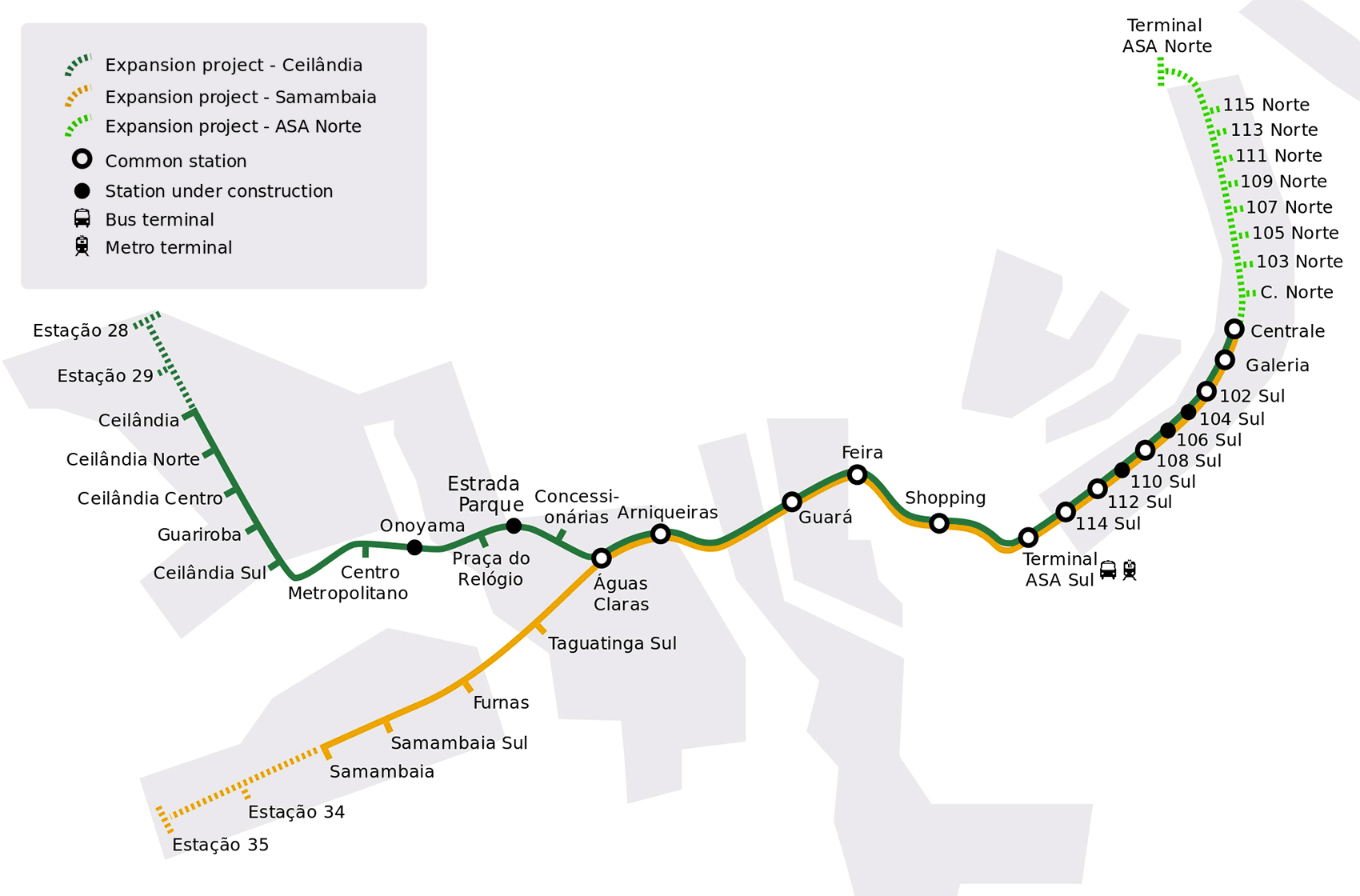
Brasília Metro Map
Map of Brasília Metro showing different lines. Click on the map to enlarge it or download the Brasília Metro map in PDF format.
Lines and Stations
Brasília Metro runs two lines, both starting from Central Station. The system uses ground-level and elevated tracks, covers roughly 42.4 kilometers (26.35 miles), and serves 24 stations. For trip planning, the shared section between Central and Águas Claras is especially important, since both routes use it.
| Line | Year Opened | Type | Length (km) | Number of Stations | Starting Station | Ending Station | Approx. Daily Ridership |
|---|---|---|---|---|---|---|---|
| Green Line (Linha Verde) | 2001 | Ground/Elevated | 20.9 | 15 | Central | Ceilândia | 150,000 |
| Orange Line (Linha Laranja) | 2001 | Ground/Elevated | 21.5 | 9 | Central | Samambaia | 120,000 |
The Green and Orange lines share tracks between Central and Águas Claras, which makes transfers simple and helps passengers read the route plan more easily.
Green Line
The Green Line route links Central Station with Ceilândia and serves residential and commercial areas along the way.
| Station | Details |
|---|---|
| Central | Main starting point on the Green Line |
| South Wing / Asa Sul | Shared section station |
| 114 South / 114 Sul | Shared section station |
| 108 South / 108 Sul | Shared section station |
| Shopping / Shopping | Shared section station |
| Guará / Guará | Shared section station |
| Águas Claras / Águas Claras | Shared section station |
| Ceilândia / Ceilândia | Line terminus |
On weekdays, the starting time from Central is 06:00, and the last train leaves Ceilândia at 23:00. On Sundays and public holidays, opening hours generally run from 07:00 to 21:00.
Orange Line
The Orange Line runs south from Central to Samambaia and mainly supports commuter travel across the wider transportation in the Federal District.
| Station | Details |
|---|---|
| Central / Central | Main starting point on the Orange Line |
| South Wing / Asa Sul | Shared section station |
| 114 South / 114 Sul | Shared section station |
| 108 South / 108 Sul | Shared section station |
| Shopping / Shopping | Shared section station |
| Guará / Guará | Shared section station |
| Águas Claras / Águas Claras | Shared section station |
| Samambaia / Samambaia | Line terminus |
On weekdays, the first train leaves Central at 06:00 and the last train leaves Samambaia at 23:05. Outside peak periods, frequency may be lower.
Major stations show English station names and direction signs, though onboard announcements are mainly in Portuguese. If you are checking a stations map or stations list before traveling, that helps a lot.
Brasília Metro Fares
Brasília Metro uses a flat fare system, so the ticket price stays the same regardless of distance. A single adult ride costs R$5.50 (about $1.10).
Passengers can use paper tickets or smart cards, and discounted fare options are available for some groups, including students, seniors, and persons with disabilities, with valid identification. Some materials also mention free travel for students.
| Fare Type | Price |
|---|---|
| Adult single ride | R$5.50 (about $1.10) |
| Children | NA |
| Seniors | NA |
| Students | NA |
| Persons with disabilities | NA |
For regular riders, a reloadable card is available. The system is simple to understand, though a fare calculator is not described in the available material.
Card
The metro uses one flat price for each ride, so distance does not affect the cost. An adult fare is BRL 5.5, or about $1.10.
Passengers can choose between paper tickets and smart card options. Reloadable card products are available for frequent commuters, and one option, BRB Mobilidade (Bilhete Único), also supports integration with bus and metro trips under the operator’s rules.
Discounted fares may apply to students, seniors, and persons with disabilities when valid ID is shown. Card services and pass options may change, so station notices remain the best source for up-to-date details.
Payment Methods
A single journey costs R$5.50 (about $1.10). Passengers can pay with paper tickets at ticket offices, while contactless debit and credit card payment is accepted at turnstiles.
Contactless payment is available at all 27 stations mentioned in the source material and works with Mastercard, Visa, and Elo cards. NFC-enabled devices such as smartphones, smartwatches, and bracelets are also accepted. At ticket offices, payment is cash only. QR code purchase at ticket offices is still available, and BRB Mobilidade cards are used by riders who need bus integration.
Contactless bank card payments do not allow fare integration. That is worth remembering if you are comparing ticket, card, or pass options for local transport.
- Only one fare can be paid per card every 5 minutes.
- If you carry more than one bank card or transport card together, the reader may charge the one closest to it.
- The bank issuer decides whether a multifunction card is processed as credit or debit.
- If payment is declined, passengers should contact their bank or the BRB Mobilidade support center.
Students, seniors, and persons with disabilities may qualify for discounted fares with valid identification.
Operating Hours and Frequency
Brasília Metro operating hours are Monday to Saturday from 06:00 to 23:30, and on Sundays and public holidays from 07:00 to 19:00. These opening times apply across the system in general, though exact timetable details can vary by line, day, and service pattern.
During peak hours, trains usually run every 3 to 7 minutes. At quieter times, the interval can range from 3 to 22 minutes. If you need timings today, schedule today updates, or the last train time, it is best to check station notices and official announcements before you travel.
| Service detail | Timings |
|---|---|
| Monday to Saturday operating hours | 06:00 to 23:30 |
| Sundays and public holidays opening hours | 07:00 to 19:00 |
| Peak-hour frequency | Every 3 to 7 minutes |
| Off-peak frequency | Every 3 to 22 minutes |
Both lines follow the same general working hours. Still, route timetable details, running time, and closing time can shift depending on demand and service adjustments.
Interconnections with Other Systems
Brasília Metro is one part of a wider public transport system in the Federal District. It works alongside bus rapid transit and regular bus services rather than covering the whole city on its own.
The key interchange is Central station, located under the Pilot Plan Bus Station in central Brasília. Since both metro lines start there and continue together until Águas Claras, Central is the main transfer hub in the network and a practical link between rail and bus transport.
The clearest documented connection is with Brasília’s central bus station, which serves local transport as well as national bus services. This gives passengers a direct way to continue their route across the city transport network.
The wider system also includes two bus rapid transit lines, Eixo Oeste (EPTG) and Eixo Sul (Expresso DF Sul). The available material does not specify direct interchange stations with the metro, but it does show that Metrô-DF operates as part of a broader transportation in Brasília.
- Central station is the main rail anchor of the system.
- Brasília’s central bus station connects directly with Central station on both metro lines.
- The Green and Orange lines share tracks across a large part of the route.
- Bus rapid transit lines are part of the wider transport system in the Federal District.
Airport Access
Presidente Juscelino Kubitschek International Airport (BSB) is about 15 kilometers (9.32 miles) from central Brasília, and the trip by car usually takes around 20 minutes.
Airport access by public transport is possible, but not direct by metro. Many travelers use bus line 102.6/102.7 to reach Asa Sul station, or bus lines 102/102.1 to reach Rodoviária de Brasília / Plano Piloto. From Rodoviária, passengers can transfer to the metro at Central station or continue by bus.
The bus journey to Asa Sul takes about 20 minutes, while reaching the city center by bus takes about 40 minutes. Bus fares are around R$2.70 (about $0.54) to Asa Sul and R$3.80 (about $0.76) to the city center. A metro ticket costs R$5.50 (about $1.10).
Executive buses also operate from the airport. Lines 113, 113.1, and 113.2 run roughly every 30 minutes and connect the airport with the north, center, and south of the city, as well as Centro de Convenções Ulysses Guimarães. A single ticket costs R$12.00 (about $2.40), payable in cash to the driver.
Taxis and rideshare apps are also available, with official taxi stands open 24/7 in the arrivals area and app pick-up points on the ground floor near the exit. For longer-distance travel, Rodoviária Interestadual can be reached by bus.
Safety Measures
Brasília Metro is generally described as a safe system, and passengers are expected to follow basic rules at stations and on trains.
- Do not try to retrieve objects from the tracks. Ask station staff for help.
- Keep children close on platforms and while boarding or leaving the train.
- Do not lean on the doors.
- Walk carefully on platforms and inside trains, especially during busy periods.
Station staff are available to assist passengers, and warning signs are clearly displayed. The first car is reserved for women, children, and people with disabilities. The lift is intended only for people with disabilities.
Smoking and eating are prohibited in the metro, helping keep the environment cleaner and safer.
Additional Amenities at Stations
Stations offer a small but useful set of amenities for everyday travel.
- All metro stations provide free Wi-Fi.
- A lost and found service is available, with items kept at the Central Post of the Brasília Metro.
The source material does not mention station parking, parking charges, or parking charges per day.
History
The history of Brasília Metro began with construction in 1992. The system was originally expected to open in 1999, but delays pushed the official inauguration to 31 March 2001. Regular passenger service started on 24 September 2001.
In the early months, trains ran only from 10:00 to 16:00 over 32 kilometers (19.88 miles) of the network, linking Rodoviária to Taguatinga and Samambaia. At that point, only 11 stations were open.
The system expanded gradually after opening, with new stations and sections added over time:
- 31 March 2001: 108 Sul station
- 5 February 2002: Samambaia Sul and Arniqueiras stations
- 11 May 2004: Concessionárias station
- 24 July 2006: service began on the Ceilândia Sul to Praça do Relógio section
- 18 April 2007: commercial operation started on the Ceilândia Sul to Praça do Relógio section
- 12 April 2008: 108 Sul station
- 16 April 2008: extension to Terminal Ceilândia
- 9 May 2009: 112 Sul station
- 4 June 2009: 102 Sul station
- 10 May 2010: Guará station
- 6 January 2020: Estrada Parque station
- 16 September 2020: 106 Sul and 110 Sul stations
Its development has been steady rather than fast, but the metro has gradually become an important part of Brasília’s urban transport system.
Future Extensions
Brasília Metro expansion is continuing through line extensions and modernization work. On February 7, the Federal District government announced the winner of a R$319.7 million contract (about $63.94 million) to extend the Orange Line southwest of Samambaia.
The project will add a 3.6-kilometer (2.24-mile) extension with two new stations, plus fixed infrastructure including an electricity substation. Formal approval still depends on the standard standstill period.
If no appeals are filed, approval and contract signing are expected in March, with completion planned within four years.
Metro-DF had also previously invited expressions of interest for a 2.3-kilometer (1.43-mile) westward extension of the Green Line from Ceilândia, also with two new stations. Together, these projects show the long-term focus on expansion and improved access for satellite cities.
Travelling in the Metro: An Overview
For everyday travel, Brasília Metro is fairly straightforward. The Green Line runs from Central to Ceilândia, and the Orange Line runs from Central to Samambaia. Both lines share several stations, including Central, Galeria, 102 Sul, 108 Sul, 112 Sul, 114 Sul, Terminal Asa Sul, Shopping, Feira, Guará, Arniqueiras, and Águas Claras.
The metro does not reach every part of Brasília, so some trips need a bus connection or a short walk. Terminal Asa Sul and Shopping are useful transfer points, especially if you are combining metro and bus travel.
In general, the schedule runs from 06:00 to 23:30 Monday to Saturday, and from 07:00 to 19:00 on Sundays and public holidays. Frequency changes by time of day, and off-peak service may be less frequent. Announcements are in Portuguese, while major stations usually display English names and directions.
The fare system is flat. The draft also notes a single ride cost of R$5, though the fare sections list R$5.50, so travelers should check current station information before buying a ticket. Payment can be made with single-trip tickets or reloadable cards, and some electronic payment options are available.
Trains and stations are described as clean, safe, and well maintained. They are air-conditioned, station staff are available to help, and safety notices are easy to spot. The first car is reserved for women, children, and people with disabilities.
- Two lines operate in the system: Green and Orange.
- Central is the main interchange station.
- Sunday and holiday service has shorter opening times.
- Tickets can be bought at station counters or machines.
- Bus transfers matter for destinations outside the metro route.
Language Use in the Brasília Metro
All announcements in Brasília Metro are made in Portuguese. If you do not speak the language, it helps to learn the main station and line names before your trip, especially if you need to change between the Green and Orange lines.
Station staff can assist passengers, and warning signs and information displays are clearly visible, which makes navigation easier for visitors.
Nearby Attractions
Brasília Metro gives easy access to several well-known attractions, especially around the central area. Many are within walking distance or a short bus or taxi ride away.
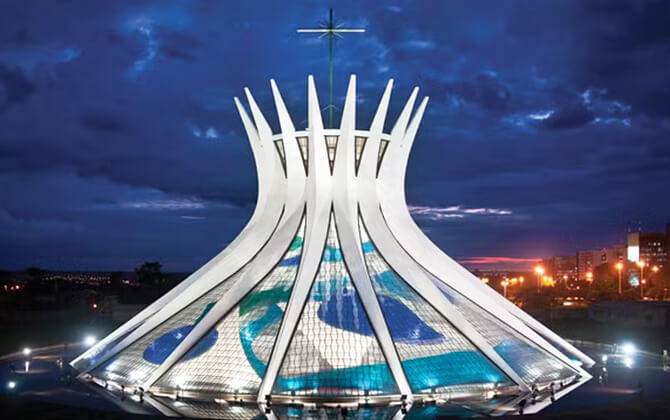
- Museu Nacional de Gemas – about 0.1 km (0.06 miles) away
- Museu de Arte Moderna – about 0.3 km (0.19 miles) away
- Museu da História e Arte de Planaltina – about 0.3 km (0.19 miles) away
- Museu de Arte de Brasília – about 0.4 km (0.25 miles) away
- Nossa Senhora do Rosário de Pompéia – about 0.4 km (0.25 miles) away
- Catedral Metropolitana – about 2.7 km (1.68 miles) away
- Congresso Nacional – about 1.7 km (1.06 miles) away
- Lago Paranoá – about 2.2 km (1.37 miles) away
- Palácio Itamaraty – about 2.1 km (1.30 miles) away
- Praça dos Três Poderes – about 1.6 km (0.99 miles) away
- Centro Cultural Banco do Brasil – about 2.9 km (1.80 miles) away
- Supremo Tribunal Federal – about 1.7 km (1.06 miles) away
- Santuário São João Bosco – about 4.8 km (2.98 miles) away
- Pontão do Lago Sul – about 4.6 km (2.86 miles) away
Other nearby places mentioned in the source material include Espaço Lúcio Costa, Palácio da Justiça, Mastro e Pavilhão Nacional, Caixa Cultural Brasília, Mané Mercado, and Clube do Choro.
The Central area can get busy, so allowing a little extra time for connections is a smart move, especially later in the day or if you are carrying valuables. The nearby bus terminal and taxi services make it easier to continue toward the Esplanada dos Ministérios and other landmarks.