The Bucharest Metro, or Metroul din București, is the underground rapid transit system in Bucharest, Romania’s capital. It opened on 16 November 1979, is operated by Metrorex, and remains the country’s only metro system. Today it is a central part of public transport in the city, working alongside STB buses, trams, and other local transport services.
| Key | Information |
|---|---|
| Operator | Metrorex |
| Opened | 16 November 1979 |
| Lines in operation | 5 lines: M1, M2, M3, M4, M5 |
| Line under construction | M6 |
| Network length | 80.1 km / 49.8 miles |
| Stations | 64 |
| Annual ridership | 142,783,000 passengers in 2023 |
| System type | Mainly underground rapid transit |
| Notable surface section | Between Dimitrie Leonida and Tudor Arghezi |
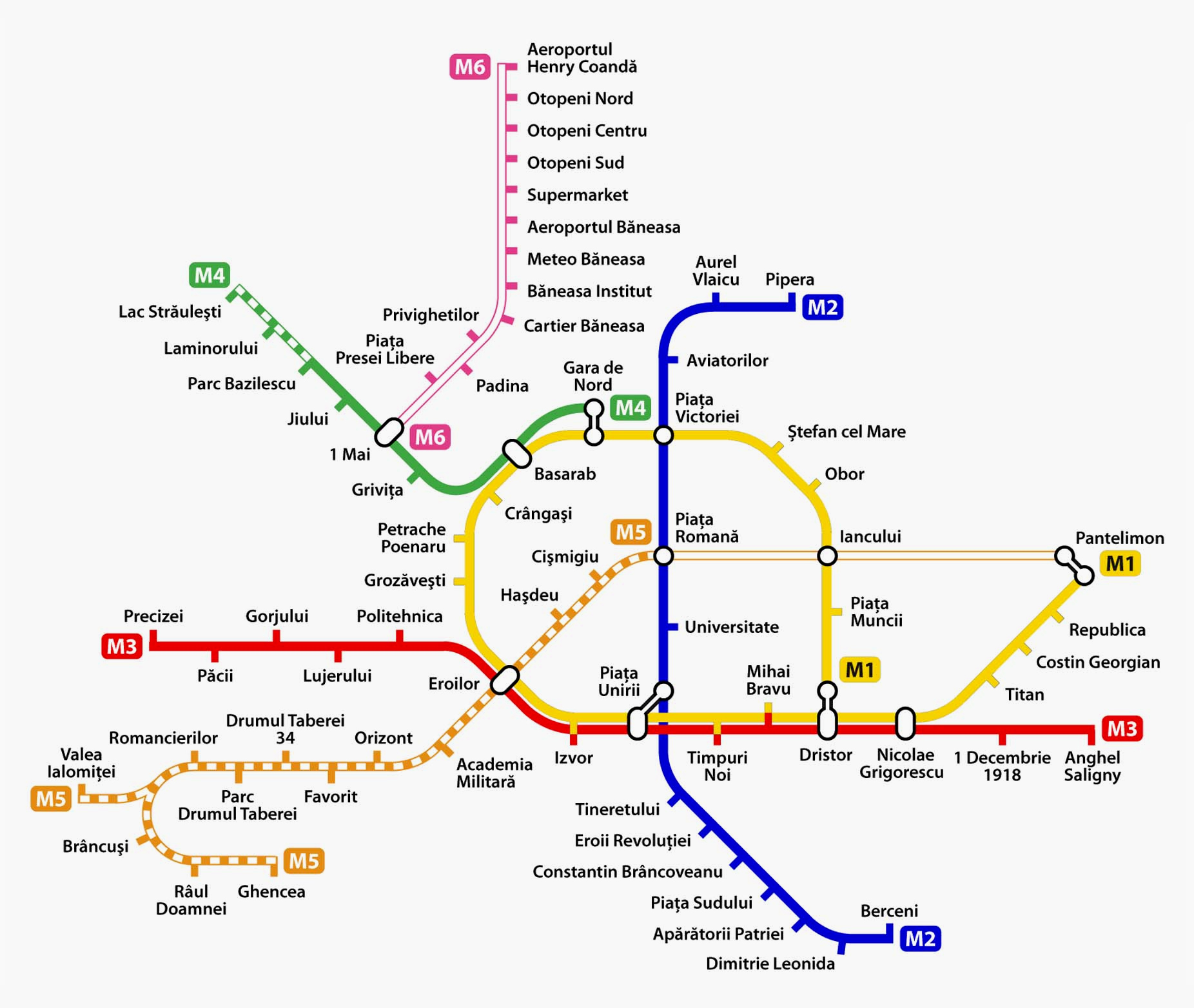
Bucharest Metro Map
Map of Bucharest Metro showing different lines and stations. Click on the map to enlarge it or download the Bucharest Metro map in PDF format.
Lines and stations
The Bucharest Metro system has five operating lines: M1, M2, M3, M4, and M5. M6 is under construction. Altogether, the network covers 80.1 km / 49.8 miles and includes 64 stations.
Each line serves a different part of the city transport network. M1, the oldest line, opened in 1979 and follows a largely circular route. M2 runs north to south through the city center and is the busiest path train line in the system. M3 crosses Bucharest east to west, south of the center, and shares tracks with M1 on part of its route. M4 connects Gara de Nord with Străulești, while M5 serves Drumul Taberei and is the newest line currently in operation. M6 is being built to link Gara de Nord with Henri Coandă International Airport.
Some stations are especially important on the stations map. Piața Unirii and Piața Victoriei are major interchange points, and both appear with separate terminals on the network map. Gara de Nord 1 and Gara de Nord 2 are different stations, even though an underground passage links them. Basarab is another key transfer point.
Most stations are underground and tend to have large interior spaces. Piața Unirii is the biggest station in the network, with extensive corridors, retail space, and a notably large scale. The only section that does not run underground is the short stretch between Dimitrie Leonida and Tudor Arghezi on the southern end of M2.
The newest station is Tudor Arghezi on M2, opened on 15 November 2023. Until 8 May 2024, shuttle operations ran from Berceni while signalling and automation work was completed.
| Station | Details |
|---|---|
| M1 | Opened in 1979; largely circular route; Dristor 2 to Pantelimon. |
| M2 | North-south route through central Bucharest; busiest line; Pipera to Tudor Arghezi. |
| M3 | East-west route south of the center; shares part of its alignment with M1; Preciziei to Anghel Saligny. |
| M4 | Connects Gara de Nord with Străulești. |
| M5 | Newest operating line; serves Drumul Taberei; Râul Doamnei / Valea Ialomiței to Eroilor 2. |
| M6 | Under construction; planned route from Gara de Nord to Henri Coandă Airport. |
| Piața Unirii | Major interchange and the largest station in the network. |
| Piața Victoriei | Important transfer station shown as two terminals on the map. |
| Gara de Nord 1 and Gara de Nord 2 | Separate stations linked by an underground passage. |
| Basarab | Key interchange station. |
| Line | Opened | Last expansion | Route |
|---|---|---|---|
| M1 | 1979 | 1992 | Dristor 2 – Pantelimon |
| M2 | 1986 | 2023 | Pipera – Tudor Arghezi |
| M3 | 1983 | 2008 | Preciziei – Anghel Saligny |
| M4 | 2000 | 2017 | Gara de Nord – Străulești |
| M5 | 2020 | N/A | Râul Doamnei / Valea Ialomiței – Eroilor 2 |
| M6 | Under construction | N/A | Gara de Nord – Henri Coandă Airport |
Timetable and frequency
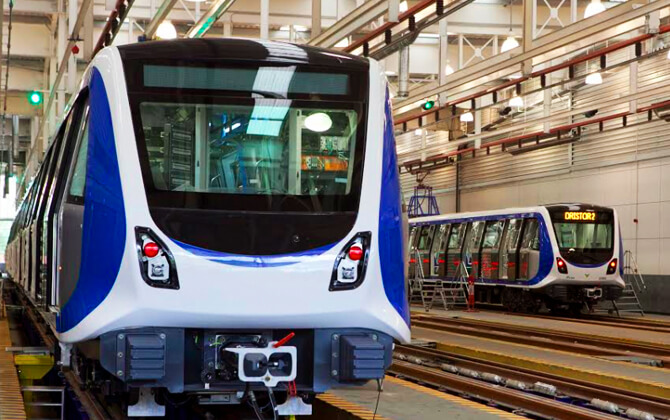
The Bucharest Metro timetable is the same every day: trains run from 5:00 AM to 11:00 PM. These are the usual operating hours, opening hours, opening times, and working hours across the network.
On the busiest lines, the last train on M1, M2, and M3 waits at Piața Unirii so passengers can transfer before departure. If you are checking timings today, schedule today, or the closing time, that 11:00 PM network close is the key point to remember.
Frequency depends on the line and time of day, so the train schedule and route timetable vary a bit across the system.
| Service detail | Timings |
|---|---|
| Network operating hours | Daily from 5:00 AM to 11:00 PM |
| M1 and M3 frequency | Every 4–6 minutes at rush hour; every 8–9 minutes off-peak |
| M2 frequency | Every 1–3 minutes at rush hour; every 4–7 minutes on weekdays off-peak; every 7–9 minutes on weekends and late nights |
| M4 frequency | Every 7–8 minutes at rush hour; every 8–10 minutes off-peak |
| M5 frequency | Every 6 minutes between Eroilor and Romancierilor at rush hour; every 12 minutes on each branch |
| Last train transfer coordination | M1, M2, and M3 last trains wait at Piața Unirii for passenger transfers |
Shared sections can affect running time and headways. M1 and M3 use part of the same tracks, and M4 is planned to share part of its alignment with M6.
Rates, tickets, and passes
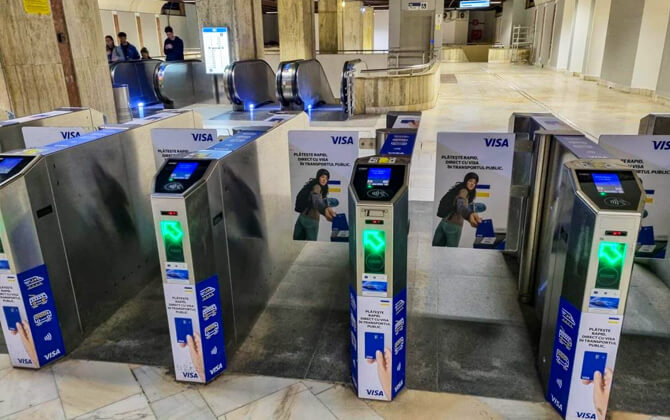
The Bucharest Metro has its own ticket system, separate from the STB surface transport network. In simple terms, a regular bus ticket cannot be used on the metro. There is no general combined fare across both systems, apart from specific integrated products.
The main exception is the monthly combined pass for Metrorex and STB. It costs 140 lei, around $30, and can be used on both the metro and surface public transport. You can buy it at metro station ticket offices and bus ticket booths.
For metro-only travel, these are the ticket price options listed in the source material:
- 1 trip — 5 lei, about $1
- 2 trips — 10 lei, about $2
- 10 trips — 40 lei, about $9
- 24 hours pass — 12 lei, about $3
- 72 hours pass — 35 lei, about $8
- Weekly pass — 45 lei, about $10
- Monthly pass — 100 lei, about $22
- 6 months pass — 500 lei, about $109
- Annual pass — 900 lei, about $196
If you plan to use the metro together with buses, trams, and trolleybuses, the integrated Metrorex-STB ticket and pass options are more practical. These include combined trips and passes with time limits such as 120 minutes, 24 hours, 72 hours, and 7 days, plus longer-term options.
Tickets and cards are sold at station ticket booths, and many stations also have self-service ticket machines. If you are comparing fare, cost, or price options, a pass is usually the easiest choice for frequent travel. The source material does not provide a fare calculator.
Connections with other systems
The Bucharest Metro is part of the wider public transport system, but it is run separately from the surface network. Metrorex operates the underground system, while STB manages buses, trolleybuses, trams, and light rail. Transfers between modes are common, even though the two systems do not share a single operating authority.
For passengers, this means transportation in Bucharest is connected, but not fully unified. Metro and STB used separate ticket systems until 2021, when integrated tickets and passes were introduced for travel across both networks within set time limits.
The metro also connects with the Romanian Railways network in two places. One is at Berceni, where the link serves the Bucharest Belt Ring. The other is at Ciurel, where an underground passage leads to the Cotroceni-Militari industrial railway, though that connection is currently unused and mothballed.
Some interchanges are especially important on any route plan. Piața Victoriei is shown on the official map as Victoriei 1 and Victoriei 2, although in practice it functions as one station with platforms on different levels. Piața Unirii is another major hub with transfers across several lines.
Gara de Nord 1 and Gara de Nord 2 are a special case. They are linked by a subterranean passage, but because passengers must leave the station area and pay again, this is not treated as a standard in-system transfer.
In day-to-day travel, the metro works best as one part of a larger city transport network. It is easy to combine underground trips with buses, trams, trolleybuses, or rail depending on your route.
- Metro operator: Metrorex
- Surface operator: STB
- Rail connections: Berceni and Ciurel
- Major interchange examples: Piața Victoriei, Piața Unirii, Gara de Nord
Connections with the airport
Bucharest Metro does not yet have a direct airport link to Henri Coandă International Airport. For now, travelers need to combine the metro with other transport services.
The most practical route is usually to take the metro to Gara de Nord and continue by train to the airport. Another option is to travel to Piața Victoriei or Gara de Nord and transfer to bus 783 or 780, both of which serve the airport.
A direct metro connection is planned through M6. This line is under construction and will run from Gara de Nord to Henri Coandă International Airport, with opening expected in stages.
For travelers using integrated tickets, the airport journey can be covered through combined metro, STB, and train travel options.
Safety and security
The Bucharest Metro is generally considered safe and reliable, and it is widely used by both locals and visitors. For most trips, including evening travel, it is a practical way to get around the city.
The main issue is petty theft, especially pickpocketing on crowded trains and at busy stations such as Piața Unirii and Universitate during peak hours. So yes, the system is safe, but it still pays to stay alert.
Security measures have been strengthened with increased patrols, wider CCTV coverage in key areas, better station lighting, and more frequent safety announcements. Metro staff have also been retrained to focus more closely on platform safety, and police officers may patrol stations in civilian clothes.
A few simple precautions help:
- Keep your bag zipped and your phone secure on crowded trains.
- Do not stand close to the platform edge.
- Use ATMs inside bank branches or malls if you need cash before traveling.
- If something feels wrong, call emergency number 112.
There have been isolated serious incidents in the past, which is why patrols and platform reminders remain important. Even so, safety audits have found the system broadly in line with current practice.
Accessibility
Accessibility in Bucharest public transport is moderate overall, but travelers with disabilities, especially wheelchair users, should plan carefully.
All city buses are wheelchair accessible. They have low floors, a fold-out ramp at the center door, and one wheelchair securement space, although securement straps are not always available. In practice, disabled passengers and wheelchair users may ride free on the city bus network, while travelers without an apparent physical disability are normally expected to apply for a disability identification card.
The trolleybus network is also largely accessible. Fourteen of the 19 trolleybus lines are wheelchair accessible: 61, 62, 66, 69, 70, 71, 79, 85, 86, 90, 91, 92, 93, and 96.
The metro can work for some manual wheelchair users, but it is not suitable for most powered wheelchairs or scooters. Many stations have elevators, though accessibility depends on the station layout and the type of wheelchair. Gaps of up to 5 inches / 12.7 cm may exist between train and platform, and trains are often not level with the platform, requiring a step up of 2–3 inches / 5.1–7.6 cm.
Some stations still have no elevator access and are not accessible for wheelchair users. Metrorex has been retrofitting elevators in many stations, and the system is also moving toward better access for visually impaired passengers through specialized design work.
Trams are the least accessible part of the network. On-street tramway boarding usually requires passengers to climb several steps, so trams are not a good option for wheelchair users.
History
The history of the Bucharest Metro goes back to the early 20th century, when Romanian engineers Dimitrie Leonida and Elie Radu first proposed a metro system for the city. Early plans were drafted in the late 1930s, but World War II and later political changes stopped the project.
By 1970, Bucharest’s public transport network could no longer keep up with the city’s growth. A commission concluded that an underground system was necessary, the first line was approved on 25 November 1974, and construction began on 20 September 1975.
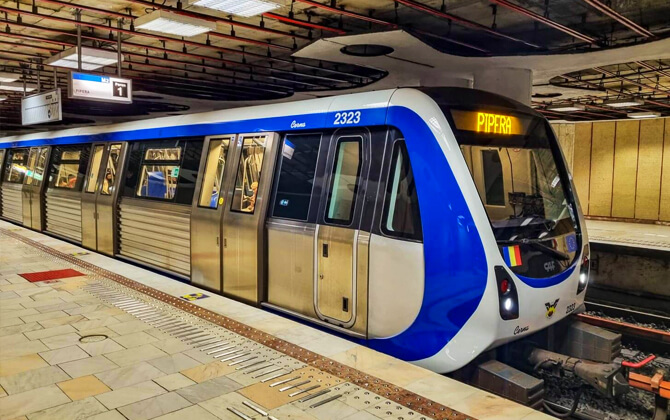
From the beginning, the system was designed differently from many other Eastern European metros. Early stations were simple, practical, and modern rather than heavily decorated. The trainsets were also built in Romania. Interiors often used color themes and open layouts, with fast movement and functionality as the main goals.
The network expanded quickly in the 1980s. M3 opened in 1983 and M2 followed in 1986. After the 1989 Romanian Revolution, expansion slowed during the 1990s. Some projects were completed in stages, such as Gorjului, where the two platforms opened in 1994 and 1998 with different materials and color schemes. Construction of M4 had started in September 1989, but the line did not open until 2000.
After Romania joined the European Union in 2007, EU funding supported further growth. M5 opened in 2020, and M6 is now under construction. The newest station, Tudor Arghezi on M2, opened on 15 November 2023, with shuttle service continuing until 8 May 2024 while signalling and automation systems were completed.
The system has also developed some unusual technical and operational features. M1 and M3 share part of their alignment between Eroilor and Nicolae Grigorescu, while M4 and M6 are planned to share a section between Gara de Nord 2 and 1 Mai. Some major stations have two terminals with different names, and Gara de Nord 1 and Gara de Nord 2 remain separate stations connected by a passage.
Construction was not always smooth. In April and May 1986, work on a connection tunnel between M1 and M2 damaged the foundations and altar of Slobozia Church, and the site was later filled with sand. On 1 May 1987, reconstruction work at Piața Unirii caused flooding after the Dâmbovița was breached again, stopping train circulation for five days.
Future Extensions
The Bucharest Metro expansion program includes lines under construction, approved projects, and longer-term proposals. The most advanced work is on M6, which is being built in stages between 1 Mai, Tokyo, and Henri Coandă Airport.
Another confirmed project is the southward extension of M2 beyond Berceni to Tudor Arghezi, which opened in 2023 and may still be followed by additional southern growth.
Other future plans include extending M4 south from Gara de Nord toward Gara Progresul and extending M5 east toward Pantelimon. Longer-term proposals also include M7, planned to connect Bragadiru and Voluntari, and M8, envisioned as a southern half-ring, though its final route has not been fully defined.
There are also ideas for further development on existing lines, including another northbound M2 extension from Pipera and a future M3 extension. Two possible infill stations have also been mentioned on M1: Dorobanți between Ștefan cel Mare and Piața Victoriei, and Giulești between Crângași and Basarab.
Nearby Attractions
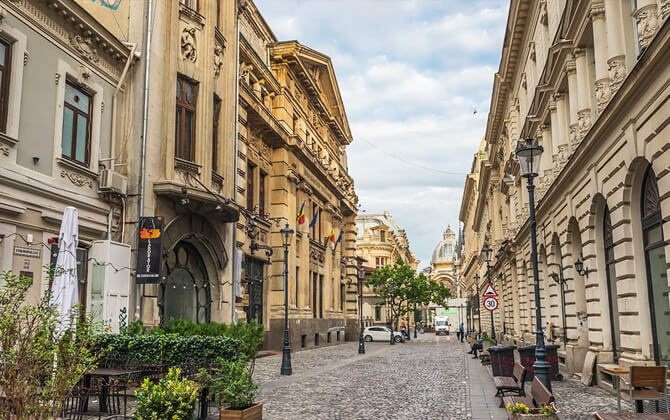
The Bucharest Metro makes it easy to reach many of the city’s best-known sights. Because stations are placed near central squares and major boulevards, you can cover a lot of Bucharest without long surface transfers.
Piața Unirii is one of the best starting points. From here, visitors can reach the Old City Center, Manuc’s Inn, The Old Cec Bank, Caru cu Bere, and the Palace of Parliament.
Universitate is a convenient stop for the University of Bucharest area, the National Theatre, and the Bucharest Municipality Museum. It also works well for walks toward the Old City Center, Queen Elisabeta Boulevard, the National Military Circle, and Cișmigiu Park.
Victoriei brings you to one of Bucharest’s busiest squares, near the Romanian Government building. It is also useful for the Natural History Museum, the Geology Museum, and the Romanian Peasant Museum. From there, you can continue along Bulevardul Victoriei to see the Atheneum, the Museum of Contemporary Art, the Royal Palace, the Novotel Building, and the National Bibliotheque.
Aviatorilor is the station for Herăstrău Park, where you can walk, relax, take a boat ride on the lake, or visit the Romanian Village Museum. The Arc of Triumph is also nearby.
Gara de Nord is the station to use for day trips beyond Bucharest. From here, travelers can continue by train to Brașov, Bran Castle, or Peleș Castle, or simply use it as the city’s main rail hub.
Planning a leisure trip to Bucharest and found the information here really useful. The rates, tickets & passes heading was especially useful – the weekly pass represents excellent value with unlimited travel.