The Budapest Metro, or Budapesti metró, is the rapid transit system of Hungary’s capital and a core part of public transport in Budapest. Opened in 1896, it is one of the oldest underground railways in the world and the second-oldest electrified underground railway after the City and South London Railway. Today, the system has four lines, 52 stations, and a total route length of 39.4 kilometers (24.5 miles), linking both Buda and Pest and supporting everyday city transport across Budapest.
| Key | Information |
|---|---|
| System name | Budapest Metro (Budapesti metró) |
| Opened | 1896 |
| Lines | 4 |
| Stations | 52 |
| Network length | 39.4 km (24.5 miles) |
| Historic line | M1, listed as a UNESCO World Heritage Site in 2002 |
| Service hours | Daily from 4:30 am to 11:00 pm |
| Frequency | Usually every 2 to 15 minutes |
Budapest Metro Map
Map of Budapest Metro showing different lines and stations. Click on the map to enlarge it or download the Budapest Metro map in PDF format.
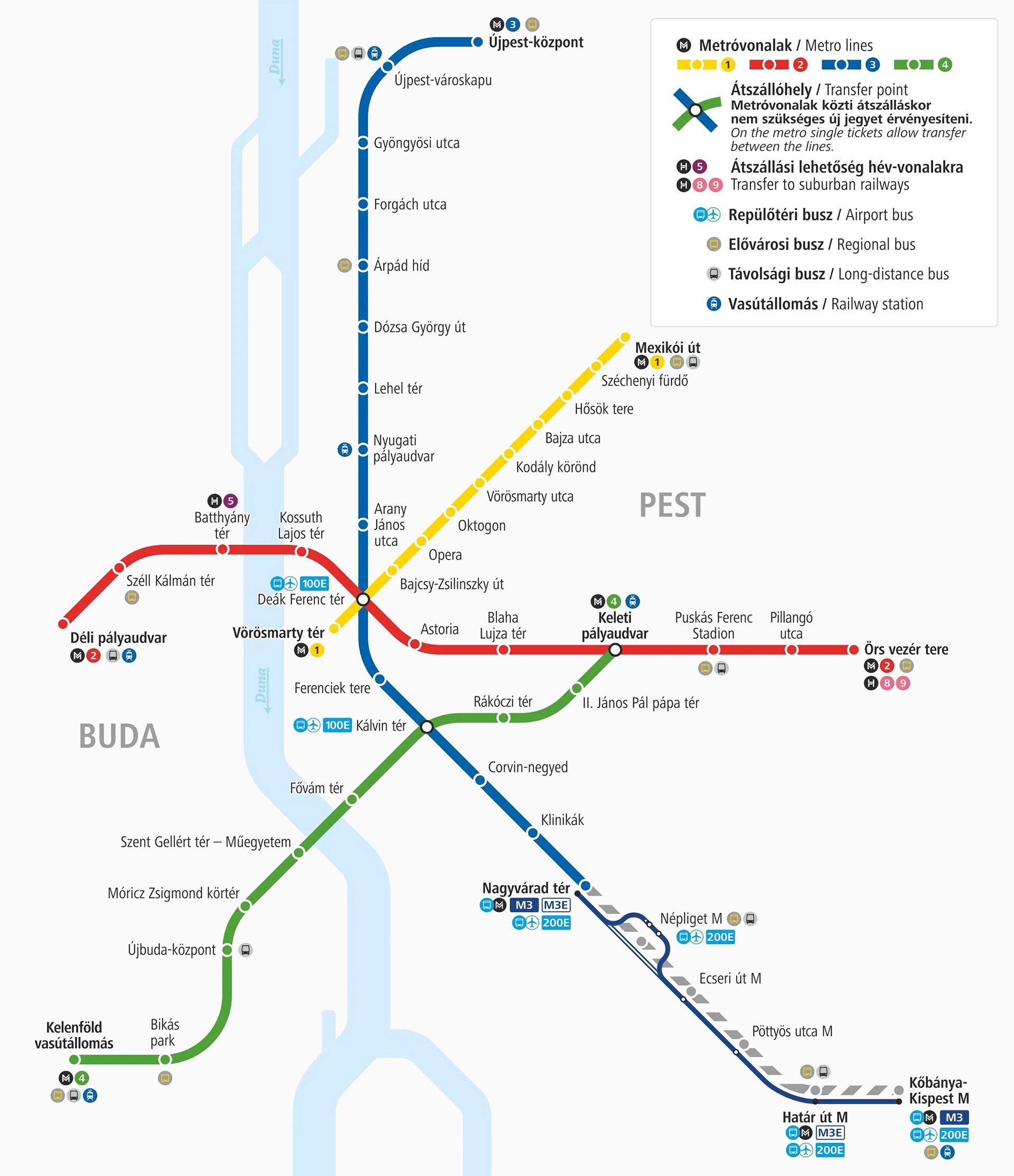
Interactive Map of Budapest Metro
Budapest Metro Lines and Stations
The Budapest Metro has four lines, each marked by a different color: M1 yellow, M2 red, M3 blue, and M4 green. The network is compact, easy to understand, and covers the city’s main transport corridors.
In total, the system has 52 stations and a route length of 39.4 kilometers (24.5 miles). M1 opened in 1896, M2 in 1970, M3 in 1976, and M4 in 2014.
| Station | Details |
|---|---|
| M1 | Yellow line. Route: Vörösmarty tér ↔ Mexikói út. Opened in 1896. Length: 4.4 km (2.7 miles). Stations: 11. |
| M2 | Red line. Route: Déli pályaudvar ↔ Örs vezér tere. Opened in 1970. Length: 10.3 km (6.4 miles). Stations: 11. |
| M3 | Blue line. Route: Újpest-Központ ↔ Kőbánya-Kispest. Opened in 1976. Length: 17.3 km (10.7 miles). Stations: 20. |
| M4 | Green line. Route: Keleti pályaudvar ↔ Kelenföld vasútállomás. Opened in 2014. Length: 7.3 km (4.5 miles). Stations: 10. |
| Total | System length: 39.4 km (24.5 miles). Total stations: 52. |
Line M1
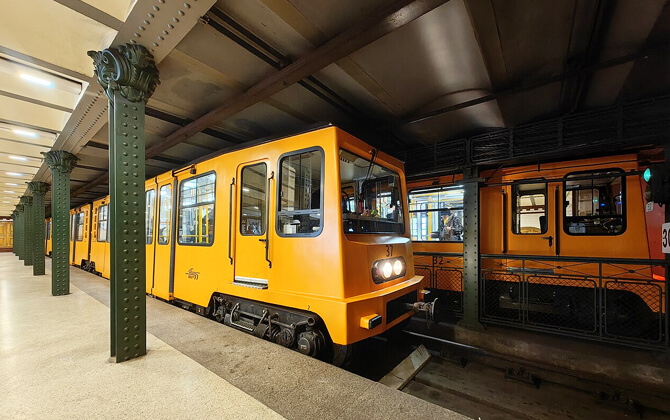
M1 is the oldest line in the Budapest Metro and the city’s original underground route. It runs from Vörösmarty tér to Mexikói út and serves central Pest, including Deák Ferenc tér, Opera, Oktogon, and stations near Heroes’ Square.
The line was completed in 1896. It later became an IEEE Milestone, and in 2002 it was listed as a UNESCO World Heritage Site. According to the source material, the original M1 route ran 5 kilometers (3.1 miles) from Vörösmarty tér to Széchenyi fürdő. Today, it has 11 stations, with eight original stations and three added during reconstruction.
Line M2
M2 runs east to west from Déli pályaudvar to Örs vezér tere, connecting Buda and Pest through the city center. Key interchange stations include Deák Ferenc tér, Keleti pályaudvar, Batthyány tér, and Örs vezér tere.
It opened in 1970 and has 11 stations. Before M4 opened, it was the only metro line serving the Buda side for more than 45 years. The line was later rebuilt, with station upgrades and track replacement completed by 2007.
Line M3
M3 is the longest route in the Budapest Metro system. It runs mainly north to south on the Pest side, from Újpest-Központ to Kőbánya-Kispest, linking densely populated residential districts with the Inner City.
Important transfer stations include Deák Ferenc tér and Kálvin tér. Construction started in 1970, the first section opened in 1976, and the line was extended several times before renovation was completed in May 2023. M3 has 20 stations.
Line M4
M4 runs between Keleti pályaudvar and Kelenföld vasútállomás. Completed in 2014, it has 10 stations and connects with M2 at Keleti pályaudvar and with M3 at Kálvin tér.
The line crosses the Danube and links two major railway stations, which makes it an important cross-city route. Across the network, Deák Ferenc tér is the main interchange for M1, M2, and M3, while Kálvin tér connects M3 and M4. Keleti pályaudvar is another key transfer point between M2 and M4.
Tickets and prices
If you plan to use the Budapest Metro along with trams and bus services, a travel card or pass is often the most practical ticket option. A one-way ticket is valid only for an uninterrupted ride, so if your route includes a change between metro lines, you need a transfer ticket.
Always buy your ticket before boarding. Ticket inspections are common on the metro, and the fine for traveling without a valid ticket can be up to 16,000 Ft (US$ 47.10).
| Service detail | Timings |
|---|---|
| Single ticket price | 350 Ft (US$ 1.03) |
| 10 Journey ticket price | 3 Ft (US$ 0) |
| Short section metro ticket fare | 300 Ft (US$ 0.88), up to three stops |
| Transfer ticket price | 530 Ft (US$ 1.56) |
| 24-hour travel card price | 1.65 Ft (US$ 0) |
| 72-hour travel card price | 4.15 Ft (US$ 0.01) |
| 7-day travel card price | 4.95 Ft (US$ 0.01) |
Tickets are sold at the airport, metro stations, tobacconists, newsstands, and by transport inspectors.
For longer stays, Budapest also offers a wider fare system for local transport and city transport, including block tickets, time-based tickets, and Budapest Card options. If you are comparing fare choices, a travel card may be more convenient than buying separate tickets for each ride.
Schedule, Timetables, and Calendar
The Budapest Metro operating hours are daily from 4:30 am to 11:00 pm. If you are checking opening hours, opening times, or working hours for the system, that is the standard schedule today. Trains usually run every 2 to 15 minutes, depending on the time of day, so frequency and timings vary across the day.
For many passengers, the key details are simple: starting time is 4:30 am, closing time is 11:00 pm, and the last train runs within that daily service window. If you are looking up timings today, schedule today, or train schedule information, it is still smart to confirm the current timetable before traveling.
Before boarding, validate your ticket in the orange machines. A single ticket is valid only for one uninterrupted one-way ride, so if you change metro lines, you need a new single ticket. One-journey validity is 80 minutes, or 120 minutes at night-time.
The main metro route timetable covers these lines:
| Service detail | Timings |
|---|---|
| M1 route | Mexikói út ◄► Vörösmarty tér |
| M2 route | Örs vezér tere ◄► Déli pályaudvar |
| M3 route | Kőbánya-Kispest ◄► Újpest-központ |
| M4 route | Kelenföld vasútállomás ◄► Keleti pályaudvar |
Many other public transport services in Budapest, including replacement bus routes and local transport connections, follow related timetable patterns. For the safest trip planning, check the current route timetable and operating day before you travel.
Deák Ferenc tér is the main interchange where three metro lines meet, so it is often the easiest transfer point in the system.
Rules and Regulations
To keep the Budapest Metro safe and comfortable, passengers are expected to follow a few basic rules. The system uses pre-purchase and validation, so tickets must be bought in advance and validated before travel.
- Smoking is strictly forbidden in the metro and in all underground areas.
- Eating and drinking are not allowed on the metro.
- Alcohol is not allowed on the underground.
- Begging and hawking are not permitted.
- Passengers may not place luggage or other objects on seats.
- Areas reserved for metro staff are off-limits.
- Loud music must not be played without headphones.
- All passengers must carry a valid ticket and show it to a ticket inspector on request.
- Tickets must be validated at the orange boxes or machines before traveling.
- Travel without a valid ticket can lead to a fine of up to 16,000 HUF (US$ 47.10).
Bicycles are allowed only on weekends and public holidays, and only on M1, M2, and M4. On weekdays, bicycles are not allowed at peak times. Animals are also allowed, but dogs must be on a lead, muzzled, and have a valid ticket, while small pets must be kept in a sealed container.
Keep your ticket until the end of the journey, since inspections can happen at any time. BKK services may also refuse travel to passengers who break the rules.
Facilities and Services
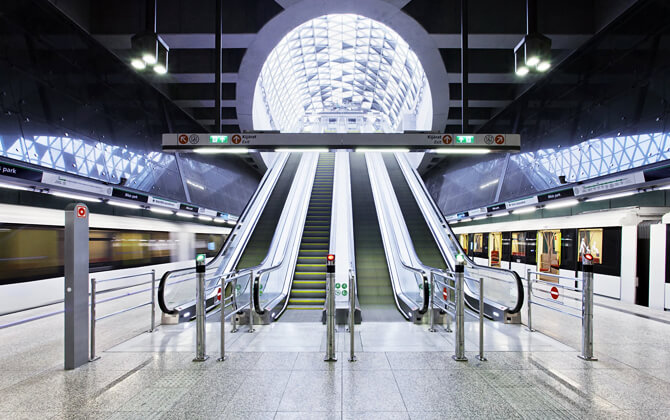
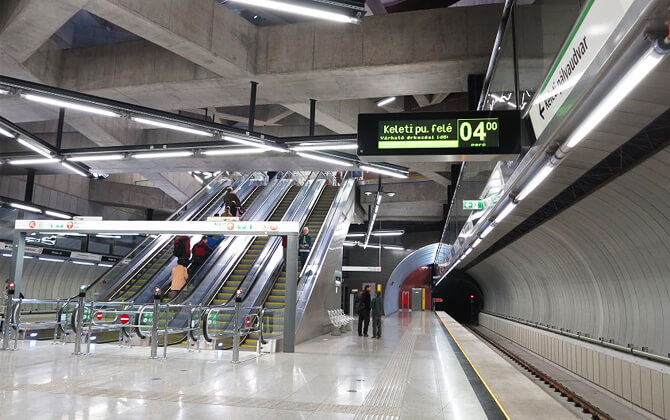
Budapest Metro stations have digital displays that show the running time until the next train. Many stations also have escalators, and some include lifts for wheelchair users.
For passenger safety, stations are monitored by CCTV cameras and supported by regular police patrols. Ticket inspections are also part of the system, so hold on to your ticket until the end of the trip and validate it before boarding.
Journey planning is fairly straightforward because the lines meet at major transfer points. Knowing your route plan in advance can make transportation in Budapest quicker, especially during busy periods.
The metro can get crowded at rush hour, so be ready to offer your seat to elderly passengers, pregnant women, or people with disabilities.
Fun Facts
The Budapest Metro opened in 1896, making it the world’s second-oldest electrified underground railway after London’s City and South London Railway.
Its first line, M1, was recognized as an IEEE Milestone and became a UNESCO World Heritage Site in 2002.
M1 introduced several innovations for its time, including bidirectional tram cars, electric lighting in stations and cars, and an overhead wire power system instead of a third rail.
Since M4 opened in 2014, the system has had four lines, 52 stations, and 39.4 kilometers (24.5 miles) of track.
M3 is the longest line in the network, with 20 stations and an estimated daily ridership of 610,000.
M4 is the newest line and is fully automated, although it does not have platform screen doors.
Deák Ferenc tér is the key interchange where M1, M2, and M3 meet.
The metro has long been part of Budapest’s transport history, and Line 1 still keeps much of the atmosphere of the original underground system.
The Hungarian thriller Kontroll was filmed in the metro system on lines M2 and M3.
Future expansions
Plans for Budapest Metro expansion focus on extending the network, improving connections, and building stronger links with suburban rail. The clearest proposal is Metro Line M5, a planned north-south tunnel designed to connect the separate H5, H6, and H7 suburban railway lines. At the moment, the project appears only in long-term plans and does not have mainstream political support.
The first phase of M5, planned up to 2030, would extend and connect the southern H6 and H7 lines to Astoria via Kálvin tér. That would create new interchange options with M2, M3, and M4. The second phase would continue to Oktogon for a connection with M1, then to Lehel tér for M3, before crossing the Danube to the Buda side and connecting with the H5 suburban railway toward Szentendre.
Other ideas have also been discussed for existing lines. For M2, planning began in 2021 for a direct connection with suburban rail through a shared new station at Örs vezér tere, plus a possible new underground station near the Hungexpo Budapest Congress and Exhibition Center. For M3, a possible extension toward Káposztásmegyer has been mentioned. M4 was also designed with future growth in mind, with plans for extensions in both directions.
Beyond rail infrastructure, BKK also plans to gradually extend its bank card-based Pay&GO system across the full public transport network in Budapest and its metropolitan area from 2028, with more electronic ticketing features planned later.
Nearby attractions
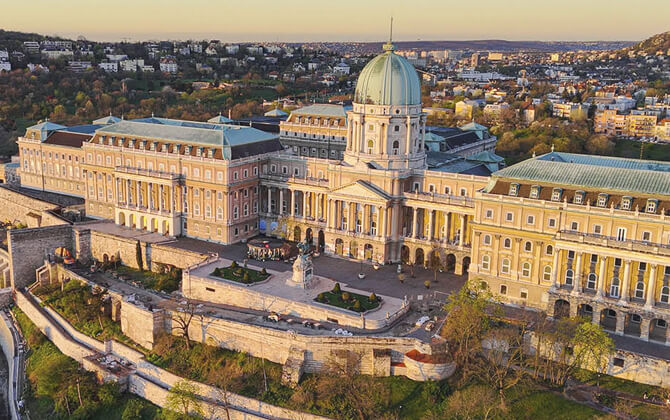
The Budapest Metro is a practical way to reach many of the city’s best-known sights. With four lines and well-placed stations, it works well for both daily transport and visitor travel.
The yellow M1 line is especially useful for visitors. It runs along Andrássy Avenue and stops near the Hungarian State Opera House, Oktogon, Heroes’ Square, City Park, and the Chain Bridge area. Its stations are also known for their decorative design, and the line is easy to use because it is not very deep.
M2 also serves important attractions. Kossuth Square is the stop for the Hungarian Parliament, Batthyány Square serves Fisherman’s Bastion, and Astoria is the closest station to the Great Synagogue.
M3 can be a good option if you arrive from the airport by bus 200E, since its first station is Kőbánya-Kispest. It also serves the Great Market Hall at Kálvin tér.
M4 links Keleti Railway Station and Kelenföld Railway Station, so it is handy for transfers between major rail hubs. If you are staying in central Budapest, Deák Ferenc Square is the main interchange, where metro lines meet and where you can continue on foot or by other public transport.
| Station | Details |
|---|---|
| Andrássy Avenue area | Reached by M1. |
| Hungarian State Opera House | Reached by M1. |
| St. Stephen’s Basilica | Within reach of the metro network. |
| Dohány Street Synagogue | Within reach of the metro network. |
| House of Terror Museum | Reached by M1. |
| Erzsébet Square | Within reach of the metro network. |
| Deák Ferenc Square | Main interchange in central Budapest. |
| Heroes’ Square | Reached by M1. |
| City Park | Reached by M1. |
| Széchenyi Baths | Within reach of M1. |
| Hungarian Parliament Building | Reached via Kossuth Square on M2. |
| Fisherman’s Bastion | Reached via Batthyány Square on M2. |
| Great Synagogue | Closest metro stop is Astoria on M2. |
| Great Market Hall | Reached via Kálvin tér on M3. |
| Buda Castle | Within reach of the metro network. |
Trams and bus routes also connect many of these places, so the metro fits easily into a wider sightseeing route across the city.