The Nuremberg U-Bahn is the rapid transit system for Nuremberg and Fürth in Bavaria, operated by VAG within the VGN public transport system. Opened in 1972, it is Germany’s newest metro system and the shortest of the country’s four heavy-rail metro networks. Today, the system has three lines, 49 stations, and 38.2 km (23.7 miles) of route. It is also known for automation: driverless trains started on U3 in 2008, and U2 was converted to fully automated operation by 2010. U1, meanwhile, follows part of the historic corridor of the Bavarian Ludwig Railway, Germany’s first passenger railway.
| Key | Information |
|---|---|
| System | Nuremberg U-Bahn |
| Operator | Verkehrs-Aktiengesellschaft Nürnberg (VAG), within VGN |
| Area served | Nuremberg and Fürth, Bavaria |
| Opening | 1972 |
| Lines | 3: U1, U2, U3 |
| Stations | 49 |
| Route length | 38.2 km (23.7 miles) |
| Special feature | U2 and U3 are fully automated and driverless |
| Main transfer stations | Plärrer and Hauptbahnhof |
| Airport link | U2 to Flughafen |
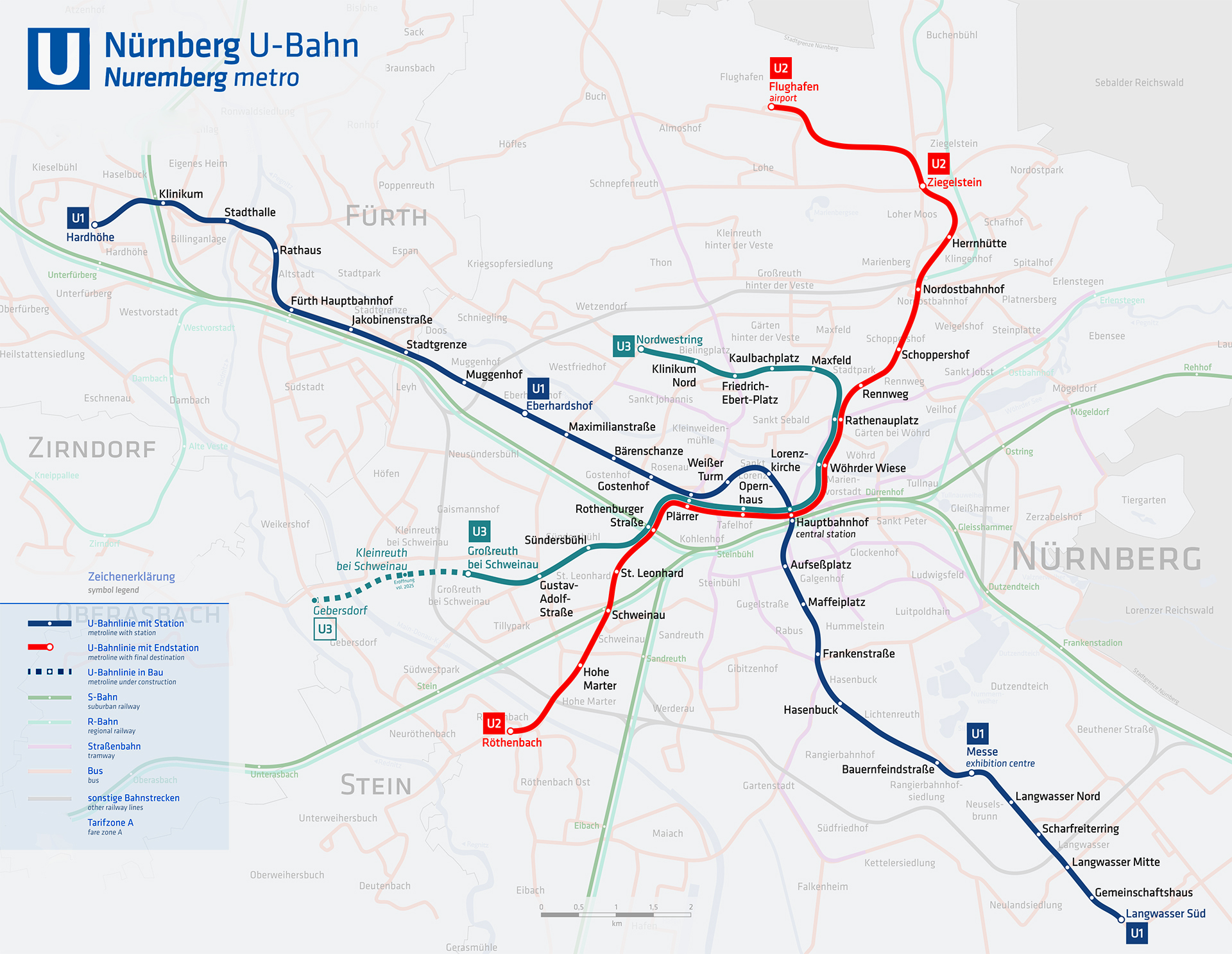
Map of Nuremberg U-Bahn
Map of Nuremberg U-Bahn showing different lines. Click on the map to enlarge it or download the Nuremberg U-Bahn map in PDF format.
Lines and Stations of the Nuremberg Metro
The Nuremberg Metro has three lines: U1, U2, and U3. Together they form a compact city transport system with 49 stations across 38.2 km (23.7 miles) of route. Key interchange stations include Plärrer and Hauptbahnhof, while Rothenburger Straße, Opernhaus, Wöhrder Wiese, and Rathenauplatz also support transfers. All stations are accessible by lift, which makes the stations map easier to use for step-free travel planning.
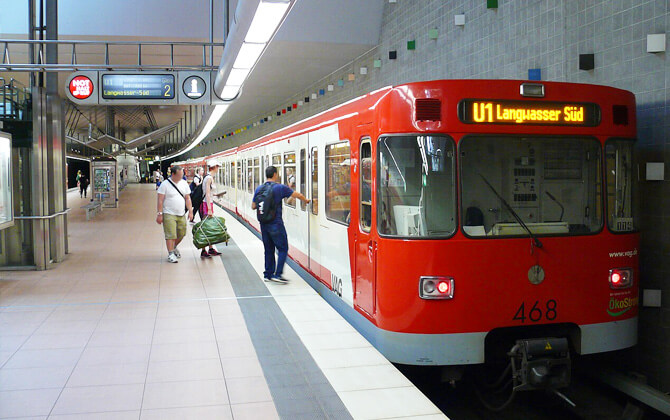
U1 is the oldest and longest route, running from Langwasser Süd to Fürth Hardhöhe. It crosses the city center and is the only line that continues beyond Nuremberg into Fürth. Part of its path follows the former Bavarian Ludwig Railway corridor.
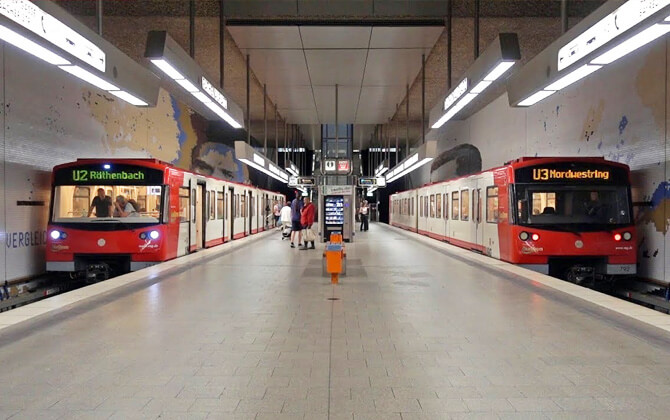
U2 runs between Röthenbach and Flughafen. It is fully automated, serves central stations such as Plärrer, Hauptbahnhof, and Opernhaus, and gives direct access to the airport.
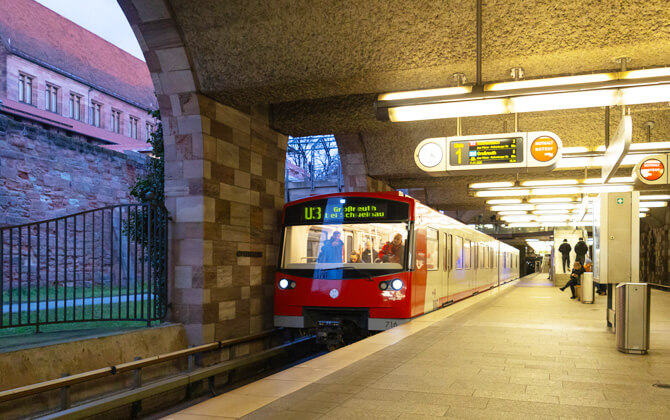
U3 is the newest line and is also driverless. It shares tracks with U2 on part of the network, then branches off to serve the northwest and southwest of the city. Its terminal stations are Nordwestring and Großreuth.
The network structure was planned to connect major destinations and development areas with relatively few stops. Over time, the system expanded in stages, especially on U3, while the last U1 extensions were completed in Fürth.
| Station | Details |
|---|---|
| U1 | Langwasser Süd — Fürth Hardhöhe; oldest and longest line; only line crossing into Fürth |
| U2 | Röthenbach — Flughafen; fully automated; direct airport connection |
| U3 | Großreuth — Nordwestring; newest line; fully automated |
| Plärrer | Main interchange for all three lines |
| Hauptbahnhof | Main interchange for all three lines and rail connections |
| Rothenburger Straße | Transfer between U2 and U3 |
| Opernhaus | Transfer between U2 and U3 |
| Wöhrder Wiese | Transfer between U2 and U3 |
| Rathenauplatz | Transfer between U2 and U3 |
Ticketing and Fare Structure
Nuremberg U-Bahn tickets are part of the VGN fare system, which also covers bus, trams, S-Bahn, and regional trains. In the Nuremberg, Fürth, and Stein area, routes are in fare zone A, and the fare depends mainly on ticket type and the number of zones traveled.
You can buy a ticket through the VGN app, on the VGN website, or from vending machines in stations and around the city. The source material notes that online purchase can be cheaper than other sales channels. If you need a fare calculator, check VGN tools directly before travel.
Common ticket types
- Single ticket: valid for 90 minutes in one direction. Adult ticket price: €2.40 to €3.10 ($2.56 to $3.31). Child fare: €0.80 to €1.60 ($0.85 to $1.71).
- Short-distance ticket: valid for two stops on the metro or four stops on buses and trams. Adult price: about €1.60 to €2.40 ($1.71 to $2.56). Child fare: about €0.80 to €1.10 ($0.85 to $1.17).
- 4-trip ticket: four rides of up to 90 minutes each. Adult fare: €11.00 to €13.90 ($11.75 to $14.85). Child fare: €5.50 to €5.80 ($5.88 to $6.20).
- 5-trip ticket: discounted multi-ride ticket for the Nuremberg/Fürth/Stein fare area.
- 10-trip pass: can be used by more than one passenger at the same time, with validation for the relevant zones.
Day and group tickets
- All-day ticket solo / TagesTicket Solo: unlimited rides for one person for one day. Prices range from €4.80 to €10.30 ($5.13 to $11.00).
- All-day ticket plus / TagesTicket Plus: valid for up to six passengers, with a maximum of two adults. Prices range from €8.00 to €15.20 ($8.55 to $16.24).
- Saturday bonus: if a day pass is bought on Saturday, it is also valid on Sunday.
- Group ticket: for groups of at least 10 adults, with a fare of €1.55 per person per trip ($1.66).
These products are not 24-hour tickets. They are valid on the day of issue, and some remain valid until 3:00 AM the following day. One passenger on the Plus ticket may be replaced by a bike.
Season tickets and passes
- MobiCard: a transferable pass with several versions, including 7-day and 31-day options. It allows unlimited travel within the valid fare zone. Some versions also let one adult and up to four children travel after 9:00 AM on weekdays.
- Annual ticket: €79.20 ($84.62), with monthly cancellation possible.
- Annual ticket plus: €86.90 ($92.85) for 1 to 6 people, payable monthly or in advance for the whole year.
- 9 a.m. season ticket: €48.30 ($51.61), payable monthly or in advance for the whole year.
- 31-day passes: listed as a standard option for frequent riders.
Discounted tickets
- Deutschlandticket: €63.00 per month ($67.32), valid across Germany on public transport and regional transport; monthly cancellable.
- Deutschlandticket Job: up to €44.10 ($47.12), valid across Germany on public transport; monthly cancellable.
- Deutschlandticket Nuremberg-Pass: €30.00 ($32.06), for one person with a Nuremberg Pass from the city of Nuremberg.
- Reduced ticket trainee / students: €43.00 per month ($45.95), with credentials required.
- Free pupil ticket: available for pupils.
- Monthly ticket pupil/trainee: €77.40 ($82.71) for pupils, trainees, and students.
Children under 6 travel free. Children aged 6 to 14 get reduced fares. Tickets must be validated where required, and validation machines are located at platform access points, elevators, and stairs.
Operating Hours and Train Frequency
The Nuremberg U-Bahn operating hours are generally from 5:00 AM to 1:00 AM every day. These opening hours apply across the network, and after closing time, night bus services take over.
During the busiest parts of the day, train frequency is usually every 3.5 to 5 minutes. Standard daytime timings are often every 6 to 10 minutes. After 8:00 PM, trains commonly run every 10 minutes, and that pattern also applies on Saturdays and Sundays with only a few exceptions.
There is one important variation in the timetable. The section between Ziegelstein and Flughafen uses a single-track tunnel, so the airport branch has a lower frequency of 400 seconds, about one train every 6 minutes 40 seconds. During the day, only every second train goes all the way to the airport; the others turn back at Ziegelstein.
The infrastructure is currently designed for a frequency of 200 seconds, or about 3 minutes 20 seconds. In the future, the ATC system is intended to allow even shorter headways of 100 seconds on suitable sections.
| Service detail | Timings |
|---|---|
| Daily operating hours | 5:00 AM to 1:00 AM |
| Peak frequency | Every 3.5 to 5 minutes |
| Standard daytime frequency | Every 6 to 10 minutes |
| Evening frequency after 8:00 PM | Every 10 minutes |
| Saturday and Sunday frequency | Usually every 10 minutes, with few exceptions |
| Ziegelstein to Flughafen branch | Every 400 seconds, about 6 minutes 40 seconds |
| Last train period | Service ends around 1:00 AM; night bus operates after close |
Connections and transfers
The U-Bahn is tightly integrated with Nuremberg public transport, so it works well with trams, bus routes, S-Bahn services, and regional rail. The easiest transfers are at Hauptbahnhof and Plärrer, the two main hubs where all three metro lines meet.
Transfers between U2 and U3 are also possible at Rothenburger Straße, Opernhaus, Wöhrder Wiese, and Rathenauplatz. That means you do not always need to return to the central core to change lines.
The metro also connects with the tramway network. Tram line 4 links with U3 at Friedrich-Ebert-Platz and with all metro lines at Plärrer. Tram line 5 connects with U1 at Frankenstraße and Aufseßplatz, and with all metro lines at Hauptbahnhof. Tram line 6 serves Plärrer for all lines and Aufseßplatz for U1. Tram line 7 connects with U2 and U3 at Rathenauplatz and Aufseßplatz, and with all three lines at Hauptbahnhof.
Hauptbahnhof is also the main rail link for transportation in Nuremberg, connecting the U-Bahn with regional and long-distance trains. For airport trips, U2 provides the direct route to Flughafen.
Transfer conditions depend on the ticket. A short-distance ticket covers only a limited journey, while a single ticket is valid in one direction.
Transfers between Metro lines
The main interchange points are easy to use, and the lines are closely connected. For most passengers, Hauptbahnhof and Plärrer are the key stations in the system.
| Station | Details |
|---|---|
| Hauptbahnhof | Transfer between U1, U2, and U3; link to national rail network |
| Plärrer | Transfer between U1, U2, and U3 |
| Rothenburger Straße | Transfer between U2 and U3 |
| Opernhaus | Transfer between U2 and U3 |
| Wöhrder Wiese | Transfer between U2 and U3 |
| Rathenauplatz | Transfer between U2 and U3 |
The wider local transport network is part of the same integrated ticketing system, so one valid ticket can also cover bus and trams under the relevant fare rules.
Airport Connections
U2 connects Nuremberg Central Station directly with Albrecht Dürer Airport Nuremberg. The running time between Hauptbahnhof and the airport is about 12 minutes, so for most travelers it is the fastest route.
At the airport, Flughafen station is located just in front of the terminal building. It has two elevators and three escalators for easy access. In normal operation, only the northern track is used for passenger service.
The airport is also served by bus. Bus lines 30 and 33 connect it with nearby destinations such as Erlangen and Fürth, while night bus N12 runs on Friday nights, Saturday nights, and before public holidays.
Tickets can be bought online through VGN, from the vending machine at the station, or from bus drivers on lines 30 and 33. If you are heading into the city center, U2 is the simplest option. From Hauptbahnhof, you can transfer to U1 if needed.
Parking
Nuremberg has several station parking and Park & Ride options for U-Bahn users and city visitors. The network includes 11 parking lots with more than 1,000 spaces in total.
Parking charges at these Park & Ride sites are simple: parking is free for up to 48 hours, but you need a valid ticket or pass to use them. If you need a longer stay, paid parking houses closer to the city center are available instead.
For current station parking details and parking charges per day at other facilities, travelers should check official operator information before the trip. Posted parking rules matter, and unlawfully parked vehicles may be towed.
Rules and Recommendations
The Nuremberg U-Bahn is part of the VGN integrated transport system, so one valid ticket can cover U-Bahn, S-Bahn, trams, and buses within the correct zone. For many trips in the center, fare zone A is the one to check first.
Before boarding, make sure your ticket matches your route. Paper tickets must be validated before first use, while digital tickets can be bought in the VGN app or online. Validation machines are available at stations, and on buses they are inside the vehicle.
If you plan several rides in one day, a day pass is often better value than separate single tickets. For longer stays, a pass such as MobiCard may make more sense. Tourists may also find the Nürnberg Card useful because it includes public transport.
For airport travel, the direct U2 service is the easiest choice. For cross-city trips, transfers at Hauptbahnhof and Plärrer are usually the most practical.
Accessibility is strong across the network, with all 49 stations reachable by lift. If you need step-free travel, it is still wise to check your stations list and route plan in advance.
Service is frequent during the day, but intervals get longer later in the evening. If you are traveling outside peak periods, leave extra time and check the latest train schedule, timetable, or schedule today before you go.
As for safety, trains are designed to continue to the next station if an emergency brake is triggered or another hazard is detected, where possible, rather than stopping inside a tunnel. That helps rescue operations and keeps the system safe.
Trivia
The Nuremberg U-Bahn is Germany’s newest metro system, but one part of it follows a much older rail corridor. U1 reuses part of the route of the Bavarian Ludwig Railway, Germany’s first passenger railway, which opened in 1835.
It is also the shortest of Germany’s four heavy-rail metro systems, with three lines, 49 stations, and 38.2 km (23.7 miles) of route.
In 2008, U3 became Germany’s first automatic U-Bahn line. By 2010, U2 had also been converted to driverless operation, the first such conversion anywhere in the world.
Plärrer has a notable cross-platform interchange layout between U1 and U2/U3 on different levels, while Hauptbahnhof is another key transfer point. U1 is also the only line that crosses the city boundary into Fürth, and parts of it run above ground.
A Brief History of Nuremberg Metro
The history of the Nuremberg Metro goes back to 1925, when engineer Oscar Freytag proposed an underground line under Fürther Straße to complement the tramway rather than replace it. The idea was not built at the time because of technical difficulty and cost. In 1938, some tram routes were placed underground under Allersberger Straße and Bayernstraße, though this was not yet a true metro.
After World War II, planning resumed. In 1963, the city council supported an underground tram system with possible later conversion, but on 24 November 1965 it approved a classic metro instead. Construction started in 1967, and the first section opened on 1 March 1972.
U1, the first line, opened between Langwasser Süd and Bauernfeindstraße and was extended step by step. It reached Fürth Hauptbahnhof in 1985 and later continued to Fürth Hardhöhe, with the latest U1 extension opening in 2007. U2 entered service in 1984 between Plärrer and Schweinau and was extended to the airport in 1999. U3 opened in 2008, with further extensions following in 2011 and 2017.
The system later became a pioneer in automation. Driverless trains began operating on U3 in 2008, and U2 was converted by 2010, marking a major milestone in metro development.
Future expansions
The original network plans were gradually completed, and at present there are no official plans to extend the three existing lines in a major way.
Still, some expansion proposals focus on new stations within the current system. These include a possible Brunecker Straße station near the planned university campus, a potential infill station between Bauernfeindstraße and Hasenbuck on U1, and a future Marienberg station on U2 between Ziegelstein and Flughafen.
U3 is the only line with construction under way. Its southern branch is being extended toward Gebersdorf, and further expansion beyond that point has been discussed in connection with the former Bibertbahn right of way.
Other ideas, including extensions toward Stein, Fürth Kieselbühl, or a branch toward Nordostbahnhof, have been discussed in the past but not approved.
Sightseeing and Tourist Attractions
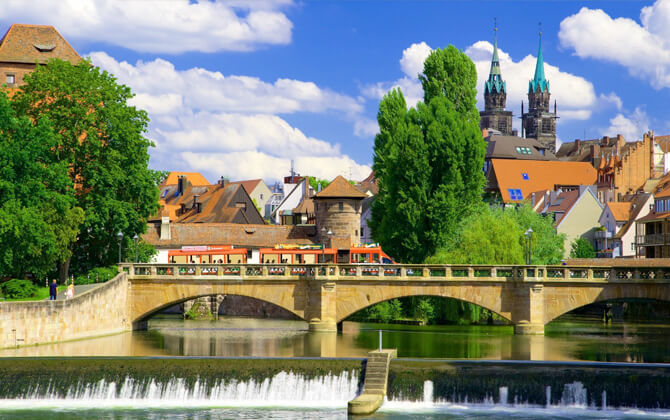
Nuremberg has more than 950 years of history, and the U-Bahn is a practical way to get around many of its main sights. It links the city center, major transport hubs, and stations close to several historic attractions, so it works well as part of a wider public transport plan.
Nuremberg Castle is one of the city’s best-known landmarks. Friedrich-Ebert-Platz station on U3 is about a 10-minute walk away, making the castle easy to reach.
Weißgerbergasse, famous for its medieval houses and old-town atmosphere, is around a 10-minute walk from Lorenzkirche station on U1.
Albrecht Dürer’s House is also near the castle area and can be reached from Friedrich-Ebert-Platz. It now operates as a museum.
For World War II history, the Zeppelin Field and Documentation Centre can be reached by taking the metro to Hauptbahnhof and then changing to tram line 6.
Central stations such as Hauptbahnhof, Plärrer, Lorenzkirche, and Opernhaus are useful starting points for sightseeing. In practice, the system works best when combined with walking and short tram or metro rides between key areas.
If you are planning a full day out, frequent service and short travel times make it easy to move between the old town, the castle area, and other sights without spending too long in transit.