The Tianjin Metro, also known as Tianjin Rail Transit, is the rapid transit system serving Tianjin, China. It was the second city in mainland China, after Beijing, to operate a subway system. The network first opened for regular service in 1984 and now covers 370.3 km (230.1 miles) with 258 stations across 13 operating lines, including underground, elevated, and at-grade sections.
| Key | Information |
|---|---|
| System name | Tianjin Metro, also known as Tianjin Rail Transit |
| City | Tianjin, China |
| Opened | Regular service began on 28 December 1984 |
| Network size | 370.3 km (230.1 miles) |
| Operating lines | 13 |
| Stations | 258 |
| Operator | Tianjin Rail Transit Group Co. (TRT) |
| Fare range | CNY 2–5, about US$0.28–0.69 |
Tianjin Metro Map
Map of Tianjin Metro showing different lines. Click on the map to enlarge it or download the Tianjin Metro map in PDF format.
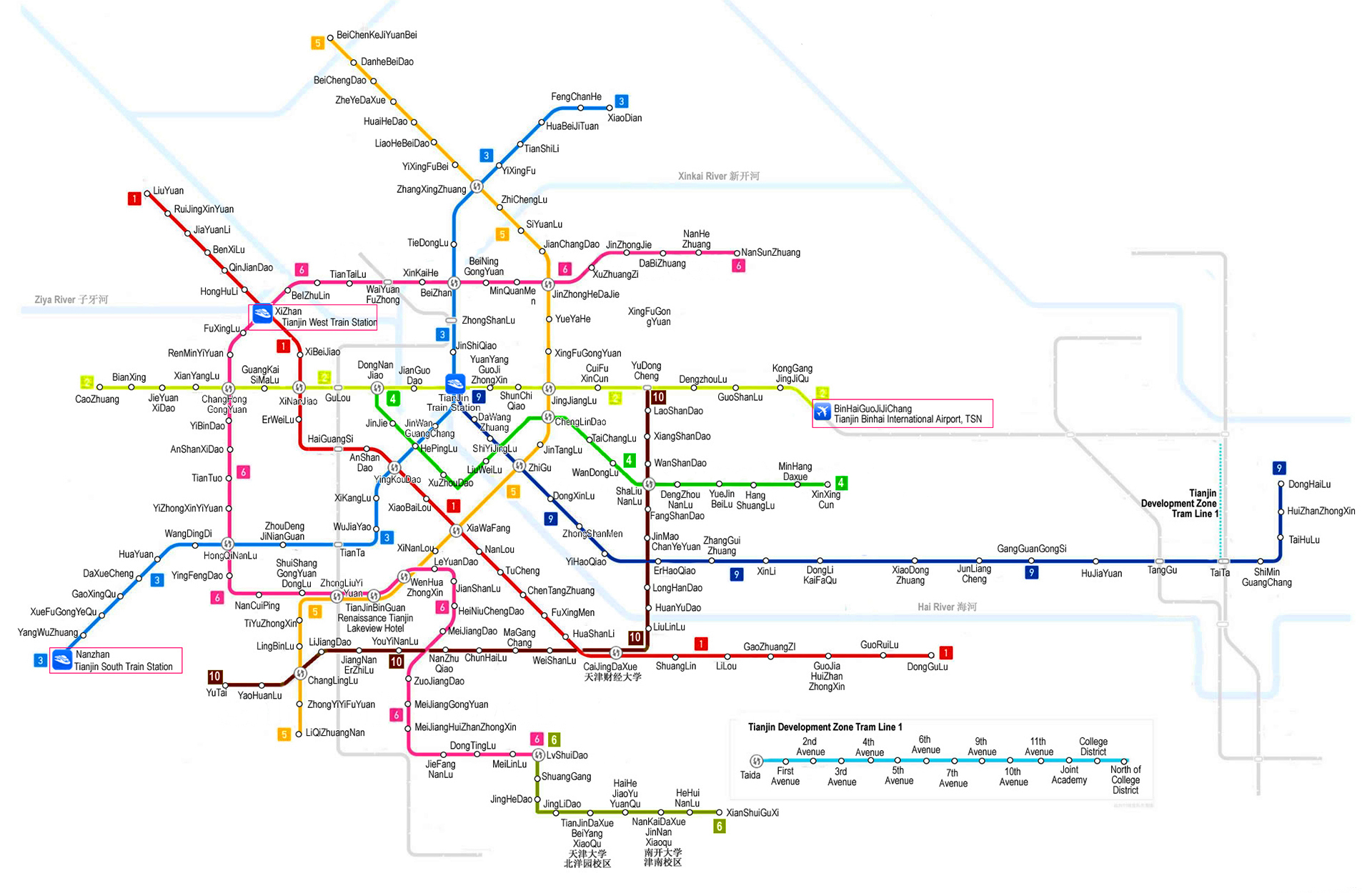
Tianjin Metro Lines and Stations
The Tianjin Metro route plan has grown from the original Line 1 into a broad city transport network serving central Tianjin, Binhai New Area, major railway hubs, and the airport corridor. The stations map is built around cross-city lines, suburban routes, and interchange points, so checking the stations list before you travel can save time.
| Line | Route | Opened | Latest extension | Length | Stations |
|---|---|---|---|---|---|
| Line 1 | Shuangqiaohe to Liuyuan | 1984 | 2024 | 42.227 km (26.2 miles) | 29 |
| Line 2 | Caozhuang to Binhaiguojijichang | 2012 | 2014 | 27.157 km (16.9 miles) | 20 |
| Line 3 | Xiaodian to Nanzhan | 2012 | 2013 | 33.7 km (20.9 miles) | 26 |
| Line 4 South | Dongnanjiao to Xinxingcun | 2021 | N/a | 19.4 km (12.1 miles) | 14 |
| Line 4 North | Xiaojie to Xizhan | 2025 | N/a | 19.85 km (12.3 miles) | 16 |
| Line 5 | Beichenkejiyuanbei to Jinghuadongdao | 2018 | 2024 | 36.1 km (22.4 miles) | 29 |
| Line 6 | Nansunzhuang to Lushuidao | 2016 | 2021 | 43.6 km (27.1 miles) | 39 |
| Line 7 | Gulou to Saidalu | 2025 | N/a | 21.82 km (13.6 miles) | 15 |
| Line 8 | Lushuidao to Xianshuiguxi | 2021 | N/a | 13.42 km (8.3 miles) | 9 |
| Line 9 | Tianjinzhan to Donghailu | 2004 | 2012 | 52.759 km (32.8 miles) | 21 |
| Line 10 | Yutai to Yudongcheng | 2022 | N/a | 21.18 km (13.2 miles) | 21 |
| Line 11 | Dongjiangdao to Dongliliujinglu | 2023 | 2024 | 23.8 km (14.8 miles) | 21 |
| Jinjing Line | Jinghuadongdao to Tuanboyixueyuan | 2024 | N/a | 13.2 km (8.2 miles) | 4 |
| Line Z4 | Zhaishang to Beitang | 2026 | N/a | 23.7 km (14.7 miles) | 10 |
| Total | Operating network | Total | Total | 370.3 km (230.1 miles) | 258 |
Line 1 is the oldest route in the system and was rebuilt from the original Tianjin Metro line. Line 2 is the airport line, Line 3 links major urban areas, and Lines 5 and 6 form an important part of the broader loop network. Line 9 connects Tianjinzhan with Donghailu and also links passengers to the former TEDA tramway corridor.
Newer routes include Lines 7, 8, 10, 11, the Jinjing Line, and Line Z4. Line 8 is notable for using Type A automated trains, while the Jinjing Line operates as a suburban rapid transit route with through service connected to Line 5.
| Station | Details |
|---|---|
| Tianjinzhan | Line 9 terminus and an interchange point with Lines 2 and 3 at Tianjin Railway Station |
| Binhaiguojijichang | Line 2 eastern terminus for Tianjin Binhai International Airport |
| Dongnanjiao | Line 4 South terminus and a useful station for nearby sightseeing areas |
| Jinghuadongdao | Terminal point for Line 5 and the Jinjing Line connection |
| Lushuidao | Terminal point shared by Line 6 and Line 8 services |
| Beitang | Line Z4 terminal area in Binhai New Area |
Schedules and Frequencies
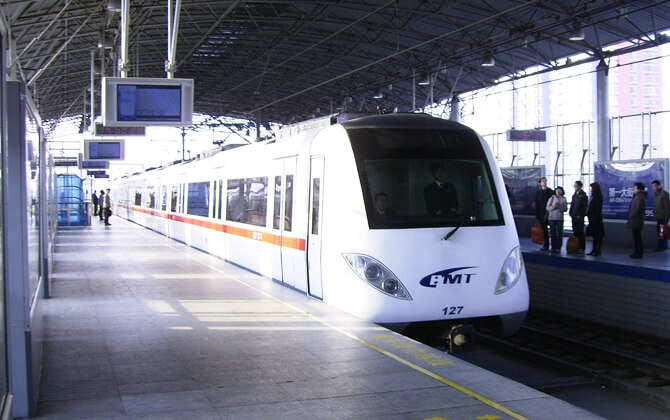
Tianjin Metro operating hours vary by line and direction, but most routes have a starting time around 6:00 and continue until late evening. The exact opening hours, opening times, closing time, and last train can differ between terminals, so it is worth checking the train schedule for your route before you go.
| Service detail | Timings |
|---|---|
| Line 1 working hours | 6:00 to 22:15; frequency is every 5–7 minutes in weekday peak periods, every 8–10 minutes at other times, and every 8–10 minutes on weekends |
| Line 2 schedule today | First trains depart at 6:00 in both directions; last train times are 22:12 and 22:05; frequency is every 6–8 minutes in weekday peaks and 8–10 minutes off-peak and on weekends |
| Line 3 route timetable | First trains leave both ends at 6:00; frequency is every 5–7 minutes during weekday peaks and 8–10 minutes off-peak and on weekends |
| Line 9 timings today | From Central Railway Station, the first train is at 6:00 and the last train is at 22:00; from Donghai, the first train is at 7:03 and the last train is at 23:03 |
| Line 9 frequency | Every 5–10 minutes in peak periods and every 10–12 minutes off-peak, including weekends |
| Line 11 running time pattern | Minimum interval is about 5 minutes |
| Line Z2 operating hours | 5:30 to 22:30; trains run every 3–4 minutes in peak hours and every 8 minutes at other times |
If you are catching a late path train or connecting to another form of public transport, allow extra time. Some lines close earlier in one direction than the other, and the last train may not match the general station closing time.
Tickets and Fares
Tianjin Metro uses a distance-based fare system. The ticket price depends on the number of stops traveled, with a fare range from CNY 2 to CNY 5, about US$0.28 to US$0.69. There is no separate day pass information in the provided fare details.
| Distance | Fare |
|---|---|
| 1 to 5 stops | CNY 2, about US$0.28 |
| 6 to 10 stops | CNY 3, about US$0.42 |
| 10 to 16 stops | CNY 4, about US$0.55 |
| 17 or more stops | CNY 5, about US$0.69 |
Tickets can be bought at manual ticket windows and self-service ticket machines at every station. Passengers can also pay by QR code. One ticket is valid for three hours, and passengers must leave the subway system within that time after entering.
For regular local transport trips, riders can use a City Card or a Common Stored Value Ticket. City Card holders receive a 10% discount, which makes the card useful if you ride often or transfer between transport modes.
Discounted travel is available for eligible students and seniors. One child under 1.1 meters, about 3 feet 7 inches, may travel free with one adult; additional children need tickets.
Luggage under 20 kg and 0.06 cubic meters can be carried free of charge. A ticket is required for luggage weighing 20 to 30 kg or measuring 0.06 to 0.15 cubic meters. Luggage over 30 kg or larger than 0.15 cubic meters is not allowed unless permission is granted.
Airport Connections
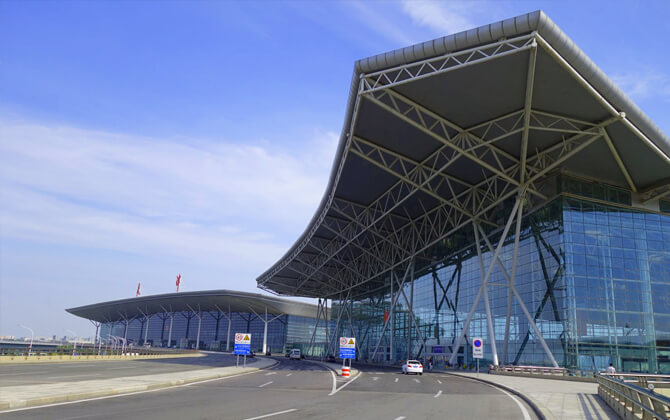
Tianjin Metro Line 2 is the airport route to Tianjin Binhai International Airport. It runs from Caozhuang in the west to Binhaiguojijichang in the east, covering 27.157 km (16.9 miles) with 20 stations.
Line 2 opened on 1 July 2012. The airport extension from Konggangjingjiqu to Binhaiguojijichang opened on 28 August 2014, and the airport station is also marked with the airport code TSN.
For airport travel, ride Line 2 to the final stop at Binhaiguojijichang. The station also connects with several bus services listed for the airport area, including airport shuttle and airport bus routes.
Connections to Other Systems
Tianjin Metro connects with other city transport and transportation in Tianjin through rail interchanges, bus links, light rail history, ferries, taxis, and card-based fare payment. For everyday trips, that makes the metro a practical backbone of the wider public transport system.
Rail interchanges are available on several lines. Line 1 connects with Lines 2, 3, 5, and 6, with future interchanges planned with Lines 4, 7, 8, and 10. Line 3 connects with Lines 1, 2, and 9 at Tianjin Railway Station. Line 9 also provided an interchange with the TEDA Tram line.
The City Card is accepted on the subway, light rail, bus, ferry, and taxi transport. Card users can also receive discounted fares when transferring between modes. QR code payment adds another convenient option for passengers moving between different parts of the system.
TEDA Modern Guided Rail Tram
The TEDA Modern Guided Rail Tram was a Translohr light rail tramway serving the Tianjin Economic-Technological Development Area. It was considered part of the Tianjin Metro system and opened on 10 May 2007.
The line ran between TEDA and North of College District stations. It was 7.86 km (4.9 miles) long, had 14 stations, and mainly served the TEDA area. Its line color was light green.
The tram was operated by Tianjin Binhai Mass Transit Development Co., Ltd., which became a subsidiary of Tianjin Rail Transit Group Corporation in 2017. Service on the TEDA Tram ended on 30 June 2023.
Tips and Rules
Tianjin Metro is one of the easiest ways to move around the city, especially for trips to Tianjin Railway Station, Binhai International Airport, Tianjin Zoo, Water Park, and Porcelain House. A few basic rules make the ride smoother and safer.
- Buy a ticket at a manual window or self-service vending machine, or use QR code payment where available.
- Keep your journey within the three-hour ticket validity period after entering the system.
- Use a City Card if you travel frequently; it gives a 10% discount and works across several local transport modes.
- Check the timetable before late trips, because the last train and closing time can vary by line and direction.
- Plan transfers in advance if your route crosses several lines. It is much easier than deciding on the platform.
- One child under 1.1 meters, about 3 feet 7 inches, can ride free with one adult. Other children need tickets.
- Follow luggage limits: small luggage under 20 kg and 0.06 cubic meters is free, mid-size luggage needs a ticket, and oversized luggage is not allowed unless permission is granted.
Fun Facts
Tianjin Metro has an important place in China’s urban rail history. It was the second city in mainland China, after Beijing, to operate a subway system.
The first metro line opened for regular service in 1984, but the modern system took shape after Line 1 reopened in 2006 following major reconstruction.
One of its most unusual engineering facts is the shallow depth of the original underground section. It sat only 2–3 meters below street level and was once regarded as the world’s shallowest metro.
Early construction relied heavily on volunteers. Although only about 1,000 people worked full time on construction, the number of volunteers often exceeded 2,000 a day.
The network expanded through the 2000s and 2010s with Line 9, Line 2, Line 3, and later additions such as Line 8, Line 10, and Line 11. Fare payment also became more flexible, with magnetic smartcards, QR codes, and the City Card used across buses, ferries, taxis, and light rail.
Line 8 stands out as the first Tianjin Metro line to use Type A, GoA4 automated trains. The system continues to grow through approved expansion plans.
History
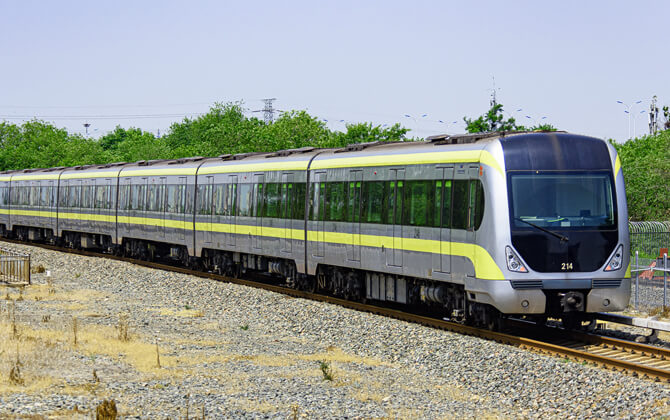
Tianjin has long been a major commercial center. After the founding of the People’s Republic of China in 1949, road traffic increased sharply and pollution became a growing problem. In response, the transport authority decided to close the old trams network and replace it with rapid transit.
Because of cost constraints, construction did not begin until 1970. The first section, with 3.6 km (2.2 miles) of track and four stations, was completed by February 1976. Work was then delayed by the 1976 earthquake. A second section added 1.6 km (1.0 mile) of track and two stations by 1980. After construction resumed, the line reached 7.4 km (4.6 miles) with eight stations, and service began on 28 December 1984.
To reduce construction costs, the authority used an abandoned canal bed for part of the route and avoided deep excavation. That is why the underground section lay only 2–3 meters below street level.
By the end of the 1990s, the system was outdated. Stations were hard to navigate, trains were infrequent and often delayed, and the rolling stock was in poor condition. A major modernization, reconstruction, and expansion plan was approved in 2000. The system closed on 1 September 2001, and renovation began on 21 November of that year.
After new rolling stock arrived, half-height platform screen doors were added, and the route was extended to Shuanglin, the rebuilt line reopened on 6 December 2006 as Line 1. Trial testing had started on 12 June.
While Line 1 was being rebuilt, other lines were developed. Line 9 began construction in 2001 and opened in stages from 28 March 2004, with additional stations added between 2004 and 2007. It was extended westward by three stations on 1 May 2011. The TEDA Modern Guided Rail Tram opened on 10 May 2007.
Line 2 opened on 1 July 2012 after a lengthy delay and a structural accident, first as two separate sections. The sections were reconnected on 28 August 2013. Line 3 opened in October 2012. In 2017, Tianjin Metro Group Co. and Binhai Mass Transit Development Co. merged to form Tianjin Rail Transit Group Co. (TRT), unifying operations.
Future Extensions
Tianjin Metro expansion continues through projects under construction and longer-term planned corridors. The approved Phase 2 construction plan points to a much larger system, strengthening links between the urban core, Binhai, the airport area, and surrounding districts.
Several projects are already listed in the expansion plan. Line 8 is advancing in two phases, Line 11 has a further extension planned, Line B1 is planned between Xinjiayuandong and Tanggu, Line Z2 is planned from Binhaiguojijichang to Beitang, and Line Z4 is planned as a major Binhai route between Beitang and Xinchengliu.
- Line 8: Phase 1 urban section and Phase 2 are both planned for 2026.
- Line 11: Phase 2 from Wenjielu to Shuishanggongyuanxilu is planned for 2026.
- Line B1: Phase 1 from Xinjiayuandong to Tanggu is planned for 2027.
- Line Z2: Phase 1 from Binhaiguojijichang to Beitang is planned for 2027.
- Line Z4: Phase 1 from Beitang to Xinchengliu is planned for 2027, with the Beitang to Binhaizhan segment also listed for 2027.
The Phase 2 construction plan approved by the NDRC indicates a total of 513 km (318.8 miles) of lines. Longer-term planning also mentions a western extension for Line Z2 toward Jinzhonghedajie station on Lines 5 and 6. The Jinjing Line has a second phase planned with an extension and a branch, suggesting broader suburban coverage in the future.
Earlier planning documents identified Lines 4, 7, and 8 as important parts of the network’s growth. Later updates show these corridors remain central to the system’s development.
Nearby Attractions
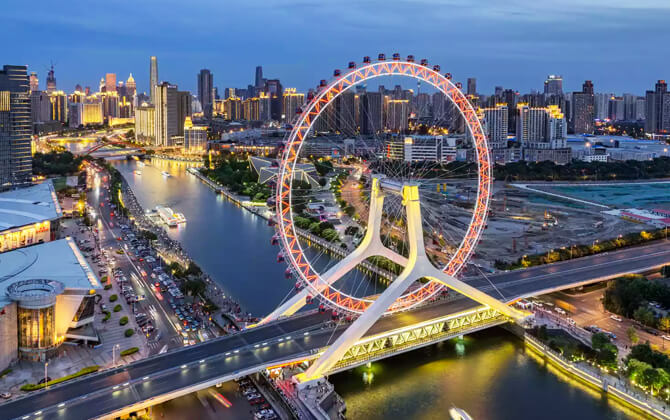
Tianjin Metro is a convenient option for sightseeing because it connects transport hubs, downtown streets, cultural landmarks, and airport access. For a simple day route, use the metro map and check transfer stations before setting out.
| Station | Details |
|---|---|
| Tianjin Railway Station | One of the city’s key transport hubs, reachable by several metro routes |
| Binhaiguojijichang | Metro Line 2 station for Tianjin Binhai International Airport |
| Yingkoudao | Useful for reaching Porcelain House from Metro Line 1, followed by a walk |
| Dongnanjiao | Access point for Eye of Tianjin and Ancient Culture Street |
| Xiaobailou | Nearest listed Metro Line 1 station for Five Great Avenues |
| Tianjin Zoo and Water Park area | Attractions served by the wider metro network |
| Downtown attraction area | Includes Italian Style Town, Jingyuan Garden, St. Joseph Cathedral, and Jinwan Plaza |
With a little route planning, the metro makes it easy to combine historic streets, museums, waterfront views, and major stations in one trip.