The Shanghai Metro is Shanghai’s rapid transit system, serving urban and suburban districts as the core of local public transport and city transport. It runs across 14 of the city’s 16 municipal districts and reaches Huaqiao in Kunshan, Jiangsu Province. Opened in 1993, the network has 19 lines, 506 stations, and 808 km (502.1 mi) of route length, making it one of the largest and busiest metro systems in the world.
| Key | Information |
|---|---|
| System type | Rapid transit and suburban rail-style metro network |
| City served | Shanghai, with service to Huaqiao in Kunshan, Jiangsu Province |
| Opened | 1993 |
| Lines | 19 |
| Stations | 506 stations, or 408 if transfer-connected stations are counted as single stations |
| Route length | 808 km (502.1 mi) |
| Daily use | Average workday ridership regularly exceeds 10 million trips |
| Record ridership | 13.39 million rides on 9 March 2024 |
| Role in public transport | Accounts for 73% of public transport trips in Shanghai |
Metro map of Shanghai
Map of Shanghai Metro showing different lines. Click on the map to enlarge it or download the Shanghai Metro map in PDF format.
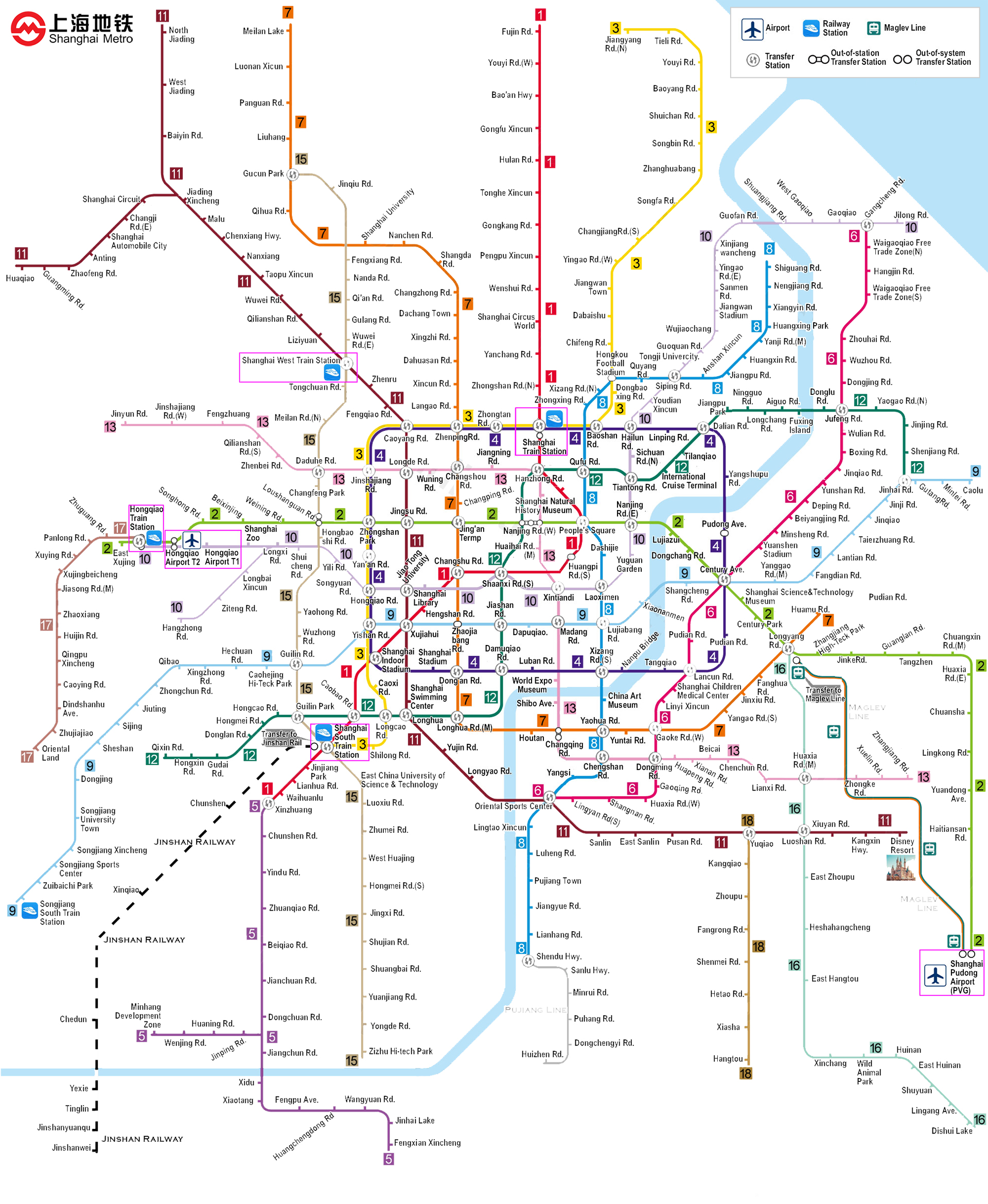
Shanghai Metro Lines and Stations Overview
The Shanghai Metro route network covers dense central districts and long suburban corridors. Lines are numbered and color-coded, which makes the route plan easier to follow on signs, train exteriors, and any stations map.
Most lines operate as single-service routes. A major exception is the shared section used by Lines 3 and 4 between Hongqiao Road and Baoshan Road, where both services use the same tracks and platforms. Line 11 also extends beyond Shanghai’s municipal boundary to Huaqiao, giving the system a cross-provincial path train connection.
| Line | Termini | Length | Stations |
|---|---|---|---|
| 1 | Fujin Road – Xinzhuang | 36.4 km (22.6 mi) | 28 |
| 2 | Panxiang Road / Shanghai National Accounting Institute – Pudong Airport Terminal 1&2 | 63.8 km (39.6 mi) | 31 |
| 3 | North Jiangyang Road – Shanghai South Railway Station | 40.3 km (25.0 mi) | 29 |
| 4 | Loop line | 33.7 km (20.9 mi) | 26 |
| 5 | Xinzhuang – Minhang Development Zone / Fengxian Xincheng | 32.7 km (20.3 mi) | 19 |
| 6 | Gangcheng Road – Oriental Sports Center | 32.3 km (20.1 mi) | 28 |
| 7 | Meilan Lake – Huamu Road | 44.2 km (27.5 mi) | 33 |
| 8 | Shiguang Road – Shendu Highway | 37.4 km (23.2 mi) | 30 |
| 9 | Shanghai Songjiang Railway Station – Caolu | 65.6 km (40.8 mi) | 35 |
| 10 | Jilong Road – Hongqiao Railway Station / Hangzhong Road | 44.9 km (27.9 mi) | 37 |
| 11 | North Jiading / Huaqiao – Disney Resort | 82.4 km (51.2 mi) | 40 |
| 12 | Qixin Road – Jinhai Road | 40.4 km (25.1 mi) | 32 |
| 13 | Zhangjiang Road – Jinyun Road | 38.8 km (24.1 mi) | 31 |
| 14 | Fengbang – Guiqiao Road | 38.5 km (23.9 mi) | 30 |
| 15 | Gucun Park – Zizhu Hi-tech Park | 42.3 km (26.3 mi) | 30 |
| 16 | Longyang Road – Dishui Lake | 59.0 km (36.7 mi) | 13 |
| 17 | Hongqiao Railway Station – Xicen | 41.6 km (25.8 mi) | 14 |
| 18 | Kangwen Road – Hangtou | 44.6 km (27.7 mi) | 31 |
| Pujiang | Shendu Highway – Huizhen Road | 6.7 km (4.2 mi) | 6 |
For trip planning, check both the stations list and the direction of travel. Several lines have branches, and choosing the wrong branch can add time even when the route looks simple on a map.
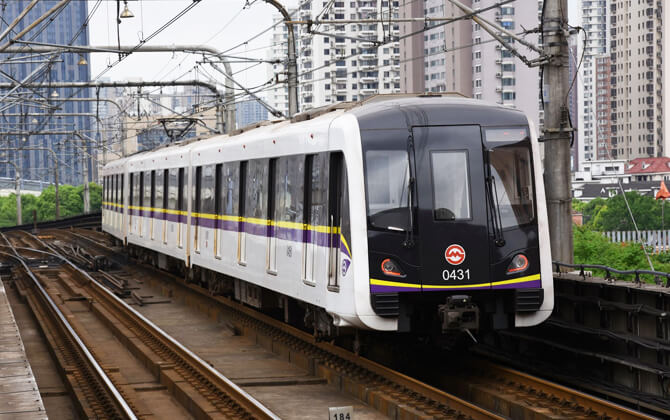
Schedule, calendar and timetables
Shanghai Metro operating hours usually start between 5:00 and 6:00 in the morning and end between 22:30 and 23:00 CST. The exact opening hours, opening times, closing time, last train, and working hours vary by line, station, direction, weekday, and weekend schedule.
City-center sections generally have higher frequency than suburban sections. During peak periods, trains on busy inner segments often run less than three minutes apart, while outer sections may have longer waits outside rush hours. If you need the train schedule today, check the route timetable for your line before leaving.
| Service detail | Timings |
|---|---|
| Maglev Train | From Pudong Airport: 07:02–21:42; from Longyang Road: 06:45–21:40 |
| Line 1 | 05:30–23:50 |
| Line 2 | 05:28–22:30 |
| Line 3 | 05:20–22:40 |
| Line 4 | 05:25–22:35 |
| Line 5 | 05:50–22:40 / 06:00–22:35 |
| Line 6 | 05:30–22:30 |
| Line 7 | 05:30–22:30 |
| Line 8 | 05:30–22:30 |
| Line 9 | 05:30–22:30 |
| Line 10 | 05:25–22:30 / 05:30–22:25 |
| Line 11 | 05:25–22:00 / 05:58–22:30 |
| Line 12 | 05:30–22:30 |
| Line 13 | 05:30–22:30 |
| Line 14 | 05:30–22:30 |
| Line 15 | 05:30–22:30 |
| Line 16 | 05:50–22:30 |
| Line 17 | 05:40–22:30 |
| Line 18 | 05:55–22:30 |
| Pujiang Metro Line | 05:30–22:30 |
| Airport Link Line | 06:00–22:39 |
The timetable above was updated in February 2024 and is for reference only. Some central lines extend evening service by one hour on Fridays and Saturdays, and extra late trains run from Hongqiao Railway Station on Line 2 and Line 10 from Sunday to Thursday after normal operating hours, stopping only at selected stations.
For precise timings today, especially early in the morning or late at night, check the official schedule for your route, date, direction, and starting time.
Tickets, Prices and Cards
Shanghai Metro fares are distance-based. A regular single ride starts at CNY 3 (about US$0.40) for short journeys under 6 km (3.7 mi), and a standard downtown trip usually costs no more than CNY 6 (about US$0.85). Ticket issuing stops three minutes before the last train departs, so do not leave buying a ticket until the final moment.
- Metro QR Code / Shanghai Metro DADUHUI App: A cashless ticket option for riders using Alipay or WeChat Pay. International passengers can also link a MasterCard and scan a QR code to travel.
- Single Journey Ticket: A one-time ticket for travel between two stations. Buy it from a machine or booth, then return it at the destination station.
- Shanghai Public Transportation Card: A reusable stored-value card for the metro and some buses, ferries, and taxis. New users commonly pay CNY 100 (about US$13.90), including a CNY 20 deposit (about US$2.80) and CNY 80 (about US$11.10) of stored value.
- One-day Travel Pass: Costs CNY 18 (about US$2.50) and gives unlimited metro rides for 24 hours after first use.
- Three-day Travel Pass: Costs CNY 45 (about US$6.25) and gives unlimited metro rides for 72 hours after first use.
- Maglev & Metro Pass: The Maglev Single Trip + Metro One-day Pass costs CNY 55 (about US$7.65). The Maglev Round Trip + Metro One-day Pass costs CNY 85 (about US$11.80).
- Souvenir Ticket: A visitor-friendly ticket sold at selected stations, valid for one year and returned after use as a keepsake.
The transportation card can lower the total cost if you ride often. Passengers who spend more than CNY 70 (about US$9.75) in a month with the card receive a 10% discount for the rest of that month. The card also allows one overdraft of CNY 8 (about US$1.10), and a transfer discount may apply for bus and metro connections.
Tickets are available from vending machines in every station. Service counters sell day pass products and transportation cards, while card top-ups are available at designated metro stations, bus stations, banks, stores, and add-value machines. Unused tickets can be refunded at the issuing station on the same day; used tickets cannot be refunded.
There is no separate fare calculator information in the provided material, but the basic price logic is clear: longer trips cost more, while passes and cards can be better value for repeat travel.
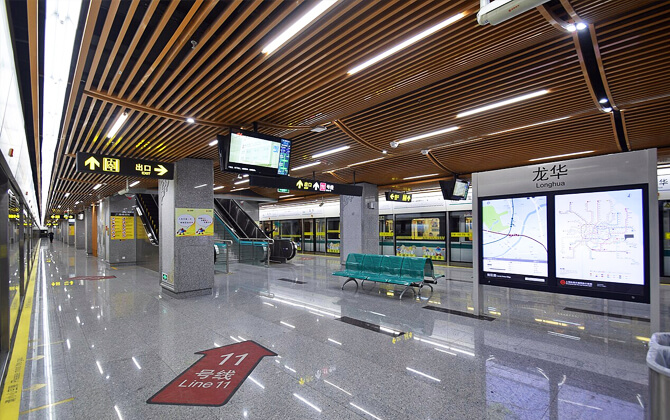
Connections
The Shanghai Metro is the backbone of transportation in Shanghai, with easy transfers between most lines and links to major railway hubs. Passengers can usually change lines without buying a new ticket if the transfer stays inside the fare-paid zone.
Some stations require passengers to exit and re-enter the fare area. In that case, a new single-journey ticket is needed, although the Shanghai Public Transportation Card is exempt from this restriction. One-time swipe cards do not allow those out-of-zone transfers for free, and transfers counted as one trip should be completed within 30 minutes.
Line 11 gives the system a regional connection beyond Shanghai. Since 16 October 2013, it has extended into Kunshan, making Shanghai Metro the first rapid transit system in China to offer cross-provincial service. It also connects with Suzhou Metro through Suzhou Metro Line 11, which links Shanghai Metro Line 11 with Suzhou Metro Line 3.
For long-distance rail, the metro serves key stations including Shanghai Railway Station, Shanghai South Railway Station, and Hongqiao Railway Station. Airport travel is also built into the network through direct metro access, the Maglev connection at Longyang Road, and the newer Airport Link Line.
Connection to the airport
The Airport Link Line is a commuter rail line of the Shanghai Suburban Railway connecting Hongqiao Airport Terminal 2 with Shanghai East railway station via Pudong International Airport. It cuts the journey between Hongqiao and Pudong from about 90 minutes on Metro Line 2 to under 40 minutes.
The first section, from Hongqiao Airport Terminal 2 to Pudong Airport Terminal 1&2, opened on 27 December 2024 with seven stations in service. First and last trains from Pudong and Hongqiao airports depart at 6:00 and 22:00, and the running time is about 39 minutes.
The line operates in a public transit style, with a platform layout, timetable, and passenger experience similar to the metro. Public transportation cards can be used to enter and exit, and the initial frequency is about every 15 minutes.
Passengers can currently transfer without paying again at Zhongchun Road, where they can connect to Metro Line 9 and continue onto other Shanghai Metro lines using the same ticket.
The Airport Link Line is 68.6 km (42.6 mi) long, with most of the route underground. It begins at Hongqiao Airport Terminal 2, passes south along the east side of the Shanghai-Hangzhou Passenger Dedicated Line, crosses the Shanghai-Hangzhou Railway Passage, turns east, crosses the Huangpu River, and continues past Pudong International Airport toward Shanghai East railway station.
An express pattern is planned but was not operating at the initial stage. For now, the line serves as an important airport rail option alongside the existing metro and Maglev services.
Rules
Shanghai Metro is generally safe and well organized, but passengers are expected to follow station and train rules. Security checks are used at station entrances, and baggage or personal belongings may be inspected.
Prohibited items include guns, ammunition, knives, explosives, flammable materials, radioactive materials, and toxic chemicals. Smoking is banned across metro premises, and e-cigarettes are also prohibited under the revised rules.
Bicycles, including folding bikes, pets, skateboards, roller skates, and similar equipment are not allowed in stations or carriages. On trains, passengers should not eat or drink, play music or videos out loud, step on seats, lie down on benches or floors, or interfere with safe operation. Exceptions for eating and drinking apply to infants and passengers with certain medical conditions.
Valid fare is required. Riders without a valid ticket must pay the fare, and regulations state that fare evasion may result in a penalty of six times the fare. Passengers should stay behind the safety line and avoid forcing their way into or out of trains.
Children under 1.3 m (4.3 ft) may travel free under the stated conditions. One adult may take up to two children of that height for free, and revised rules allow passengers to bring more than two children free. The luggage weight limit has been raised to 30 kg (66.1 lb). The system is fully wheelchair accessible, with elevators at all stations.
| Rule area | What passengers should know |
|---|---|
| Security | Passengers and belongings may be checked at station entrances. |
| Prohibited items | Weapons, explosives, toxic chemicals, and other dangerous items are not allowed. |
| On-train behavior | No smoking, no loud playback, and no eating or drinking on trains except in permitted cases. |
| Other restrictions | Bicycles, pets, skateboards, and roller skates are not allowed. |
| Accessibility | All stations have elevators, and the system is fully wheelchair accessible. |
Shanghai Metro Tips
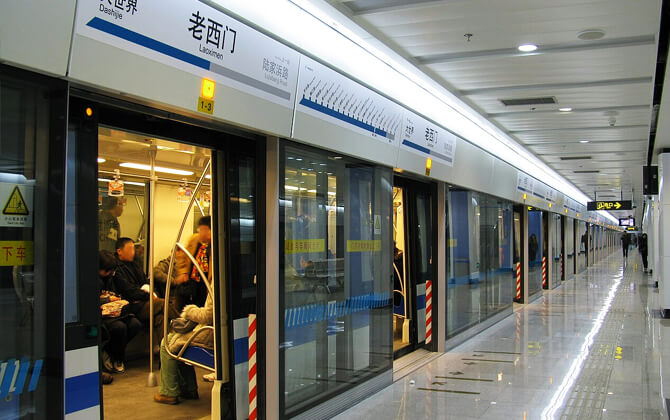
Shanghai Metro is easy to use once you know a few habits. Look for the red M above ground to find entrances, and check your exit before leaving the station. Many stations have multiple exits, and choosing the wrong one can put you on the opposite side of a large road or intersection.
Do not assume nearby stations are a quick walk apart. In many areas, walking between stops can take around 10 to 20 minutes. If you are carrying luggage, add extra time for security checks at station entrances.
English-language ticket machines make buying a single ticket straightforward. If you are staying more than a day, the Shanghai Public Transportation Card is often more convenient because it works on the metro and other transport modes.
Trains and platforms can get crowded, especially during peak hours. People move fast when boarding, and pushing can happen in busy conditions. Stay calm, keep your belongings close, and move with the flow.
Station and train announcements are made in Mandarin and English. Onboard maps help you track your stop, phone signal works in the metro, and cleanliness is usually excellent across stations and trains.
Future Expansions
Shanghai Metro expansion remains a major part of the city’s long-term transport planning. The 2018–2023 construction plan called for five new metro lines, two commuter rail lines, and two extensions to existing lines, with the network expected to reach 1,154 km (717.1 mi) after completion.
Longer-term plans point to even more growth. The Shanghai Metro network, including commuter rail, is expected to reach 1,642 km (1,020.3 mi) by 2030 and more than 2,000 km (1,242.7 mi) by 2035.
| Planned opening date | Line | Project | Termini | Length | Stations | Status |
|---|---|---|---|---|---|---|
| 2026 | 13 | Western extension | Jinyun Road to National Exhibition and Convention Center | 9.8 km (6.1 mi) | 5 | Under construction |
| 2026 | 13 | Eastern extension | Zhangjiang Road to Dangui Road | 4.1 km (2.5 mi) | 2 | Under construction |
| 2026 | 22 | Phase I | Jinji Road to Yu’an | 42.8 km (26.6 mi) | 8 | Under construction |
| 2027 | 12 | Western extension | Qixin Road to Dongjing | 17.2 km (10.7 mi) | 6 | Under construction |
| 2027 | 19 | Initial section | Baoshan Railway Station to Yierba Jinian Road | 9.2 km (5.7 mi) | 8 | Under construction |
| 2027 | 21 | Phase I and east extension | Dongjing Road to Shanghai East railway station | 42 km (26.1 mi) | 22 | Under construction |
| 2027 | 23 | Phase I | Shanghai Stadium to Minhang Development Zone | 28 km (17.4 mi) | 22 | Under construction |
| 2028 | 15 | Southern extension | Zizhu Hi-tech Park to Wangyuan Road | 11.4 km (7.1 mi) | 4 | Under construction |
| 2028 | 21 | East extension remaining section | Shanghai East railway station to Pudong Airport Terminal 3 | 2 km (1.2 mi) | 1 | Under construction |
| 2029 | 19 | South section | Houtan to Hongjian Road | 37 km (23.0 mi) | 9 | Under construction |
| 2030 | 20 | Phase I West Section | Jiaotong Road to Shanghai Circus World | 7.2 km (4.5 mi) | 7 | Under construction |
| 2030 | 20 | Rest of Phase I and eastern extension | Shanghai Circus World to North Xinyuan Road | 16.6 km (10.3 mi) | 14 | Under construction |
| 2032 | 19 | Middle section | Yierba Jinian Road to Houtan | 37 km (23.0 mi) | 17 | Under construction |
Other projects are listed as shelved, pending, reserved, or in long-term planning. These include the Line 1 southern extension to Humin Road, the Line 2 southern extension to Pudong Airport Terminal 3, the Line 5 southern extension reserve to Pingzhuang Highway, the Line 9 eastern extension to Caolu Railway Station, and infill stations on Lines 14 and 18.
The metro is also expanding infrastructure beyond tracks and stations. Plans call for rooftop solar plants totaling 30 to 50 megawatts between 2021 and 2025.
History
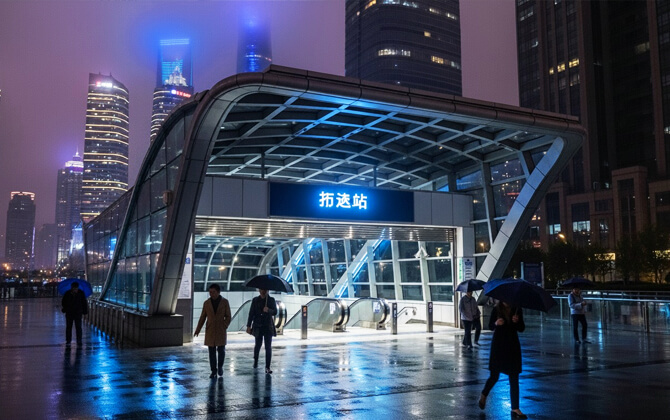
The history of the Shanghai Metro began long before public service. The first subway proposal dates to 1950, when Soviet technical specialists suggested an underground railway that could serve both mass transit and wartime shelter needs.
Planning continued through the 1950s and 1960s, including early north-south and east-west line concepts. Experimental tunneling began in 1960, but the Cultural Revolution interrupted development before a full network could be built.
Plans returned in the 1980s as economic reforms and rising travel demand put pressure on Shanghai’s public transit system. In 1986, the State Council approved the Master City Plan of Shanghai and construction of Line 1.
The first section of Line 1 opened on 28 May 1993 between Shanghai South Railway Station and Xujiahui. Line 1 was extended in 1995 and 1996, Line 2 opened in 1999, Line 3 followed in 2000, Line 5 in 2003, and Line 4 in 2005. Line 4 later became a loop line in 2007.
The fastest growth came before Expo 2010. Lines 6, 7, 8, and 9 opened in 2007, Line 2 gained more extensions in 2008 and 2010, Line 10 opened in 2010, and Line 13 provided temporary Expo-related service. By 2010, the metro had become the longest metro system in the world.
After 2010, the system kept growing with new routes, extensions, and infill stations. Line 11 reached Huaqiao in Jiangsu Province in 2013, giving Shanghai the first rapid transit system in China with cross-provincial service. Lines 12, 13, 15, and 16 added further reach, and Line 15 opened in January 2021.
The fare scheme changed as the network matured. Trial operations in the 1990s used sightseeing fares. A single fare of 2 yuan (about US$0.30) was introduced in 1995, followed by 3 yuan (about US$0.40) for shorter rides and 4 yuan (about US$0.55) for longer rides by 1999. In 2005, the minimum fare rose again, and the metro introduced products such as the One-Ticket Pass and a cumulative discount scheme.
Fun Facts
The Shanghai Metro became the world’s largest metro system by route length and continues to grow. In only 15 years, it surpassed the London Underground’s 140-year build-up to become the longest metro network in the world, with around 420 km (261.0 mi) of track at that point.
Line 2 is the busiest line in the system, carrying nearly 2 million passengers a day. Some lines also have unofficial nicknames: Line 10 is known as the Golden Line because it links attractions such as Yuyuan and Xintiandi, while Line 6 is sometimes called the Hello Kitty Line because of its pink livery.
Line 4 has one of the network’s most dramatic construction stories. It was planned as a loop, but in 2003 the section under the Huangpu River collapsed during construction. No one was injured, and the final section opened in 2007.
The metro’s mascot is a small blue robot named Chang Chang, meaning smooth traffic in Chinese. At some terminal stations, a snippet of Kenny G’s Going Home is played.
Long trips can still be very affordable. The longest possible journey mentioned in the source material is between Pudong International Airport on Line 2 and Anting on Line 11. It takes about two and a quarter hours and costs RMB 10 (about US$1.40).
At very busy times, Line 8 has been so crowded that staff have helped push extra passengers into carriages. Riders have also reported unusual costumes on the metro, including a robot, Superman, an Egyptian mummy, and Leopard Print Man.
Nearby Attractions
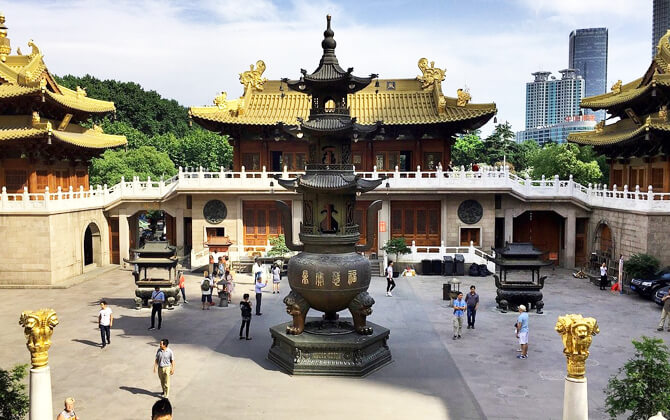
Shanghai Metro puts many major sights within easy reach, especially around Yuyuan and Old Town, also known as Nanshi. From the Yuyuan area, Yu Garden, Yuyuan Old Street, and the Shanghai Temple of the Town God are only a few minutes away on foot.
Nearby places listed in the source material include Huxinting Teahouse, Yuyuan Fashion Street, Chenxiang Temple, and Gucheng Park. For a longer walk, visitors can continue toward The Bund, one of Shanghai’s best-known waterfront areas.
The area is also useful for shopping and dining. If your route plan includes historic gardens, old streets, or one of the city’s busiest sightseeing districts, the metro is a practical starting point.