The Charleroi Metro, officially the Métro Léger de Charleroi, is a 33-kilometre (20.5-mile) light rail and tramway system in Charleroi, Belgium. It combines a central loop in downtown Charleroi with branches to Gilly, Anderlues, and Gosselies, so the network works as both a metro-style system and a tramway. The system opened in stages between 1976 and 2013, has 48 stations and stops, and connects with national rail services at Charleroi-Central and Charleroi-Ouest. A partly built branch toward Châtelet remains closed and is planned to open in 2027.
| Key | Information |
|---|---|
| System | Charleroi Light Metro (Métro Léger de Charleroi) |
| Type | Light metro and tramway |
| Network length | 33 kilometres (20.5 miles) |
| Operational lines | M1, M2, M3, M4 |
| Stations and stops | 48 |
| Main route plan | Central loop with branches to Gilly, Anderlues, and Gosselies |
| Main rail connections | Charleroi-Central and Charleroi-Ouest |
| Airport link | No direct metro connection; airport served by express bus from Gare de Charleroi-Sud |
| Future expansion | Châtelet branch planned to open in 2027 |
Charleroi Metro Map
Map of Charleroi Metro showing different lines. Click on the map to enlarge it or download the Charleroi Metro map in PDF format.
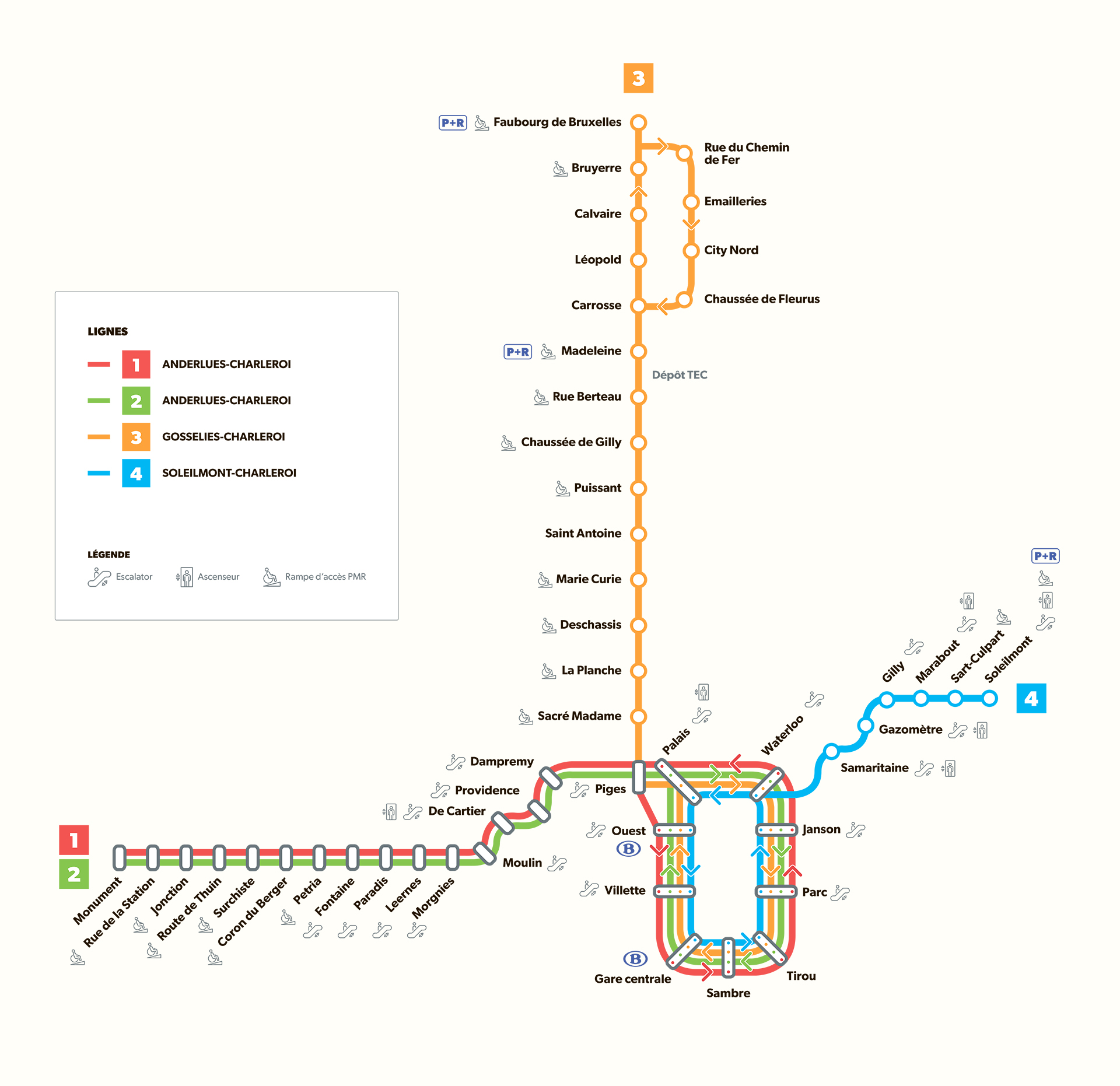
Lines and Stations
The Charleroi Metro has four operational lines: M1, M2, M3, and M4. Together they cover the 33-kilometre (20.5-mile) network and serve 48 stations and tram stops. In the city centre, the system uses metro-style infrastructure; farther out, parts of the route run as street tramway.
The network is built around a central loop in downtown Charleroi. All four lines use this section, which includes key interchange stations such as Sud, Villette, Ouest, Beaux-Arts, Waterloo, Janson, Parc, Tirou, and Sambre. From there, the lines continue toward outer districts and suburbs.
M1 and M2
M1 and M2 share the same route between Anderlues and central Charleroi. The difference is how they run on the loop: M1 goes counter-clockwise, while M2 runs clockwise. These lines mix metro stations with tramway stops, and the western section continues as street running in Anderlues.
| Station | Details |
|---|---|
| Piges | Key station on the shared M1 and M2 corridor |
| Dampremy | Served by M1 and M2 |
| Providence | Served by M1 and M2 |
| De Cartier | Served by M1 and M2 |
| Moulin | Served by M1 and M2 |
| Morgnies | Served by M1 and M2 |
| Leernes | Served by M1 and M2 |
| Paradis | Served by M1 and M2 |
| Fontaine | Served by M1 and M2 |
| Pétria | Served by M1 and M2 |
| Monument | Outer stop on the Anderlues corridor |
M3
Line M3 connects Piges with Gosselies. Opened in 2013, it continues beyond Piges through 18 tram stops and serves areas including Lodelinsart, Jumet, and Gosselies, ending at Faubourg de Bruxelles.
| Station | Details |
|---|---|
| Piges | Interchange station and starting point for the M3 branch |
| Lodelinsart area | M3 serves this district on its way north |
| Jumet area | M3 continues through this part of the network |
| Gosselies area | Outer section of the M3 route |
| Faubourg de Bruxelles | Terminus of M3 |
M4
M4 links central Charleroi with Gilly and Soleilmont. It has six stations and gives direct access from the city centre to the eastern branch.
| Station | Details |
|---|---|
| Samaritaine | Station on the M4 line |
| Gazomètre | Station on the M4 line |
| Gilly | Station on the M4 line |
| Marabout | Station on the M4 line |
| Sart-Culpart | Station on the M4 line |
| Soleilmont | Terminus of M4 |
Unused Châtelet branch
There is also an unfinished branch toward Châtelet. It includes four completed but unopened stations and remains out of service for now, though expansion plans would finally bring it into use.
| Station | Details |
|---|---|
| Neuville | Completed but unopened station on the unused branch |
| Chet | Completed but unopened station on the unused branch |
| Pensée | Completed but unopened station on the unused branch |
| Centenaire | Completed but unopened station on the unused branch |
For station access, entrances are marked with a stylized white M on a blue background. Platforms are generally open, and most stations are not staffed. If you are looking for a stations map or stations list, the network is easiest to understand as a downtown loop with three active branches and one future branch.
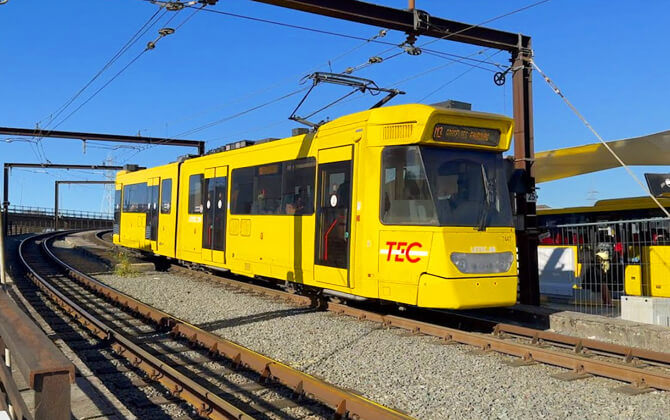
Schedule
The Charleroi Metro timetable varies by line and by day. Operating hours, opening times, and frequency are not the same across the system, so checking the current train schedule or schedule today before you travel is a smart move.
| Service detail | Timings |
|---|---|
| M1 and M2 opening hours | Starting time 4:00 a.m.; closing time 8:00 p.m. |
| M1 and M2 replacement bus | 8:00 p.m. to 10:00 p.m. |
| M1 and M2 frequency | Every 30 minutes on Monday to Friday peak periods; every 60 minutes during summer, weekends, public holidays, and off-peak weekdays |
| M3 opening hours | Starting time 5:00 a.m.; close at 8:00 p.m. |
| M3 frequency | Every 10 minutes Monday to Friday; every 15 minutes on Saturdays and during summer; every 20 minutes on Sundays |
| M4 opening hours | 5:00 a.m. to 8:00 p.m. |
| M4 frequency | Every 10 minutes Monday to Saturday; every 15 minutes on Sundays and public holidays |
For M1 and M2, the route timetable starts at 4:00 a.m. and regular service ends at 8:00 p.m. After that, a replacement bus runs until 10:00 p.m. On weekdays during peak periods, frequency is every 30 minutes. In summer, on weekends, on public holidays, and during off-peak weekdays, trains run every 60 minutes.
M3 begins at 5:00 a.m. and runs every 10 minutes from Monday to Friday. Services stop at 8:00 p.m., with no night replacement bus. On Saturdays and during summer, the line runs every 15 minutes; on Sundays, every 20 minutes.
M4 also runs from 5:00 a.m. to 8:00 p.m. There is no replacement bus service on this line. Trains run every 10 minutes from Monday to Saturday and every 15 minutes on Sundays and public holidays.
At CHARLEROI Parc, the available service patterns include M1 and M2 on the shared network, plus other local transport routes. Timings today can vary by direction and line, so it is best to check the latest departure board before heading to the platform.
Opening hours, working hours, and last train information may change depending on school holidays, Saturdays, Sundays, public holidays, or seasonal adjustments. The running time and route timetable can also vary slightly by service pattern.
Fares
Charleroi Metro fare levels depend on the number of zones you travel through. Tickets can be used on the metro and city bus network when the correct zones are covered, which makes the system practical for public transport across the city. The lowest ticket price is €2.00 (about $2.18).
The fare system includes standard tickets, reloadable card options, and mobile app products. Travel is generally honour-based, so you need to carry a valid ticket or pass even if there are no barriers.
If you are comparing fare, price, and cost, the main difference comes down to zones and ticket format. Buying on a rechargeable card is usually cheaper than using a physical ticket.
Abonnement and discounts
Charleroi Metro tickets are zone-based, and the same products can be used on both the metro and TEC bus network when the zones match. The system offers single tickets, multi-journey products, subscription pass options, and day pass products.
- Next (1 or 2 zones): €2.00 ($2.18) on a rechargeable card or €2.50 ($2.73) as a physical ticket.
- Horizon+ (unlimited zones): €5.00 ($5.45) on a reloadable card or €5.50 ($6.00) as a physical ticket.
- 1 Jour day pass: €4.00 ($4.36) on a rechargeable card or €5.00 ($5.45) as a physical ticket for one or two zones; €8.00 ($8.72) on a rechargeable card or €10.00 ($10.90) as a physical ticket for unlimited zones.
- 3 Jours: €8.00 ($8.72) on a rechargeable card for 1 or 2 zones; €16.00 ($17.44) on a reloadable card for unlimited zones.
- Multi 8: €8.80 ($9.59) on a rechargeable card or €9.10 ($9.92) as a physical ticket for the Next version.
- Multi 4: €13.20 ($14.39) on a rechargeable card for the Horizon+ version.
Subscriptions are available by age group. For ages 6 to 11, Horizon+ is free. For ages 12 to 24, Next costs €16.00 per month ($17.44) or €131.00 per year ($142.79), while Horizon+ costs €36.00 per month ($39.24) or €280.00 per year ($305.20). For ages 25 to 64, Next costs €37.00 per month ($40.33) or €320.00 per year ($348.80), and Horizon+ costs €70.00 per month ($76.30) or €580.00 per year ($632.20). For passengers over 65, Horizon+ costs €36.00 per year ($39.24).
There is also a City Pass, an integrated subscription that combines SNCB trains with TEC Charleroi buses, trams, and metro services. It covers a broad area including employment and school zones, the airport area, and access to the A airport shuttle line. A 24-hour version is available as well.
Some discounts apply to selected users, and lower prices are available when tickets are bought in advance or loaded onto a rechargeable card such as Mobib. If you need a fare calculator or a current zone map, you will need to check the official transport information before travel.
Connections
The Charleroi Metro connects with trams, buses, and trains across the network. That makes it a key part of transportation in Charleroi and a practical backbone for city transport.
Gare de Charleroi-Sud has links to many bus lines and national rail services, including trains to Bruxelles-Midi, Namur, and Erquelinnes. Charleroi-West also connects with several bus routes and with train line L-14 between Ottignies and Jambes.
Other stations with bus connections include Janson, Parc, Tirou, Piges, Dampremy, Providence, De Cartier, Moulin, Morgnies, Fontaine, and Pétria. In short, the metro works closely with the wider local transport system rather than as a standalone network.
There is no direct metro route to Charleroi Airport, but Gare de Charleroi-Sud provides the main connection to the airport express bus.
Connection to the Airport
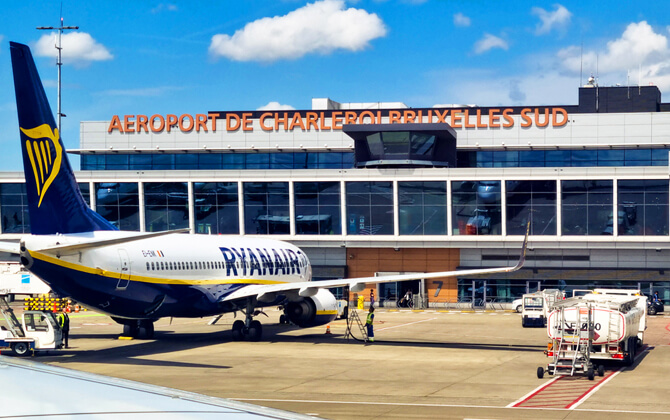
The Charleroi Metro does not have a direct airport branch. To reach the airport, passengers need to take the express bus from Gare de Charleroi-Sud to the terminal.
This service is known as Line A or Airport Express. It runs every 30 minutes, with operating hours from 5:00 a.m. to 10:00 p.m. Weekend departures start at 5:30 a.m., and service ends at 10:30 p.m.
The journey takes about 15 minutes. The fare is €6.00 (about $6.54). Walking from the city to the airport is not recommended because pedestrian infrastructure is lacking.
Rules
Using the Charleroi Metro is straightforward, but a few rules help keep the system safe and comfortable for everyone.
- Offer your seat to pregnant women, disabled passengers, older people, and adults with babies.
- Do not block aisles or doors.
- Let passengers get off before boarding.
- Keep the train clean and do not litter or eat onboard.
- Smoking is forbidden on trains.
- Alcohol and drunkenness are prohibited on metro trains and buses.
- Do not disturb other passengers; harassment is not tolerated.
- Do not try to open doors while the vehicle is moving.
- Pets must be properly muzzled or kept in a cage.
- Pushchairs must be foldable; otherwise, use wheelchair spaces only when they are empty and available.
- Excessive luggage can lead to denied access.
- These rules apply from the moment you enter the premises, and penalties may apply for violations.
History
The Charleroi Metro has an unusually ambitious history. In the 1960s, it was planned as a 52-kilometre (32.3-mile) network with eight branches and 69 stations. Had the full system been built, it would have been the largest metro in the Benelux region.
At the time, Charleroi already had a substantial tramway network run by SNCV and STIC. As buses began replacing trams, the new metro project was meant to modernize public transport while preserving tram-based mobility on faster, dedicated infrastructure.
Planning assumed construction between 1992 and 1994. In general, tracks were meant to run at ground level on separated rights-of-way. Viaducts were preferred where needed, and tunnels were used mainly in central Charleroi and other dense areas.
The first section opened on 21 June 1976 between Sud and Villette. Villette became the first metro station in Belgium built on a viaduct. Piges and Ouest followed on 30 June 1980.
On 24 May 1983, Palais, Dampremy, and the section between Morgnies and Paradis opened. Pétria opened on 24 May 1986. That same year, a first section of the Châtelet branch up to Centenaire was completed, but it never entered service.
The remaining stations on the Anderlues branch, Providence, De Cartier, Moulin, and Fontaine, opened on 22 August 1992. One week later, on 28 August, the first section of the Gilly branch from the downtown loop to Gilly opened together with Waterloo station. Infrastructure beyond Gilly toward Soleilmont was partly complete but not yet in service.
On 30 August 1996, Janson and Parc opened on the downtown loop. Construction then stalled for years.
Work resumed in 2008 and 2009 after a €75 million ($81.75 million) loan from the European Investment Bank, from a total estimated cost of €150 million ($163.5 million). The downtown loop works started on 20 October 2008, the Gosselies branch on 16 March 2009, and the Soleilmont extension on 30 March 2009.
The completed downtown loop entered service on 27 February 2012, when the Sud to Parc section opened. The Soleilmont extension also opened that day. This marked a major system reorganization, including the new M1, M2, and M4 line numbers, new colors, and the adoption of the Charleroi Metro name.
The Gosselies branch later became line M3. Part of its infrastructure already existed to the Jumet tram depot, but it had not been equipped for passenger service and had to be rebuilt. The final line entered service on 22 June 2013 after delays to the project.
The eastern branch from Waterloo to Châtelet had originally been planned in the 1980s with eight stations. A first 4-kilometre (2.5-mile) section was completed, but only four stations, Neuville, Chet, Pensée, and Centenaire, were fully finished and never opened. Track to Chet was used for driver training, while the rest stayed incomplete.
In 2011, early estimates put the cost of refreshing the Waterloo to Centenaire section at €5 million ($5.45 million), with another €20 million ($21.8 million) needed to complete the line to Corbeau. In June 2021, Belgium’s recovery plan allocated €60 million ($65.4 million) to extend the metro to the future Grand Hôpital de Charleroi in Gilly, including renovation of six unopened stations and construction of two new stations, Corbeau and Les Viviers.
In January 2023, the building permit covering the track, eight stations, and a service building was granted. Construction started in November 2024, and opening is planned for 2027.
Future Expansions
The main expansion project is the long-delayed eastern branch from Waterloo to Châtelet, planned as line M5. This route was part of the original network plan, but only a partially completed section was ever built.
The project would modernize the unfinished section and extend service toward the new hospital area at Les Viviers. Funding was confirmed in 2021, the building permit was granted in January 2023, construction started in November 2024, and the planned opening is 2027.
- M5 is planned to run between Les Viviers and Waterloo, using part of the unfinished Châtelet branch.
- The project includes renewal of the existing section between Waterloo and Pensée.
- The extension is intended to connect the system with the new hospital under construction.
The broader route plan from the 1960s imagined eight branches from the central loop, but high costs and lower-than-expected ridership prevented that full build-out.
Touristic Attractions
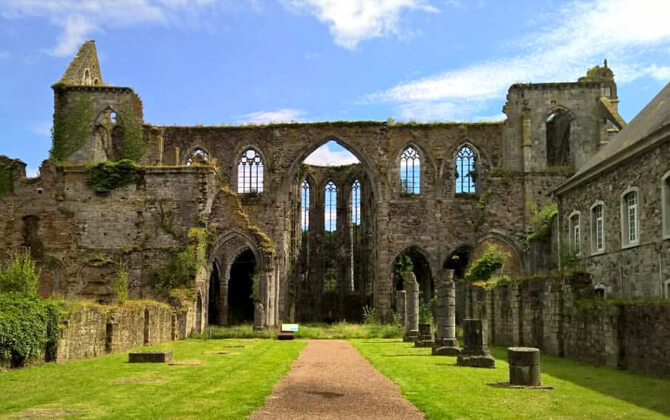
Charleroi has a mix of culture, industrial heritage, and urban exploration. In the city centre, Place Charles II brings together the Town Hall, the Belfry, and Saint-Christophe church. The Palais des Beaux-Arts and the Musée des Chasseurs à Pied are also nearby.
Several attractions are tied to the city’s industrial history. Bois du Cazier is a major memorial site and a UNESCO-listed mining complex, with the Industry Museum and the Glass Museum on the same site. BPS22, set in a former industrial building, is known for its contemporary art program.
The city also has a creative side. The Urban Dream street art trail and comic strip references in the metro reflect that character nicely. For visitors using public transport, the metro itself can be part of the experience, since it reaches several districts and surrounding municipalities.
Outside the centre, visitors can head to the Museum of Photography in Mont-sur-Marchienne, Château de Trazegnies, and the peaceful Aulne Abbey area. Charleroi’s slag heaps are another distinctive part of the landscape, and some can be climbed for wide views over the city.