The Docklands Light Railway (DLR) is an automated light metro system in London, serving the Docklands, the City, Stratford, Lewisham, Beckton, London City Airport and Woolwich Arsenal. It opened on 31 August 1987 and has grown into a key part of public transport in east and south-east London, with a network length of 38 km (24 miles). The system is known for step-free access at every station, level boarding, and easy connections with other city transport networks including the Underground, London Overground and National Rail.
| Key | Information |
|---|---|
| System | Automated light metro in London |
| Opening date | 31 August 1987 |
| Network length | 38 km (24 miles) |
| Operator | KeolisAmey Docklands for Transport for London |
| Accessibility | Step-free access from street to train at all stations |
| Rolling stock | 149 trains with no driving cabs |
| Annual ridership | 97.8 million journeys in financial year 2024/25 |
Docklands Light Railway Map
Map of Docklands Light Railway showing different lines and stations. Click on the map to enlarge it or download the Railway map in PDF format.
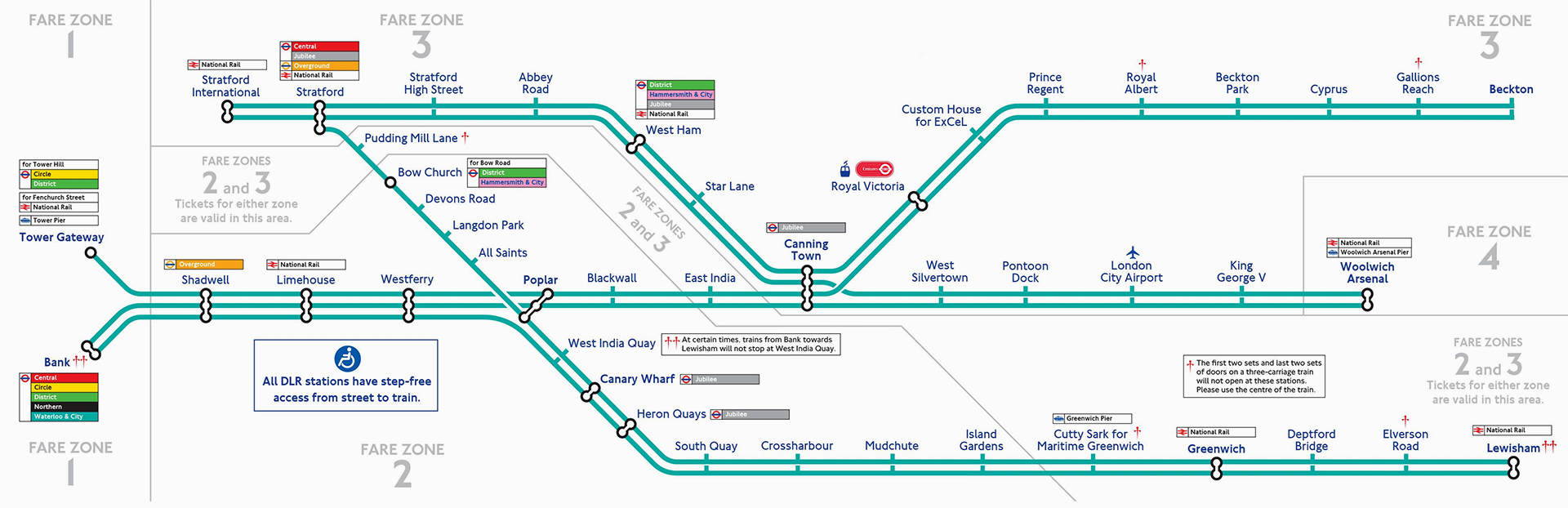
Docklands Light Railway Lines
The Docklands Light Railway route plan covers east, south-east and central London through six main branches. It reaches Stratford and Stratford International in the north, Lewisham in the south, Beckton and Woolwich Arsenal in the east, and Bank and Tower Gateway in central London. For everyday transport, the network is simple to use, and all stations have step-free access from street to train.
| Station | Details |
|---|---|
| Bank – Lewisham | Shadwell, Limehouse, Westferry, West India Quay (Bank-bound only), Canary Wharf, Heron Quays, South Quay, Crossharbour, Mudchute, Island Gardens, Cutty Sark for Maritime Greenwich, Greenwich, Deptford Bridge, Elverson Road |
| Canning Town – Beckton | Royal Victoria, Custom House, Prince Regent, Royal Albert, Beckton Park, Cyprus, Gallions Reach |
| Stratford – Canary Wharf | Pudding Mill Lane, Bow Church, Devons Road, Langdon Park, All Saints, Poplar, West India Quay |
| Stratford International – Woolwich Arsenal | Stratford, Stratford High Street, Abbey Road, West Ham, Star Lane, Canning Town, West Silvertown, Pontoon Dock, London City Airport, King George V |
The stations map also includes important interchanges with London Underground, London Overground, National Rail and the IFS Cloud Cable Car. A further expansion to Thamesmead is proposed, with Thames Wharf, Beckton Riverside and Thamesmead named in current planning material.
Important Stations
Several DLR stations stand out for interchanges, route options and major destinations. Bank is one of the main western termini and connects directly with the Central, Circle, District, Northern and Waterloo & City lines. Tower Gateway also serves the City of London, with access to the Circle and District lines via Tower Hill.
In Docklands, Canary Wharf and Heron Quays are major interchange points. Poplar is the network hub and the only station with trains to every destination. Canning Town is another key stop, linking the DLR with the Jubilee line and multiple DLR branches.
Stratford, West Ham, Lewisham and Woolwich Arsenal are especially useful for National Rail and Underground connections. London City Airport station is also a notable stop for airport travel.
| Station | Details |
|---|---|
| Bank | Direct interchange with multiple Underground lines |
| Canary Wharf | Major Docklands destination and interchange |
| Canning Town | Key connection point for the Jubilee line |
| Poplar | DLR hub with trains to every destination |
| Stratford | Major northern terminal and interchange |
| Lewisham | Southern terminal with National Rail connections |
| Woolwich Arsenal | Eastern terminal and National Rail interchange |
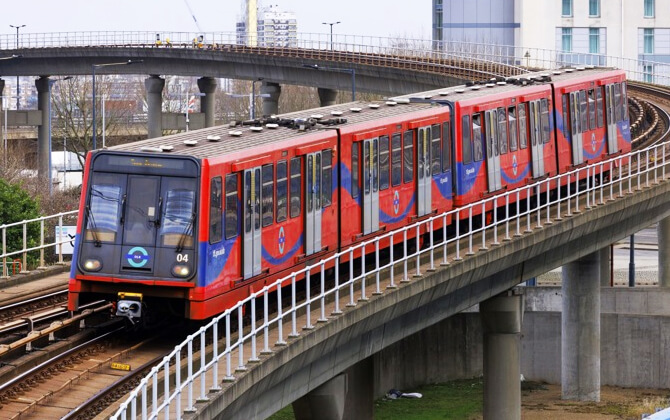
Timings and Schedule
The DLR operating hours usually run from about 5:30am to just after midnight from Monday to Saturday. On Sundays, opening times are generally around 7:00am to just before midnight. If you are checking timings today or the schedule today for a specific branch, it is worth keeping in mind that service patterns can change.
During peak periods, train frequency is typically every 3 to 4 minutes. Off-peak and weekend services usually run every 10 to 15 minutes. At the busiest times, the same routes operate more often, with frequency increased by 25 percent.
There are a few route timetable details to know. Bank to Lewisham services do not call at West India Quay, because those trains use the diveunder track to avoid junction conflicts. In the morning peak, alternate Stratford to Canary Wharf trains continue to Lewisham.
If engineering works or special events affect the network, the train schedule may change and other service patterns can be introduced, such as Beckton to Lewisham when the Bank and Tower Gateway branch is closed.
| Service detail | Timings |
|---|---|
| Starting time Monday to Saturday | About 5:30am |
| Closing time Monday to Saturday | Just after midnight |
| Starting time Sunday | Around 7:00am |
| Closing time Sunday | Just before midnight |
| Peak frequency | Every 3 to 4 minutes |
| Off-peak and weekend frequency | Every 10 to 15 minutes |
All stations have step-free access from street to train. For exact opening hours, working hours, last train information and route-specific running time, check the live timetable before you travel.
Docklands Light Railway Fare, Tickets and Cards
The DLR is part of the London fare zone system, so the fare is calculated in the same way as on the Tube. Travelcards covering the relevant zones are valid, and passengers can also use Oyster cards, Visitor Oyster cards and contactless payment cards.
Tickets are sold from ticket machines at station entrances before platform access. If you use Oyster or contactless, you need to touch in and touch out on the card readers at gates or platforms. At DLR-only stations there are no ticket barriers, so ticket checks are carried out by random on-train inspections.
Barriers are in place at Bank, Canning Town, West Ham and Stratford, where DLR platforms sit within a London Underground or National Rail barrier line. Woolwich Arsenal also has barriers, and passengers can move between the DLR and Southeastern platforms within the paid area.
If you do not touch in at the start of your journey, or travel without the correct ticket, you may face a penalty fare of £100 (about $126) or prosecution for fare evasion.
- Accepted payment options include Oyster cards, Visitor Oyster cards, contactless payment cards and Travelcards.
- Tickets are available from machines before platform access.
- Oyster and contactless journeys require touch in and touch out.
- Random inspections are used at stations without barriers.
There is no fare calculator, ticket price table or day pass pricing in the source material, but the DLR follows standard London fare rules. All stations also offer step-free access, which helps passengers with luggage, pushchairs or reduced mobility.
Connections to Other Systems
The DLR is built as part of London’s wider transport system, with direct and indirect links to London Underground, London Overground, National Rail and other local transport services. Four stations have direct Underground interchanges: Bank, Canning Town, West Ham and Stratford. Out-of-station connections are also available at Canary Wharf, Heron Quays, Bow Church and Tower Gateway.
National Rail interchanges are available at Greenwich, Lewisham, Limehouse, Woolwich Arsenal, Stratford, West Ham and Stratford International. The DLR also connects with London Overground at Stratford and Shadwell.
At Stratford International, interchange with DLR services via Poplar is possible, though the platforms are widely separated and on different levels, with no physical connection between the two branches. Other notable connections include the route to London City Airport and the link with the IFS Cloud Cable Car at Royal Victoria.
All stations have step-free access from street to train, which makes changing between systems easier for passengers with mobility aids, luggage or pushchairs.
Airport Connections
The DLR provides a direct public transport link to London City Airport. The airport branch opened in 2005 and runs from Canning Town via West Silvertown, Pontoon Dock and London City Airport to King George V.
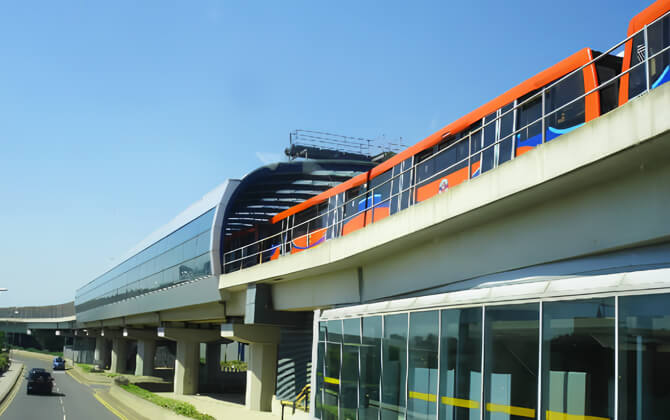
Because every station has step-free access from street to train, the airport route is straightforward for passengers travelling with luggage. It also connects the airport with Docklands, Stratford, the City of London and Woolwich Arsenal.
| Station | Details |
|---|---|
| West Silvertown | Station on the airport branch |
| Pontoon Dock | Station on the airport branch |
| London City Airport | Direct station for the airport |
| King George V | Eastern station beyond the airport |
The airport extension removed the need for shuttle bus services between the airport and Canning Town or Liverpool Street.
Parking near Railway
Parking near DLR stations can be useful for commuters, visitors and anyone making an interchange with other rail services. Popular station parking areas include Royal Victoria, Custom House for ExCeL, Canary Wharf, Canning Town and Stratford, especially for onward travel into central London or around east London.
If you are planning your route, it helps to choose a station that fits your journey rather than simply the nearest stop. Around busy interchanges and employment areas, pre-booked parking can make things easier and save time on the day.
The source material does not give exact parking charges or parking charges per day, so there is no confirmed station parking price list here. What it does make clear is that some key stations are very busy at peak times, so nearby parking may be limited.
- Some major stations can be especially busy during peak hours.
- Step-free access is available across the whole network.
- Several stations connect directly with National Rail.
- Choosing parking close to your destination can save time on busy travel days.
Rules and Tips
The DLR is designed to be safe and easy to use. All stations have step-free access from street to train, so boarding is straightforward for wheelchair users, passengers with pushchairs and anyone carrying luggage.
Before travelling, make sure you have a valid ticket or a touched-in Oyster or contactless card. You must touch in at the start of your journey and touch out at the end, even at stations without gates.
Passengers are expected to follow the DLR conditions of carriage. Smoking, vaping and drinking alcohol are not allowed on trains or at stations. Bicycles, scooters, skateboards, roller skates, roller blades and hover boards must not be used on DLR trains or premises.
Full-size bicycles are allowed only at off-peak times and weekends, except at Bank station, where they are not permitted for safety reasons. Folding bicycles are not subject to those time restrictions.
Ticket checks take place on board, so keep your fare valid for the whole trip. If you are travelling through busy interchanges, allow extra time and follow staff instructions if parts of a station close temporarily for safety reasons.
History
The history of the Docklands Light Railway begins with the redevelopment of London Docklands, which had declined after the loss of traditional dock traffic. In the 1970s, the government and the Greater London Council explored several transport ideas for the area, including a lower-cost light rail and tramway-style system. A 1982 report proposed a north-south route from Mile End to the Isle of Dogs and an east-west route linking the Isle of Dogs with the City of London.
Construction was authorised by Acts of Parliament in 1984 and 1985, and work started in 1985. The first phase was built as a low-cost railway and made extensive use of underused or disused rail infrastructure. The DLR opened on 31 August 1987, after a formal opening by Queen Elizabeth II on 30 July 1987. The original system had 15 stations and two routes: Tower Gateway to Island Gardens and Stratford to Island Gardens.
Demand rose quickly as Docklands developed. Plans for the Bank extension were already under way before the original opening, and that extension entered service in 1991, bringing the railway into the City of London. The Beckton extension followed in 1994.
The Greenwich and Lewisham extension opened in 1999. Then came the London City Airport branch in 2005 and the Woolwich Arsenal extension in 2009, both strengthening transport links in east London. In 2011, the route to Stratford International opened, adding another major connection and supporting demand linked to the 2012 Olympic and Paralympic Games.
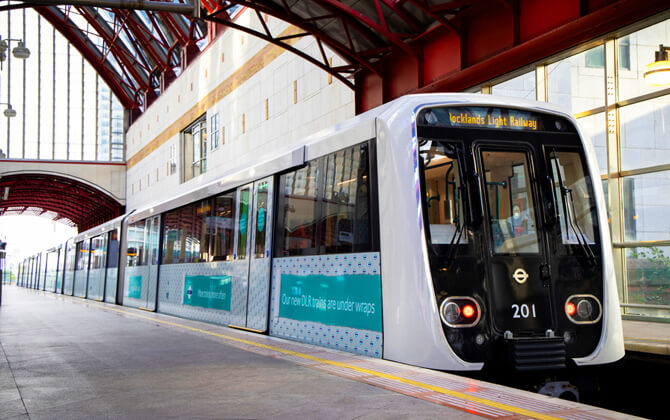
As the network grew, platforms were extended for three-car trains on the busiest routes, and the rolling stock developed through several generations. What started as a small light rail system became a major part of London’s city transport network.
- Opened: 31 August 1987
- Original network: 15 stations
- Initial routes: Tower Gateway to Island Gardens and Stratford to Island Gardens
- Major early extension: Bank, opened in 1991
- Later extensions: Beckton, Lewisham, London City Airport, Woolwich Arsenal and Stratford International
Future Extensions
The main DLR expansion proposal is an extension from Gallions Reach to Beckton Riverside and Thamesmead. Transport for London has said the scheme is intended to support regeneration, improve cross-river transport links, and give better access to jobs and housing growth in east London.
The preferred plan includes a new station at Beckton Riverside, a tunnel under the River Thames, and a new station at Thamesmead. Public consultation has already taken place, and TfL has said it will continue working with partners on the business case, funding and planning.
TfL has also said the proposed route could allow a future continuation beyond Thamesmead, including towards Belvedere or other locations in the London Borough of Bexley. Earlier material also mentioned the possibility of continuing to Abbey Wood.
Other ideas considered over time include replacing Tower Gateway with an interchange at Tower Hill, along with proposals towards Dagenham Dock, Euston, St Pancras, and onward from Lewisham to Catford and Beckenham Junction. Some of those plans were never taken forward, while others were cancelled or remained long-term possibilities.
Step-free access remains an important part of the railway’s role in serving future growth areas.
Nearby Attractions
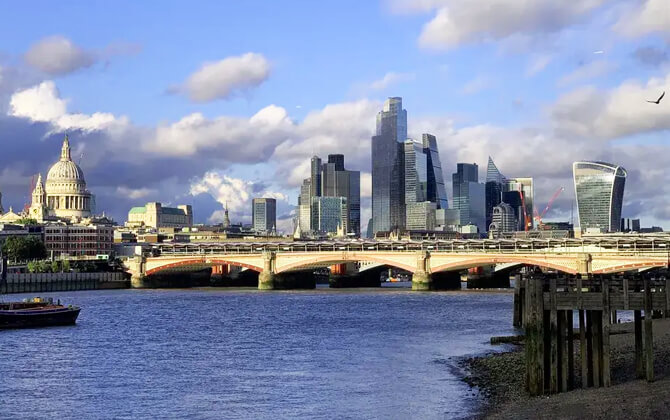
The DLR makes it easy to reach several of London’s best-known areas by public transport. In the west, the line serves the City of London through Bank and Tower Gateway. In the east, it reaches destinations such as London City Airport, the Royal Docks and Beckton.
For riverside visits, the route gives easy access to Greenwich. Cutty Sark for Maritime Greenwich and Greenwich stations put you close to the historic waterfront. Stratford and Stratford International are useful for the wider Stratford area, while Canary Wharf, West India Quay and Poplar are convenient for exploring Docklands.
The railway also links to ExCeL, Woolwich Arsenal, and the Olympic area around Stratford High Street and Stratford International. With step-free access throughout the system, it’s a practical option for sightseeing as well as everyday transport.
- City of London via Bank and Tower Gateway
- Greenwich via Cutty Sark for Maritime Greenwich and Greenwich
- Canary Wharf, West India Quay and the wider Docklands
- London City Airport and the Royal Docks
- Stratford and Stratford International
- ExCeL, Woolwich Arsenal and other east London destinations
wollte am 14.04.2024 um 07.20 uhr AM an der Station :Royal Victoria meine Oyster Vistor card
mit 20 f auladen mit Bargeld.Die Maschine nahm das Geld aber ich hatte keine Aufladung aufmeiner Oyster Card . Deshalb versuchte ich meine 20 f wieder aus der Maschine zu holen, aber ich bekam nur einen Beleg über 20 f mit der beleg nr : 05.Ich bitte Sie mir das Geld wieder nach Germeny zu überweisen.