Helsinki Tram is a core part of public transport in Finland’s capital, especially for getting around the city center. The system is organized by the Helsinki Regional Transport Authority and operated by Metropolitan Area Transport Ltd. In 2019, it carried 56.8 million trips. Alongside the traditional tramway, Helsinki also has a separate light rail line that opened in October 2023. As of 2 September 2024, the system includes 11 individually numbered city center tram lines and 1 numbered light rail line. The network mostly runs on city streets, uses 1,000 mm gauge track, and is powered by 750 V DC overhead wires.
| Key | Information |
|---|---|
| System type | Traditional tram system with a separate light rail line |
| Operator | Metropolitan Area Transport Ltd |
| Authority | Helsinki Regional Transport Authority |
| Trips recorded | 56.8 million in 2019 |
| Network size | 11 city center tram lines and 1 light rail line |
| Light rail opening | October 2023 |
| Track gauge | 1,000 mm |
| Power supply | 750 V DC overhead wires |
| Track layout | Almost entirely double track |
| Historic start | Horse-drawn trams in 1891, electric services since 1900 |
Helsinki Tram Map
Map of Helsinki Tram showing different lines and stations. Click on the map to enlarge it or download the Helsinki Tram map in PDF format.
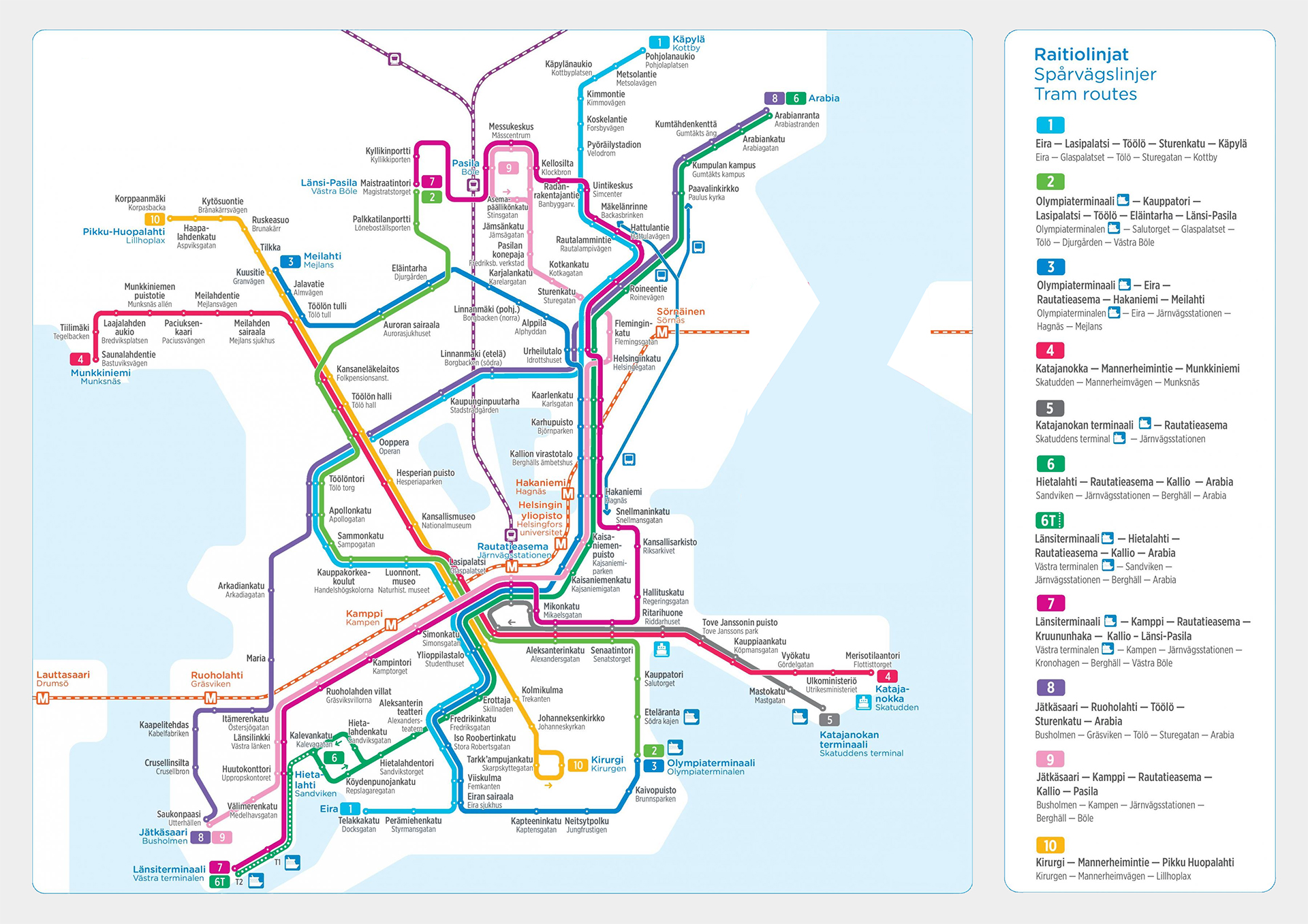
Helsinki Tram Lines and Statoins
The Helsinki Tram route plan is easiest to understand through route maps organized by transport mode and area. These maps help you find tram routes in the city center and nearby districts, while stations map materials give extra detail for selected stops and interchange connections with metro, bus, and commuter rail.
The tram system has operated continuously with electric traction since 1900 and mainly serves the dense central districts and surrounding neighborhoods. As of 2 September 2024, it includes 11 individually numbered city center tram lines and 1 numbered light rail line.
Line 15 is the only tram route that also reaches Espoo. The city center lines stay mostly within Helsinki, while the light rail line is separate from the downtown tram network even though it is technically compatible. Lines 1 and 8 have weekend route variants to West Harbour marked with a T suffix, and lines 3N and 9N use modified night routes.
Major interchange stations connect tram services with other local transport options. If you are planning a trip, the stations list and stations map are the best starting point for finding the right route and transfer point.
| Station | Details |
|---|---|
| Central Railway Station | Major interchange for tram, commuter rail, and other city transport |
| Kamppi | Important transfer point with bus and other transport connections |
| Hakaniemi | Key interchange appearing in route and station maps |
| Sörnäinen | Transfer location linked with wider public transport connections |
| Pasila | Important hub for tram and rail connections |
| University of Helsinki | Listed as a key connection point in network materials |
| Aalto University | Important interchange shown in route and station maps |
The tram system is also supported by depots and workshops in Töölö and Koskela, plus a maintenance facility in Vallila. A new depot is being built in Ruskeasuo and is planned to replace the Töölö and Vallila facilities, together with a rebuild of the aging Koskela depot.
| Station | Details |
|---|---|
| Network note | 11 numbered city center tram lines |
| Light rail note | 1 numbered light rail line |
| Line 15 | Only line that reaches Espoo |
| Weekend variants | Lines 1 and 8 use a T suffix on some West Harbour services |
| Night services | Lines 3N and 9N follow modified routes |
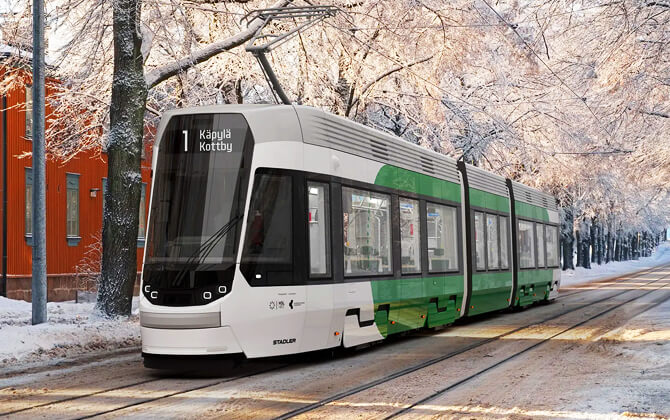
Timetable & Operating Hours
Helsinki Tram timetable information is available in printable PDF form as well as through the Journey Planner. For schedule today details, live departures, route timetable updates, and timings today, real-time tools are the most useful option.
If you want current opening hours, operating hours, working hours, or the latest train schedule style departure view for tram services, check live stop information before you travel. It is the easiest way to see the starting time of the next service, expected running time, frequency, and any changes to the schedule.
Printable timetable availability includes the following periods:
- 23.6.–27.7.: Helsinki 603, 701, 702, 802, 805, 812–818
- 23.6.–27.7.: Espoo, Kauniainen, and Vantaa: I, P (Helsinki–Lentoasema–Helsinki)
- From 28 July: timetable updates available in the same planning tools
Service periods shown in the materials include Helsinki city center, Espoo and Kauniainen, Eastern Vantaa and Kerava, and Western Vantaa from 12 August.
The tram network runs regular city center services as well as some seasonal and modified patterns. Weekend variants and night routes mean opening times, timings, closing time, and the last train can vary by line, so always confirm the latest timetable before heading out.
| Service detail | Timings |
|---|---|
| Line 1 | 10:00–15:00 |
| Line 1A | 06:00–09:30, 15:00–18:30 |
| Line 2 | 06:00–01:30 |
| Line 3 | 06:00–01:30 |
| Line 4 | 06:00–01:30 |
| Line 4T | 10:00–11:30, 16:00–17:00 |
| Line 6 | 06:00–23:30 |
| Line 6T | 14:00–22:30 |
| Line 7A | 06:00–23:30 |
| Line 7B | 06:00–23:30 |
| Line 8 | 06:00–23:30 |
| Line 9 | 06:00–24:00 |
| Line 10 | 06:00–23:30 |
Additional summer-only routes also run during limited periods.
| Service detail | Timings |
|---|---|
| Market Square route | 10:00–17:00 |
| Rautatientori route | 14:00–21:00 |
The listed schedule should be treated as approximate. For exact route timetable details, live departure timings, and close-of-service information, use the Journey Planner or real-time stop view.
Helsinki Tram Fares, Tickets and Cards
Helsinki Tram fare rules are part of the wider HSL public transport system, so the same ticket can usually be used on trams, buses, the metro, ferries, and other HSL services. The fare and ticket price depend on the travel zones used and on whether the passenger is an adult or a child.
For occasional travel, a single ticket is usually the simplest option. Depending on the zone combination, single tickets are valid for 80, 90, or 110 minutes. If you travel regularly but not every day, HSL also offers 10-journey and 20-journey tickets. For several journeys over one or more days, a day pass is available for 1 to 13 days.
For regular use, a season pass can be a practical choice. It is sold either as a one-off purchase or as an auto-renewing subscription, and it allows unlimited travel during the validity period. HSL also offers zone extensions for season tickets.
You can buy a ticket through the HSL app, from ticket machines, and at sales and service points. Single and day tickets can also be loaded onto disposable cardboard cards. If you use the app, make sure the ticket is active before boarding a tram, bus, or train, or before entering the metro or ferry payment area.
Traveling without a valid ticket can lead to a penalty fare of 100 euros (about $109) plus the price of a single ticket.
The HSL area is divided into four zones: A, B, C, and D. Most of Helsinki lies in the AB zone. Helsinki Card is another option for visitors, combining unlimited public transport travel for one to three days with other city benefits. Helsinki Card City is valid in zones A and B, while Helsinki Card Region covers zones A, B, and C.
No exact standard fare, day pass cost, or fare calculator result is given in the source material, so the current price should be checked through HSL before travel.
Parking near Tram
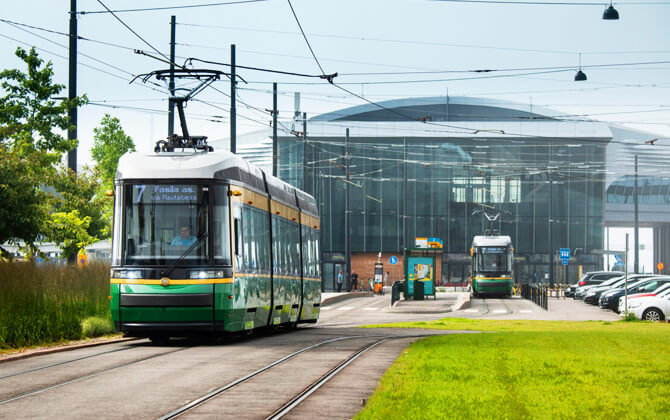
Parking in Helsinki is controlled, and in the city center it is allowed only in marked spaces. Parking charges usually apply on weekdays between 9 a.m. and 7 p.m., and some areas are also charged on Saturdays. Time limits may apply, and the inner city is the most expensive zone.
For a simpler option, station parking and park-and-ride facilities near public transport stops and stations can be useful. These areas let you leave your car and continue by tram, metro, bus, or commuter rail. Parking charges per day are usually none there, as commuter parking is usually free of charge.
If you park near tram tracks, follow tramway clearance rules carefully. On straight roads, vehicles should leave at least 80 centimetres from the tracks. On bends, the minimum is 140 centimetres. Parking too close can lead to removal.
Traffic wardens enforce parking regulations in Helsinki, and illegal parking may result in a parking ticket. Police also monitor parking, especially when a vehicle creates serious danger or inconvenience.
Always check street signs before leaving your car. Rules can change by area, time of day, and street.
History
The history of Helsinki Tram goes back to the late 19th century. Early proposals appeared in the 1870s, but public transport began in 1888 with horse-drawn omnibuses. In 1889, the operating company gained the right to build tram lines, and the system was built for horse-drawn trams because funding was limited and support for electric trams was weak.
The horse tram network used a 1,000 mm gauge. Test traffic began in December 1890, and the system officially opened in June 1891. It covered 8.5 kilometres, about 5.3 miles, but capacity soon proved too small for demand.
In 1897, permission was granted to build an electrified tramway. Electrification was mostly completed in 1900, with one short horse line lasting until 1901. By then, the system had four lines, all still single-track. In 1906, permission was granted to convert the network to double track.
Double-tracking work took place from 1908 to 1910. Further expansion followed in the 1910s, including routes to Kulosaari, Alppila, Taka-Töölö, and Hermanni. World War I slowed construction because of equipment shortages.
After the war, the network expanded again. By 1928, one company had become the sole tram operator in Helsinki. During this period, line numbers and letters were introduced alongside line colors. The network reached its greatest extent in 1930, with 14 lines in operation. By 1939, annual ridership had reached 61 million journeys.
At the end of 1944, the City of Helsinki took full control, and in 1945 the company became the municipal transport authority HKL. In the following decades, line identifiers changed, and while larger tramway expansion plans existed, they were pushed aside as resources went to the metro and bus network. In 1969, the city council decided future tram lines would be limited to the inner city and that the system could be ended no earlier than 2000.
That decision did not last. New articulated Valmet Nr I trams arrived in 1973–1975. The first expansion after a long pause opened in 1976 with the Itä-Pasila connection, followed by a Katajanokka extension in 1980. More expansion came in the 1990s, including the line to Pikku Huopalahti in 1991.
In the 2000s, Helsinki moved toward newer rolling stock. A Crotram TMK 2200 unit was tested in 2007–2008, and line 9 opened on 10 August 2008, the first new tram line in Helsinki since the reopening of line 2 in 1976.
In summer 2013, Helsinki introduced the Artic tram, designed for the city’s network and Nordic climate. It uses pivoting bogies for tight curves and steep hills and includes a fully low floor, LED lighting, recovered braking energy for heating, LCD screens for drivers, and cameras instead of rear-view mirrors. A major new step came in October 2023, when a separate light rail line opened. It is technically compatible with the tram network but operates separately from the city center system.
Future Extensions
Helsinki and neighboring Vantaa are planning a major tramway and light rail expansion in the 2020s and 2030s. If completed, the network would more than double in length compared with 2021, combining extensions to the existing system with new light rail routes.
Projects under construction
Laajasalo: Helsinki decided in 2016 to build a tramway to Laajasalo, east of the city center. The project includes three new bridges, with the longest planned at 1.2 kilometres, about 0.75 miles. These bridges will also carry bicycle and pedestrian lanes. The total length of new double track, including track on Laajasalo itself, is about 10 kilometres, or 6.2 miles.
Vantaa light rail: In May 2023, Vantaa approved a new 19.3-kilometre light rail line from Mellunmäki to Helsinki Airport. That is about 12.0 miles. Construction began in June 2025, and the line is projected to open in 2029 with estimated daily ridership of 31,000.
Approved projects
West Helsinki light rail: Helsinki approved the general plan in January 2021. The project includes a 5-kilometre light rail line via Vihdintie toward Kannelmäki, about 3.1 miles, plus new city center tram tracks via Topeliuksenkatu to reduce pressure on the crowded Mannerheimintie corridor. The estimated cost is €160 million, about $174 million, and construction was expected to start in 2026.
Line reorganisation
The Helsinki Regional Transport Authority is also planning a reorganization of the route network as new light rail lines are built. Earlier plans for the end of 2027 and from around 2035 show a much larger system, with routes extended, renumbered, or linked to new corridors such as Laajasalo, Pasila, Kannelmäki, and the airport line.
These changes are intended to improve connections between new districts, rail stations, and major interchanges. In practice, they would reshape many current tram services into longer, more frequent light rail-style routes.
Other possibilities
Another possible option is a tram or light rail system for the Östersundom area, annexed by Helsinki from Vantaa and Sipoo in 2009. Light rail was studied there as an alternative to extending the metro, mainly because it could be cheaper.
If built, the line could also continue east as far as Porvoo. A 2024 proposal suggested the new system would connect with the metro and with current and planned light rail lines, including Helsinki light rail line 15 in Itäkeskus, Vantaa light rail in Bredbacka, and route 560 in Fallbacka.
Helsinki Tram Places of Interest
Helsinki has an efficient public transport network, and the tram is one of the easiest ways to explore the city. For many visitors, it is both practical transportation in Helsinki and a relaxed way to see major sights without relying only on buses or walking.
For sightseeing, trams work well for longer hops between attractions, while short walks fill in the gaps. That mix makes the system especially useful if you want to explore the city center at your own pace.
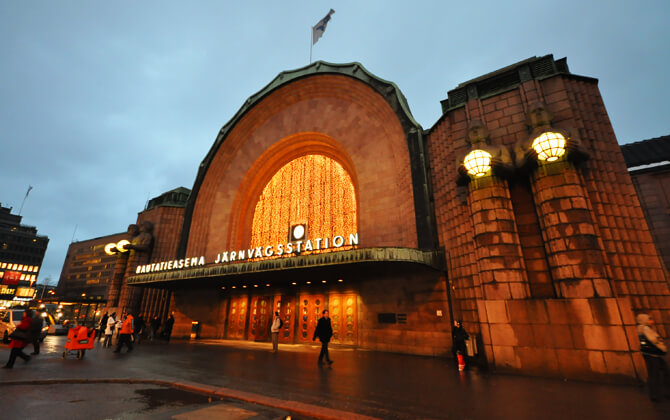
Highlighted places along the tram routes
- The Cathedral of Helsinki and Senate Square
- Central Railway Station
- Esplanadi boulevard
- Finlandia Hall
- Amos Rex
- Kiasma contemporary art museum
- Parliament Buildings
- Market Square (Kauppatori)
- Hakaniemi market hall
- Music Center and National Opera
- Chapel of Silence and the Kamppi area
- Temppeliaukio Rock Church
- Design District Helsinki
Tram Museum
The Tram Museum is at Töölönkatu 51 A in Kulttuuritehdas Korjaamo, inside Helsinki’s oldest tram depot from 1900. It presents the history of trams in Helsinki from a passenger’s point of view and is a branch of the Helsinki City Museum.
Visitors can sit in an old tram and get a feel for what the city looked like in earlier days. The museum also includes tram-related exhibits, a simulator, and activities that are especially engaging for children and for anyone interested in tramway history.
Useful notes for sightseeing by tram
Visitors who want an easy sightseeing route often use tram 2, described as the sightseeing tram. It makes a full loop of the city center and passes well-known places including Finlandia Hall, the Olympic Stadium, Parliament House, the Winter Gardens, Helsinki’s Botanical Garden, and Senate Square.
For architecture, route 4 is often recommended. It runs from Katajanokka to Munkkiniemi and passes several notable buildings. Route 6 is a good choice if you are interested in design, art, and food culture, with the Design District, market halls, museums, and other attractions along the way.
A public transport map is helpful when planning stops and walks between sights. Since a sightseeing route may combine tram rides with walking, it works best as a moderate walking outing supported by city transport.
Meeting point and arrival
A meeting point can be arranged at Narinkka Square in Kamppi, close to the modern city center. It is well connected from all three cruise ship ports by public transport and is a short walk from Central Railway Station.
The exact meeting point is in front of two black containers with large bicycle symbols and the text “Pyöräkeskus – Bicycle Center” at Narinkka 3, Helsinki. The guide area has a sign reading HAPPY GUIDE HELSINKI.
Tickets and local transport tips
Bus tickets can be bought directly from the driver in cash, while tram tickets must be purchased in advance from ticket machines or sales points. In some places, such as West Harbour, tickets are available from the machine next to the tram stop. In Katajanokka, tram tickets are sold at sales points or parking ticket machines around the terminals.
You can change between vehicles using the same ticket within one hour. A day pass for public transport is valid for 24 hours.