Bursaray, also written as BursaRay, is a light metro system in Bursa in Turkey’s Marmara Region. Built in 2000 by TÜVASAŞ and operated by Burulaş, it opened to passenger service on 24 April 2002. The system has two lines that share a main route and split at the western end, covering 38.9 kilometers (24.2 miles) and serving 39 stations, including 7 underground stations. It is a key part of public transport and city transport in Bursa, linking central areas with outer districts.
| Key | Information |
|---|---|
| System type | Light metro |
| City | Bursa, Turkey |
| Operator | Burulaş |
| Built | 2000 |
| Opened to passengers | 24 April 2002 |
| Lines | 2 |
| Route length | 38.9 kilometers (24.2 miles) |
| Stations | 39 |
| Underground stations | 7 |
| Typical platform length | 120 meters |
| Platform height | 92 centimeters |
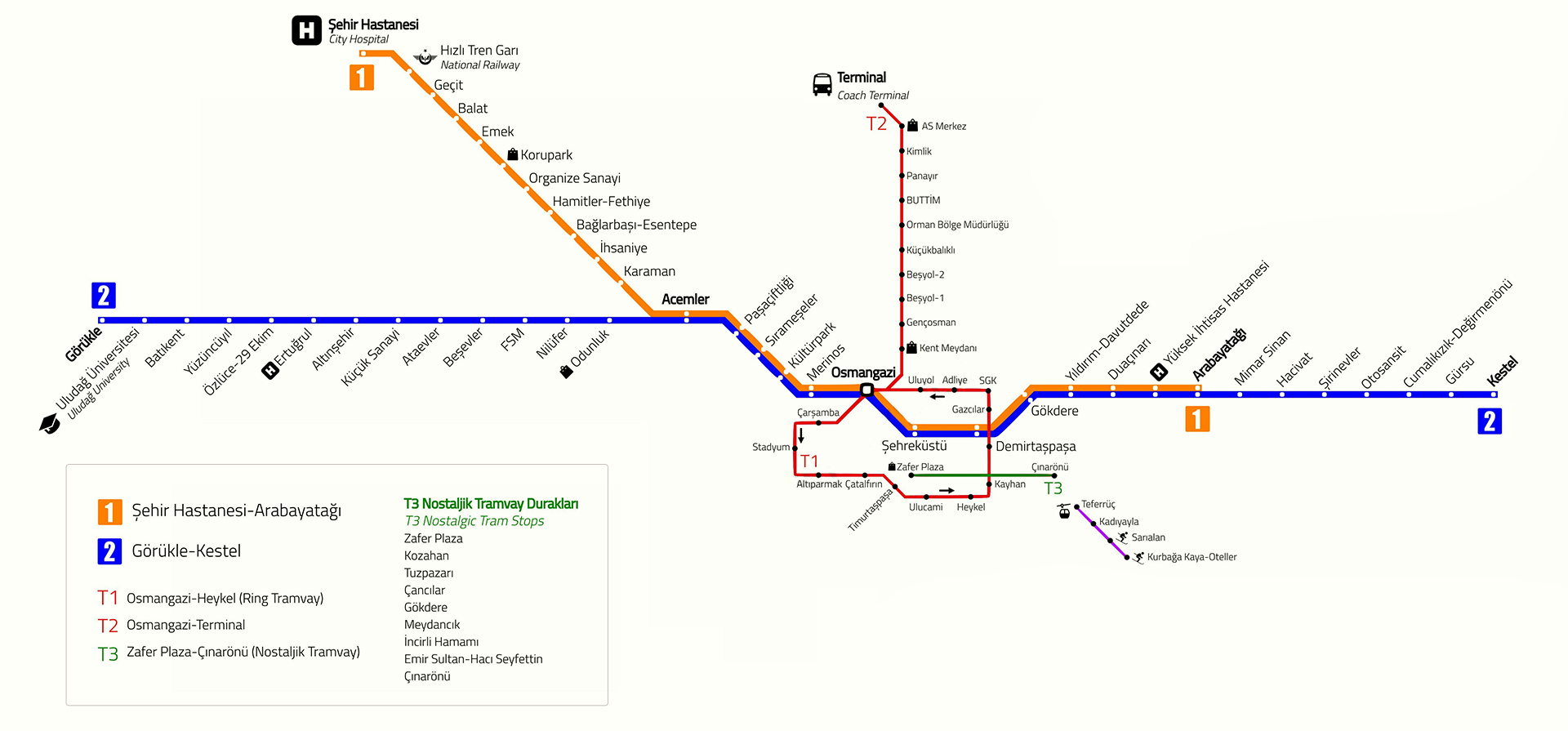
Bursaray Map
Map of Bursa Metro showing different lines and stations. Click on the map to enlarge it or download the Bursa Metro map in PDF format.
Lines and Stations
Bursaray runs on two lines with a shared central route and western branches. The route is fully independent from other public transport lines. One branch starts at Emek on Mudanya Road, the other at Üniversite on İzmir Road, and both meet at Acemler before continuing through central Bursa.
The network has 39 stations across 38.9 kilometers (24.2 miles). Seven stations are underground, including the section between Şehreküstü and Merinos. There is also a short tunnel near Acemler, tunnels at the western end of Line 2, and Batıkent is underground as well. Most stations use island platforms.
For route planning, Line 1 connects Arabayatağı and Emek with a running time of about 35 minutes. Line 2 runs between Kestel and Üniversite, with a full route timetable of about 42 minutes. Some source material also describes the system as having 38 active stations.
| Station | Details |
|---|---|
| Emek | Western branch terminal on Mudanya Road; also useful for ferry-to-metro transfers by bus or taxi. |
| Organize Sanayi | Station on the western side of the network. |
| Acemler | Key junction where the two lines converge before the shared central route. |
| Şehreküstü | Central station; part of the underground section and useful for the city center. |
| Merinos | Central underground station; section to Şehreküstü has higher frequency service. |
| Osmangazi | Central stop with access to major urban areas. |
| Demirtaşpaşa | Station on the eastern side of the central area. |
| Yıldırım/Davutdede | Station on the eastern corridor. |
| Arabayatağı | Eastern terminal of Line 1. |
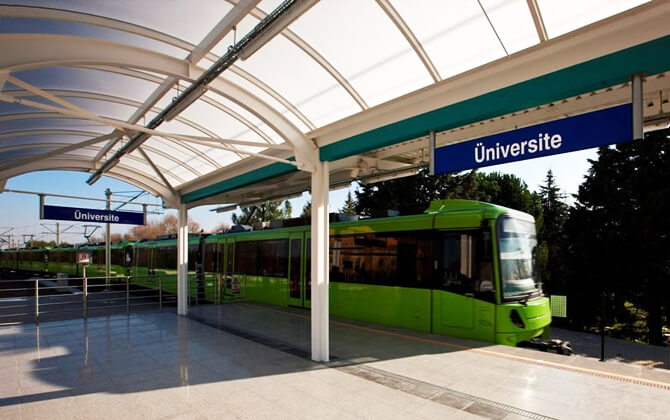
| Üniversite | Western branch terminal of Line 2. |
| Batıkent | Underground station. |
| Küçük Sanayi | Western-side station on the network. |
| Ataevler | Station on the western branch. |
| Nilüfer | Station serving the Nilüfer area. |
| Hacivat | Station on the eastern extension. |
| Şirinevler | Station on the eastern extension. |
| Otosansit | Station added during the Phase 3 eastern expansion. |
| Gürsu | Eastern extension station opened in 2014. |
| Kestel | Eastern terminal of Line 2. |
Hours of Operation
Bursaray operating hours vary by day, so it is worth checking the timetable and schedule today before you travel. In general, trains run every day and the system does not operate 24 hours. The usual opening hours are around 5:00 am to 12:00 am.
During most of the day, frequency is about every 10 minutes. On the Şehreküstü-Merinos section, trains come more often, about every 5 minutes during daytime service. The exact timings and working hours can change on weekends, holidays, and special occasions.
| Service detail | Timings |
|---|---|
| General opening times | About 5:00 am-12:00 am daily |
| Typical daytime frequency | About every 10 minutes |
| Şehreküstü-Merinos frequency | About every 5 minutes during the day |
| Monday to Friday | 05:35-00:14, every 7-12 minutes |
| Saturday | 05:35-02:45, every 7-13 minutes |
| Sunday | 03:15-00:14, every 10-13 minutes |
If you are planning around the last train, remember that timings today may differ from the standard route timetable. Closing time may also shift during public holidays.
Fare and Ticket
Bursaray uses a pre-paid fare system. Reduced fare options are available for passengers over 60, students, and teachers, with ID required. Disabled passengers, people over 65, veterans, state government employees, and national-level athletes can travel free.
You can use paper magnetic tickets, season tickets, and travel cards. Regular tickets are sold from ticket machines at stations, while travel cards are issued at designated station offices. The available ticket and pass options also include short-line and long-line single rides, plus subscription products.
| Ticket Type | Price |
|---|---|
| Full ticket | 2.55 TL (about $0.08) |
| Student | 1.45 TL (about $0.04) |
| Discounted ticket | 2.10 TL (about $0.06) |
| Student monthly subscription card | 100 TL (about $2.95) |
Ticket price, fare, and pass cost can vary by line category and product type. The source material does not provide a fare calculator.
Connections to Other Systems
Bursaray is independent from other metro, tramway, and bus routes in operational terms, but it still plays a central role in transportation in Bursa. It links the city center with suburban districts and works as part of the wider local transport and public transport network.
Useful central stops mentioned in the available material include Kültürpark, Osmangazi, and Şehreküstü. Bursa transport also includes bus services, minibuses, taxis, ferries, and airport connections. If you arrive by ferry from Istanbul, you can continue by bus or taxi to Emek station and then use the metro into the city.
The system also has station parking in the form of adjacent car parks at stations. However, no parking charges or parking charges per day are given in the source material.
Airport Connections
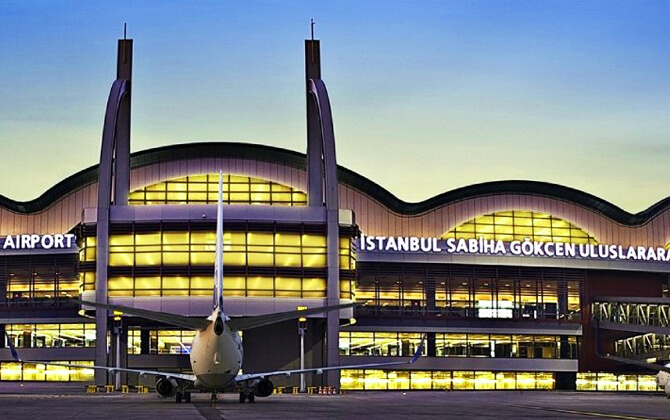
Bursa can be reached by bus, ferry, or plane from major cities in Turkey. For air travel, the city is served by Yenişehir Airport, which handles domestic flights and a small number of international flights. Most international travelers will usually connect through a larger airport in Turkey.
From Istanbul Sabiha Gökçen Airport, direct buses run to Bursa and the trip takes about 2 hours. Bursa also has sea connections with Istanbul: ferries and sea buses serve Mudanya and Güzelyalı, with crossings taking around 90 minutes. From the ports, passengers can continue by bus or taxi to Emek station and then take Bursaray toward downtown.
From Yenişehir Airport, you can continue to the city center by public bus or taxi. Intercity buses also arrive at the coach terminal outside the center, with onward bus connections available. There are no trains to Bursa from Istanbul, so the main options are ferry, bus, or flight.
Facilities and Services
Burulaş provides a range of facilities to make travel more comfortable and safe on the system.
- Air-conditioned trains
- Emergency equipment on board, including fire extinguishers and emergency door opening handles
- Lost and Found service
- Adjacent car parks at stations
These services support everyday travel across the network.
Rules
Passengers should follow the system rules carefully. Pets are allowed only in suitable cages, except guide dogs for visually impaired passengers. Explosives and flammable materials are banned, and no one may walk on the tracks or cross barriers.
Passengers should avoid behavior that disturbs others. Large packages are limited to a quarter of a cubic metre and 15 kg. Bicycles, prams, and similar items should not be left unattended in underground areas. Smoking is prohibited on platforms and in waiting areas.
If you find lost property, hand it to station staff and request a Lost Property Report. The Lost Property Office is at Osmangazi Station.
- Lost Property Office phone: (0224) 452 52 44 / 6600
- Working hours: 08:00-18:00 on weekdays
Bicycles are allowed only at certain times. On weekdays, they are not allowed between 07:00-09:00 and 17:00-19:00. On weekends, public holidays, school holidays, semester breaks, and summer weekdays, bicycles are allowed without time limits. Only one bicycle is allowed per vehicle, and foldable bikes must be folded. Bicycles are not allowed on T1 and T3 tram vehicles, and motorcycles are not allowed on HRS, T1, or T3 vehicles.
Musical instruments used in a disturbing way, begging, loud noise, eating or drinking, littering, and damaging equipment are prohibited. If you notice unsafe behavior, inform station staff, security guards, or the train driver through the emergency call button. If something falls onto the track, do not enter the track area.
Train doors have safety sensors, and trains cannot move until the doors are closed. After the door-closing sound, do not board or exit. Free cards must be shown to security staff at controlled turnstiles. When using BursaKart, show the card at metro turnstiles and on readers on buses and trams. Travel is not allowed without an electronic ticket or a personalized BursaKart.
Children aged 0 to 6 travel free with parents. Disabled passengers, elderly people, pregnant women, and women with children are given priority when boarding and alighting.
Tips
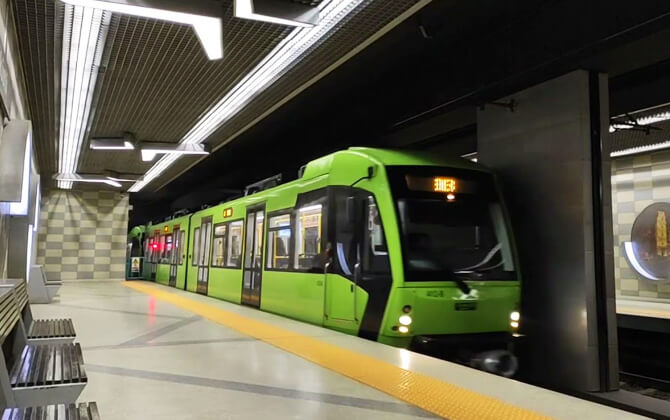
Bursa has a broad public transport system with metro, trams, bus routes, minibuses, and taxis, so getting around is usually straightforward. A little planning helps, especially during busy periods.
BursaKart and ticket payment
On the metro, trams, and city buses, payment is made with a contactless card bought in advance. BursaKart, also called BuKart, is the reusable option and is usually the cheapest way to travel. Single-use contactless tickets are also available. Cash is not accepted on metro, tram, or city bus services.
Sales points and ticket machines are available at major stations. Machines can be switched to English, and you can also top up the card there. On buses and trams, tap when boarding; on the metro, tap at the turnstiles.
Useful metro stops
For visitors, Bursaray is especially handy for the city center. Kültürpark, Osmangazi, and Şehreküstü are among the most useful stops. If you arrive from the Mudanya ferry area, head toward Emek station and continue by metro.
Getting between the ferry, terminal, and city center
From the Mudanya ferry pier, yellow city bus routes such as 1/GY and 1/M connect with Emek station. From the intercity bus terminal, bus 38 is an important route into the center. In heavy traffic, the trip to Ulu Cami or Heykel can take 45 minutes or more, so leave extra time.
Plan for busy periods
Buses can get crowded during rush hour. If your schedule is flexible, travel outside peak times. If you are unsure about the right bus stop or route plan, asking hotel staff or local passengers is often the quickest fix.
When a taxi makes sense
If you have luggage or want a more direct trip, a taxi can be practical. Taxis are cash only, unlike the metro, trams, and buses. For short city-center journeys, they can save time when traffic is heavy.
History
Bursaray, or BursaRay, takes its name from Bursa and the Turkish word ray, meaning rail. The project was approved on 31 January 1997, and construction began on 14 October 1998. Passenger trial service started on 24 April 2002, and the first section officially opened on 19 August 2002 between Şehreküstü and Küçük Sanayi (Hipodrom).
The system expanded in phases. Phase 1 Stage B began on 2 January 2005, and the extension from Şehreküstü to Arabayatağı opened on 6 April 2008. Phase 2 construction started on 28 October 2008. The Küçük Sanayi (Hipodrom) to Özlüce extension opened on 24 December 2010, followed by the Üniversite and Emek extensions on 19 September 2011 and 15 December 2011.
Phase 3 extended the line eastward in 2014. Arabayatağı to Otosansit opened on 19 March 2014, Otosansit to Gürsu on 27 March 2014, and Gürsu to Kestel on 5 June 2014.
Construction of the Bursa City Hospital extension began on 2 April 2021. The fleet was also enlarged with 30 Bombardier Flexity Swift light rail cars. Burulaş purchased 44 used Duewag SG2 cars from Rotterdam; 25 entered service and 19 were kept for spare parts. All Duewag SG2 cars are now discontinued.
Future Extensions
The system is planned to grow to about 50 kilometers (31.1 miles). The most clearly stated expansion project is the Bursa City Hospital extension, where construction began in April 2021. It is expected to run from Emek to the new city hospital via the future Bursa high-speed rail station.
Another announced project is the extension from Uludağ University station to Görükle. A groundbreaking ceremony was held in January 2023, though construction had not yet started according to the source material.
Other proposals mentioned include a western extension toward Görükle, a northwestern extension to the city hospital area, a possible northeast branch toward Demirtaş, a future Çalı-Gürsu Metro Line, and integration of the T1 and T2 trams with Bursaray through Osmangazi Station. There are also references to a new metro line between Paşaçiftliği and Mimar Sinan-BTÜ, with feasibility studies expected to begin at the end of 2025, plus future rail and bus links connecting Bursa Terminal, Kestel, Uludağ University, and the historic center.
Nearby Attractions
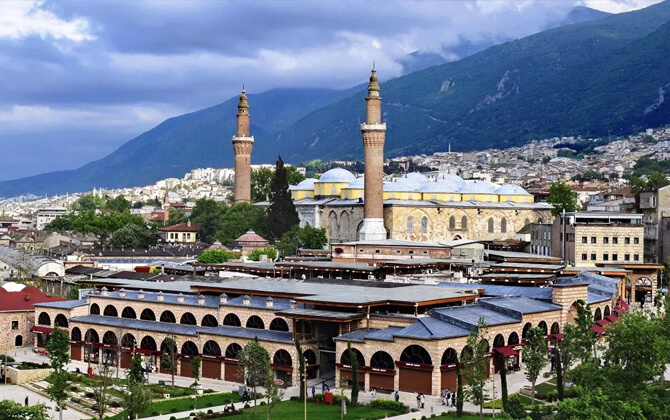
Bursaray gives easy access to many of Bursa’s main sights, especially around the historic center. From the metro, you can continue on foot or switch to trams and buses for a wider sightseeing route.
Historic Center Highlights
Around Osmangazi, several major landmarks are close together. Nearby attractions include the Grand Mosque, the Green Complex, the Muradiye Complex, the Tombs of Osman and Orhan Gazi, historic houses, bazaars, and Irgandı Bridge.
The old town also works well for walking. Places mentioned in the source material include Koza Han, the Covered Bazaar, the Salt Market, and the Bursa City Museum.
Nature, Views, and Outdoor Breaks
Uludağ National Park is one of the city’s best-known natural attractions. In winter it is popular for skiing and snow activities, while summer brings cooler weather and green scenery. The Bursa Teleferik cable car is one of the standout ways to reach the mountain area.
Reşat Oyal Culture Park is another easy option near the city center, with green space, walking areas, cafés, seasonal events, and family-friendly activities.
Culture and Local Life
For museums and local heritage, the source material highlights the Tofaş Museum of Anatolian Carriages, Bursa Karagöz Museum, Bursa Archaeological Museum, and Conquest 1326 Panorama Museum. These add context to Bursa’s long Ottoman and transport history.
For a more modern side of the city, Nilüfer is known for shopping, dining, and nightlife.
Easy Day-Trip Options
Cumalıkızık Village, a UNESCO-recognised Ottoman-era settlement, is a popular excursion from the city. Another option is attending a match at the Bursaspor stadium for a local football experience.
With Bursaray plus bus and tram connections, it is possible to combine several of these places in one day without relying on taxis for every trip.