The Ankara Metro is the rapid transit system in Ankara, Turkey’s capital. It includes the Ankaray light rail line, the combined M1-M2-M3 metro service, and the M4 line. The system connects central districts, residential areas, major transport hubs, and key parts of the wider city transport network. In 2024, it carried 172.1 million passengers, or about 470,185 a day, showing how important it is for everyday public transport in Ankara.
| Key | Information |
|---|---|
| System | Ankara Metro and Ankaray light rail |
| City | Ankara, Turkey |
| Lines in service | M1, M2, M3, M4, and Ankaray A1 |
| Network length | 64.36 km / 40.00 miles including Ankaray; 57.2 km / 35.54 miles for metro lines only |
| Stations | 54 including Ankaray; 42 on the four main metro lines |
| Main interchange | Kızılay |
| Opening year | 1996 for Ankaray; 1997 for the first full metro line |
| Annual ridership | 172.1 million in 2024 |
Ankara Metro Map
Map of Ankara Metro showing different lines and stations. Click on the map to enlarge it or download the Ankara Metro map in PDF format.
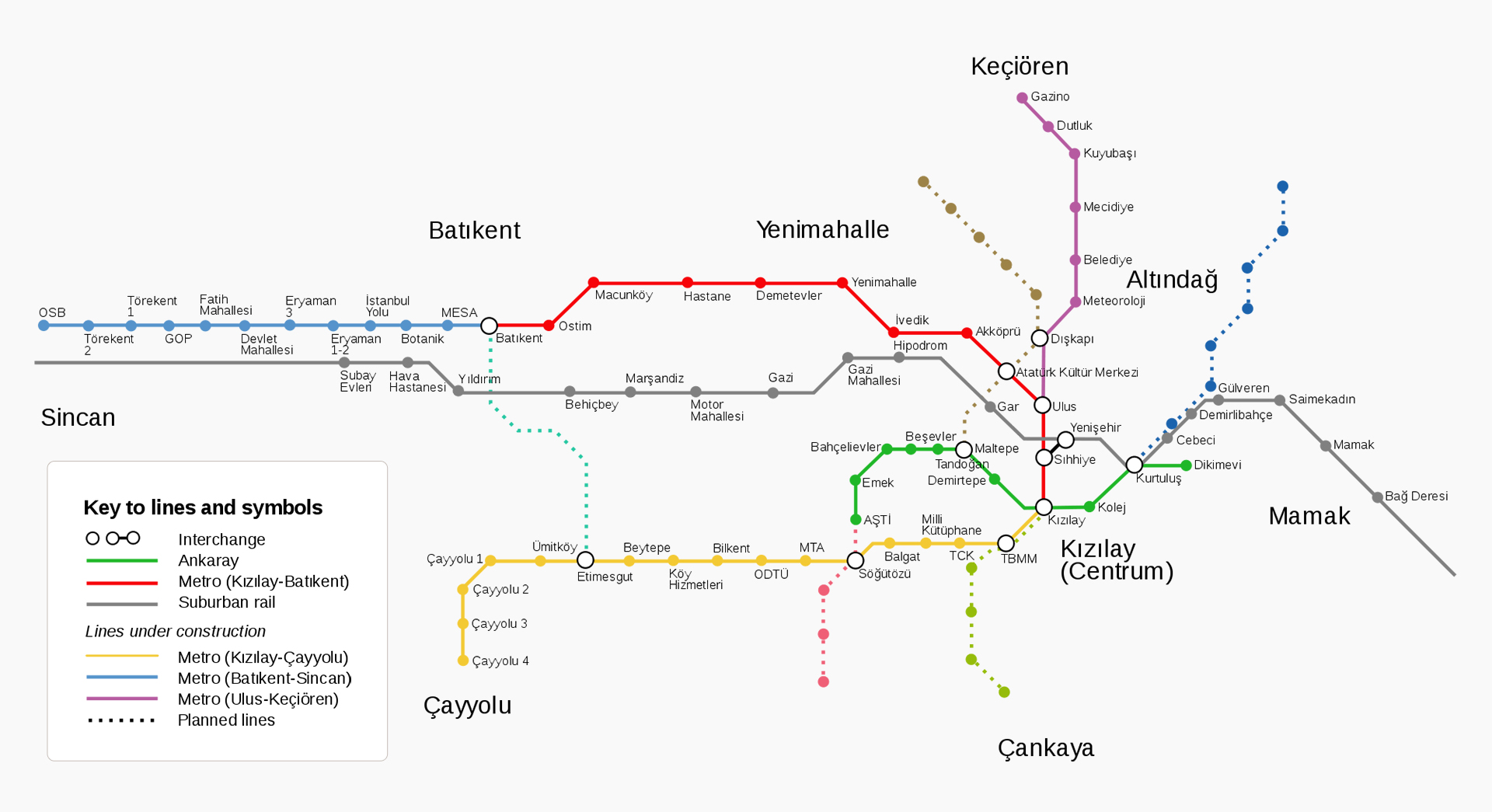
Ankara Metro Lines and Stations
The Ankara Metro system has four metro lines plus the Ankaray light rail line. Together, they cover 64.36 km, or 40.00 miles, and serve 54 stations. If you count only the main metro network, the total is 57.2 km, or 35.54 miles, with 42 stations.
For trip planning, the route plan is fairly straightforward. Kızılay is the key interchange, and several stations connect with bus services, commuter rail, and other local transport options.
| Station | Details |
|---|---|
| M1 | Metro line, 14.66 km / 9.11 miles, 12 stations, route from Kızılay to Batıkent |
| M2 | Metro line, 16.59 km / 10.31 miles, 10 stations, route from Kızılay to Koru |
| M3 | Metro line, 15.36 km / 9.54 miles, 11 stations, route from Batıkent to Törekent |
| M4 | Metro line, 9.22 km / 5.73 miles, 9 stations, route from Atatürk Cultural Center to Gazino |
| Ankaray | Light rail line, 8.53 km / 5.30 miles, 11 stations, route from Dikimevi to AŞTİ |
M1 was the first metro line to open, in 1997, linking Kızılay and Batıkent. M2 and M3 opened in 2014. M4 opened in 2017 and extended the system farther north. Ankaray has been running since 1996 between Dikimevi and AŞTİ.
The stations map is especially useful if you need to switch lines. Some trips are direct, while others require a transfer at Kızılay or another interchange station. Checking the stations list before you travel can save time.
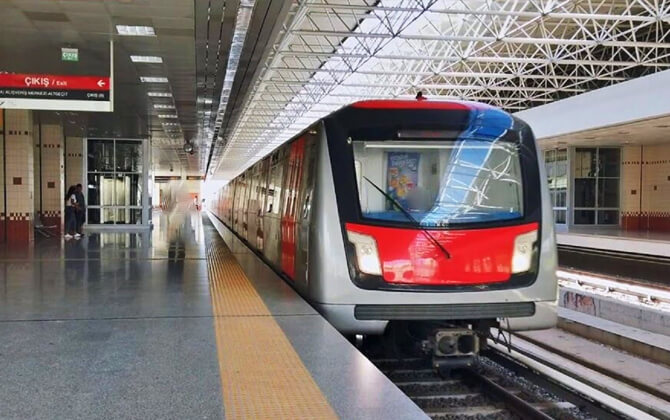
Ankara Metro Hours
Ankara Metro opening hours generally start at 6:00 am, and the system runs until around midnight. Exact opening times, closing time, and last train details vary by line, station, and direction, so checking the latest timetable or train schedule is smart, especially for timings today or a late return trip.
The working hours are similar across the network, but the last departures are not identical. Frequency also changes during the day, with shorter waits in peak periods and longer intervals later in the evening.
| Service detail | Timings |
|---|---|
| System starting time | 06:00 |
| M1-M2-M3 last train | Usually around 00:10 to 01:00, depending on station and direction |
| M4 last train | Usually around 00:30 to 01:10, depending on station and direction |
| Ankaray A1 last train | Usually around 00:50 to 01:00, depending on station and direction |
| M1-M2-M3 frequency | About every 5-7 minutes at peak times, 7-10 minutes off-peak, and about every 15 minutes after 11:00 pm |
| M4 frequency | About every 6-9 minutes during busy periods |
| Ankaray A1 frequency | About every 4-6 minutes at peak times, 7-10 minutes off-peak, and about every 20 minutes after midnight |
If you need the schedule today, route timetable, or timings for a specific station, check the official service update before you go. Holiday schedule changes can happen, even when the usual operating hours stay close to normal.
Fares, Tickets and Cards
The Ankara Metro fare system includes paper tickets, multi-ride options, passes, and the rechargeable AnkaraKart card. Ticket price details in the source material are inconsistent, so it is best to treat all prices as approximate and check the latest fare before travel.
A single journey ticket is listed at about 10 TL, or roughly $0.31, for adults, while students and seniors pay around 5 TL, or about $0.16. A 10-ride ticket costs about 80 TL, or $2.49, and a monthly pass is around 200 TL, or $6.22. The AnkaraKart single fare is about 7 TL, or $0.22.
Another fare listing mentions magnetic paper tickets at 1.75 TL, or about $0.05, with a student fare of 1.30 TL, or about $0.04. These tickets allow more than two transfers within 75 minutes, with each transfer costing 0.59 TL, or about $0.02. Discount cards do not have a transfer fee within that time window.
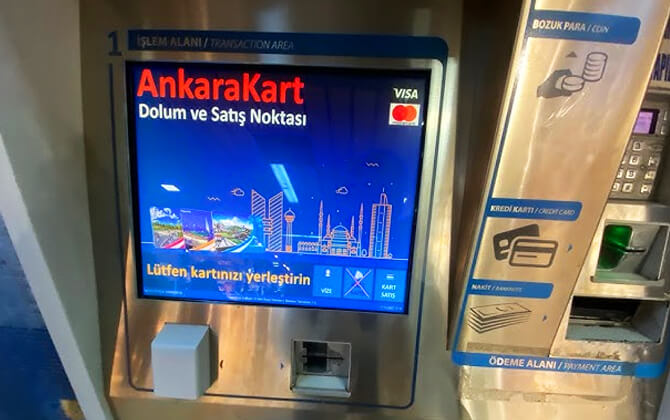
The AnkaraKart is the most convenient ticket option for regular travel. You can buy and top up the card at station machines or service centers, and recharging is also available online through a mobile app. Tickets must be validated before entering the paid area.
- Single journey ticket: about 10 TL ($0.31) for adults; around 5 TL ($0.16) for students and seniors
- 10-ride ticket: about 80 TL ($2.49)
- Monthly pass: about 200 TL ($6.22)
- AnkaraKart single fare: about 7 TL ($0.22)
- Paper ticket fare: 1.75 TL ($0.05), or 1.30 TL ($0.04) for students
If you are comparing ticket cost options, the rechargeable card is the practical choice for most riders. There is no mention of direct mobile payment at gates, and a fare calculator is not described in the source material.
Connections to Other Systems
Ankara Metro is well integrated with the city’s wider public transport system. Transfers between metro, bus, commuter rail, and the aerial tramway are available at several important stations, which makes transportation in Ankara much easier.
The main connection is the EGO bus network. Many metro stations link directly with bus routes, and the metro and bus system share a common fare structure. That matters if you are combining city transport modes in one trip.
The metro also connects with Başkentray commuter rail. Sıhhiye is the key interchange for Line 1, while Kurtuluş connects with Ankaray. Maltepe links with Turkish State Railways services.
Another useful transfer is the Yenimahalle-Şentepe aerial tramway. From Yenimahalle station, passengers can switch to this tramway-style cable car system serving the Şentepe area.
For airport access, there is no direct path train or metro route to Esenboğa International Airport. Instead, connections are made by shuttle and bus from stations such as Ulus, AŞTİ, and Kızılay.
- Bus: extensive EGO bus connections across the city
- Commuter rail: Başkentray via Sıhhiye and Kurtuluş
- Aerial tramway: Yenimahalle-Şentepe via Yenimahalle
- Rail-related links: Maltepe for Turkish State Railways services
- Airport transport: bus and shuttle links from major stations
Airport Connections
There is no direct metro connection from AŞTİ to Ankara Esenboğa Airport. In practice, airport transport depends on bus, shuttle, taxi, private car, or town car services.
The direct EGO 442 bus runs from AŞTİ to the airport every 30 minutes. The running time is about 1 hour, and the fare is listed as €2, roughly $2.18. Shuttle buses are faster, taking around 45 minutes, with a price of €1-4, or about $1.09-$4.36.
By road, the distance between AŞTİ and the airport is 30.8 km, or 19.1 miles. Driving time is about 25 minutes. Taxi fare is typically €18-22, around $19.62-$23.98, and town car services are also available on demand with a similar travel time.
If you are planning airport transfers with luggage, the shuttle or taxi is usually the easiest option. For the lowest cost, the 442 bus is the budget choice.
Ankara Metro Parking
Some Ankara Metro stations offer station parking through Park and Ride facilities. This can be a useful way to avoid driving into busy central districts and continue by public transport instead.
The source material does not provide a full stations list for parking locations or exact parking charges per day. It does note that availability and parking charges can vary by facility, and that some sites are underground or closed parking lots. In some cases, real-time space information is available through the Parkera app and website.
If you plan to use station parking, check current details before leaving. Metro operating hours usually run from 6:00 am to midnight, so parking linked to metro travel is most practical during those hours.
Useful Parking Tips
- Check live availability before arrival if the parking lot supports it.
- Use the Parkera app or website to review parking details.
- Look at the fee structure carefully, since charges may differ for cars, minibuses, buses, and motorcycles.
- Plan your trip around metro opening hours and last train timings if you will return late.
Future Extensions
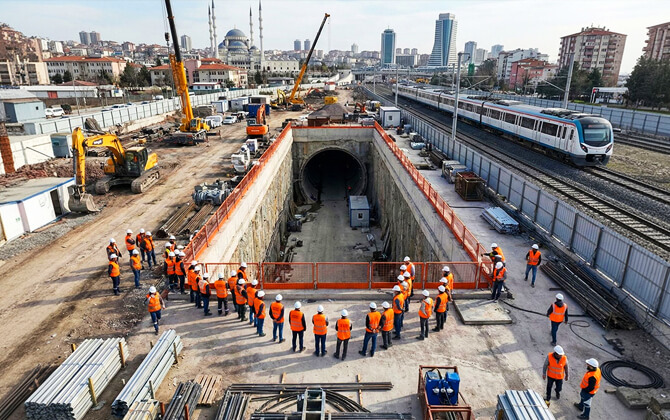
The Ankara Metro system is still expanding. Planned and ongoing projects are aimed at improving capacity, adding new route options, and strengthening links between the metro and Ankaray networks.
According to the source material, the long-term expansion plan includes three new lines: a southwest route from Kızılay to Çayyolu, a northern route from Ulus to Keçiören, and a southern route from TBMM to Dikmen. Line 1 is also planned to extend west from Batıkent toward Sincan.
Ankaray is expected to grow as well. One project is the AŞTİ to Söğütözü extension, which has not yet opened because of signaling incompatibility and is planned to open after renewal works. Another extension under construction is Dikimevi to Natoyolu.
The available materials also mention future Ankaray links from Kurtuluş to Siteler and from Maltepe to Etlik. In addition, a proposed Line 5 is described as a 25 km route, or 15.53 miles, with seven stations linking Kuyubaşı with Esenboğa International Airport and Yıldırım Beyazıt University.
Rules and Tips
Ankara Metro is simple to use, and it is generally a safe system if you follow the basic rules. Validate your ticket or card before entering, and keep it with you until you leave the paid area completely.
Smoking and alcohol are prohibited in stations and on trains. Loud behavior should be avoided, and passengers are expected to keep trains and platforms clean. Stay behind the yellow safety line and follow staff instructions.
Security officers may check tickets and ask for identification when needed. Traveling without a valid fare can lead to serious fines, so make sure your ticket has been validated properly.
There are also restrictions on luggage and bulky items. Large loads should not block doors, aisles, or seats. Pets, bicycles, scooters, and similar items are allowed only under specific conditions and outside certain peak periods, so it is worth checking the current rules before you travel.
For smoother local transport connections, plan your route in advance. Kızılay is the main hub, and most transfers are straightforward once you know which line you need.
History
Ankaray
Ankaray, whose name comes from the Turkish word for rail, was the first part of Ankara’s modern rapid transit system. It was planned in the city’s 1990 investment program, approved in late 1991, and built between 1992 and 1996.
The line opened on 30 August 1996. It runs between AŞTİ and Dikimevi, with 11 stations across 8.53 km, or 5.30 miles, and is classified as light rail. This was the starting point for the modern rail transport system in Ankara.
Ankara Metro
The first full metro line, M1, opened on 29 December 1997 between Kızılay and Batıkent. M3 opened on 12 February 2014 between Batıkent and OSB-Törekent, and M2 followed on 13 March 2014 between Kızılay and Koru.
At first, M2 and M3 operated separately from M1. In July 2018, M1 and M3 were merged, and in February 2019 M2 joined the same through service. That created uninterrupted travel between Koru and OSB-Törekent.
Testing on M4 began in August 2016. The first section, from Şehitler-Gazino to Atatürk Kültür Merkezi, opened on 5 January 2017. The extension from Atatürk Kültür Merkezi to Kızılay opened on 12 April 2023.
In 2019, ASELSAN began traction and control upgrades on older Bombardier trains. By 2024, Ankaray and the metro lines together were carrying 172.1 million passengers a year.
Nearby Attractions
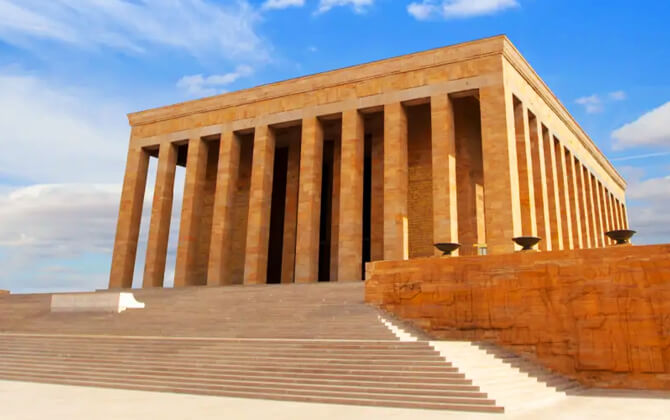
Two major attractions near the Ankara Metro are Anıtkabir and the Museum of Anatolian Civilizations. Both are practical stops if you want to combine sightseeing with public transport in the city.
Anıtkabir
Anıtkabir is the mausoleum of Mustafa Kemal Atatürk, founder of the Republic of Turkey. It also includes a museum with personal items, photographs, and documents. Going early in the day is a good idea if you want to avoid crowds.
- Address: Akdeniz Cd. No:31, Çankaya, Mebusevleri, Ankara, 06570, TR
- Phone: +903122311861
- Hours: Daily, 9 am-5 pm
From Kızılay Metro Station, take the M1 line toward Atatürk Airport and get off at Aşık Veysel Stop. From there, it is about a 20-minute walk, or you can take a taxi.
Museum of Anatolian Civilizations
The Museum of Anatolian Civilizations is one of Ankara’s leading museums, with artifacts from many periods of Anatolian history. It is near Ankara Castle and is a strong pick for anyone interested in archaeology and heritage.
- Address: Gözcü Sk. No:2, Ulus/Altındağ, Kale, Ankara, 06240, TR
- Phone: +903123243160
- Hours: Daily, 8:30 am-5:30 pm
To get there by public transport, take the metro to Kızılay and continue by bus toward Ulus. From the Ulus stop, it is a short uphill walk to the museum. A taxi from central Ankara is also an easy option.