The Adana Metro is a rapid transit system in Adana, Turkey, consisting of a single north–south line about 13.5 km long with 13 stations, which began partial service in March 2009 and fully opened on 14 May 2010; it has a travel time of around 21 minutes end to end, a capacity of approximately 21,600 passengers per hour per direction, and operates 36 Hyundai Rotem vehicles in three-car trains carrying about 933 passengers each. Planning started in 1988, construction began in 1999, was halted in 2002 due to funding issues, and resumed in 2008. The line runs across major city corridors, including crossing the Seyhan River, and is integrated with the bus network, while a planned extension of about 9.3 km with seven additional stations would expand the system to roughly 23.3 km and 20 stations.
Adana Metro Map
Map of Adana Metro showing different lines. Click on the map to enlarge it or download the Adana Metro map in PDF format.
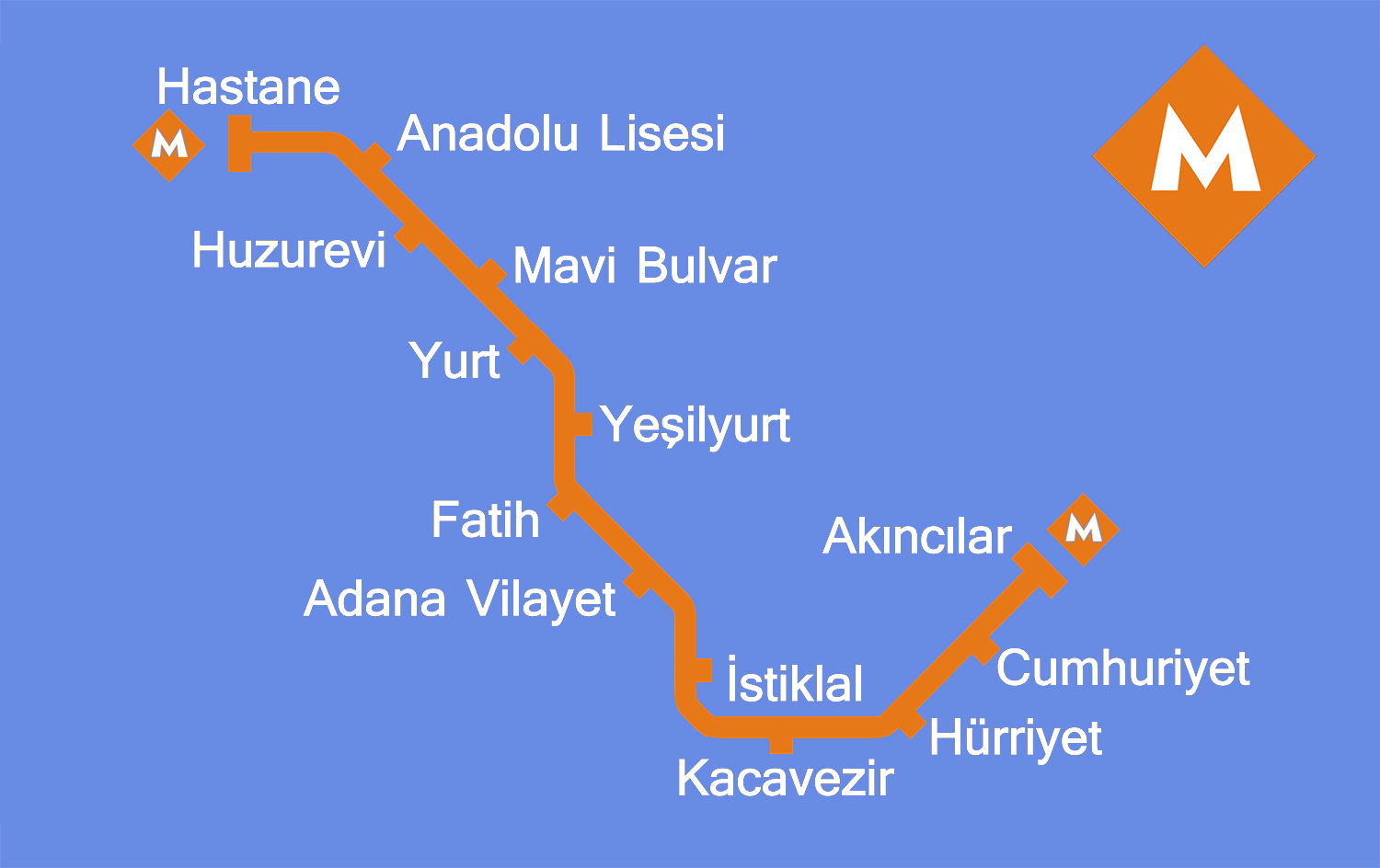
Lines and Stations
The Adana Metro has one north–south line running between Hastane and Akıncılar. The route is about 13.5 kilometres long, serves 13 stations, and takes approximately 21 minutes from end to end.
Line
The line starts near the depot and Hastane station by the Mental Health Hospital, follows Turgut Özal Boulevard to Anadolu Lisesi, then continues south along Alparslan Türkeş Boulevard. It crosses the Seyhan River north of the Regülatör Bridge and ends at Akıncılar beside the Yüreğir Bus Terminal.
Stations
There are 13 stations in total: 4 underground, 5 elevated, and 4 at ground level. Stations are equipped with escalators and elevators for accessibility.
- Hastane — Underground. Located on Turgut Özal Boulevard, with feeder buses to Bahçeşehir, Carrefour, and Adana Koop.
- Anadolu Lisesi — Underground. Located on Turgut Özal Boulevard, with bus links to Seyhan Hospital, Kurttepe, and Demirel Boulevard.
- Huzurevi — Ground level.
- Mavi Bulvar — Ground level. Connected to the O-50 Adana Beltway area.
- Yurt — Ground level. Local bus links include Barış Manço Boulevard, PTT Street, HayalPark, Mavi Bulvar, and Çetinkaya.
- Yeşilyurt — Ground level.
- Fatih — Elevated. Served by Karaisalı minibuses and nearby local bus stops.
- Vilayet — Underground. The main interchange with Adana railway station, with bus links to central city locations.
- İstiklal — Underground. Located near the D-400 state road.
- Kocavezir — Elevated. Connected with feeder buses serving central districts.
- Hürriyet — Elevated. Near the Seyhan River and served by Akkapı minibuses.
- Cumhuriyet — Elevated. Connected to Karataş buses and local minibuses, also near the river.
- Akıncılar — Elevated. Terminal station beside the D-400 and Yüreğir Bus Terminal, served by Kozan Yolu bus lines 110, 113, 114, 116, 118, and 126.
Several stations connect directly with city buses and dolmuş services, while Vilayet is the most important interchange for regional and national rail services via Adana railway station.
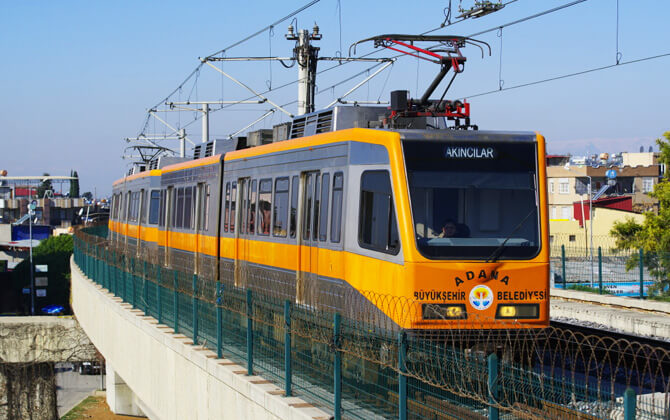
Schedule and Timetables
The Adana Metro runs every day but does not operate 24 hours. The current line has 13 stations, and a complete trip across the system takes about 21 minutes.
Typical service pattern
- Weekdays: timetable information indicates a first departure from Akıncılar at 06:24. Trains generally run about every 10 minutes through most of the day, then every 15 minutes after around 21:24, with last trains at about 23:24.
- Weekends: first trains are reported to start later, around 06:39, with trains typically every 15 minutes and final departures around 23:24.
- General hours: some published information gives overall operating times of roughly 06:00 to 23:30. Exact first and last trains can vary by station, holidays, and special events.
Practical advice: always confirm current schedules, service notices, and holiday changes through official Adana Metropolitan Municipality or metro information channels before travelling.
Tariffs, Tickets, and Cards
The Adana Metro uses a flat-fare system. Common ticket products include single journeys, round trips, and multi-ride options. Reduced fares are available for some passenger groups, and children under six travel free.
- Typical fares: reported prices include about 2.75 TRY for a single trip, about 5.00 TRY for a round trip, and about 9.50 TRY for a four-trip ticket.
- Discounts: reduced fares are reported for students, at around 1.20 TRY, and for university staff or professors, at around 2.00 TRY.
- Contactless card: the Kentkart is accepted on both the metro and municipal buses. Using it generally offers lower fares and easier transfers.
- Where to buy: tickets and card top-ups are available at station ticket machines and authorised sales points.
Fare levels and ticket products are set by the Adana Metropolitan Municipality. Check official station information or municipal transport sources for the latest prices and concession rules.
Connections to Other Systems
The Adana Metro connects with the city’s wider public transport network through local buses, dolmuş services, regional rail, and intercity bus links at selected stations.
- Local buses — Municipal buses serve most metro stations and use the same Kentkart payment system. Examples include feeder links at Hastane, Anadolu Lisesi, Yurt, Fatih, Vilayet, and Akıncılar. Akıncılar also connects directly with the Yüreğir Bus Terminal. Bus stops are not available at Cumhuriyet and İstiklal.
- Dolmuş — Shared minibuses complement the metro by covering areas beyond the rail line. Fares are set separately, payment is cash only, and passengers commonly say “İnecek var!” when they want to get off.
- Rail and intercity links — Vilayet station is the main transfer point for Adana railway station, providing access to regional and national rail services. Akıncılar is the main link for intercity bus travel through the nearby terminal.
For integrated city travel, the Kentkart is the most practical option. For dolmuş and regional connections, check separate timetables and payment conditions in advance.
Connections to the Airport
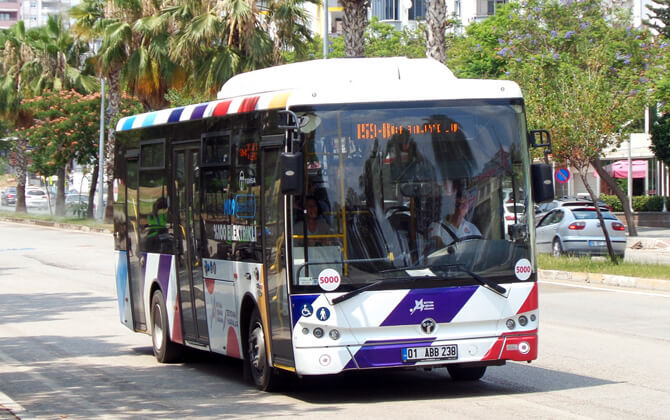
There is no direct metro connection to Adana Şakirpaşa Airport. Public transport access is provided by bus routes that connect the airport with central parts of the city and with points near the metro.
- Route 135 — Connects the airport with Balcalı Hospital and Çukurova University. Service is reported to run roughly once an hour. A future metro extension would improve its connection to the rail network.
- Route 159 — Runs between the airport and the city centre, with stops near Vilayet station. This is one of the main public transport links between the airport and the metro.
- Route 125 — Links the airport with Beyceli and stops at Adana Gar and the Old Town. Adana Gar is within walking distance of Vilayet station.
Practical notes: Vilayet is the most convenient metro transfer point for airport buses and rail connections. The airport is about 4 kilometres from central Adana, and travel times depend on traffic. Always verify current routes and frequencies before setting out.
Rules and Regulations
Passengers are expected to follow station signage and staff instructions to keep the system safe and orderly.
- Animals: Small pets are allowed only in secure cages and only if they do not disturb other passengers. Assistance animals are permitted.
- Prohibited items: Flammable or explosive materials, high-pressure containers, biological waste, hazardous substances, and similar dangerous goods are forbidden. Weapons are not allowed unless the person is licensed to carry them.
- Smoking and alcohol: Smoking and drinking alcohol are prohibited in stations and on trains.
- Platform safety: Stay behind the yellow line until the train stops completely. Do not cross the tracks or walk between platforms.
- Wheeled items: Bicycles, carts, skates, and similar wheeled objects are not permitted.
- Luggage limits: Hand luggage should not exceed 15 kilograms and should stay within 100 x 50 x 60 centimetres.
- Lift priority: Elevators are primarily intended for elderly passengers and people with disabilities or reduced mobility.
- Photography and recording: Photography and video recording inside stations and trains are not permitted.
- Food and drink: While not strictly banned, passengers are expected to keep stations and trains clean.
Staff may take action when these rules are not followed, including asking passengers to leave the system.
Tips and Advice
These practical tips can make using the Adana Metro and its connecting transport easier.
- Check service times: trains usually run from early morning until late evening, but first and last departures can vary by station, weekend, and holiday.
- Use a Kentkart: the contactless card is the easiest way to pay on the metro and municipal buses, and it usually offers better value than paper tickets.
- Plan transfers: most stations connect with buses or dolmuş, but airport access still requires a bus or taxi because there is no direct metro link.
- Allow extra time: off-peak and late-evening frequencies are lower, so waiting times may be longer outside rush hours.
- Follow accessibility signs: stations generally have elevators and escalators, which helps passengers with luggage or reduced mobility.
- Watch your belongings: the system is monitored, but it is still wise to keep valuables secure and stay aware in busy areas.
- Know your station names: English signage may be limited, so saving station names on your phone or carrying a map can help.
- Use apps carefully: route planners such as Google Maps or Moovit can be useful, but official transit information remains the best source for schedule changes.
- For dolmuş trips: carry cash and remember that routes can be less formal than bus or metro services.
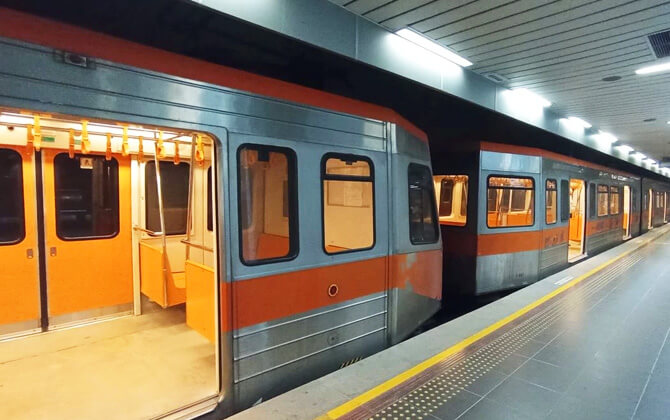
History
Plans for a rapid transit system in Adana began in 1988 after requests by Mayor Aytaç Durak and Çukurova University rector Mithat Özsan to the Turkish Ministry of Transportation.
- A feasibility report was completed on 30 May 1990 by PMBI A.Ş. and Brinckerkoff Int.Inc, approved by the State Planning Agency, and included in the 1993 investment program.
- In 1996, the project contract was awarded to the Adtranz-Alarko-ABB Electric Consortium for US$340 million.
- The municipality revised the plan to extend the line to southern Adana, with amendments approved in 1999. Construction began on 28 January 1999.
- Work was suspended in 2002 because of cost increases and funding shortages, then resumed in 2008 after approval of an additional US$194.2 million.
- On 18 March 2009, a partial section between Hastane and Vilayet, about 8 kilometres long, opened using a 36-car Hyundai Rotem fleet. After three months of free service, that section closed temporarily while the underground Vilayet-Akıncılar segment was completed.
- The full line opened to the public on 14 May 2010.
As part of the construction, cut-and-cover tunnels were built with a diameter of 5 metres, at depths of about 15 to 16 metres, and with a total length of around 1.13 kilometres.
Future Expansions
The main planned expansion is a second-stage extension from Akıncılar toward Çukurova University. It is described as 9.3 kilometres long with seven additional stations, which would increase the network to 20 stations. Project documents also mention potential daily ridership of up to 660,000 after completion.
Key aims of the expansion include improving cross-city travel, reducing pressure on bus services, easing traffic around the City Hospital, strengthening links between the university, hospital, and city centre, and expanding higher-capacity rail service to more districts.
Planned technical and operational features mentioned in available sources include new transfer hubs for bus integration, underground stations in dense areas, high-capacity service on the university-hospital corridor, and longer service hours at night. A complementary suburban rail proposal using existing railway corridors has also been discussed.
According to municipal sources, technical feasibility work is largely complete and talks with national authorities are ongoing. The municipality expects the final route and station design to be settled in 2025, with a possible tender and start of construction in 2026.
Note: beyond the second-stage extension and the discussed suburban rail proposal, available sources do not point to any other confirmed metro expansions at this time.
Fun Facts and Trivia
Here are a few quick facts about the Adana Metro.
- Opening date: the full line opened on 14 May 2010.
- Current network: one line, 13 stations, and a route length of about 13.5 to 13.9 kilometres.
- Journey time: the full ride takes about 21 minutes.
- Mixed alignment: the system combines underground, surface, and elevated sections.
- Accessibility: all stations are equipped with escalators and elevators.
- Train fleet: 36 Hyundai Rotem cars operate in 3-car sets, with capacity for about 933 passengers per train.
- Speed: the reported maximum speed is up to 80 km/h.
- Frequency: trains typically run every 10 minutes during weekday peaks and about every 15 minutes at quieter times.
- Extension plans: the planned 9.3-kilometre extension to Çukurova University would bring the system to about 20 stations.
- Visual identity: the system is often noted for its bright orange logo.
Sightseeing near Metro

The Adana Metro crosses the city on a north–south axis, making several major attractions relatively easy to reach. Vilayet is the most useful station for central sightseeing, and many other stations offer onward bus or dolmuş connections.
- Atatürk Park — A central urban park a short distance from Vilayet station.
- Sabancı Central Mosque — One of the city’s landmark sights, located near Merkez Park and accessible from central metro stops.
- Adana Railway Station — Next to Vilayet station, this historic building is notable for its First National Architectural Style.
- Merkez Park — A large riverside green space near the city centre.
- Archaeology Museum — Housed in a former textile mill and known for its extensive collection.
- Tepebağ Old Quarter, Ziyapaşa Boulevard, Ramazanoğlu Mansion, Industrial Heritage Museum — Other central cultural and historic sites reachable by metro with a short walk or a connecting bus or dolmuş ride.
Practical tips: Vilayet is the closest metro station for the main railway station and several central attractions. Check museum opening hours before visiting, and observe platform safety rules while travelling.