The Barcelona Metro, also called Metro de Barcelona, is the rapid transit system serving central Barcelona and nearby suburbs. It is part of the city’s wider public transport network, with integrated fares under the Autoritat del Transport Metropolità scheme. As of 2024, the system is run by Transports Metropolitans de Barcelona and Ferrocarrils de la Generalitat de Catalunya. It has 12 lines in total, including L9 and L10, which are still being opened in stages and are due to be fully completed in 2030. By November 2021, the network measured 170 kilometres (105.6 miles) and included 183 stations.
| Key | Information |
|---|---|
| System | Barcelona Metro / Metro de Barcelona |
| Operators | Transports Metropolitans de Barcelona and Ferrocarrils de la Generalitat de Catalunya |
| Total lines | 12 |
| Network length | 170 kilometres (105.6 miles) |
| Stations | 183 |
| Fare integration | Unified fares under the Autoritat del Transport Metropolità scheme |
| Airport metro line | L9 Sud |
| Notable feature | Uses three track gauges and both narrow and broad gauge tracks |
Barcelona Metro Map
Map of Barcelona Metro showing different lines and stations. Click on the map to enlarge it or download the Barcelona Metro map in PDF format.
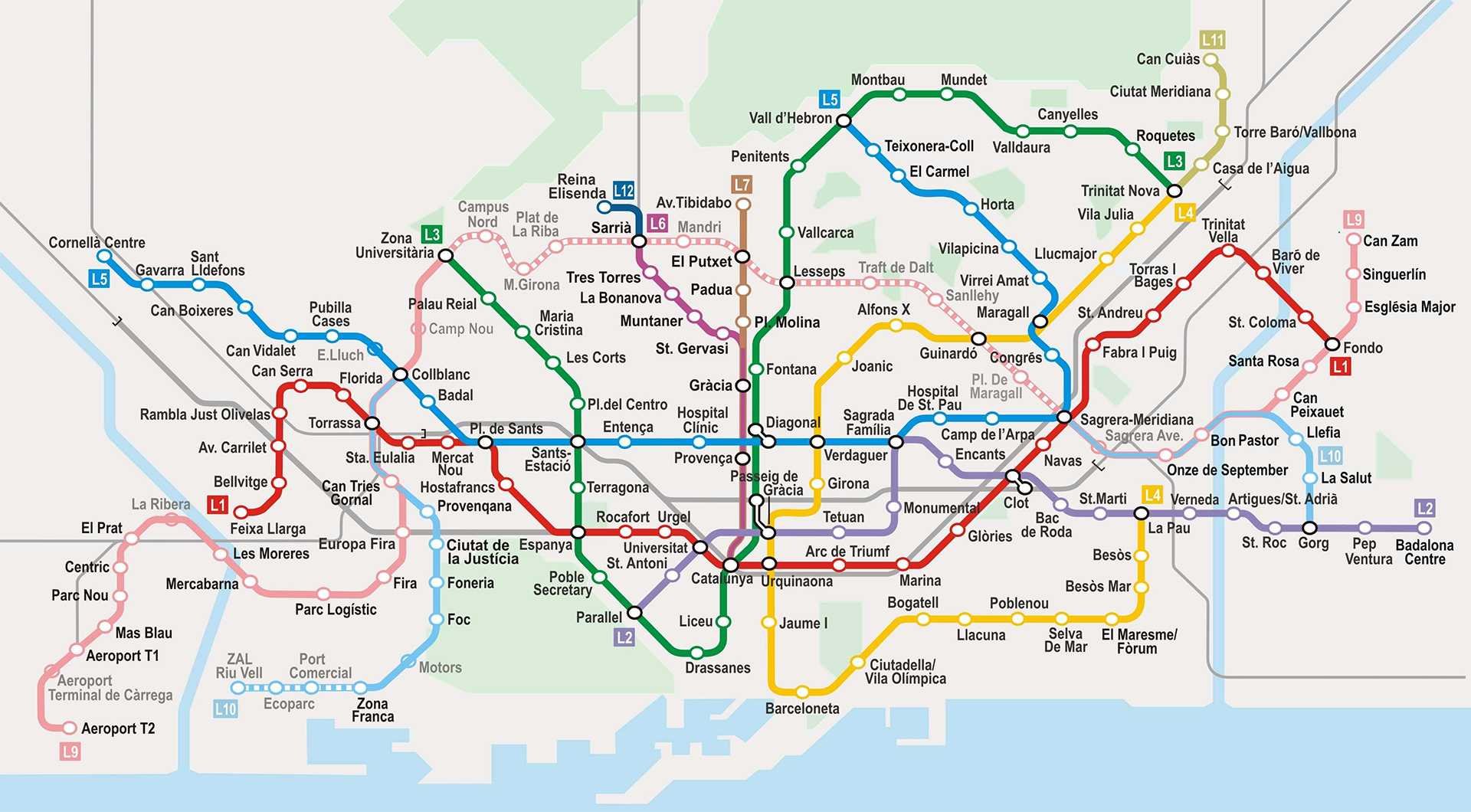
Lines and Stations
The Barcelona Metro system includes 12 lines run by TMB and FGC, covering the city center, surrounding districts, and parts of the wider metropolitan area. It is one of the most practical ways to get around Barcelona, with a clear stations map, frequent service, and air-conditioned trains. All metro stations are in Zone 1, so a standard ticket, card, or tourist pass can be used across the city network.
The main TMB lines are L1, L2, L3, L4, L5, L9, L10, and L11. FGC operates L6, L7, L8, and L12. Most stations are underground and usually have stairs, escalators, or elevators. Entrances are clearly marked with either the TMB or FGC logo.
Main metro lines
| Station | Details |
|---|---|
| L1 | Runs east to west and stops near Arc de Triomf, Plaça Catalunya, and Plaça d’Espanya. |
| L2 | Connects Badalona to Paral·lel and serves Sagrada Familia, Passeig de Gràcia, and Sant Antoni. |
| L3 | Crosses La Rambla with stops at Plaça Catalunya, Liceu, and Drassanes, then continues to Plaça d’Espanya, Park Güell, Camp Nou, and Mundet. |
| L4 | Links Gràcia, Passeig de Gràcia, the Gothic Cathedral area, Barceloneta, and the Olympic Port. |
| L5 | Useful for Sants station, Badal, and Sagrada Familia. |
| L9S | Connects both terminals of Barcelona El Prat Airport with the metro network. |
Important station connections
| Station | Details |
|---|---|
| Plaça Catalunya | A key interchange for central Barcelona. |
| Plaça d’Espanya | One of the most useful transfer points in the network. |
| Diagonal | Important interchange station. |
| Passeig de Gràcia | Major transfer point with central connections. |
| Sagrada Familia | Useful interchange and a convenient stop for a major attraction. |
| Urquinaona | Important transfer station. |
| Verdaguer | Useful interchange point. |
| Collblanc | Important connection for western and airport-related routes. |
| Torrassa | Important connection on the airport and western lines. |
| Zona Universitària | Key western interchange with airport-related connections. |
| Badal | Useful connection on the western side of the network. |
The Barcelona Metro stations list is easy to follow on network maps available inside stations and at tourist information offices. A PDF stations map can also be checked before your trip if you want to plan your route in advance.
Hours of Operation: Timetable and Frequency
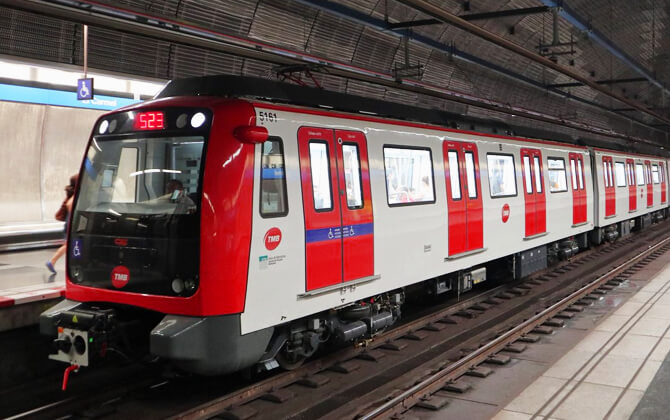
The Barcelona Metro timetable stays fairly regular during the week, with longer opening hours on Fridays and all-night service on Saturdays. The closing time refers to when the last train leaves each terminal station, so some stops may close a little later. If you are checking timings today, always remember that the last train starts from the end of the line, not from your station.
| Service detail | Timings |
|---|---|
| Monday to Thursday and midweek public holidays | 05:00 to midnight |
| Fridays and nights before public holidays | 05:00 to 02:00 |
| Saturdays | Starting time 05:00; continuous service through Saturday into Sunday night |
| Sundays | Service ends at midnight |
Special Timetables
| Service detail | Timings |
|---|---|
| 23 June (Sant Joan’s eve) | Continuous service through the night from 23 to 24 June |
| 23 September (La Mercè eve) | Continuous service through the night from 23 to 24 September |
| 24 December | 05:00 to 23:00 |
| 31 December | Continuous service throughout New Year’s Eve |
Mas Blau, Mercabarna and Parc Logístic on L9 Sud, as well as ZAL | Riu Vell, Ecoparc and Port Comercial | La Factoria on L10 Sud, follow the same daily opening times: 05:00 to midnight. On 24 December, these stations close at 23:00.
Metro Frequency
During the day, train frequency is typically every 2 to 4 minutes. At night, waiting time can stretch to around 10 minutes. That means the running time between trains is short for most daytime journeys, but less frequent later on.
The Montjuïc Funicular has its own schedule and route timetable, with timings varying by season and day. It is out of service until mid-March 2026 because of roadworks on Carrer de Vila i Vilà, and a special bus runs between Paral·lel and Parc de Montjuïc instead.
Tickets, Cards and Fares
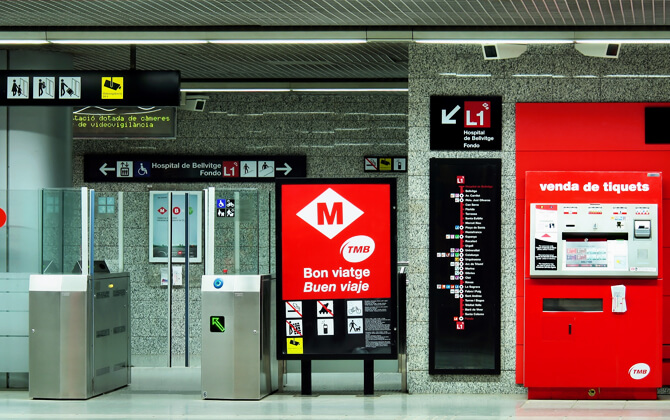
Barcelona Metro fares range from a simple single ticket to multi-journey cards and unlimited travel passes. Many of these options work across the integrated public transport network, including metro, bus, tramway, trams, and suburban rail. For most visitors, the key things to compare are fare, ticket price, validity, and whether airport travel is included.
The most useful options for many travelers are the single ticket, T-casual 10-journey card, T-usual 30-day pass, T-jove youth pass, and the Hola Barcelona Travel Card for 2 to 5 days of unlimited travel. Airport access is not included with every ticket, so check before you travel.
| Ticket | Validity | Price |
|---|---|---|
| Single ticket | One journey | €2.90 (about $3.16) |
| T-casual | 10 journeys | €13.00 (about $14.17) |
| T-usual | Unlimited journeys for 30 consecutive days | €22.80 (about $24.85) |
| T-jove | Unlimited journeys for 90 consecutive days | €45.50 (about $49.60) |
| Hola Barcelona Travel Card | Unlimited travel for 2, 3, 4 or 5 days | From €18.70 (about $20.38) |
Popular ticket options
- Hola Barcelona Travel Card — unlimited travel across the city for up to 5 days, with return metro trips to and from the airport included.
- T-usual — personal and non-transferable, valid for unlimited journeys during 30 consecutive days from first validation.
- T-casual — a single-person card for 10 journeys until the next fare change.
- Airport ticket — a metro ticket including Aeroport T1 and Aeroport T2 stations.
- T-grup — a multi-person ticket valid for 70 journeys over 30 consecutive days from first validation.
- T-familiar — a multi-person ticket for 8 journeys in 30 consecutive days from first validation.
- T-dia — a day pass with unlimited journeys for 24 hours from first validation, including one journey to and one journey from the airport stations.
Tickets for children, families and special needs
- T-16 is a personal and free ticket for children and young people aged 4 to 16.
- T-metropolitana Free pink card offers unlimited journeys for eligible individuals and costs €0 ($0).
- T-metropolitana Companion pass is a free pass for companions of people who cannot travel alone because of a disability.
- Family and large-family tickets include reduced-price versions of T-usual, T-70/90 and T-jove.
Airport travel and fare notes
Not all tickets are valid for Aeroport T1 and Aeroport T2 on L9 Sud. T-casual, T-grup, T-familiar, and some other standard multi-journey options do not include airport access. If you need airport travel, choose a ticket that specifically includes it.
Barcelona uses an integrated fare system, and many cards and passes can be loaded onto a T-mobilitat card. This contactless card replaces the paper ticket and works on metro, tram, bus, and selected rail services. If you want a quick fare calculator in practice, the main check is simple: confirm zones, airport validity, and pass type before buying.
Prices for More Than 1 Zone
Fares vary by the number of zones traveled. For occasional use, the table below shows how the ticket price changes from 1 to 7 zones. Some products, including Hola Barcelona Travel Card, T-usual, T-jove, and T-4, are sold at a single price across the applicable territory or all zones.
| Ticket | 1 zone | 2 zones | 3 zones | 4 zones | 5 zones | 6 zones | 7 zones |
|---|---|---|---|---|---|---|---|
| Bitllet senzill | €2.90 ($3.16) | €4.15 ($4.52) | €5.40 ($5.89) | €6.90 ($7.52) | €8.80 ($9.59) | €10.25 ($11.17) | €11.60 ($12.64) |
| T-casual | €13.00 ($14.17) | €25.50 ($27.80) | €34.70 ($37.82) | €44.65 ($48.67) | €51.20 ($55.81) | €54.45 ($59.35) | €57.60 ($62.78) |
| T-dia | €12.00 ($13.08) | €18.30 ($19.95) | €22.95 ($25.02) | €25.65 ($27.96) | €28.70 ($31.28) | €32.10 ($34.99) | €34.70 ($37.82) |
| T-familiar | €11.50 ($12.54) | €21.75 ($23.71) | €30.80 ($33.57) | €39.95 ($43.55) | €45.65 ($49.76) | €47.95 ($52.27) | €49.70 ($54.17) |
| T-grup | €91.00 ($99.19) | €178.50 ($194.57) | €242.90 ($264.76) | €312.55 ($340.68) | €358.40 ($390.66) | €381.15 ($415.46) | €403.20 ($439.49) |
| T-aire | €2.35 ($2.56) | €4.60 ($5.01) | €6.25 ($6.81) | €8.05 ($8.77) | €9.25 ($10.08) | €9.80 ($10.68) | €10.65 ($11.61) |
Airport ticket: €5.90 (about $6.43). This ticket includes Aeroport T1 and Aeroport T2 stations.
For frequent-use passes, zone-based prices are as follows:
| Ticket | 1 zone | 2 zones | 3 zones | 4 zones | 5 zones | 6 zones | 7 zones |
|---|---|---|---|---|---|---|---|
| T-usual | €22.80 ($24.85) | €30.55 ($33.30) | €42.70 ($46.54) | €52.15 ($56.84) | €59.60 ($64.96) | €63.85 ($69.60) | €67.65 ($73.74) |
| T-usual FM/FN general | €18.20 ($19.84) | €24.40 ($26.60) | €34.15 ($37.22) | €41.70 ($45.45) | €47.65 ($51.94) | €51.05 ($55.64) | €54.10 ($58.96) |
| T-usual FM/FN especial | €11.40 ($12.43) | €15.25 ($16.62) | €21.35 ($23.27) | €26.05 ($28.39) | €29.80 ($32.48) | €31.90 ($34.77) | €33.80 ($36.84) |
| T-70/90 FM/FN general | €36.40 ($39.68) | €71.40 ($77.83) | €97.15 ($105.89) | €125.00 ($136.25) | €143.35 ($156.25) | €152.45 ($166.17) | €161.25 ($175.76) |
| T-70/90 FM/FN especial | €22.75 ($24.80) | €44.60 ($48.61) | €60.70 ($66.16) | €78.10 ($85.13) | €89.60 ($97.66) | €95.25 ($103.82) | €100.80 ($109.87) |
Single-price tickets regardless of zones:
- Subsidised T-usual: €5.65 (about $6.16)
- T-jove: €45.50 (about $49.60)
- T-jove FM/FN general: €36.40 (about $39.68)
- T-jove FM/FN especial: €22.75 (about $24.80)
- T-4: €2.25 (about $2.45)
These tickets are valid across the applicable territory or all zones, depending on the product conditions.
Interconnections with Other Systems
The Barcelona Metro is part of a much wider public transport system rather than a standalone network. Unified fares under the ATM scheme make it easy to combine metro travel with other transport modes using the same ticketing system.
In daily use, the metro connects closely with FGC services, Rodalies trains, trams, and the Montjuïc funicular. Recent network maps show Renfe and FGC lines alongside metro lines, as well as the Trambaix and Trambesòs tramway routes. This gives a clearer route plan for transportation in Barcelona as a whole.
Some stations offer direct transfers to commuter and regional rail. The source material specifically mentions non-accessible connections at Catalunya and Passeig de Gràcia, where metro links meet Rodalies and FGC services. It also notes that FGC lines L6, L7, and L8 begin in the metro network and continue as a railway system serving much of the metropolitan area.
Paral·lel station connects with the Montjuïc funicular, which is included in the integrated fare system and gives access to Montjuïc. L9 Sud links Barcelona El Prat Airport with the metro and connects onward through interchanges with central lines such as L1, L5, and L3.
Connections with Barcelona Airport
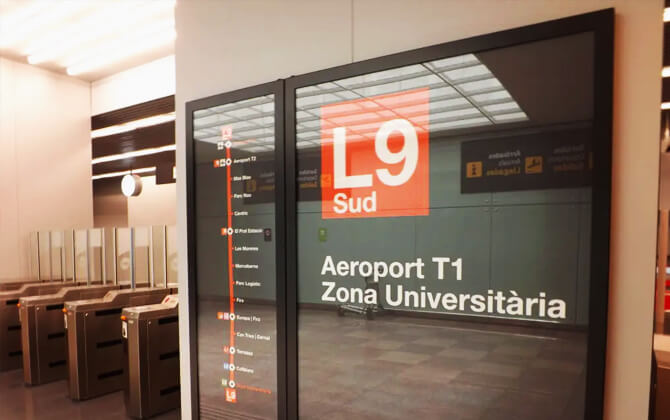
Barcelona Airport is connected to the metro system by L9 Sud, which links terminals T1 and T2 with the city in about 30 to 32 minutes. Trains run every 7 minutes, and the line also serves Fira de Barcelona.
L9 Sud has several useful interchange stations. You can change at Can Tries | Gornal for L10 Sud, at Torrassa for L1 and L10 Sud, at Collblanc for L5 and L10 Sud, and at Zona Universitària for L3. If you are planning your airport route, these transfer points matter.
Not every metro ticket is accepted for airport travel. Single tickets, T-casual, T-grup, and some other cards are not valid for trips to or from Aeroport T1 and Aeroport T2. In those cases, you need the Airport Ticket.
The Hola Barcelona Travel Card is valid for airport journeys and includes unlimited travel on public transport in Barcelona for 2, 3, 4, or 5 consecutive days. If you need both airport access and city transport, it is one of the most practical pass options.
The Airport Ticket is a single metro ticket for travel between any metro station and the airport. If you arrive at Aeroport T1 or Aeroport T2 with an invalid ticket, you must buy the correct one before leaving the station.
Other transport options between the airport and the city center include the official Aerobus, bus line 46, the R2 train, and night buses N16, N17, and N18.
L9 to Barcelona Airport
Tips and Rules
To use the Barcelona Metro smoothly, follow the signs at station entrances and inside the stations. Information panels show station names, lines, maps, access points, and local area details, so finding your path through the system is usually straightforward.
Before going to the platform, make sure you have a valid ticket. You can buy one from station machines or top up your T-mobilitat card in the TMB App. Machines offer several languages, including Catalan, Spanish, English, and French.
For safe travel, use elevators whenever possible if you have luggage, a bicycle, or a stroller. If you use escalators, stand on the right and leave the left side clear. Avoid placing your feet close to the edges or metal teeth, and take extra care if you are wearing flip-flops.
Do not run inside metro premises. On the platform, stay behind the safety line until the train stops fully, then let passengers get off before boarding. It sounds obvious, but it helps a lot with flow and delays.
Check line diagrams and direction signs before boarding, especially when changing lines. Announcements and onboard displays show upcoming stations and connections. Wheelchair users are advised by TMB to board and leave through the second door of the first carriage.
Inside the train, avoid standing in the doorway. Once the door-closing alert sounds, do not try to get on or off. Watch the gap between train and platform, especially at curved stations. On some trains, doors open by button; on others, by a small lever.
Reserved seating is for elderly passengers, pregnant women, and people with reduced mobility. If you feel unwell or see something unsafe, contact the Metro Control Centre through an intercom or ask staff for help. All stations have SOS intercoms, and a defibrillator is placed next to the platform intercom.
Basic conduct rules also apply. Be respectful to staff and other passengers, follow signs and announcements, and keep your validated ticket until you leave the metro area. Smoking, blocking doors, traveling without footwear or with an uncovered torso or lower body, and carrying hazardous items are not allowed.
Some transport rules are very specific. Electric scooters and similar personal mobility vehicles are not allowed on the network. Skates and similar equipment cannot be used in metro premises or onboard. Bicycles are allowed only at certain times, while fully folded folding bikes can be carried at any time if they do not disturb others.
Dogs are allowed under certain conditions. They must stay close to the handler, use a non-extending lead, and take lifts or stairs rather than escalators. Assistance dogs are always permitted. For passengers with reduced mobility, accessible information is also available through maps, customer service offices, relief maps, and Braille guides.
Interesting Facts
The Barcelona Metro is part of a unified city transport system, with fares coordinated under the ATM scheme. As of 2024, it is operated by TMB and FGC.
The network has 12 lines, and L9 and L10 are still under construction. These lines are opening in stages and are planned to be fully completed in 2030. They are also known for automatic train operation and driverless service.
Barcelona is one of only two metro systems in the world to operate on three different track gauges. Line 8 uses metre gauge, Line 1 uses older Iberian gauge, and the remaining lines use standard gauge. It is also the only metro in the world that runs on both narrow and broad gauge tracks.
As of November 2021, the network extends for 170 kilometres (105.6 miles) and includes 183 stations. Another unusual point is its use of spare energy from regenerative braking to help power charging stations near metro infrastructure.
The system’s history goes back to 1863, when the first rapid transit railway service in Barcelona was founded by the private company Ferrocarril de Barcelona a Sarrià. In the 1920s, the Gran Metro and Metro Transversal appeared and later became parts of today’s L3 and L1.
The first metro section opened in 1924 between Lesseps and Plaça de Catalunya, now part of Line 3. Over time, the network grew into one of Europe’s more distinctive metro systems.
Some parts of the metro are tied to local urban legend. Barcelona is known for abandoned or never-used stations such as Gaudí and Banc, while Correos survives as a reminder of the network’s past. During the Spanish Civil War, metro tunnels were also used as air raid shelters.
With all stations in fare Zone 1, the metro remains one of the most practical ways to travel across Barcelona and its suburbs.
Future Extensions
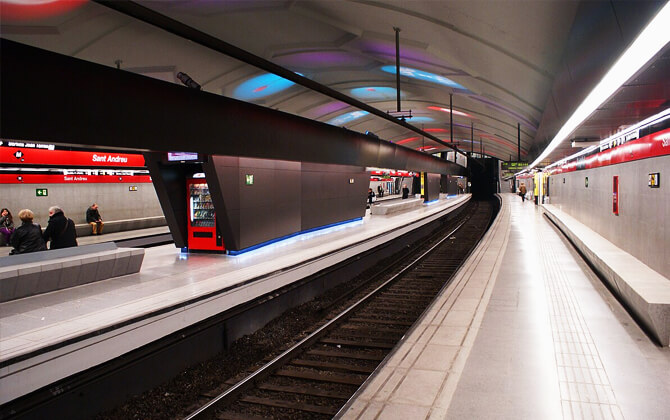
Barcelona’s metro network is already extensive, but future extension plans show there is still a lot to come. By 2040, the system is expected to grow beyond 200 stations and more than 200 kilometres (124.3 miles) of track, compared with 165 stations and 125 kilometres (77.7 miles) today. The biggest projects focus on extending existing lines to new neighborhoods, major transport hubs, and key destinations across the city and nearby municipalities.
Line 1
L1 is planned to extend in both directions. In the north, it will continue from Fondo toward Badalona with new stops including Montigalà Centre, Lloreda St. Crist, Bufalà, Badalona Pompeu Fabra, and Badalona, where it should connect with Rodalies trains. This northern extension is expected to open around 2030. On the southern side, L1 is also planned to reach El Prat, improving access toward Barcelona-El Prat airport.
Line 2
L2 is set to expand from Sant Antoni into Montjuïc and the Zona Franca industrial area. The planned route includes new stations linked to Montjuïc, the MNAC area, and Parc Logístic, with a future connection toward L9 Sud. From there, the line would follow the L9 corridor to the airport, creating a stronger public transport link to one of the city’s most important facilities.
Line 3
L3 has two major future projects. One would extend the line from Zona Universitària toward Esplugues and Sant Feliu de Llobregat, with new stations serving areas such as Sant Joan de Déu and Sant Joan Despí. Another planned addition would connect Trinitat Nova and Trinitat Vella with a new stop on the Besòs side, improving local transport in the north of the network.
Line 4
L4 is expected to grow from La Pau to La Sagrera, the future major transport hub in Sant Andreu. The extension would add stations such as Santander, La Sagrera-TAV, and La Sagrera, strengthening links between metro and rail services.
Lines 9 and 10
The central trunk linking the separate northern and southern sections of L9 and L10 is the biggest project under construction. When complete, it will add around 50 kilometres (31.1 miles) of track across the city and bring a long stations list, including Collblanc, Camp Nou, Campus Nord, Manuel Girona, Sarrià, Mandri, El Putxet, Lesseps, Muntanya, Sanllehy, Guinardó | Hospital Sant Pau, Maragall, and La Sagrera. L10 Sud is also planned to continue farther south from the Zona Franca area to Pratenc, near Barcelona-El Prat airport.
Alongside these extensions, the city is planning broader changes around Montjuïc and Plaça Espanya. The L2 extension to Montjuïc is part of a wider transformation with better access to the Olympic Ring, a more pedestrian-friendly square, and a stronger public transport hub for the metropolitan area.
History
The first rapid transit railway service in Barcelona was founded in 1863 by the private company Ferrocarril de Barcelona a Sarrià. This line later became the core of today’s L6 service. At the time it was a surface railway, and it was gradually moved underground.
In the 1920s, Barcelona added two more rapid transit systems. The Gran Metro opened between Lesseps and Plaça de Catalunya and later became part of today’s L3. Two years later, the Metro Transversal opened and became part of today’s L1. It linked the city center with Plaça d’Espanya and Montjuïc, site of the 1929 Barcelona International Exposition.
The first metro section opened on 30 December 1924, when the line from Lesseps to Plaça Catalunya began carrying passengers. At that point, the network had 2.7 kilometres (1.7 miles) of track and four stations. Barcelona became the 12th city in the world to have a metro system.
Expansion continued through the 20th century as new sections, branches, and extensions were added across the city and suburbs. During the Civil War, metro tunnels were used as air raid shelters. In 1969, the first electronic ticket vending machine was introduced at Liceu station.
By the early 21st century, the network had become a 12-line system managed by Transports Metropolitans de Barcelona and Ferrocarrils de la Generalitat de Catalunya, with fares and line naming coordinated by the Autoritat del Transport Metropolità.
A major modern phase began with Lines L9 and L10. The project was approved in 2000, though technical difficulties and pending geological analysis delayed some parts. The first section of Line 9, between La Sagrera and Can Zam, opened in 2009, and by June 2010 eleven new stations on L9 and L10 were already in service. These lines have continued to open in phases, with full completion planned for 2030.
Since 2009, the network has also introduced automatic train operation and driverless service on selected lines. Line 11 was converted first, followed by Lines 9 and 10.
Nearby Attractions
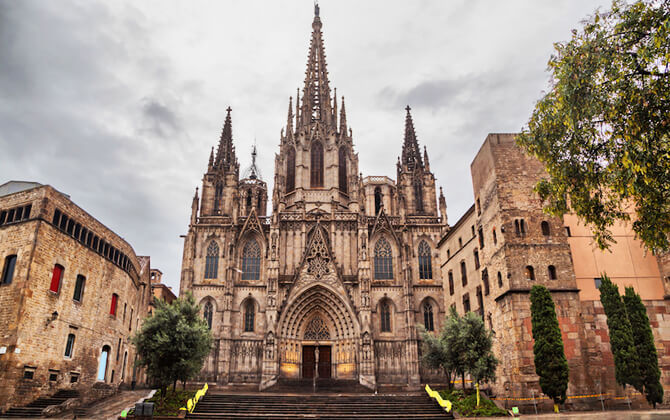
The Barcelona Metro is one of the easiest ways to reach the city’s best-known sights. Frequent trains, good network coverage, and simple route planning make it especially convenient for sightseeing.
Several lines stop near major attractions. L1 links Arc de Triomf, Plaça Catalunya, and Plaça d’Espanya. L3 is useful for La Rambla, Liceu, Drassanes, Park Güell, and Camp Nou. L2 serves Sagrada Familia and Passeig de Gràcia, while L4 is convenient for Barceloneta, the Olympic Port, Jaume I, and the Gothic Quarter area.
For Gaudí landmarks, the metro makes things easy. Sagrada Familia is served by L2 and L5. Casa Batlló is closest to Passeig de Gràcia on L2, L3, and L4. Casa Milà is easy to reach from Diagonal on L3 and L5.
The network also works well for museums and waterfront areas. The Picasso Museum is closest to Jaume I on L4, while La Rambla is served by Liceu and Drassanes on L3. For the harbor area, Barceloneta and Drassanes are both useful stations.
Some places need a short walk after the train ride. Park Güell can be reached from Lesseps or Vallcarca on L3, and Camp Nou is accessible from L3 and L5 stations including Palau Reial, Les Corts, Collblanc, and Badal. For the airport, L9S connects both terminals with the city transport network.
With all stations in Zone 1, the metro is a smart option for combining several attractions in one day.
Media