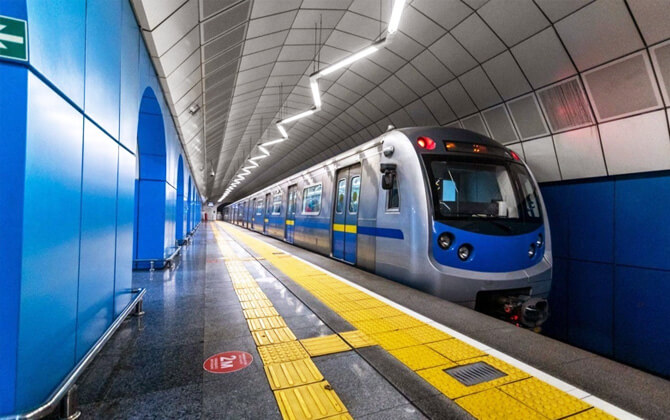
Almaty Metro is the rapid transit system of Almaty, Kazakhstan’s largest city and former capital. It is the country’s first and only metro system, and the second in Central Asia after Tashkent. After construction began in 1988 and stretched on for more than two decades, the first section opened on 1 December 2011. Today, the system consists of one underground line with 11 stations and a route length of 13.4 kilometres (8.3 miles). It is known not just for public transport value, but also for striking station design, polished stone interiors, mosaics, and artwork rooted in Kazakh history and culture. The metro is integrated with the city transport network, including bus and trolleybus services, and its operating hours are generally from 6:20 to 0:00.
| Key | Information |
|---|---|
| System | Almaty Metro, the only metro in Kazakhstan |
| City | Almaty, Kazakhstan |
| Opening date | 1 December 2011 |
| Construction start | 1988 |
| Lines | 1 |
| Operational stations | 11 |
| Route length | 13.4 kilometres (8.3 miles) |
| Operating hours | Typically 6:20 to 0:00 |
| Average speed | About 40 km/h |
| Typical frequency | About 8 to 15 minutes |
| Rolling stock | Hyundai Rotem trains |
| Notable feature | Architecturally distinctive stations with Kazakh cultural themes |
Almaty Metro Map
Map of Almaty Metro showing different lines. Click on the map to enlarge it or download the Almaty Metro map in PDF format.
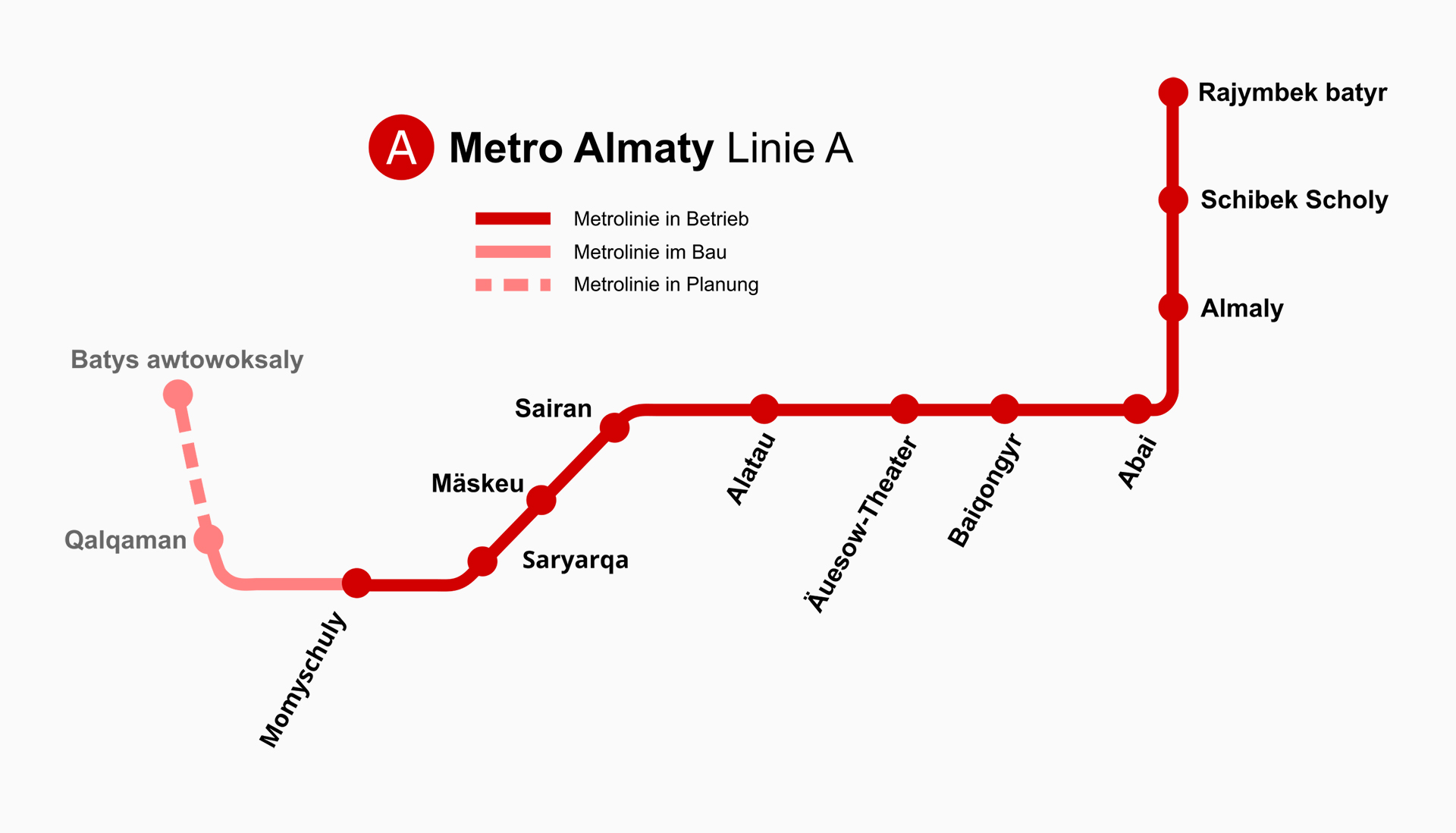
Stations and Lines of the Almaty Metro
The Almaty Metro currently has one line. Its route runs broadly north to south and then west, linking the historic center with business, cultural, and residential districts before reaching newer western neighborhoods. For a compact system, it plays a big role in city transport and offers a practical alternative to traffic on major corridors.
The first section of Line 1 opened on 1 December 2011. It was 8.54 kilometres (5.3 miles) long and included seven stations, with four deep-level stations and three sub-surface ones. The route began near Raiymbek Avenue, continued under what is now Nazarbayev Avenue, and then turned west along Abai Avenue to Alatau.
From the beginning, the stations were designed as more than functional stops. Many use granite and other stone from Kazakhstan, and several include thematic panels tied to national history, literature, science, or traditional art. That design approach still defines the system today.
Development of Line 1
After the original section opened in 2011, the metro expanded westward. A 2.9-kilometre (1.8-mile) extension to Sayran and Moskva entered service on 18 April 2015, strengthening links with western districts and surface transport corridors.
The next extension added another 3.1 kilometres (1.9 miles) and two more stations, Sary-Arka and Bauyrzhan Momyshuly. It opened on 30 May 2022 and brought the total route length to 13.4 kilometres (8.3 miles). The draft also notes that the metro had grown from a seven-station starter system to 11 operational stations by the end of 2022.
Even with just one line, the system already forms a useful backbone for public transport in Almaty. Its route overlaps with major travel corridors once served, or still served, by bus and former tramway links, which is one reason the metro matters so much in daily city transport.
Station Themes and Notable Stops
Each station has its own theme and visual identity. Below is the stations list and key details from the draft.
| Station | Details |
|---|---|
| Raiymbek batyr | Northern terminal of the original section, located between Furmanov Street and Raiymbek Avenue. Named after a Kazakh folk hero. |
| Zhibek Zholy | Under Panfilov Street between Zhibek Zholy and Gogol Streets. Named after the Silk Road, with beige marble and decorative motifs inspired by traditional Kazakh art. |
| Almaly | Under Furmanov Street between Bogenbai Batyr and Kabanbay Batyr streets. Features marble mosaics expressing Kazakh national identity and integrated ceiling lighting. |
| Abay | At Abai Avenue and Furmanov Street. A standout station with Florentine mosaics, marble walls, brown granite floors, and bronze reliefs. |
| Baikonur | Beneath Abai Avenue between Masanchi and Baitursynov Streets. Uses a high-tech look inspired by the Baikonur Cosmodrome, with blue and light gray panels and a large LED screen. |
| Alatau | South of Abai Avenue between Gagarin Avenue and Zharokov Street. References traditional customs through white and green marble, granite flooring, and themed mosaics. |
| Sayran | Under Abai Avenue between Brusilovski and Tlendiev Streets. Named after the nearby Sayran Reservoir, about 1 kilometre (0.6 miles) away. Opened in 2015. |
| Moskva | Under Abai Avenue in the Auezov district, between Utegen Batyr and Altynsarin Streets. Opened in April 2015 as a symbolic gesture of friendship between Almaty and Moscow. |
| Sary-Arka | Opened in 2022 as part of the western extension. The draft notes the station but does not give design details. |
| Bauyrzhan Momyshuly | Opened in 2022 as part of the western extension. The draft notes the station but does not give design details. |
| M. Auezov Theatre | Appears in the legacy schedule data for the earlier network configuration. |
All original stations from Raiymbek batyr to Alatau opened together on 1 December 2011. Sayran and Moskva followed in 2015, while Sary-Arka and Bauyrzhan Momyshuly were added in 2022. If you are looking for an Almaty Metro stations map or route plan, these stations form the current path train corridor across the city.
Current Network and Future Growth
At present, the Almaty Metro operates one fully underground line. Its route starts near Raiymbek Avenue, runs south under Nazarbayev Avenue, and then heads west along Abai Avenue toward the western districts.
Though still compact, the system is becoming more important year by year. Planned expansion to Kalkaman, Barlyk, and Almaty-1 railway station would add new stations, extend coverage, and strengthen links with other forms of local transport. In short, this is a small metro system with a clear growth path.
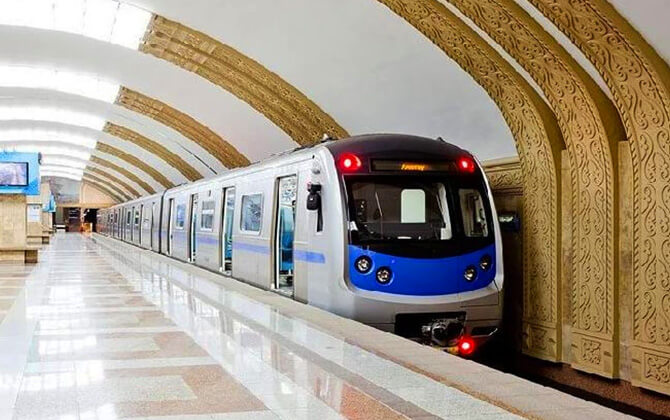
Schedule
The Almaty Metro runs daily on a single line. If you are checking operating hours, opening hours, opening times, or timings today, the key point is that service starts early in the morning and continues until late at night. Exact train schedule details can vary slightly by source, especially for the last trains.
Regular Operating Hours
The standard daily operating window is usually given as about 06:20 to 23:30, while system-wide information also states that trains run daily from 06:20 to 00:00. Because of that, passengers should treat 06:20 as the usual starting time and late evening as the likely closing time, with midnight shown in some official references.
| Service detail | Timings |
|---|---|
| Standard daily schedule | Approximately 06:20 to 23:30 |
| System-wide reference time | Daily from 06:20 to 00:00 |
Each station has its own precise first-train arrival in each direction, but these timings fall within the wider service window above.
First and Last Trains by Day Type
For the current 11-station setup, the route timetable follows this general pattern.
| Service detail | Timings |
|---|---|
| Weekdays first train, both directions | 06:20 |
| Weekdays last train, both directions | 23:40 |
| Weekends and public holidays first train, both directions | 06:30 |
| Weekends and public holidays last train, both directions | 23:30 |
Earlier in the metro’s history, trains ran from 06:30 to 23:30, and before 4 January 2012 from 06:00 to 00:00. For current travel, it makes sense to rely on the more recent timetable and schedule today information where available.
Train Frequency
Frequency depends on the time of day and whether it is a weekday or weekend. In general, trains come every 8 to 15 minutes.
| Service detail | Timings |
|---|---|
| Weekday peak hours frequency | About 8 to 10 minutes |
| Weekday inter-peak frequency | About 10 to 12 minutes |
| Weekend and holiday frequency | About 12 to 15 minutes |
So if you are wondering about running time between trains, or how often the metro comes, that is the range to expect. It is not a high-frequency system by big-city standards, but it is predictable enough for most trips.
Station-Specific First Train Times (Legacy 9-Station Configuration)
For reference, the earlier 9-station route from Raiymbek Batyr to Moskva had published first-train timings by station. These times may differ slightly from today’s network after later extensions, but they show how service started along the line.
| Station | Details |
|---|---|
| Raiymbek Batyr | First train toward Moskva: 06:24 |
| Zhibek Zholy | Toward Raiymbek Batyr: 06:49; toward Moskva: 06:27 |
| Alma Ly (Almaly) | Toward Raiymbek Batyr: 06:46; toward Moskva: 06:29 |
| Abay | Toward Raiymbek Batyr: 06:46; toward Moskva: 06:29 |
| Baikonur | Toward Raiymbek Batyr: 06:41; toward Moskva: 06:35 |
| M. Auezov Theatre | Toward Raiymbek Batyr: 06:38; toward Moskva: 06:27 |
| Alatau | Toward Raiymbek Batyr: 06:36; toward Moskva: 06:29 |
| Sayran | Toward Raiymbek Batyr: 06:32; toward Moskva: 06:33 |
| Moskva | Toward Raiymbek Batyr: 06:30 |
Practical Notes
Passengers can check live arrivals on platform LED screens or through official mobile tools such as the Almaty City Metro app. On major holidays and during special events, opening times or closing time may be adjusted, so late-night travelers should check before they go.
Prices, tickets and discounts
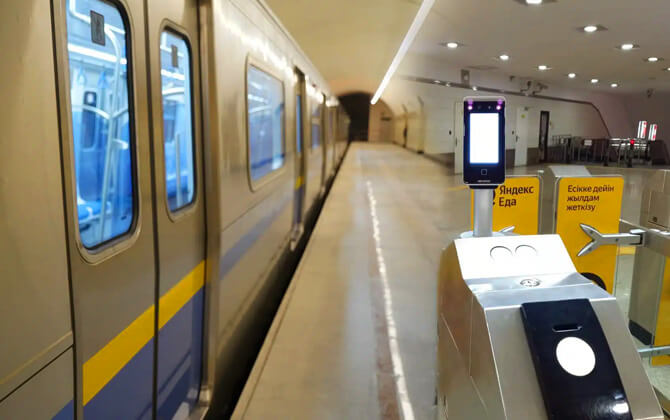
Almaty Metro uses a mostly cashless fare system built around smart cards, disposable tokens, and contactless bank cards. The fare is low by international standards, and the same transport card system also works on other city transport, including bus and trolleybus services.
Basic metro fares
The standard ticket price for one metro ride is 120 tenge as of 2024. That is also the basic fare and price for a single trip. Payment can be made with metro smart cards, disposable tokens, ONAI cards, or contactless bank cards at turnstiles.
Using a rough local-currency conversion based on figures elsewhere in the draft, 120 tenge is about US$0.24. On Wednesdays, sometimes called token day, expired tokens can be used again within the current day.
- Single ride fare: 120 tenge (about US$0.24)
- Payment options: metro smart card, disposable token, ONAI card, contactless bank card
Smart cards and ONAI
The metro has its own contactless card, while the wider city transport network uses the ONAI system. ONAI works on the metro, buses, and trolleybuses, so for visitors using a mix of public transport, it is often the most practical option.
- Metro smart card cost: 100 tenge (about US$0.20), without balance
- Card validity: 3 years
- Top-up points: station ticket offices and terminals; ONAI can also be recharged at terminals, online, or via the app
For many travelers, a physical ONAI card is easier than relying on the mobile app, since the app may require a Kazakh phone number and local banking details for full use.
Tokens
Disposable tokens are still available and work well for occasional trips.
- Validity: until the end of the day of purchase
- Use: one token per person per trip
- Special rule: on Wednesday token day, expired tokens can be reused
Discounts for children
Children under 7 travel free on the metro. Children aged 7 to 15 can use reduced fares, with a birth certificate or ID required. The wider city transport system also offers half-fare for schoolchildren aged 7 to 15 through special cards.
Social discounts and free travel
Almaty provides targeted discounts and free travel on urban public transport for several categories of passengers, usually through dedicated cards.
- Free travel, excluding taxis, for war veterans and equivalent categories, pensioners over 75, people with disabilities in groups I and II, and disabled children
- 50% discount for students over 15, full-time university students, age-based retirees, and mothers of large families with at least four children under 18
Named cards mentioned in the draft include Zhastar, Kurmet, Kamkor, Ardager, and Ardakty ana.
Practical tips for visitors
For a short stay, tokens or bank card payment at the turnstile are usually the easiest ticket options. If you plan to use the metro together with buses, a physical ONAI card can be more convenient.
The draft does not provide a fare calculator, day pass, or pass product for unlimited travel, so it is better not to expect one based on the information here. Also, keep some cash handy if you plan to top up at machines that may not accept foreign cards.
Interconnections with Other Systems
The Almaty Metro is being developed as part of a broader city transport system rather than as a stand-alone project. Plans tie it to national rail, future light rail, buses, trolleybuses, and BRT corridors, with the goal of making public transport more competitive with private cars.
Linking the Metro with National Railway Stations
One long-standing weakness of the metro has been the lack of direct links to Almaty’s main railway stations, Almaty-1 and Almaty-2. Current plans aim to extend the existing line toward Barlyk and then to Almaty-1, creating a proper interchange between urban rail and longer-distance trains.
At the same time, the planned LRT is expected to provide a rail connection to Almaty-2. If completed, these links would make transportation in Almaty smoother for both local and regional passengers.
Integration Between Metro and Light Rail
The metro and future LRT are planned to work together. The existing line is expected to continue west from Bauyrzhan Momyshuly to Kalkaman and then toward Barlyk, where interchange with LRT is expected.
- Direct transfers around Barlyk, where metro and LRT lines are expected to meet
- Future links with a proposed green metro line
- Complementary roles, with the metro acting as the high-capacity backbone and light rail covering additional corridors
That kind of integration matters. It spreads passenger flows more evenly and makes the system more useful than a single isolated line.
Connections with Bus, Trolleybus, and BRT Networks
Buses and trolleybuses already carry a large share of passengers in Almaty, and they are central to local transport. As the metro expands, these surface modes are expected to feed passengers into rail stations and distribute them onward across the city.
- Transfers between bus or trolleybus services and metro or LRT lines
- Better coverage in districts not directly served by rail
- Extra flexibility during peak periods, when bus capacity can support busy corridors
This multimodal approach is also tied to air-quality goals, since shifting trips from private cars to city transport could help reduce congestion and winter smog.
Regional and Airport-Oriented Links
Future expansion has a regional dimension too. Plans and studies include links toward suburban areas, Alatau Smart City, and the airport. The draft mentions a possible metro branch from Zhibek Zholy station to Almaty International Airport as well as a dedicated LRT connection.
If these projects move ahead, Almaty would end up with a more layered transport system, where metro, light rail, bus corridors, intercity rail, and airport links all connect more naturally.
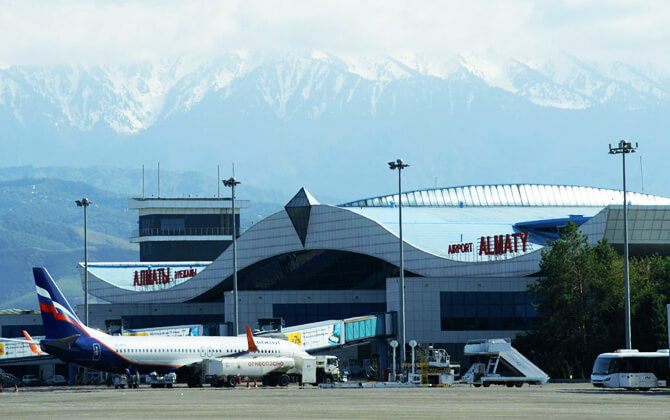
Connection to the airport
There is no direct metro route to Almaty International Airport. The line does not reach the airport, so any trip there requires a transfer to another mode of transport.
The most common public transport option is the city bus. The draft lists routes 79, 86, 92, and 106 as serving the airport and the Sayakhat bus terminal near the city center. From Raiymbek batyr station, travelers can use the metro and then transfer toward the Sayakhat area for an airport bus.
The bus journey between central Almaty and the airport takes about 40 minutes, depending on traffic. Buses are inexpensive and reasonably frequent, but they can be crowded and are still affected by congestion. If you are traveling late, carrying luggage, or just want a simpler trip, taxis and airport transfers are widely available.
Bus payment can be made with the ONAI card, which also works on the metro, or in cash. The draft notes that a new top-up may take around 15 minutes to activate, and one card cannot be used to pay for two passengers on a bus.
Looking ahead, a future metro branch from Zhibek Zholy to the airport is under discussion, but for now there is no rail airport link.
History
The history of Almaty Metro begins in the late Soviet period. Construction officially started on 7 September 1988, after the city passed the one-million population threshold that traditionally qualified a Soviet city for a metro. The project was launched on Kremlin orders and funded from Moscow.
After the Soviet Union collapsed in 1991, progress slowed sharply. Central funding disappeared, Kazakhstan could not maintain the costly underground works at the same pace, and the project remained largely frozen through the 1990s.
Work resumed in the early 2000s as the economy improved. In 2003, the government approved a new development initiative with state financing, and by 2005 the program had funding commitments for 2006 to 2008. This period also overlapped with the gradual decline of Almaty’s tramway network, most of whose routes closed by 2010.
Construction milestones followed. In May 2007, the tunnel between Almaly and Abai was completed, reaching a depth of 73 metres at one point. Later in 2007, the tunnel from Abai toward Baikonur was finished, and another section on the same stretch was completed in 2008. The first line was estimated to cost around 101 billion tenge, approximately US$1 billion, and it was built with strong seismic reinforcement because Almaty is earthquake-prone.
After more than two decades of delays, the first section opened on 1 December 2011. It was 8.54 kilometres (5.3 miles) long and had seven stations. At opening, Almaty Metro became the second metro in Central Asia, the sixteenth in the former Soviet region, and Kazakhstan’s first independently completed metro system.
Expansion continued in stages. The 2.9-kilometre (1.8-mile) extension to Sayran and Moskva opened on 18 April 2015. On 30 May 2022, another 3.1 kilometres (1.9 miles) and two more stations, Sary-Arka and Bauyrzhan Momyshuly, were added, bringing the route to 13.4 kilometres (8.3 miles) and the total number of stations to 11.
The metro’s history has not been smooth all the way through. In 2019, work at two stations, Dostyk and Saryarka, was suspended after corruption charges involving a construction company and a criminal case.
Even so, the system has gone from a stalled Soviet-era project to a modern and increasingly important part of Almaty public transport.
Future expansions
Almaty Metro expansion plans focus on extending the existing Red Line and developing new lines toward the airport and Alatau. Several projects are at different planning or construction stages.
Red Line (Line 1) extensions
The current Red Line runs from Baurzhan Momyshuly to Raiymbek Batyr and is planned to almost double in length. Construction is under way on a 1.9-kilometre (1.2-mile) extension from Baurzhan Momyshuly to Kalkaman. According to the draft, tunnel excavation is close to completion, station work is in its final stages, and construction and installation work is scheduled to finish in the first half of 2026.
From Kalkaman, the line is planned to continue west toward Barlyk market with three additional stations. Another extension is planned from Raiymbek Batyr to Almaty-1 railway station, adding about 7.7 kilometres (4.8 miles) and five more stations.
If the segments to Kalkaman, Barlyk, and Almaty-1 are all completed, the Red Line is expected to reach about 29.2 kilometres (18.1 miles) and 20 stations.
Blue Line: direct link to Almaty International Airport
The planned Blue Line is described as the largest element of the future network, with a projected length of 76.6 kilometres (47.6 miles) and 42 stations. Its first priority section would connect the area around Zhibek Zholy station with Almaty International Airport.
That initial airport segment is expected to be about 14 kilometres (8.7 miles) long with eight stations. The feasibility study for the airport section has been completed, while further work is focused on station locations and technical coordination with the airport.
Green Line to Alatau Smart City
The proposed Green Line would connect the northern transport node with the city center and the planned Alatau satellite city. The route is expected to be about 28 kilometres (17.4 miles) long with 17 stations.
It would start in the Kazakhfilm area, pass through Sairan, and continue north toward Alatau, with two stations in the new city. A feasibility study for this corridor has been announced.
Integration with LRT, BRT and suburban corridors
Metro expansion is being planned alongside LRT and BRT development. One LRT line is expected to run from Barlyk along Tole bi Street, continue via Abilai Khan Avenue to Almaty-2, and then extend east and south through other corridors.
Under the updated master plan to 2040, the metro may also extend beyond current city limits into suburban zones. The idea is to link major hubs and make public transport more useful across a wider urban area.
Construction model, land use and timelines
Planners have identified a shortage of tunnel-boring equipment as one of the risks that could slow construction. To reduce delays, the city is considering EPC contracts, where one contractor handles both design and construction.
According to the draft, with enough equipment and experienced builders, individual segments could be completed in about five years. As of early 2026, there were still no finalized agreements with foreign contractors.
To limit disruption, most new stations are planned under existing roads. Land acquisition is expected mainly for station entrances, with compensation offered at market rates where needed.
Impact on traffic, air quality and seismic resilience
City officials see metro expansion as a way to cut traffic, reduce emissions, and improve air quality. Better rail links could also support economic activity around stations and major interchanges.
Because Almaty is in a seismic zone, underground infrastructure is also viewed as important from a safety perspective. As new lines progress, the system is expected to take pressure off busy roads and make daily transport more reliable.
Regulations
Passenger transportation on Almaty Metro is governed by local rules approved by the Akimat of Almaty and amended in September 2024. These rules cover ticket validity, passenger rights, obligations, safety, and screening requirements.
Tickets and validity
Passengers may travel only after purchasing a valid travel document. On the metro, a paid trip is valid from the moment a passenger passes through the entry turnstile at the departure station until passing through the exit turnstile at the destination station.
Passenger rights
Under the rules, passengers have the right to:
- buy a valid ticket and travel under the established conditions
- carry children up to and including age 7 free of charge
- carry children aged 7 to 15 at a 50% discounted fare, with proof of age
- carry a guide dog free of charge for a visually impaired passenger, if the dog is muzzled, on a short leash, and has identification
Passenger obligations
Passengers must:
- follow public order and the metro rules
- pay the fare and hold a valid ticket
- report unattended items, smoke, fire, foreign objects on the track, or other safety risks
- give up seats to passengers with disabilities, elderly passengers, pregnant women, and adults with small children
- prepare in advance to leave the train at their station
- leave the train at terminal stations
- hold small children by the hand
Prohibited behavior
For safety and comfort, passengers must not:
- block or force train doors
- distract the driver while the train is moving
- smoke on stations, platforms, passageways, or in cars
- litter station areas, trains, escalators, or tracks
- consume alcohol or remain on the system while intoxicated
- carry flammable, explosive, poisonous, or otherwise dangerous substances
- carry sharp gardening tools without proper packaging
- use open flames or pyrotechnics
- enter without paying or pass through closed turnstiles
- enter the cab, track area, tunnels, or service rooms without authorization
- lean on train doors
- cross the platform safety line before the train stops
- ride bicycles, skateboards, or roller skates in stations or cars
- use the driver communication system without a real need
- run on platforms or throw objects onto the tracks
Luggage, screening and animals
Hand luggage rules follow national legislation. For transport security, passengers and their belongings may be screened under the relevant national order governing security inspections at transport facilities.
Small domestic animals, dogs, and birds must be carried in boxes, baskets, cages, or containers. Owners are responsible for cleanliness in the carriage.
Information for passengers
At stations, passengers should be provided with information on departure and arrival times, fare levels, ticket office working hours, baggage rules, emergency medical assistance, station layouts, and available services. This information is updated as needed and may be provided through announcements or visual displays.
Notable facts
- Almaty Metro is the only metro system in Kazakhstan and the last Soviet-style metro project to be completed after construction began in 1988.
- The system opened on 1 December 2011 after more than 23 years of intermittent construction.
- At opening, it became the second metro in Central Asia after Tashkent and the sixteenth in the former Soviet region.
- By the end of 2022, the metro had one line 13.4 kilometres (8.3 miles) long with 11 stations.
- The system operates seven four-car Hyundai trains with full autopilot and an average speed of about 40 km/h.
- Daily ridership rose from about 45,000 passengers on working days in 2016 to around 80,000 on weekdays after the 2022 extension.
- The metro is especially known for station architecture, natural stone finishes, and artwork with national themes.
- Future expansion plans include extensions toward Kalkaman, the Western Bus Station, and Almaty-1, plus additional lines with transfers at Sairan and Zhibek Zholy.
- Moskva station in Almaty and Alma-Atinskaya station in Moscow reflect a symbolic exchange of names tied to relations between the two cities.
Tourist attractions
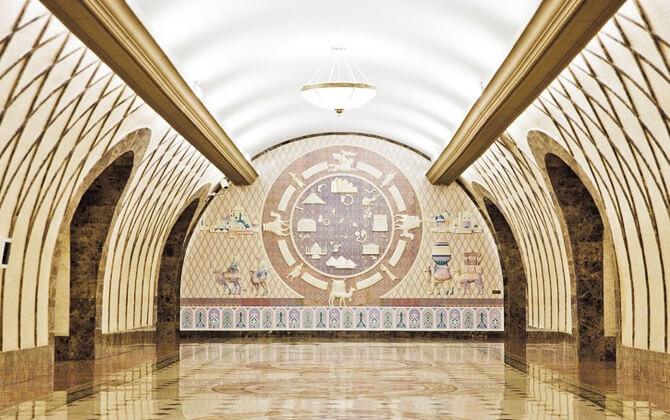
Almaty is a city where the metro itself can be part of the sightseeing plan. The stations are attractive, easy to visit, and useful for reaching several of the city’s main landmarks. For visitors, that makes the system both practical transport and a destination in its own right.
Almaty Metro as a sightseeing highlight
Even with one line, the metro is worth riding for its design alone. Stations feature polished stone, mosaics, chandeliers, murals, and themes linked to Kazakh culture and history. The result is a system that feels more curated than purely utilitarian.
Zhibek Zholy is known for Silk Road imagery. Almaly references the apple that symbolizes the city and includes stained glass and decorative patterns. Abai stands out with mosaics and bronze reliefs dedicated to the poet Abay Qunanbaiuly. Baikonur has a more futuristic look inspired by the spaceport.
Some travelers join dedicated metro tours that focus on architecture and station stories. Even without a tour, it is an easy, safe, and enjoyable system to explore on your own.
Historic center and city atmosphere
Above ground, central Almaty is pleasant for walking, with broad streets, trees, parks, cafes, and a mix of Soviet-era and locally influenced architecture. The area between Abay Avenue and the Park of 28 Panfilov Guardsmen is especially good for a relaxed city walk.
Arbat, the pedestrian part of Zhibek Zholy Street, is one of the liveliest stretches in the center. In the evening, landmarks such as Hotel Kazakhstan and the Palace of the Republic help give the city its distinct skyline.
Parks, churches and mosques
The Park of 28 Panfilov Guardsmen is one of Almaty’s best-known public spaces. It includes Zenkov Cathedral, a wooden Orthodox church built without nails, and the Memorial of Glory with its eternal flame.
Other green spaces mentioned in the draft include Central Park, Astana Square, and the First President’s Park, which offers mountain views. The Almaty Botanical Garden is another scenic stop, with plant collections from several regions and a noted Japanese Garden.
Near the Green Bazaar, the Central Mosque of Almaty is one of the country’s largest mosques and an important example of modern Islamic architecture.
Museums and markets
The Central State Museum is the main museum attraction listed in the draft, with more than 200,000 artifacts covering Kazakh history and culture. Other museums mentioned include the Museum of Musical Instruments, the Kasteyev Museum of Fine Arts, and the Tselliny Center for contemporary art.
For everyday city life, the Green Bazaar is a classic stop. It is a good place to see local food culture, with stalls selling fruit, vegetables, meat, spices, dairy products, and Central Asian specialties.
Mountain escapes and viewpoints
Almaty sits at the foot of the Tian Shan, so mountain scenery is never far away. Kok Tobe Hill, reached by cable car, offers broad views over the city and surrounding peaks. It also has entertainment, food outlets, and viewing platforms.
Medeu, at 1,691 metres above sea level, is known for its high-altitude skating rink and mountain setting. From there, cable cars continue to Shymbulak and Talgar Pass at over 3,000 metres.
Another popular destination is Big Almaty Lake, about 30 kilometres (18.6 miles) from the city center. The alpine reservoir is famous for its turquoise color and dramatic mountain surroundings.