BART, short for Bay Area Rapid Transit, is the main rapid transit system for San Francisco and much of the wider Bay Area. It serves 50 stations across six services and 131 miles (211 kilometers, 81.4 miles) of track, including eBART to Antioch and the Oakland Airport Connector. The system links San Francisco with Alameda, Contra Costa, San Mateo, and Santa Clara counties, and it provides direct airport rail service to both San Francisco International Airport and Oakland International Airport. BART began opening in stages from 1972 to 1974, and the most recent expansion opened in 2020 with Milpitas and Berryessa/North San José.
| Key | Information |
|---|---|
| System | Bay Area Rapid Transit (BART) |
| Area served | San Francisco Bay Area |
| Stations | 50 |
| Routes | Six services, including eBART and the Oakland Airport Connector |
| Network length | 131 miles (211 kilometers) |
| eBART spur | 9 miles (14 kilometers, 5.6 miles) |
| Oakland Airport Connector | 3 miles (4.8 kilometers, 3.0 miles) |
| Weekday ridership | Average of 186,000 weekday passenger trips in Q4 2025 |
| Annual ridership | 55,483,900 passenger trips in 2025 |
| Airports served | San Francisco International Airport and Oakland International Airport |
| Latest extension | Milpitas and Berryessa/North San José, opened in 2020 |
San Francisco BART Map
Map of San Francisco BART showing different lines and stations. Click on the map to enlarge it or download the San Francisco BART map in PDF format.
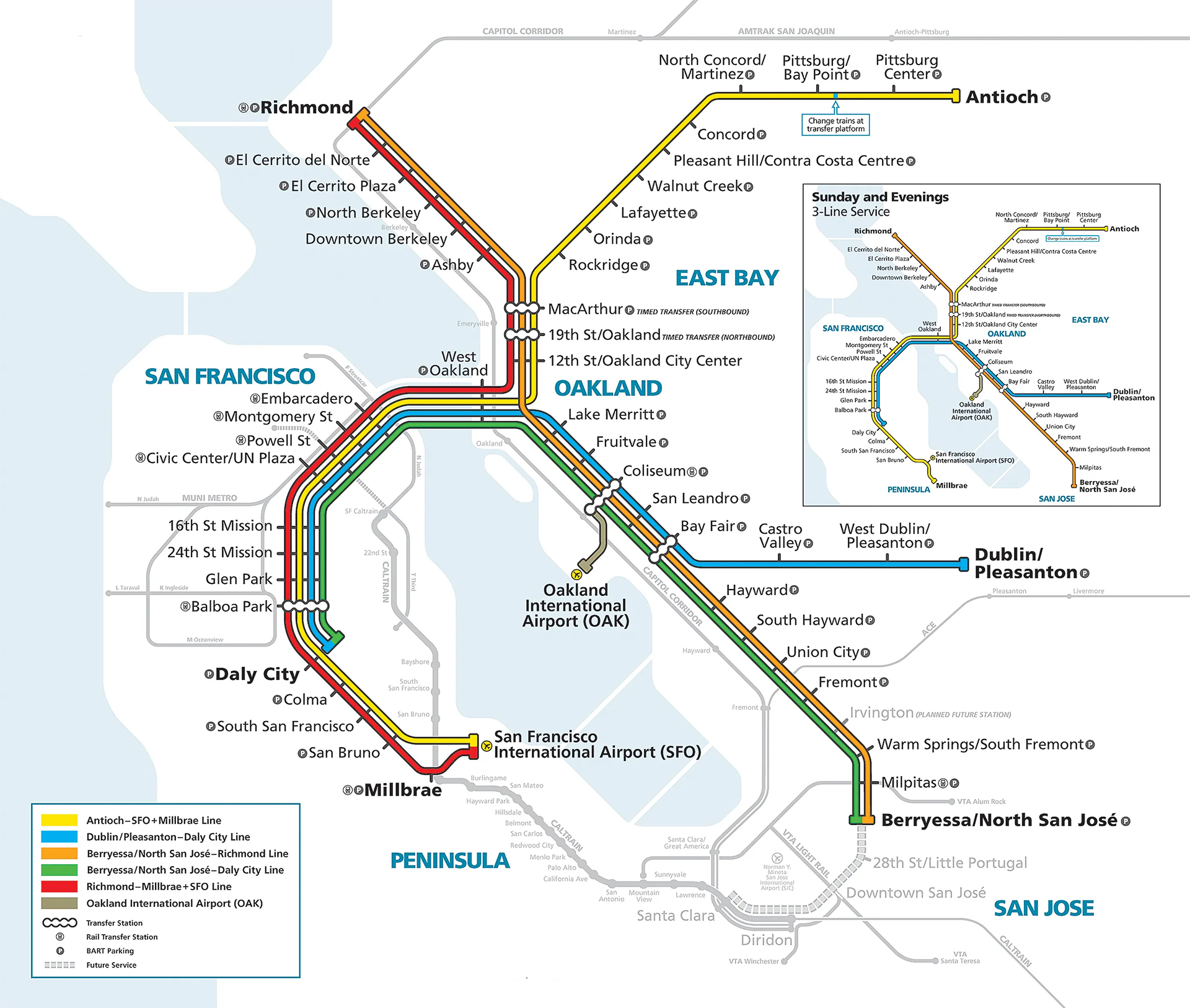
San Francisco BART Interactive Map
San Francisco BART Lines and Stations
BART operates five named heavy rail services plus one automated guideway line. In San Francisco, the system runs through the Market Street subway and the Transbay Tube. All five main services reach the city during the day, and even when some lines stop after 9 pm, all San Francisco stations stay connected through transfers. If you are checking the stations map or planning a route, downtown San Francisco is the core of the network.
Lines serving San Francisco
- Blue Line: Daly City to Dublin/Pleasanton
- Green Line: Daly City to Berryessa/North San José
- Red Line: Millbrae to Richmond
- Yellow Line: SFO or Millbrae to Antioch, depending on time of day
- Orange Line: Richmond to Berryessa/North San José
The Yellow Line serves San Francisco International Airport during daytime service and switches to Millbrae after 9 pm. The Red and Green lines do not usually run late at night, while the Blue, Yellow, and Orange lines continue.
San Francisco stations
| Station | Details |
|---|---|
| 16th Street Mission | Served by Blue, Green, Red, and Yellow lines. |
| 24th Street Mission | Served by Blue, Green, Red, and Yellow lines. |
| Balboa Park | Served by Blue, Green, Red, and Yellow lines. |
| Civic Center/UN Plaza | Served by Blue, Green, Red, and Yellow lines; connects with Muni Metro. |
| Embarcadero | Served by Blue, Green, Red, and Yellow lines; connects with Muni Metro. |
| Glen Park | Served by Blue, Green, Red, and Yellow lines. |
| Montgomery Street | Served by Blue, Green, Red, and Yellow lines; connects with Muni Metro. |
| Powell Street | Served by Blue, Green, Red, and Yellow lines; connects with Muni Metro. |
These stations give direct access to central San Francisco and key transfer points in the city transport network. Embarcadero, Montgomery Street, Powell Street, and Civic Center/UN Plaza also connect with Muni Metro, which makes them especially useful for local transport.
For many riders, the downtown stations are the main entry points for the city center. Balboa Park and Glen Park matter too, especially if you need a transfer within the system or a route onward through public transport in San Francisco.
BART Hours / Schedule
BART runs every day, with trains starting early in the morning and ending around midnight. Standard operating hours are weekdays from 5:00 am to midnight, Saturdays from 6:00 am to midnight, and Sundays from 8:00 am to midnight. If you are checking opening hours, working hours, or opening times today, those are the core system timings.
| Service detail | Timings |
|---|---|
| Weekday operating hours | 5:00 am to midnight |
| Saturday operating hours | 6:00 am to midnight |
| Sunday operating hours | 8:00 am to midnight |
| Daytime frequency | Usually every 15 to 20 minutes |
| Central San Francisco peak frequency | As often as every 2 to 3 minutes with overlapping lines |
| After 9:00 pm frequency | Generally every 20 minutes on reduced service |
| Closing time | Around midnight |
There is no overnight service, so the last train is an important thing to check before you travel. During the day, trains usually run every 15 to 20 minutes. In central San Francisco, where several lines share the same tracks, frequency can be much better at peak times.
After 9:00 pm, service drops to three lines and trains generally run every 20 minutes. The Green and Red lines often do not operate late in the evening or on Sundays, but other lines cover the main route through San Francisco.
The timetable in this article reflects the schedule in effect from August 11, 2025. No schedule change is noted for January 2026, and the next route timetable update is expected in August 2026.
Planning your trip
The BART Trip Planner is the easiest way to check the train schedule, route plan, and schedule today, including planned delays. PDF timetables are also available, along with transfer timetables for Caltrain and Capitol Corridor.
Helpful notes
- Station monitors show the next trains in real time.
- BART is not a 24-hour system, so it does close overnight.
- Weekday rush hours are often crowded, especially in the Transbay Tube.
- The Oakland Airport Connector does not have real-time train tracking data or a PDF timetable.
- The average wait for BART to OAK is 4.5 minutes, and the running time is about 9 minutes.
If you are connecting at Millbrae, transfers to Caltrain are straightforward.
Fares, Tickets and Cards
BART uses distance-based fares, so the ticket price depends on how far you travel. Riders must use the fare gates on both entry and exit. There are no weekly or monthly passes for the full system.
You can pay with Clipper or Tap and Ride. Proof of payment is required. If you use a physical Clipper card or a bank card, take it out of your wallet or purse when you tap. Tap and Ride works only on BART, while Clipper is accepted on other Bay Area public transport systems too.
To check the fare, price, or trip cost for a specific route, use the BART fare calculator. A minimum stored value is required to enter a station: $2.40 on a regular Clipper card, $1.20 on a Youth Clipper card, and $0.90 on a Senior or RTC Clipper card.
Children aged 4 and under ride free. Everyone else needs their own Clipper card or Tap and Ride payment method. Discount fares must be set up in advance through Clipper, and station vending machines do not provide those discounts.
If you do not have enough fare to exit, the gate will display UNDERPAID: GO TO ADDFARE. Addfare machines inside the paid area accept cash, credit, and debit cards. If you still cannot add the minimum amount, ask the Station Agent for access to the free area to reload.
The excursion fare is $7.55 (about USD 7.55). If you enter and exit at the same station within three hours, the system treats the trip as an excursion. Tap and Ride users get a 30-minute grace period if they decide not to travel after entering.
The penalty fare is also $7.55 (about USD 7.55). It applies if you do not use the same card or device to enter and exit, if you fail to tap out within six hours, or if an entry or exit tap is missing.
Clipper discounts and special products include the Clipper Access card with 62.5% off for eligible riders under 65 with qualifying disabilities, a High-Value Discount that gives 6.25% off single rides when buying $48 of value for $45 or $64 of value for $60, the BART/Muni Adult A Fast Pass for a calendar month on Muni vehicles and BART between Embarcadero and Balboa Park, and Clipper BayPass, a prepaid unlimited transit pass available through the pilot program.
Paper tickets are no longer sold or accepted at fare gates.
Connections to Other Systems
BART connects with a wide range of local transport, regional transport, and intercity transportation in the Bay Area. Many stations work as transfer hubs, so continuing by rail, bus, ferry, or shuttle is usually easy.
In San Francisco, the downtown Market Street stations connect with Muni Metro light rail. Powell Street also provides access to the Union Square/Market Street Muni Metro T Third Street line. Cable cars are nearby at Powell Street, and the Salesforce Transit Center is one block from Embarcadero and Montgomery stations.
Millbrae offers a direct transfer to Caltrain. Richmond and Oakland Coliseum connect with Amtrak service. Richmond serves the California Zephyr, Capitol Corridor, and Gold Runner, while Capitol Corridor also stops at Oakland Coliseum.
BART also links with many bus systems, including AC Transit, Muni, SamTrans, County Connection, Tri Delta Transit, WestCAT, WHEELS, VTA, and Golden Gate Transit. Several stations have dedicated bus transfer areas, which helps a lot for city transport and suburban feeder trips.
In the South Bay, Milpitas connects with VTA light rail, and the Silicon Valley extension supports bus and rail travel into San Jose and Silicon Valley. BART also connects to airport transportation, with direct service to SFO and OAK, while San Jose International Airport is reached by VTA bus from Milpitas.
When BART is closed overnight, substitute bus networks such as All Nighter and Early Bird Express provide limited service to major stations. BART also works with partner agencies on paratransit and shuttle connections for riders who need accessible options.
Airport Connections
BART connects San Francisco International Airport and Oakland International Airport with downtown San Francisco, downtown Oakland, and many other Bay Area destinations. For airport travel, it is often one of the easiest ways to avoid traffic.
San Francisco International Airport (SFO)
The BART station at SFO is in the International Terminal, within walking distance of Terminals 1 and 3. The free SFO AirTrain also links all terminals to the station. The trip to downtown San Francisco takes about 30 minutes.
From SFO, take a Yellow Line or Red Line train to one of the four downtown San Francisco stations. Returning to the airport is just as simple: board any SFO-bound train. If you are coming from elsewhere in the system, you may need a transfer, so check the stations map or route plan before you go.
At the airport, you can walk to Terminal 2 or use the AirTrain Red Line to reach Terminals 1, 2, or 3 for domestic flights. The International Terminal check-in area is also a short walk from the station.
Paying for your trip
BART fare gates accept contactless bank cards, Google Pay, and Apple Pay through Tap and Ride. No setup is needed. Each rider aged 5 and older must use their own card or device.
BART also accepts Clipper, the region’s all-in-one transit card. Paper tickets are mentioned in the draft for SFO, but elsewhere BART states that paper tickets are no longer sold or accepted at fare gates.
Service hours and trip planning
Use the BART Trip Planner to check airport train schedule details, opening times, timings today, and the last train before you head out.
| Service detail | Timings |
|---|---|
| SFO service weekdays | 4:58 am to midnight |
| SFO service Saturday | 5:47 am to midnight |
| SFO service Sunday | 8:08 am to midnight |
If you have an early Sunday flight, make alternative travel plans. The starting time is later on Sundays.
Oakland International Airport (OAK)
BART also connects Oakland International Airport with San Francisco. To reach downtown San Francisco from OAK, take the airport connector to Coliseum Station and transfer to a San Francisco or Daly City train.
This connection is a practical, lower-cost alternative to a shuttle, ride share, or taxi, and service runs frequently during peak periods.
San Francisco BART Parking
BART operates station parking at 35 stations for riders. This section covers only BART-operated parking and does not apply to Berryessa/North San Jose or Milpitas, which are run by VTA.
Parking payment is required Monday through Friday from 4:00 am to 3:00 pm for most programs. Non-BART parking is available only from 3:15 am to 5:30 am. Parking is free on weekends and BART holidays. Typical parking charges are $3.40 per day for Daily Fee parking, $4.50 per day and up for Single or Multi-Day Reserved parking, and $93.80 per month and up for Monthly Reserved parking. Rates vary by station, and local taxes may apply.
Parking types
- Daily Fee parking: first come, first served for stays up to 24 hours. Use the designated area and pay in the official BART app or at station machines within 10 minutes of parking.
- Single/Multi-Day Reserved parking: for stays up to 20 weekdays, including airport trips. Single-day reservations expire at midnight on the purchase day. Multi-day parking allows overnight stays only when using BART to travel onward. Reservations can be made up to 60 days in advance.
- Monthly Reserved parking: for stays up to 24 hours at a time, billed monthly. It guarantees a space until 10:00 am.
- ADA parking: available at all stations. Payment is required at the Daily Fee price for stays up to 24 hours.
- Motorcycle parking: free in designated areas at all times.
- Carpool parking: available in reserved areas at the Daily Fee price when you carpool to BART.
- EV charging: available at Warm Springs/South Fremont and Lafayette with a reservation in the official app.
- Non-BART parking: designed for riders parking very early and connecting to Early Bird Express bus service.
Helpful notes
Reserved spaces are usually guaranteed until 10:00 am. If a reserved area is full, you may use a Daily Fee space instead. Tap and Go can be set up in the app for faster parking payment.
If you are heading to the airport, Single or Multi-Day Reserved parking can be booked in advance through the website or app for stays of up to 20 weekdays. For many riders, that is the simplest option.
For support, BART recommends contacting parking assistance by email. You can also check parking FAQs, rules, terms, pricing policy, and station parking maps.
Rules and Tips
BART links the San Francisco Peninsula with the East Bay and South Bay, and it reaches many of the area’s busiest destinations. A few basic tips can make the trip smoother.
Service hours
BART operating hours are weekdays from 5:00 am to 12:00 am, Saturdays from 6:00 am to 12:00 am, and Sundays from 8:00 am to 12:00 am. If you are checking opening hours, closing time, or schedule today, those are the standard system hours.
Fares and Clipper Cards
Clipper is the main fare product used systemwide. It is reusable, reloadable, and accepted on other regional transit systems. Buying a physical card carries a $3 acquisition fee, and Clipper is also available on Apple iOS and Android devices.
Safety tips
To stay safe, pay attention to the people and activity around you, avoid getting too absorbed in your phone, and keep your belongings with you. When possible, travel with others and stand near other passengers. If something feels off, move away and trust your instincts.
Reporting problems
For a medical emergency, crime, or urgent problem, contact BART Police directly. You can also use the BART Watch app to send a silent report and include a photo. Try to note exactly where you are, whether that is the concourse, platform, or train car.
Accessibility and rider support
BART provides accessible features such as elevators and escalators, along with support for seniors and riders with disabilities. Trip planning tools and station information are also available to help riders move through the system more easily.
Helpful reminders
- Check schedules and real-time departures before you travel.
- Use route and trip planning tools to find the best path train option for your journey.
- Keep your card or payment method ready before entering.
- Follow BART’s customer code of conduct and safety guidance.
BART Services
BART operates five named heavy rail services plus one separate automated guideway line. All heavy rail services run through Oakland, and all except the Orange Line cross the bay to San Francisco through the Transbay Tube. Every station is served during system operating hours.
The network covers large parts of San Francisco, Alameda, and Contra Costa counties, plus smaller parts of San Mateo and Santa Clara counties. In total, BART has 50 stations and includes service to SFO and Oakland International Airport.
| Route | First service | Termini | Notes |
|---|---|---|---|
| Orange Line | 1972 | Berryessa/North San José to Richmond | Operates during all service hours. |
| Yellow Line | 1973 | SFO until 9 pm; Millbrae after 9 pm to Antioch | Operates during all service hours. Uses DMU vehicles between Antioch and Pittsburg/Bay Point. |
| Green Line | 1974 | Daly City to Berryessa/North San José | No evening service after 9 pm. |
| Blue Line | 1972 | Daly City to Dublin/Pleasanton | Service pattern varies by time of day. |
| Red Line | 1974 | Richmond to Daly City | Service pattern varies by time of day. |
All five main services run until 9 pm. After that, only three continue in the evening. The eastern part of the Yellow Line between Antioch and the transfer platform east of Pittsburg/Bay Point uses different rolling stock and is separated from the rest of the line.
Hours and Frequencies
Most primary services run every 20 minutes. The Yellow Line is more frequent on weekdays, operating every 10 minutes. Because many stations are served by multiple lines, the shared section between West Oakland and Daly City gets especially frequent service in peak periods. The Oakland Airport Connector runs on demand, usually every 10 minutes or less.
The first inbound trains leave outer terminals around 5:00 am on weekdays, 6:00 am on Saturdays, and 8:00 am on Sundays and most holidays. The last train of the day leaves outer terminals around midnight, with guaranteed transfers at key stations.
Bus Services
When BART is not operating overnight, two regional bus networks provide replacement transport.
- All Nighter: late-night bus service to San Francisco, the East Bay, and the Peninsula, covering limited Yellow, Blue, and Orange Line corridors.
- Early Bird Express: early-morning bus service to major BART stations, generally between about 3:50 am and 5:30 am, with routes meeting at Salesforce Transit Center.
BART also works with AC Transit to provide East Bay Paratransit for riders whose conditions or disabilities prevent them from boarding a train.
Connecting Services
BART connects with Amtrak, Caltrain, Muni Metro, VTA light rail, and a wide range of regional and local bus systems. Major rail links include Richmond for the California Zephyr, Capitol Corridor, and Gold Runner, Millbrae for Caltrain, and the shared Market Street subway stations for Muni Metro.
Bus connections are available at all stations, and many suburban routes work as feeder services. BART also acts as a transfer point for longer-distance commuter buses from across the Bay Area.
Airport Connections
BART runs directly to San Francisco International Airport and Oakland International Airport. San Jose International Airport can be reached by VTA bus from Milpitas.
For airport travel, BART is one of the quickest traffic-free options between the airports and downtown San Francisco.
History
BART’s history goes back to 1946, when Bay Area business and civic leaders began looking for ways to reduce growing postwar traffic. In 1947, a joint Army-Navy review board concluded that another transbay link would eventually be necessary and proposed an underwater tube for high-speed electric trains.
In 1951, the State Legislature created the San Francisco Bay Area Rapid Transit Commission to study long-range transportation needs. Its final report in 1957 argued that transport planning had to be tied to the region’s wider development. The commission then recommended a five-county rapid transit district to build and operate a high-speed rail system linking major commercial centers with suburban hubs.
The San Francisco Bay Area Rapid Transit District was formed in 1957. It originally included Alameda, Contra Costa, Marin, San Francisco, and San Mateo counties, with taxing authority to support bond financing. Between 1957 and 1962, engineers developed plans for a grade-separated electric rail network with fast service, modern trains, and stations intended to add architectural value to their communities.
Public participation shaped route and station planning through hundreds of meetings. By 1961, the final plan had been submitted to the five counties, but San Mateo County withdrew in December 1961 because of cost and existing commuter rail service. Marin County withdrew in early 1962 after concerns about its tax base and debate over whether trains could cross the Golden Gate Bridge.
The plan was then revised into a three-county system focused on San Francisco and the East Bay. Voters approved the BART Composite Report in July 1962, and that November they passed a $792 million bond issue for a 71.5-mile (115.1-kilometer) system with 33 stations. Funding also covered rebuilding part of the San Francisco Municipal Railway to connect with BART on Market Street.
Construction began on June 19, 1964. Major engineering work included the Transbay Tube, subway tunnels in San Francisco, Oakland, and Berkeley, aerial structures in the East Bay, and the Berkeley Hills Tunnel. The Transbay Tube was completed in 1969 and restored transbay rail service for the first time since the Key System ended Bay Bridge crossings. Embarcadero Station was also added, even though it was not part of the original plan.
Passenger service started on September 11, 1972, between MacArthur and Fremont. Service reached San Francisco later, and the network opened in stages through 1974. Early years were affected by low ridership forecasts, train-control issues, and safety concerns. In 1972, an ATC failure caused a train to run off the elevated track at Fremont and crash to the ground, injuring four people. That incident led to train-control redesign and investigations by state and federal agencies.
In 1974, hearings on financial mismanagement led to the resignation of the General Manager and the replacement of the appointed Board of Directors with an elected board. BART then continued to expand, with extensions to North Concord/Martinez, Colma, Pittsburg/Bay Point, Dublin/Pleasanton, San Francisco International Airport, Oakland International Airport, and Antioch. In 2020, Milpitas and Berryessa/North San José opened as part of the Silicon Valley extension.
Long-term planning has continued as well. With the Transbay Tube nearing capacity, proposals have included a new four-bore tunnel under San Francisco Bay to add future rail capacity.
Future Extensions
As the Bay Area grows, BART expansion remains a major part of regional transport planning. By 2040, the region is expected to add more than two million residents, pushing the population above nine million. BART and its partners are advancing projects aimed at improving capacity, reliability, safety, and access.
Future development is guided by the System Development Policy adopted in September 2023. Under that policy, proposed line extensions, new stations, and infill stations must show clear benefits for riders and the region, support ridership and climate goals, and justify public investment through a business-case process.
Active projects and system improvements
Projects already underway or in development include the Silicon Valley Extension, the Transbay Corridor Core Capacity Program, Train Control Modernization, Station Modernization, Traction Power Substations, the Hayward Maintenance Complex, BART Wireless Technology, the San Francisco Station Escalator Replacement project, the New Transbay Rail Crossing (Link21), and Irvington Station.
The Silicon Valley Extension is managed by VTA and will extend service farther into Santa Clara County. The Transbay Corridor Core Capacity Program is designed to increase peak-hour capacity into San Francisco by 40%, while train control modernization and new traction power substations are intended to support more frequent service. The Hayward Maintenance Complex is planned to support the larger next-generation fleet.
Other projects focus on the rider experience. Station modernization is aimed at better access, safety, security, and customer experience. The wireless technology program is intended to improve cell service and Wi-Fi coverage in stations and on trains. BART has also expanded its falconry-based nuisance bird control program to more stations.
Long-range expansion concepts
Longer-range ideas include a second Transbay crossing, possible future service to Livermore, potential extensions toward Hercules, and additional infill stations such as Irvington and 30th Street/Mission. Earlier proposals, including Menlo Park and a Geary subway, were studied but not advanced.
BART’s long-range planning also recognizes that some future expansion may be delivered by partner agencies rather than BART itself. The Silicon Valley Extension, for example, is managed by VTA, and discussion of the Livermore corridor eventually led to the Valley Link effort instead of a full BART extension.
Nearby Attractions
The Bay Area has plenty to see, and many attractions are easy to reach by BART. For routes, stations list details, and public transport connections, the BART Trip Planner is the best place to start.
- Exploratorium at Embarcadero: a hands-on science and art museum. From Embarcadero Station, it is 0.6 miles (1.0 kilometers) to Pier 15 at Embarcadero and Green Street.
- San Francisco Railway Museum at Embarcadero: a free museum focused on historic streetcars and cable cars. From Embarcadero Station, it is 0.2 miles (0.3 kilometers) to 77 Steuart Street.
- Children’s Creativity Museum at Powell: a hands-on space for arts, crafts, tech, and play. From Powell Station, it is 0.4 miles (0.6 kilometers) to 221 4th Street.
- Oakland Museum of California at Lake Merritt: an interactive museum centered on California history, art, and nature. From Lake Merritt Station, it is 0.1 miles (0.2 kilometers) to 1000 Oak Street.
- Berkeley Art Museum and Pacific Film Archive at Downtown Berkeley: known for visual art and film. From Downtown Berkeley Station, it is 0.1 miles (0.2 kilometers) to 2155 Center Street.
- African American Museum and Library at Oakland at 12th St/Oakland: a free museum and library with strong local history collections. From 12th St/Oakland Station, it is 0.3 miles (0.5 kilometers) to 659 14th Street.
- Children’s Fairyland at 19th St Oakland: a family-friendly storybook park near Lake Merritt. From 19th St Oakland Station, it is 0.6 miles (1.0 kilometers) to 699 Bellevue Avenue.
- LEGOLAND Discovery Center in Milpitas: a LEGO attraction with miniature Bay Area landmarks and workshops. From Milpitas Station, it is 0.8 miles (1.3 kilometers) to 870 Great Mall Drive.
- Lindsay Wildlife Museum in Walnut Creek: a wildlife rehabilitation center and museum. Ride to Pleasant Hill / Contra Costa Centre, then take County Connection bus 9 to 1931 1st Avenue.
Whether you want museums, family attractions, or a mix of both, BART makes getting around the Bay Area much easier.
Great post! The detailed map and clear explanations of the lines and routes make it so easy to navigate BART. I appreciate the information on hours and ticketing too – it’s super helpful for newcomers to San Francisco. Thank you for sharing!