The Carmelit is an underground funicular railway in Haifa, Israel, running through Mount Carmel between the lower city and Carmel Center. Opened in 1959, it is the oldest funicular railway and underground public transport system in the Middle East, and for many years it was the only underground system in Israel. The route is short but distinctive: about 1.8 km (1.1 miles), with six stations, a single tunnel, and a climb of 274 meters (899 feet). Its slanted cars and stepped station platforms make it one of the most unusual pieces of city transport in Haifa.
| Key | Information |
|---|---|
| Type | Underground funicular railway |
| Location | Haifa, Israel |
| Opened | 1959 |
| Route length | 1.8 km (1.1 miles) |
| Stations | 6 |
| Journey time | About 8 minutes end to end |
| Elevation change | 274 meters (899 feet) |
| System layout | Single line, single tunnel, passing loop |
| Trains | Four cars operating as two two-car trains |
| Accessibility | Not wheelchair accessible |
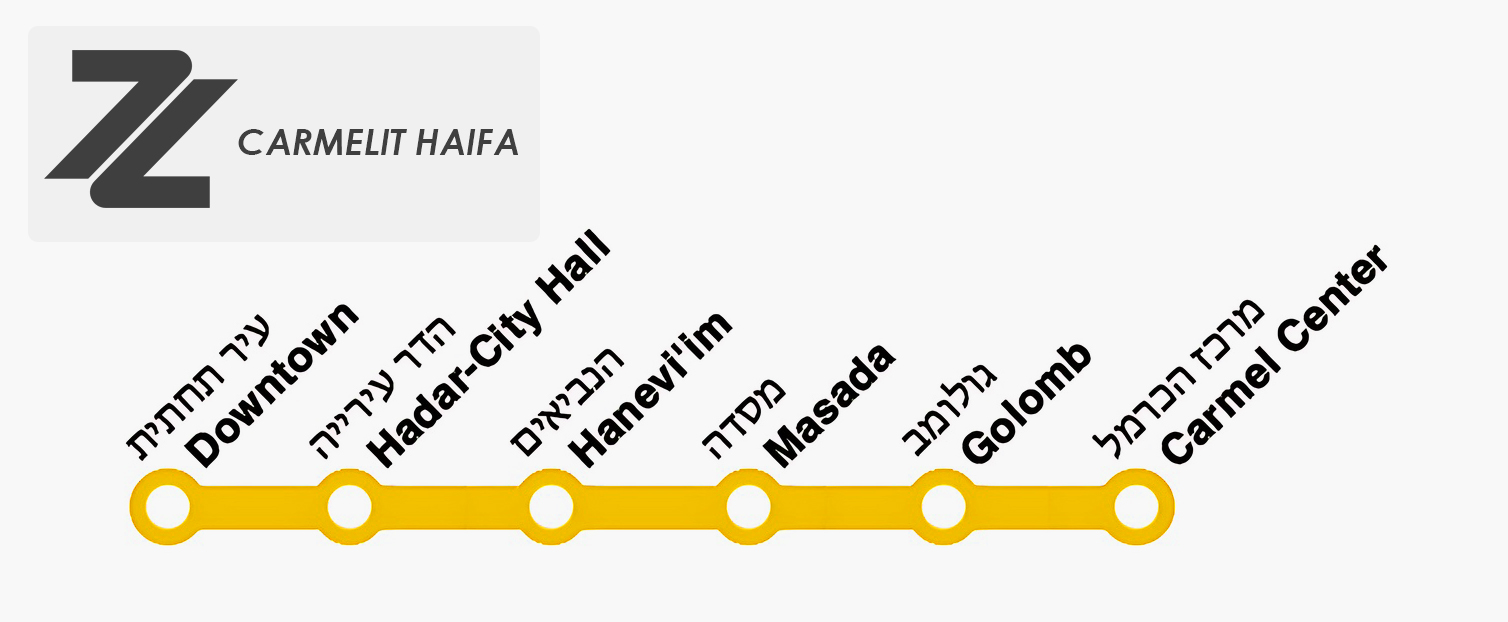
Haifa Metro Map
Map of Carmelit (Haifa) Metro showing different lines. Click on the map to enlarge it or download the Carmelit (Haifa) Metro map in PDF format.
Lines and Stations
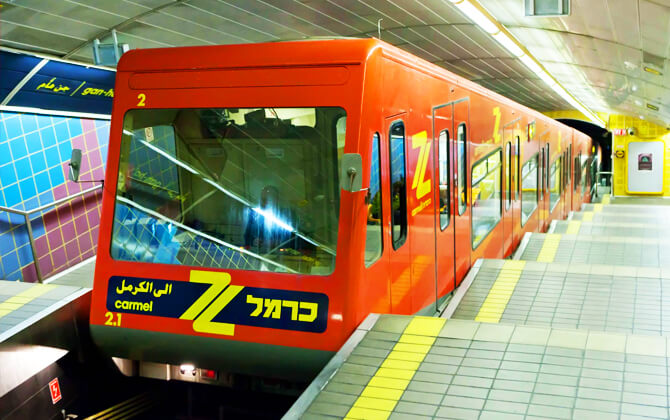
The Carmelit operates as a single underground line in Haifa. It uses two 2-car trains on a single track, with a short passing loop where the trains cross. The route links Downtown with Carmel Center, and the full running time is about 8 minutes.
The system has six stations. Cars are sloped, platforms are built in steps, and stations are relatively small. Not all stations have concourses, and the system is not wheelchair accessible.
Here is the stations list from lower to upper level.
| Station | Details |
|---|---|
| Paris Square | Downtown terminal near government buildings, the courthouse, and Haifa Centre HaShmona Station. |
| Solel Boneh | Near HaAtzmaut Park, Hanevi’im Tower, and Haifa City Hall. |
| HaNevi’im | Serves the Hadar HaCarmel business district and connects with Metronit Line 3. |
| Massada | On Massada Street in Hadar HaCarmel, near the Science and Technology Museum, galleries, antique shops, and restaurants. |
| Bnei Zion | On Golomb Street, near Bnai Zion Medical Centre and the Bahá’í World Centre. |
| Gan HaEm | In Carmel Center, close to the Haifa Auditorium, the Haifa Zoo, and several hotels. |
For many visitors, the Carmelit stations map is easy to grasp because the route is so compact. Even so, it works best as part of a broader route plan with bus and rail connections across the city.
Operating Hours
The Carmelit operating hours and opening times vary by day. If you are checking timings today or planning around the last train, it is worth noting that the system does not run 24 hours.
| Service detail | Timings |
|---|---|
| Sunday to Thursday opening hours | 06:00-24:00 |
| Friday and eve of a holiday | 06:00-15:00 |
| Saturday in summer | 19:00-24:00 |
| Saturday in winter | 20:00-24:00 |
Some sources also mention special holiday schedule changes, including earlier closing time on the eve of Yom Kippur and the eve of Passover, while the Carmelit is closed on Yom Kippur.
As for frequency, trains usually run every 10 to 12 minutes. That makes the route timetable simple enough for quick trips between downtown and Mount Carmel.
Fares and Tickets
The Carmelit is a low-cost public transport option in Haifa, with a fare structure integrated into the wider local transport network. A ride is comparable in price to local bus travel, and the short running time can save time as well.
Children under 5 travel free. IDF soldiers in uniform and blind passengers also travel free, and discounts are available for students and senior citizens.
Tickets can be bought from vending machines at stations. Single-ride paper tickets are available, while multi-ride tickets use the Rav-Kav card system. Rav-Kav cards can be loaded at machines across the city and at Carmelit stations.
| Key | Information |
|---|---|
| Single ticket adult | 5.90 NIS (about $1.60), Carmelit only |
| Group ticket, 10 people or more | 3.00 NIS (about $0.81), Carmelit only |
| Single continuation ticket adult | 5.90 NIS (about $1.60), Haifa area only |
| Single continuation ticket adult | 9.10 NIS (about $2.46), Haifa and beyond |
| Single continuation ticket adult | 12.50 NIS (about $3.38), Metropolin network |
| Daily ticket | 13.50 NIS (about $3.65), valid on the date of purchase |
| Weekly ticket | 64.00 NIS (about $17.30), valid for 7 days from purchase |
| Monthly ticket | 213.00 NIS (about $57.57), valid for 1 calendar month |
| Student semester ticket | 527.00 NIS (about $142.43), Haifa ring 1 |
| Student annual ticket | 1278.00 NIS (about $345.41), Haifa ring 1 |
Payment can be made with coins or credit cards. Tickets must be validated at the turnstiles before entering the paid area.
The system became part of the Haifa Metropolin public transport network in January 2017. That network includes bus transport, Metronit transport, and the Carmelit. If you are comparing fare, ticket price, pass options, or looking for a fare calculator, the Rav-Kav system is the key tool for integrated travel.
Connections to Other Systems
The Carmelit is closely linked to Haifa’s wider public transport system, even though its own route covers only a limited corridor. Its downtown station is within walking distance of Haifa Center Railway Station, and it also provides access to the Port of Haifa.
Several stations connect with the Metronit bus rapid transit network. HaNevi’im station is the transfer point for Metronit Line 3, while Downtown connects with Metronit Lines 1 and 2. These connections extend the Carmelit’s reach well beyond its short underground path train route.
Travel is integrated with the Rav-Kav fare system used on buses, trains, and Metronit. A Rav-Kav card can be used for multi-ride travel, and transfers from buses or the Metronit to the Carmelit are possible at no extra charge within 90 minutes.
In practice, the Carmelit works best as part of a combined city transport journey. It gives you a fast underground link between the mountain and the center, while bus and Metronit services handle the broader transportation in Haifa and the surrounding area.
Airport Connections
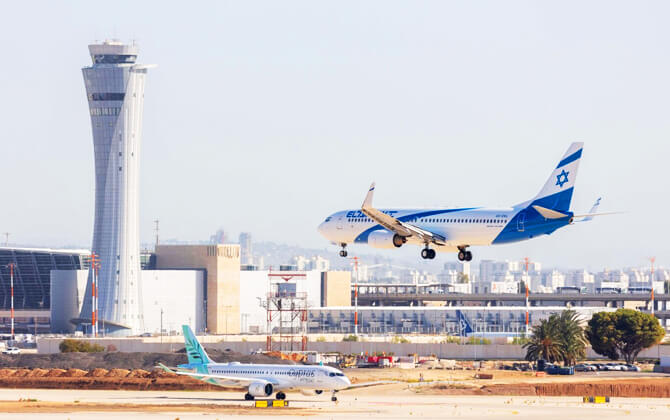
Haifa’s public transport network makes airport travel fairly straightforward. The city is served by buses, trains, light rail, the Carmelit, and service taxis, so airport journeys can be combined with local transport fairly easily.
If you are using public transport, the Rav-Kav card is the main payment method. It works on buses, trains, light rail, and the Carmelit. The card costs 5 NIS (about $1.35) and can be bought at Ben Gurion Airport, central train stations, all light rail stations in Haifa, or from local vendors.
You can also use the Rav-Kav app to add funds from your phone. Trips are valid for 90 minutes, so if your journey includes a transfer between bus services or a light rail ride in Haifa, you do not need to pay separately for each leg as long as the transfer is made within that time.
The train network provides direct access to Ben Gurion Airport, making rail a practical option for longer-distance travel. For shorter trips within Haifa, the Carmelit can help you avoid road traffic and reach central areas quickly.
Combined Carmelit and bus tickets are also available, which can be useful if your airport route includes more than one mode of transport.
Facilities and Services
The Carmelit is designed to make travel around central Haifa simple and practical. Its stations are close to attractions, hotels, shops, museums, restaurants, and city offices, linking Downtown Haifa with Carmel Center in just a few minutes.
Stations include stairs and, at selected locations, escalators. Ticket vending machines are available, and machine instructions are offered in Hebrew and English. The system uses the Rav-Kav card for multi-ride tickets, while single paper tickets can also be bought at station machines.
The service runs frequently, and the complete route takes about 8 minutes. The Carmelit is also considered a safe underground space and was built to serve as a public bomb shelter if needed. Security guards are stationed at station entrances.
Passengers can use combined ticket options with Egged bus lines, including discounted tickets for organized groups. According to the source material, bicycles can be taken on the trains free of charge.
Accessibility is limited. The system is not wheelchair friendly, and there are no ramps or elevators, only stairs and a small number of escalators at selected stations. Information about station parking, parking charges, or parking charges per day is not provided in the source material.
Rules and Tips
The Carmelit is an easy way to travel between Downtown Haifa and Carmel Center, but a few practical rules and tips can make the trip smoother.
Rules
- Eating and drinking are prohibited on trains and in stations.
- Weapons are not allowed in the turnstile area.
- Use the litter bins to help keep stations and trains clean.
- Keep your ticket with you while inside the turnstile area.
Tips
- Use the Carmelit to avoid traffic jams, parking problems, and pollution.
- The full route takes about 8 minutes, so it is one of the quickest ways to travel between the city centre and Carmel Center.
- Trains usually run every 10 to 12 minutes, so if you miss one, the next service should not be far away.
- If you are transferring, buy a ticket that covers the next part of your journey when needed.
- The Rav-Kav card is used for multi-ride tickets, and single paper tickets are sold at station machines.
- Bring a valid ticket that matches your journey, especially if you plan to combine the Carmelit with other public transport in Haifa.
- Be aware that the system is not wheelchair accessible and involves a lot of stairs, with only limited escalator access.
- The underground stations can also serve as a safe shelter in the event of missile or rocket fire.
History
A rail-based link between Mount Carmel and downtown Haifa had already been envisioned by the British mandatory authorities, but practical discussions began only in 1955 under mayor Abba Hushi. In 1956, an agreement was signed after the French company Compagnie Dunkerquoise d’Entreprises prepared a detailed plan and proposed a major loan for the project.
The Carmelit was built as an underground funicular system, with construction carried out by the Israeli company Solel Boneh. Work moved forward at about three meters a day, except in one geologically difficult section where progress slowed to 1.5 meters a day. The system opened in 1959, with Israeli prime minister David Ben Gurion and French transport minister Robert Buron among those present.
After 27 straight years of service, the Carmelit shut down for major renovation on December 19, 1986. Renovation eventually began on October 29, 1990, after several delays and failed attempts. The old rolling stock was taken to a scrapyard near Kfar Masaryk in 1991 after being offered to the Israel Railway Museum, which declined it because transport costs were too high. The line reopened to the public in early September 1992.
Over the years, the system has closed for repair several times. Even so, it remains a distinctive part of Haifa’s transport history as the oldest funicular railway and underground transit system in the Middle East.
Future Expansion
Despite linking important residential and commercial areas, the Carmelit has limited coverage and is not especially popular. It does not cover its operating costs, and the city council currently has no plans for expansion because of financial constraints.
There have been discussions about extending the tunnels to serve more passengers, but no concrete expansion project has been carried out.
Nearby Attractions
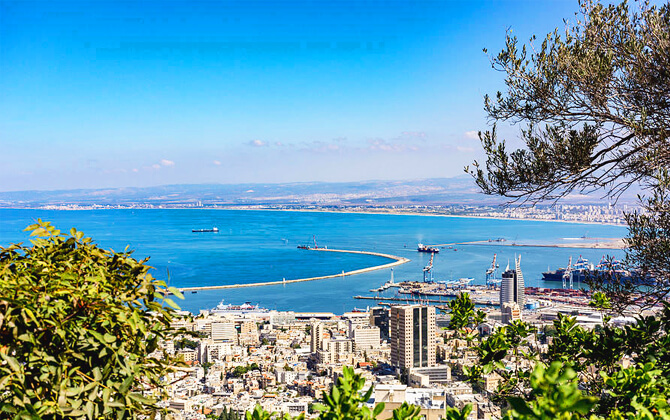
The Carmelit is a handy way to reach several of Haifa’s best-known attractions, especially around Carmel Center, Hadar, and downtown. With only six stations, it connects visitors quickly to museums, promenades, gardens, markets, and historic neighborhoods.
From Gan HaEm Station, you can explore Carmel Center, one of the city’s main entertainment areas. Nearby are the Louis Promenade, the Municipal Zoo, the Tikotin Museum of Japanese Art, the Mane Katz Museum, and the Bahá’í Gardens. The upper entrance to the gardens is also within walking distance.
From Bnai Zion Station, you can reach Rothschild (Bnai Zion) Hospital and the Spinoza Stairs, part of Haifa’s thousand stairs track. This station can also be a starting point for a walk toward Wadi Nisnas.
From Massada Station, Massada Street offers cafes, galleries, and distinctive shops in a lively setting. It is also a convenient stop for visiting MadaTech, the National Museum of Science.
From HaNevi’im Station, you can visit the Haifa Museum, walk through Wadi Nisnas, or continue toward the German Colony. This part of Hadar has busy streets and plenty of local shops.
From Solel Boneh, City Hall and the Garden of Independence are nearby. The garden is known for broad views over Haifa Port and Haifa Bay, with clear-day views stretching toward the Galilee Mountains and Mount Hermon.
From Paris Square, you are close to the Israel Railway Museum, Faisal Square, the Port Campus, and many pubs, restaurants, and cafes. A short walk also leads to the German Colony and the City Center Mall. This station is within walking distance of Haifa’s central train station, HaShmona, making it a useful starting point for sightseeing.
- Louis Promenade
- Bahá’í Gardens
- Municipal Zoo
- Tikotin Museum of Japanese Art
- MadaTech
- Wadi Nisnas
- German Colony
- Garden of Independence
- Israel Railway Museum