The Hong Kong Mass Transit Railway, or MTR, is the city’s main rapid transit system and a core part of public transport in Hong Kong. It has been operating since 1979 and links Hong Kong Island, Kowloon, the New Territories, Lantau Island, and cross-boundary points. Today, the system includes nine main commuter lines, Light Rail, feeder bus services, the Airport Express, and High Speed Rail connections from Hong Kong West Kowloon Station.
| Key | Information |
|---|---|
| Name | Mass Transit Railway (MTR) |
| Opened | 1979 |
| Role | Main public transport and city transport rail system in Hong Kong |
| Main network | 9 commuter lines, plus Airport Express and High Speed Rail connections |
| Additional modes | Light Rail and feeder bus services |
| Coverage | Hong Kong Island, Kowloon, New Territories, Lantau Island, and cross-boundary links |
| Stations and stops | 99 stations across MTR, Airport Express, and High Speed Rail, plus 68 Light Rail stops |
| Reputation | Safe, reliable, efficient, with bilingual signage and announcements |
Hong Kong Mass Transit Railway Map
Map of Hong Kong Mass Transit Railway showing different lines and stations. Click on the map to enlarge it or download the Hong Kong MTR map in PDF format.
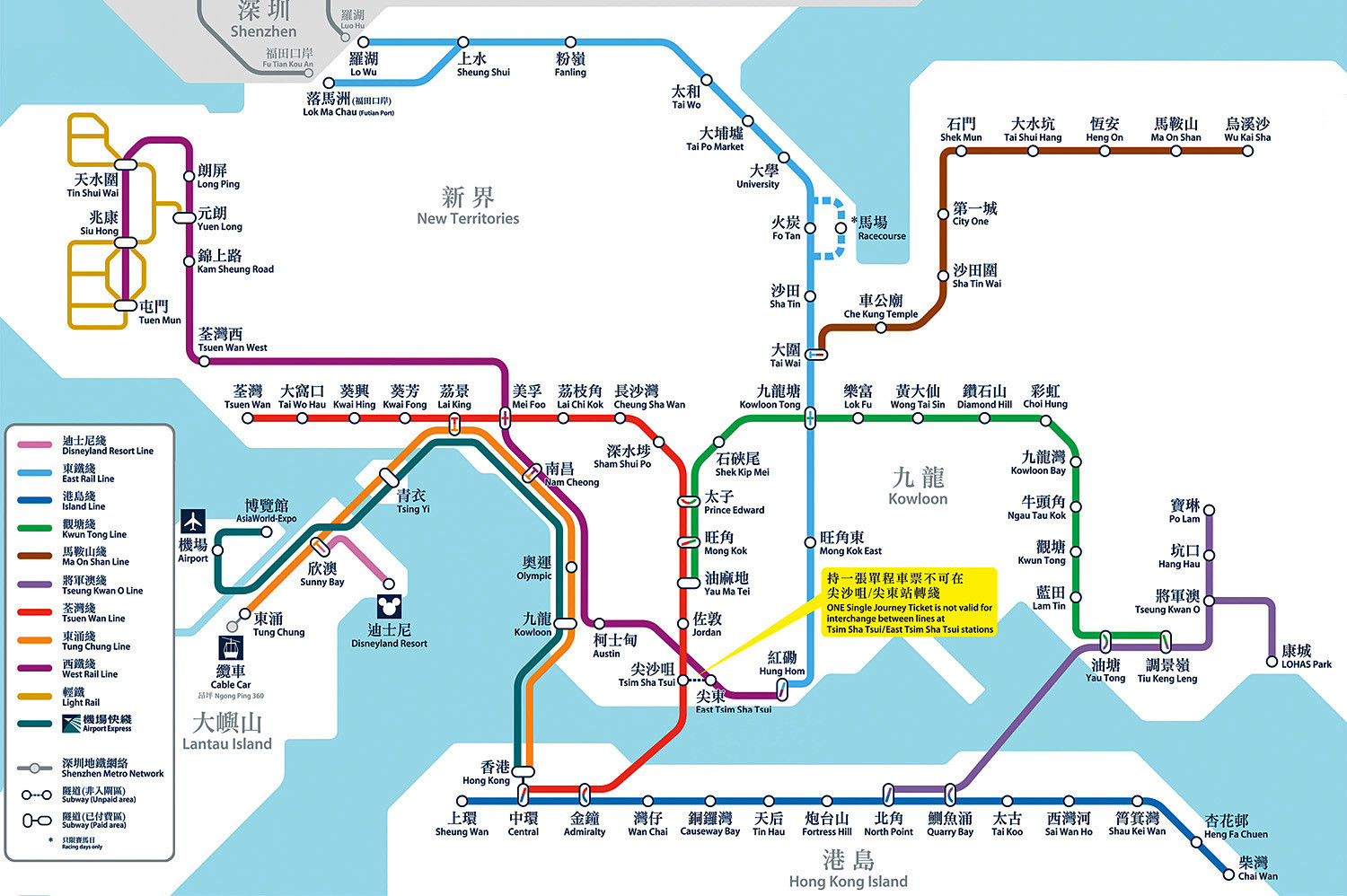
Hong Kong Mass Transit Railway Lines and Stations
The MTR system is one of the most extensive rail networks in Asia. After the 2007 merger of the MTR and Kowloon-Canton Railway systems, it became a broader transport network covering Hong Kong Island, Kowloon, the New Territories, and links to Lo Wu and Lok Ma Chau for travel toward Shenzhen.
Besides the main urban railway, the network also includes Light Rail in the North West New Territories, feeder bus connections for local transport, the Airport Express, and High Speed Rail services from Hong Kong West Kowloon Station.
MTR operates nine main commuter lines: Kwun Tong Line, Tsuen Wan Line, Island Line, South Island Line, Tseung Kwan O Line, Tung Chung Line, Disneyland Resort Line, East Rail Line, and Tuen Ma Line. The wider system also includes the Airport Express and the Hong Kong section of the Guangzhou-Shenzhen-Hong Kong Express Rail Link.
| Station | Details |
|---|---|
| Kwun Tong Line | One of the 9 main commuter lines in the MTR system |
| Tsuen Wan Line | Main urban line serving key parts of the network |
| Island Line | Main line across Hong Kong Island |
| South Island Line | Connects the Southern District to the MTR network |
| Tseung Kwan O Line | Commuter line with branch-based service patterns |
| Tung Chung Line | Serves Tung Chung and connects with the airport rail corridor |
| Disneyland Resort Line | Dedicated branch serving Hong Kong Disneyland Resort |
| East Rail Line | Provides local and cross-boundary connections including Lo Wu and Lok Ma Chau |
| Tuen Ma Line | Major commuter corridor across several districts |
| Airport Express | Dedicated express route to Hong Kong International Airport and AsiaWorld-Expo |
| High Speed Rail | Connects Hong Kong West Kowloon Station with mainland destinations |
| Light Rail | 68 stops serving communities in the North West New Territories |
In total, the MTR, Airport Express, and High Speed Rail networks have 99 stations, while Light Rail adds 68 stops. For many travelers, the stations map and stations list are what make the system so practical: it reaches much of the city and supports a rail-led approach to transportation in Hong Kong.
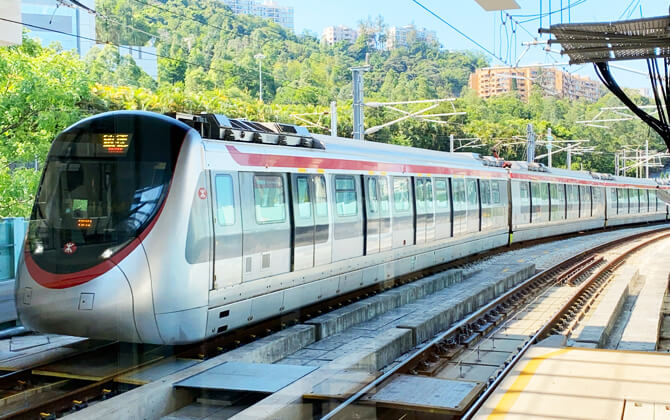
Timetable & Operating Hours
Hong Kong MTR operating hours usually run from around 5:55 a.m. to about 1:00 a.m., though opening hours, opening times, and closing time vary by line and station. During the day, train frequency is generally every 2 to 6 minutes. Late at night and early in the morning, timings are wider on several routes.
For the most accurate timetable, train schedule, route timetable, and schedule today or timings today, passengers need to check by station and line. The Trip Planner is useful for route planning, running time, fare details, interchange information, and first and last train data.
| Service detail | Timings |
|---|---|
| General MTR operating hours | Usually around 05:55 to about 01:00, depending on line and station |
| Island Line | About 05:55 to 00:50 at Kennedy Town and 05:55 to 00:35 at Chai Wan; frequency every 2-6 minutes |
| Tsuen Wan Line | About 06:00 to 00:30 at Tsuen Wan and 06:06 to 00:54 at Central; frequency every 2-5.5 minutes |
| Kwun Tong Line | Frequency about 2.1-5.3 minutes on the core timetable |
| Tseung Kwan O Line | Frequency about 2.2-13.8 minutes depending on branch and section |
| South Island Line | About 06:00 to 01:05; frequency every 3.3-6 minutes |
| Tung Chung Line | About 06:01 to 00:50 at Hong Kong and 06:02 to 00:43 at Tung Chung; frequency every 3.6-12 minutes |
| Disneyland Resort Line | About every 10 minutes in normal service |
| Tuen Ma Line | About 05:45 to 00:15 at Tuen Mun and 05:53 to 00:25 at Hung Hom; frequency every 2.9-7 minutes |
| East Rail Line | Admiralty services from about 05:54 to 01:15; Lo Wu and Lok Ma Chau branches run on different timetables |
| Airport Express | About every 10 minutes; service from around 05:50/05:54 to about 00:45-00:48 depending on station |
| Light Rail | Route intervals vary by line and time of day; some routes up to 25 minutes early morning and late night |
During early morning and late night periods, frequency is reduced on a number of lines. Some services run at up to 12-minute intervals, while East Rail Line services between Sheung Shui and Lo Wu or Lok Ma Chau can reach 21 minutes. Some Light Rail routes may run every 25 minutes.
The Tsuen Wan Line and Kwun Tong Line can also have adjusted timings after 11:00 p.m. because of signalling changes and overnight maintenance. If you need the last train or want to know when a station will close, it’s best to check the daily schedule before you travel.
Airport Express timings should also be checked on the day of travel, especially from Hong Kong Station, Kowloon Station, Tsing Yi Station, Airport Station, and AsiaWorld-Expo Station. Special holiday service is provided during selected periods, including Lunar New Year’s Eve, Mid-Autumn Festival, Christmas Eve, and New Year’s Eve.
Hong Kong Mass Transit Railway Fares, Tickets and Cards
MTR fare is distance-based, so the ticket price depends on your route, payment method, and ticket type. You can use the Trip Planner as a fare calculator to check the fare, price, and route before you travel.
Adult fares range from HK$3.50 (about US$0.45) to HK$51.00 (about US$6.54). Concessionary fares usually range from HK$1.50 (about US$0.19) to HK$26.00 (about US$3.33). Student fares on checkpoint termini routes are charged at adult rates, ranging from HK$1.40 (about US$0.18) to HK$47.20 (about US$6.05).
Ways to pay
- Octopus Card – the most flexible and widely used option, with discounts on many rides.
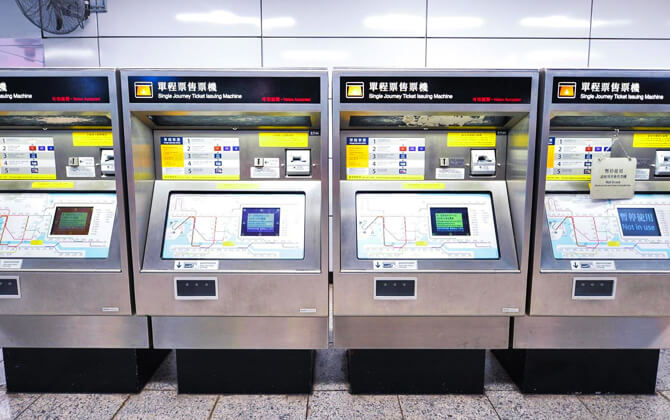
- Single Journey Ticket – a practical choice for one-off trips, available from ticket machines at MTR stations.
- QR Code – available for Octopus and QR code fares.
- Contactless Bank Card – accepted on designated gates.
- Special Edition Octopus and China T-Union Card are also listed among available options.
Octopus Cards
The Octopus card is the main stored-value card used across the MTR system. It can reduce fare cost depending on the line and time of travel, and it can also be used in some shops, restaurants, and parking lots. Cards are available at metro stations, Light Rail stops, and Hong Kong Airport.
The Adult Tourist Octopus costs HK$39 (about US$5.00) and has no guarantee deposit. On-Loan Octopus cards are available for adults, children aged 3 to 11, and elderly passengers over 65 at HK$50 (about US$6.41), with top-up required at purchase.
If an On-Loan Octopus has no payment activity for 3 years, it becomes inactive and an administrative fee of HK$15 (about US$1.92) is deducted annually until no deposit remains. Refunds may involve a handling fee of HK$11 (about US$1.41) or 1% of the remaining value.
Single Journey Tickets
Single Journey Tickets are sold at all MTR stations and are also distance-based. There are Adult and Concessionary tickets. Concessionary fares apply to children aged 3 to 11 and senior citizens aged 65 or above.
Students aged 12 and above using Single Journey Tickets pay the full fare unless they travel with a Personalized Octopus Card marked with Student Status. On some routes with transfers, you may need two separate tickets, though a different interchange station can sometimes keep the journey on one ticket.
| Key | Information |
|---|---|
| Sunny Bay – Disneyland | Single Journey Ticket HK$7.5 (about US$0.96); Octopus HK$7.4 (about US$0.95) |
| Central – Causeway Bay | Single Journey Ticket HK$6 (about US$0.77); Octopus HK$5.9 (about US$0.76) |
| Central – Wan Chai | Single Journey Ticket HK$5 (about US$0.64); Octopus HK$4.9 (about US$0.63) |
| Austin – Yuen Long | Single Journey Ticket HK$23 (about US$2.95); Octopus HK$22.1 (about US$2.83) |
| Mongkok East – Sha Tin | Single Journey Ticket HK$13 (about US$1.67); Octopus HK$11 (about US$1.41) |
| Central – Tsim Sha Tsui | Single Journey Ticket HK$12.5 (about US$1.60); Octopus HK$10.6 (about US$1.36) |
| Yau Ma Tei – Tsim Sha Tsui | Single Journey Ticket HK$5 (about US$0.64); Octopus HK$4.9 (about US$0.63) |
| Tsim Sha Tsui – Mongkok | Single Journey Ticket HK$5 (about US$0.64); Octopus HK$4.9 (about US$0.63) |
| Tsim Sha Tsui – Sham Shui Po | Single Journey Ticket HK$7.5 (about US$0.96); Octopus HK$7.4 (about US$0.95) |
| Sham Shui Po – Tsuen Wan | Single Journey Ticket HK$10.5 (about US$1.35); Octopus HK$9.2 (about US$1.18) |
Tourist Passes
- Tourist Day Pass: HK$75 (about US$9.62), valid for 1 month from issue, with 1 day of unlimited travel on the MTR, Light Rail, and MTR Bus.
- Child Tourist Day Pass: HK$35 (about US$4.49), for children aged 3 to 11, with the same unlimited travel conditions.
These passes do not cover Airport Express, East Rail Line First Class, or trips to and from Lo Wu or Lok Ma Chau Station. They are for non-Hong Kong residents who have stayed in Hong Kong for less than 14 days.
Which ticket should you choose?
- For 1 day or 5 to 7 days: Octopus Card
- For longer routes or several rides within one day: Tourist Day Pass
- For a round trip: Single ticket
Special schemes and frequent user passes
- Elderly and Eligible Persons with Disabilities
- Student Travel Scheme
- Fare Saver
- Intermodal discount
- Park and Ride Scheme
- City Saver
- Monthly Pass
From 3 Apr 2026, the Government Public Transport Fare Concession Scheme for the Elderly and Eligible Persons with Disabilities changes from a flat HK$2 fare per trip to either a HK$2 flat rate or 80 per cent off. The available selection period in Ticket Suggestion is up to 2 Apr, and displayed fares are for reference only.
Connections to Other Systems
The MTR is tightly connected with other transport systems in Hong Kong, which is a big reason it works so well as the backbone of city transport. Since the 2007 merger with the Kowloon-Canton Railway Corporation, it has operated as one integrated railway network.
Within Hong Kong, the system connects with Light Rail in the North West New Territories, while feeder bus services help passengers reach many stops and interchange points. The East Rail Line also supports cross-boundary transportation in the region via Lo Wu and Lok Ma Chau.
For airport access, the Airport Express provides a direct path train link to Hong Kong International Airport and AsiaWorld-Expo, and the network also includes High Speed Rail services from West Kowloon Station to mainland destinations without interchange.
Beyond MTR itself, Hong Kong also has other fixed-track transport, including the tramway and the Peak Tram. Separate rail and people-mover services also operate in the territory, including the airport automated people mover.
Airport Connections
The Airport Express is the fastest rail route between central Hong Kong and Hong Kong International Airport. The running time from Hong Kong Station to the airport is about 24 minutes, while the journey to or from AsiaWorld-Expo takes about 28 minutes. From Airport Station to AsiaWorld-Expo, it’s just a two-minute ride.
All five Airport Express stations were designed to provide a smooth travel experience, and the service is a key part of local transport for air passengers.
- Free MTR connections
- Free return journey for same-day return trip
- Free return journey and special fare for same-day return trip to AsiaWorld-Expo
- Free in-town check-in service
- Free in-train Wi-Fi service
- Station parking
- Complimentary in-train power charging service in designated cars
Tickets can be booked online through the MTR booking service.
Hong Kong Mass Transit Railway Parking
The MTR offers station parking through its Park & Ride Scheme at selected car parks. Parking charges vary by location, and there are hourly and daily options. In most cases, payment is by Octopus only, and the same card must be used for entry, exit, and the relevant MTR or Airport Express trip during the parking period.
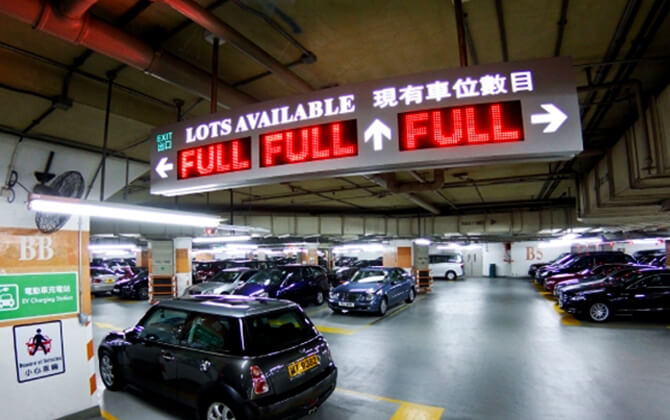
Station car parks and rates
| Key | Information |
|---|---|
| Hong Kong Station Car Park | MTR Park & Ride HK$23 per hour (about US$2.95); Airport Express Park & Ride HK$13 per hour (about US$1.67); Airport Express Park & Fly HK$120 per day (about US$15.38) |
| Kowloon Station Car Park | MTR Park & Ride HK$21 per hour (about US$2.69); Airport Express Park & Ride HK$13 per hour (about US$1.67); Airport Express Park & Fly HK$115 per day (about US$14.74) |
| Tsing Yi Station Car Park | MTR Park & Ride HK$13 per hour (about US$1.67); Airport Express Park & Ride HK$12 per hour (about US$1.54); Airport Express Park & Fly HK$110 per day (about US$14.10) |
| Kam Sheung Road Station Car Park | HK$6 per 0.5 hour (about US$0.77); Park & Charge Combo AC 7kW max HK$15 per 0.5 hour (about US$1.92); DC 50kW max HK$80 per 0.5 hour (about US$10.26) |
| Ocean Park Station Car Park | Mon-Fri HK$18 per hour (about US$2.31); Sat, Sun and Public Holidays HK$21 per hour (about US$2.69) |
| Tsuen Wan West Station Car Park | Mon-Fri HK$15 per hour (about US$1.92); Sat, Sun and Public Holidays HK$18 per hour (about US$2.31) |
| High Speed Rail West Kowloon Station Car Park | MTR Park & Ride Mon-Fri HK$21 per hour (about US$2.69), Sat, Sun and Public Holidays HK$24 per hour (about US$3.08); High Speed Rail Park & Ride Mon-Fri HK$135 per day (about US$17.31), Sat, Sun and Public Holidays HK$145 per day (about US$18.59) |
| Choi Hung Park & Ride Public Car Park | HK$11 per hour (about US$1.41) |
| Hung Hom Station Car Park | HK$120 per day from 00:00 to 20:00 (about US$15.38) |
Important notes
- The Park & Ride offer is available on a one-day basis from 05:30 on the parking day to 01:00 the following day.
- A normal rate applies for non-specified hours, except at High Speed Rail West Kowloon Station and Hung Hom Station Car Park.
- For hourly-charged station parking, a partial hour is charged as a full hour, except at Kam Sheung Road Station Car Park.
- At Kam Sheung Road Station Car Park, parking charges and charging fees are calculated on a half-hour basis.
- Park & Fly rates and High Speed Rail Park & Ride rates are charged daily, and a partial day counts as a full day.
- For Park & Fly, parking must be for at least two days and can run up to 14 days.
- For High Speed Rail Park & Ride, the maximum offer period is also 14 parking days.
- For Octopus users, the same card must be used for car park entry, exit, and the related rail trip, and it should not have more than 9 transaction records between those rides and parking payment.
- Information is subject to change without prior notice.
If you’re comparing parking charges per day or looking for station parking linked to the rail system, these car parks are the main MTR-managed options.
Safety and Services
Railway safety in Hong Kong is regulated by the Electrical and Mechanical Services Department. For the MTR system, it carries out risk-based inspections, safety assessments, project reviews, and incident investigations to help keep the network safe and reliable.
MTR Corporation must notify the Transport Department of incidents that have caused, or are expected to cause, service disruption of eight minutes or more. When that happens, the Transport Department works with MTR on service adjustments and may coordinate with other public transport operators. EMSD then inspects the incident, follows up on the investigation, and checks that corrective measures are put in place.
MTR has also continued to maintain services during emergency repairs, including crowd management, public announcements, station notices, and help for passengers with ticket issues. Over the past five years, Passenger Journeys On Time averaged 99.9 per cent.
Recent safety and reliability work has included technology such as train speed and position supervision, smart flashing bollards at selected Light Rail crossings, CCTV monitoring of platform and track safety, and smart tunnel systems on parts of the network.
| Key | Information |
|---|---|
| Safety compliance inspections | Monitor high-risk areas, review safety-critical systems, and confirm new projects meet safety requirements before opening |
| Project assessment | Review new projects, extensions, and major modifications through formal safety processes |
| Incident investigation | Identify causes, require follow-up actions, and help prevent repeat incidents |
| Asset and system audits | Examine maintenance, asset management, and safety management arrangements across the network |
Fun Facts
The MTR is Hong Kong’s main railway system and one of its most widely used transport options. On an average weekday, it carries more than five and a half million trips and has recorded a 99.9% punctuality rate for arrivals and departures.
As of 2018, it held a 49.3% share of the franchised public transport market. The launch of Octopus card payment in September 1997 made everyday travel much easier and helped shape the way local transport works today.
The system expansion after the 2007 merger added the East Rail line, West Rail line, Ma On Shan line, Light Rail, and through train services to Guangzhou. Some lines also stand out for their design and operation. The South Island line uses fully automated three-car trains, while the Disneyland Resort line runs driverless trains and has a station themed to match the resort.
- The South Island line opened in 2016 and connected the MTR with Hong Kong’s Southern District for the first time.
- With that opening, all 18 districts of Hong Kong became served by the MTR.
- The Tsuen Wan line has kept the same alignment longer than any other MTR line since opening in 1982.
- The Disneyland Resort line uses refurbished M-trains with themed details such as Mickey Mouse-shaped windows and bronze Disney decorations.
History
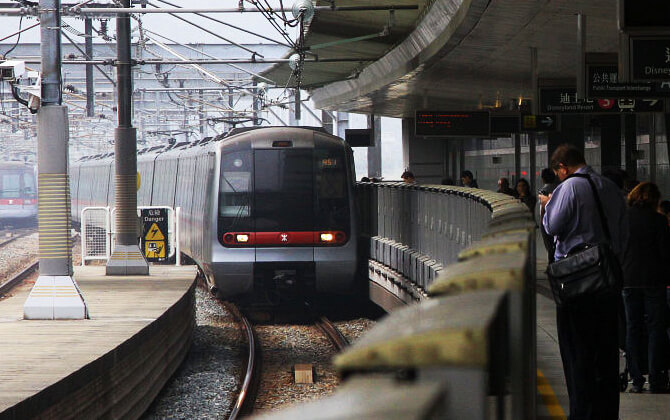
The history of the Hong Kong Mass Transit Railway began in the 1960s, when rapid economic growth put pressure on the road network. In 1966, consultants Freeman, Fox, Wilbur Smith & Associates were commissioned to study Hong Kong’s transport needs. Their 1967 Hong Kong Mass Transport Study recommended a 40-mile system, about 64.4 km, built in stages.
A revised 1970 report reduced the proposed network and shaped the government’s decision to approve the Initial System in 1972. In early 1975, the plan was reduced again and renamed the Modified Initial System. The government created the Mass Transit Railway Corporation through the Mass Transit Railway Ordinance on 7 May 1975, and construction began on 11 November 1975.
The first section opened on 1 October 1979, with service from Shek Kip Mei to Kwun Tong. The full Modified Initial System opened on 12 February 1980, including the harbour crossing to Central. As demand grew, trains were expanded from four cars to six.
The network kept growing through the 1980s and 1990s. The Tsuen Wan line opened in 1982, the Island line in 1985, and the extension to Sheung Wan in 1986. The airport rail project then led to the Tung Chung line opening on 21 June 1998 and the Airport Express on 6 July 1998.
In the 2000s and 2010s, more lines and extensions followed, including the Tseung Kwan O line, Disneyland Resort line, West Island line, Kwun Tong line extension to Whampoa, and the South Island line. In 2007, MTRCL took over operation of the Kowloon-Canton Railway network under a 50-year service concession, merging fare systems and expanding the network further.
More recent additions included the Tuen Ma line, opened in phases in 2020 and 2021, and the East Rail line extension in 2022. Over time, the system has grown from a compact urban railway into Hong Kong’s principal rail network.
Future Extensions
The MTR expansion program includes projects already in planning as well as longer-term proposals. Since the 2007 rail merger, the combined network grew to 211.6 km, about 131.5 miles, and 84 stations. Committed and future railway projects raise that total to more than 270 km, about 167.8 miles, and 98 stations, while the wider pipeline could take the system to over 540 km, about 335.5 miles.
Current plans
The Northern Link is one of the main current projects. It is planned as a 26 km line, about 16.2 miles, creating a corridor between the Tuen Ma line and the East Rail line in the northern New Territories. Kwu Tung station is expected in 2027, while construction of the Northern Link is scheduled to begin in 2025 and finish in 2034.
The Tung Chung Line Extension will add a 1.3 km westward extension, about 0.8 miles, from Tung Chung station to Tung Chung West, plus Tung Chung East as an infill station. Construction began in 2023 and completion is expected by 2029.
Oyster Bay station, previously called Siu Ho Wan station, is planned between Sunny Bay station and the future Tung Chung East station. It is expected to open in 2030.
The Tuen Mun South extension is a proposed 2.4 km extension, about 1.5 miles, of the Tuen Ma line southwards from Tuen Mun station to a new terminus near Tuen Mun Ferry Pier. It would include a new intermediate station, A16.
Hung Shui Kiu station is another planned Tuen Ma line stop and is expected to be completed in 2030. The remaining section of the Airport Railway Extended Overrun Tunnel is expected to be built east of Hong Kong station from 2025 to 2032 to improve operational flexibility.
Proposals
Several other projects remain under study. These include a proposed Science Park/Pak Shek Kok station on the East Rail line between University and Tai Po Market stations, expected by 2031.
The Tseung Kwan O line southern extension was announced in the 2022 policy address to support future development in Area 137, though no timetable has been confirmed.
Other proposed new lines or extensions include the South Island line (West), the North Island line, a newer East Kowloon line concept serving areas such as Po Lam, HKUST and Sau Mau Ping, and the Tung Chung to Tai O light rail system. Additional ideas linked to the Northern Metropolis and Lantau Tomorrow Vision are also under discussion.
Nearby Attractions
The MTR makes it easy to reach attractions, events, local neighborhoods, and cultural spots across Hong Kong. MTR Mobile can also help with route plan ideas and nearby discoveries.
Newer stations such as Exhibition Centre, To Kwa Wan, and Sung Wong Toi have improved access to Wan Chai, North Kowloon, and Kowloon East.
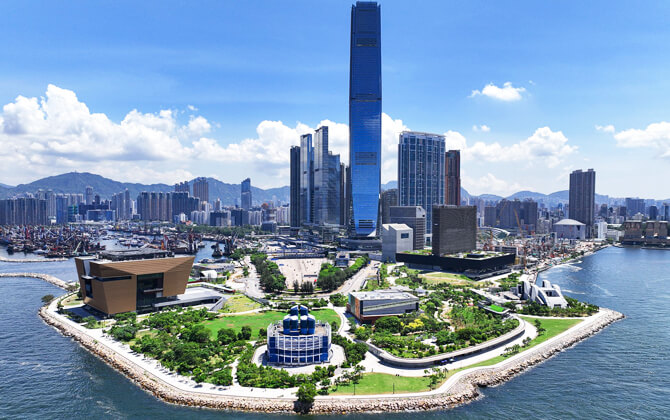
Exhibition Centre (East Rail Line)
Exhibition Centre gives direct access to Wan Chai’s harbourfront, the Hong Kong Convention and Exhibition Centre, and major events such as Art Basel Hong Kong and the Hong Kong Book Fair. Nearby options also include the Hong Kong Arts Centre and the Wan Chai-Tsim Sha Tsui Star Ferry route.
To Kwa Wan (Tuen Ma Line)
To Kwa Wan is a good stop for exploring a neighborhood with strong local character. Highlights mentioned for the area include the 13 Streets area, the Cattle Depot Artist Village and Arts Park, Jiksap vintage shop, Coutou, and Fishball King. It is also a handy place for a ferry ride to North Point.
Sung Wong Toi (Tuen Ma Line)
Near Sung Wong Toi, you can explore Kowloon City’s heritage and food scene. Suggested stops include Sung Wong Toi Garden, the Walled City Garden, Tai Wo Tang, and Goodies. The area is also known for Thai food and other local finds.
- Use MTR Mobile to plan your route and discover more nearby places.
- Look out for station displays and design details that reflect local heritage.
- Check the MTR website’s Barrier-Free Facilities Search if you need accessibility information.