QLine is a modern streetcar line in Detroit running along Woodward Avenue. As of March 2026, it operates as a single 3.3-mile (5.3 km / 3.3 miles) corridor with 12 stops. The line connects Downtown, Midtown, North End, and New Center.
Most of the route runs in mixed traffic alongside regular vehicles. There is also a short dedicated transit lane designed to reduce delays and improve reliability in a busy section.
QLine Detroit Map 2026
As of 2026, the QLine operates as a straight, single-corridor streetcar route along Woodward Avenue. The southern terminal is at Congress Street, and the northern terminal is at Grand Boulevard.
Two stops have different names depending on the direction of travel. This happens because the northbound and southbound platforms are located on nearby blocks. It is common for curb-running streetcars.
QLine Detroit map showing 1 lines and 12 stations. Click on the map to enlarge it or download the QLine Detroit map in PDF format.
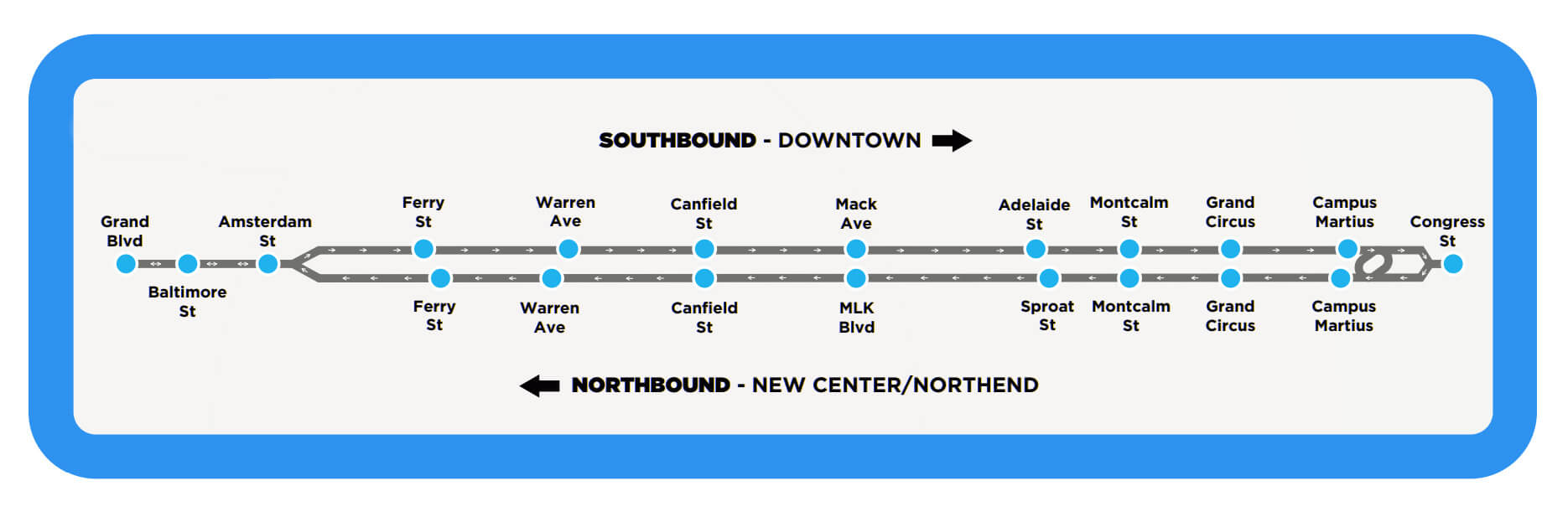
QLine Detroit Line and Stations
QLine operates a single line with 12 stops. Stations are usually referred to by their stop names. Two locations use direction-specific platform names: Adelaide/Sproat and MLK Blvd/Mack Ave.
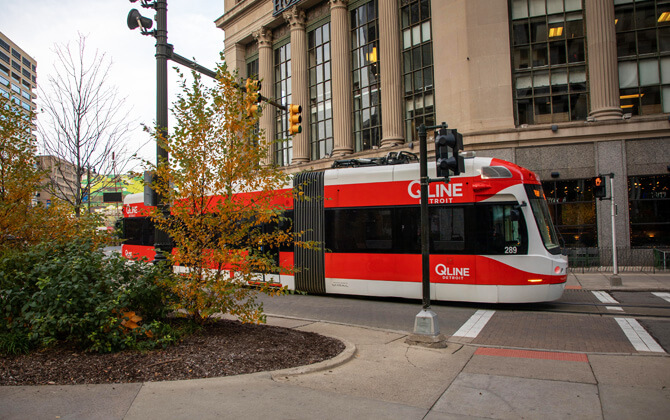
Below is the operational station order from south to north, aligned with the official station map.
| Order (S→N) | Stop Location (Common Name) | Direction-Specific Platform Name(s) | Notes |
|---|---|---|---|
| 1 | Congress Street | Congress St | Southern terminal of the 3.3-mile (5.3 km / 3.3 miles) line. |
| 2 | Campus Martius | Campus Martius | Located in the Downtown core. |
| 3 | Grand Circus | Grand Circus | Major Downtown hub area. |
| 4 | Montcalm Street | Montcalm St | Serves the stadium and theatre district. |
| 5 | Adelaide / Sproat Street | Adelaide St (northbound) / Sproat St (southbound) | Same general area; platform name changes by direction. |
| 6 | MLK Boulevard / Mack Avenue | MLK Blvd (northbound) / Mack Ave (southbound) | Same general area; platform name changes by direction. |
| 7 | Canfield Street | Canfield St | Access to Midtown dining and arts corridor. |
| 8 | Warren Avenue | Warren Ave | Access to the Cultural Center and campus area. |
| 9 | Ferry Street | Ferry St | Serves nearby cultural institutions. |
| 10 | Amsterdam Street | Amsterdam St | Edge of New Center; near tech and campus facilities. |
| 11 | Baltimore Street | Baltimore St | New Center access; close to intercity rail services. |
| 12 | Grand Boulevard | Grand Blvd | Northern terminal stop. |
The system covers a 3.3-mile (5.3 km / 3.3 miles) corridor from Downtown to Grand Boulevard. Both QLine and the Regional Transit Authority of Southeast Michigan describe the same 12-stop route framework.
QLine Detroit Hours of Operation
Operating Hours & Timings Today
The current operating hours are:
Monday–Saturday: 8:00 AM – 12:00 AM (midnight)
Sunday: 8:00 AM – 9:00 PM
Because the line runs in regular street traffic, delays may occur during snow, ice, or low-visibility conditions. Travel times can vary in bad weather.
Train Intervals
The published service target is a streetcar every 15 minutes or less.
Since QLine operates on-street, headways can increase during heavy traffic, collisions, illegally parked vehicles, or severe weather. Real-world intervals may differ from the schedule.
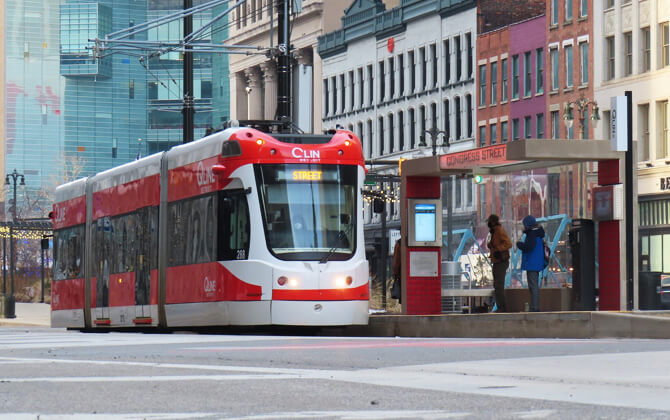
Streetcars stop at stations when passengers are waiting on the platform. Riders already onboard can request a stop by pressing the blue stop-request button.
QLine Detroit Prices, Tickets, and Travel Cards
The current fare is $0 (free). No ticket purchase, validation, or transfer product is required to ride QLine.
In 2026, fare questions typically relate to regional bus services or airport connections, not to QLine itself.
QLine (Streetcar) Fare
| Product | Price (Local) | Price (USD) | Notes |
|---|---|---|---|
| Single ride / any ride | $0 | $0 | Fare-free service. |
Regional Bus Fares (SMART + DDOT via DART Passes)
These fares apply to SMART and Detroit Department of Transportation (DDOT) bus services. They do not apply to QLine.
| Pass Type | Full Fare (Local) | Full Fare (USD) | Reduced Fare (Local) | Reduced Fare (USD) | Coverage |
|---|---|---|---|---|---|
| 4 Hour DART | $2.00 | $2.00 | $0.50 | $0.50 | Valid on SMART/DDOT fixed routes for 4 hours. |
| 24 Hour DART | $5.00 | $5.00 | $2.00 | $2.00 | Valid on SMART/DDOT fixed routes for 24 hours. |
| 7 Day DART | $22.00 | $22.00 | $10.00 | $10.00 | Valid on SMART/DDOT fixed routes for 7 consecutive days. |
| 31 Day DART | $70.00 | $70.00 | $29.00 | $29.00 | Valid on SMART/DDOT fixed routes for 31 consecutive days. |
Purchase options, as officially published: SMART sells physical passes online and through transit centers or retail partners. Mobile passes are available via the Transit app. DDOT mobile payments for DART passes use the Token Transit system.
Airport Bus Fares (Downtown ↔ DTW)
For many visitors, this is the main public transport cost when traveling between Downtown Detroit and Detroit Metropolitan Airport (DTW).
| Service | Standard Fare (Local) | Standard Fare (USD) | Discount Fare (Local) | Discount Fare (USD) | Notes |
|---|---|---|---|---|---|
| Detroit Air Xpress (advance online) | $6 | $6 | $4 | $4 | Advance online purchase. |
| Detroit Air Xpress (buy onboard) | $8 | $8 | $4 | $4 | Subject to seat availability on the day. |
| Detroit Air Xpress (passbooks) | $50 / 10 rides ($5 per ride) $100 / 50 rides ($2 per ride) |
Same | — | — | Designed for frequent riders. |
Transit Connections
QLine runs along the Woodward corridor and connects directly to major Downtown and Midtown transit options. These include local rail, city buses, regional express buses, and shared micromobility services.
- Other rail in Downtown: The Detroit People Mover currently operates fare-free. No ticket or pass is required. It also highlights transfer points to QLine at key Downtown locations.
- Local and regional buses: QLine intersects with multiple DDOT and SMART routes. For visitors, FAST limited-stop services along Woodward, Michigan, and Gratiot corridors are often the most practical options.
- Airport and intercity surface connections: Downtown provides access to Detroit Air Xpress (DAX) and SMART/FAST routes serving the airport.
- Real-time trip planning: QLine stations are equipped with real-time arrival displays. Arrivals and trip planning are also supported in the Transit app.
QLine Detroit to Airport Connection Guide
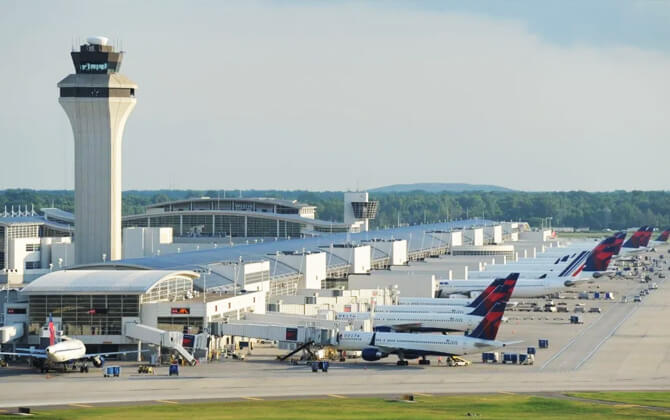
The main airport for most travelers is Detroit Metropolitan Wayne County Airport (DTW). There is no direct one-seat ride from a QLine platform to the airport. However, the connection from Downtown is straightforward.
The best option depends on whether you prioritize speed, simplicity, or frequency.
Option A: DAX (Fastest and Simplest Downtown ↔ DTW Public Option)
Detroit Air Xpress (DAX) operates a nonstop coach between Downtown Detroit and DTW. Service runs daily, including holidays.
Step-by-step from QLine:
- Ride QLine to the Downtown core. Campus Martius, Grand Circus, or Congress Street are the most convenient stops.
- Walk to the DAX stop at 1119 Washington Blvd, between Michigan Avenue and State Street.
- Buy a ticket online in advance for $6 (USD 6) or pay $8 (USD8 ) onboard, subject to seat availability.
- At DTW, DAX serves both terminals:
Evans Terminal: Ground Transportation Center
McNamara Terminal: Departures Level near Door #1
Operational details:
Service hours: 3:30 AM – 11:00 PM daily, including holidays.
Frequency: Up to 16 round-trips per day. Departures are roughly hourly.
Travel time: Approximately 30–50 minutes, depending on traffic and terminal.
Amenities include luggage space, comfortable seating, charging ports, and Wi-Fi.
Option B: FAST Michigan Route 261 (SMART) to DTW
FAST Michigan Route 261 is a limited-stop SMART bus serving Downtown Detroit and both DTW terminals. FAST is SMART’s high-frequency brand operating along major corridors.
Route 261 connects Downtown, Corktown, Dearborn, Inkster, and both airport terminals (Evans and McNamara).
How to use it with QLine:
- Take QLine to Downtown and walk to a FAST boarding stop. Stop locations vary by direction. Outbound stops may differ from inbound stops.
- Board FAST Michigan Route 261 to DTW.
Evans Terminal: Ground Transportation Center
McNamara Terminal: Departures Level near Door #1
Frequency and timing:
Peak headways are approximately 15–20 minutes. FAST operates seven days a week, including evenings and weekends.
Payment:
FAST uses SMART fares. A 4-hour DART pass costs $2.00 (USD 2.00) for full fare.
Other DTW Public Transport Options
SMART local Routes 125 and 280 also serve the airport. Route 125 connects to both terminals. Route 280 serves the Evans Terminal.
How To Ride
Boarding basics:
Stand clear of the platform edge while waiting. Board only after the streetcar has come to a full stop and the doors open. Let passengers exit first. Do not block doors or emergency exits. Hold handrails and supervise children.
To exit, press the blue stop-request button onboard.
How stops work:
Streetcars stop when passengers are waiting at a station or when someone onboard presses the blue stop button. This affects total travel time, especially during busy periods.
Trip planning and live arrivals:
Stations display real-time arrival information. You can also track arrivals and plan trips using the Transit app.
Mobility devices, bikes, strollers, scooters:
QLine platforms provide level access. Streetcars include marked priority areas for seniors and riders with disabilities.
Bicycles are allowed if space is available. Use the onboard bike racks in the center section. If racks are full, hold the bike upright. Personal scooters are permitted only if they can be safely stowed. Hanging bike racks cannot be used for scooters.
Amenities:
Streetcars are climate-controlled. Stations are heated when temperatures drop below freezing. Complimentary Wi-Fi is available onboard and at stations.
Park & Ride
QLine offers a weekend Park & Ride option. From Friday through Sunday, parking costs $5 (USD 5) at Wayne State Lot 12, located next to the Amsterdam Street station at 6050 Woodward. Vehicle access is via Harper. QLine rides remain free.
For weekday parking or event travel, riders are directed to city and private parking options, including Detroit’s parking mobile app and private operators.
Parking behavior directly affects service reliability. Improper parking near the tracks delays service by an average of 27 minutes (43 km/h equivalent delay impact context not applicable) and may result in towing. Always stay within the marked white line and never block the tracks.
Rules of Road and Rail
This section covers both passenger conduct and street-running safety rules for drivers, cyclists, and pedestrians.
Onboard conduct:
Smoking, eating, and drinking are not permitted. Pets are not allowed, except for service animals. Dangerous or flammable items are prohibited. Playing music through external speakers is not allowed. Riders must not interfere with operations or sell goods onboard.
Passengers should follow posted safety rules and report suspicious items or activity to the operator.
Driver and parking rules:
Do not double park or stop on the streetcar tracks. Obey posted signs. Stay within the marked white line when parking. Never block the tracks, even briefly. Blocking causes delays and may lead to towing.
Except for a short dedicated-lane segment, QLine operates in mixed traffic. Illegal stopping or parking has a direct impact on reliability.
Cyclist and pedestrian safety:
Cyclists should cross tracks at a 90-degree angle to prevent wheels from getting caught. Pedestrians must obey traffic signals, use crosswalks, and stay alert. Streetcars are relatively quiet.
Streetcars can travel up to 35 mph (56 km/h). They require a longer stopping distance than a typical car. Do not step in front of a moving streetcar.
Overhead wires are live. Do not touch wires or climb poles along the alignment.
Fun Facts
QLine includes several features that make it more advanced than many early U.S. streetcar revivals.
- Off-wire operation: A significant portion of the 3.3-mile (5.3 km / 3.3 miles) corridor operates without overhead wires. Brookville vehicles run off-wire for about 60% of the route using onboard 750-volt rechargeable lithium-ion battery systems.
- Top speed: Streetcars can reach speeds of up to 35 mph (56 km/h). This is typical for modern streetcars, not metro systems.
- Passenger amenities: QLine highlights visitor-friendly features such as complimentary Wi-Fi, climate-controlled streetcars, and heated stations during freezing weather.
- Stops on request: Streetcars do not automatically stop at every station. They stop when passengers are waiting or when someone onboard presses the blue stop-request button.
History
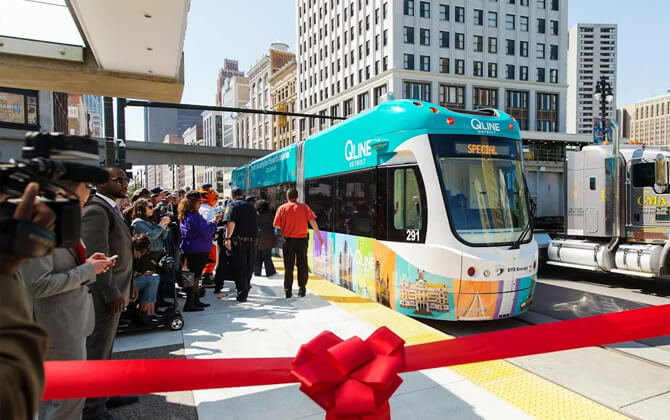
2016 – Branding: In March 2016, Quicken Loans and M-1 Rail announced “QLINE” as the official name of Detroit’s modern streetcar project.
2017 – Opening: The line officially opened on May 12, 2017, as a 3.3-mile (5.3 km / 3.3 miles) streetcar route along Woodward Avenue. Project cost was widely reported at approximately $180 million (USD 180 million).
At launch, leaders described the corridor as a first step toward broader regional transit development.
2020–2021 – Pandemic disruption: Service stopped in spring 2020 due to COVID-19. QLine reopened in September 2021 and resumed operations as a fare-free system.
Long-term subsidy and fare-free model: The system was later reported to receive state support commonly described as $5 million annually (USD 5 million) through 2039. The fare-free model remained in place.
2024 – Governance transfer: Effective October 1, 2024, the Regional Transit Authority assumed control of QLine operations. Service continued without interruption, and the fare remained free.
Future Expansions
As of March 2026, there is no officially published construction schedule to extend the existing 3.3-mile (5.3 km / 3.3 miles), 12-stop corridor. Public discussion continues, but there is no committed expansion project.
The transfer of QLine from M-1 Rail to the Regional Transit Authority (RTA) is widely described as expansion-enabling. Under public control, the system becomes eligible for state and federal funding that was previously unavailable.
RTA leadership has stated that the governance shift reopens the conversation about using QLine as a broader regional catalyst. At the same time, officials have clarified that expansion would not happen immediately.
Long-term operational stability plays a role in future capital planning. State support commonly described as $5 million per year (USD 5 million) through 2039 helps sustain fare-free service. However, operating funding alone does not equal a construction commitment.
Nearby Attractions
The following attractions are located near QLine stations along the corridor.
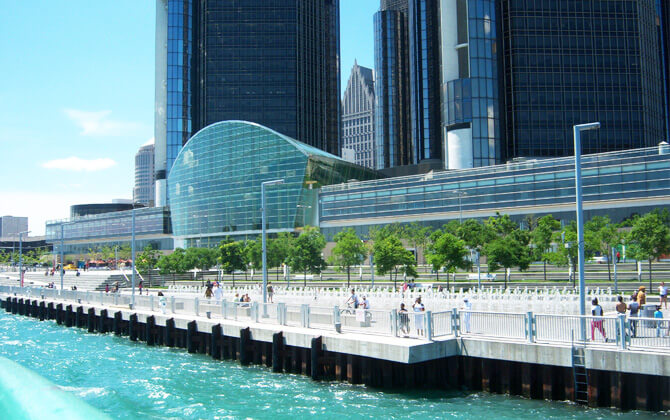
- Downtown – Congress Street area: Detroit International RiverWalk, Hart Plaza.
- Campus Martius area: Campus Martius Park, Capitol Park.
- Grand Circus / Montcalm area: Ford Field, Comerica Park, Fox Theatre, The Fillmore Detroit.
- Midtown / Cultural Center – Adelaide / Sproat area: Brush Park, Masonic Temple Theatre.
- Canfield area: Museum of Contemporary Art Detroit, The Whitney.
- Warren / Ferry area: Charles H. Wright Museum of African American History, Michigan Science Center, Detroit Institute of Arts, Detroit Historical Museum, Detroit Public Library Main Branch.
- New Center – Grand Boulevard area: Fisher Building, New Center Park, Cadillac Place.